Cannon’s Polarity Principle:

arrows

I recently read the wonderful book “On the Design of Stable Systems”, by Jerry Weinberg and Daniela Weinberg. I came across a principle that I had not heard of before called “Cannon’s Polarity Principle”. Cannon’s Polarity Principle can be stated as the strategy that a system can use to overcome noise by supplying its own opposing actions. If a system relies on an uncertain environment to supply the opposing factor to one of its regulatory mechanisms, that mechanism must have a much more refined model. By supplying its own opposing factor, it can get away with a much simpler model of the environment.

This principle is one of those things that is profound yet very simple. The Weinbergs give the example of a sticky knob on a gas stove to explain this idea. If the knob is sticky then it is tricky to raise the flame to the precise point we would like it to be. Due to the “stickiness” we will try to apply much more force than needed and inadvertently overshoot, going past the desired point. The result is that the flame is at a much higher setting. When we try to turn the flame down we are still in the same situation and again go past the point where we would like to be.

What we can do instead is to use one hand to push against the direction we would like and then slowly try to turn the knob with our other hand. With this approach we can be much more refined and be at our desired position. By working “against” our own goal, we make precise adjustment possible in the face of an unknown, but small, amount of stickiness.

This got me thinking. There are several times where we apply opposing forces to slow us down, to take the time to reach the correct decision (precise adjustment). One of my favorite Toyotaism is – Go slow to go fast. This makes a lot of sense in the light of the Polarity Principle. Any time we are doing a root cause analysis, we are prone to a plethora of biases including confirmation bias – selectively looking for ideas that reinforce our thinking, and availability bias – latching on to the first idea because that was the immediate idea we came up with. These biases might make us jump to unwarranted conclusions to address symptoms, and not addressing the root problem(s). The Polarity Principle would advise us to slow down.

I will finish this short and sweet with an apt Zen saying:

The one who is good at shooting does not hit the center of the arrow.

Always keep on learning…

In case you missed it, my last post was Contextual Why:

Contextual Why:

Láminas_8_y_9_del_Códice_de_Dresden

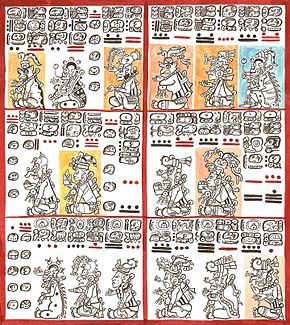
One of the scientists that I have referenced in my posts a lot is the American physicist Richard Feynman. I particularly love his imaginary depiction of Mayan astronomy. Feynman went to Mexico for his second honeymoon and came across a copy of the Dresden Codex (one of the oldest surviving books from the Americas). He was particularly interested in the bars and dots in the codex. He was able to decipher the number system that the Mayans used to depict Venus’ trajectory in the solar system. He was so good at it that he was able to find that some of the versions were actually fakes. Feynman imagined the Mayans counting and putting nuts in a pot to make predictions of where Venus would be on a given day. Feynman was curious whether the Mayans actually knew what was happening (why it was happening) or whether they were going by the rules and making predictions based on a rule-based system of counting and manipulating numbers. Feynman stated that the Mayans may have gotten really good with counting but they must not have understood how the celestial bodies worked.

The push for following rules without understanding the context is unfortunate. Yet this is very prevalent. The rigidity of the rules cannot be sustained when a complex situation arises. The rigidity of rules indicates a direct linear relationship where cause and effect are clearly noted. This is the push for standardization and having one best way of doing things. This leads to stagnation, since this stymies creativity and the push for innovation. Rigid rules always break. Another way to look at this is as the push for robustness – avoiding failure by any means. We will put redundant steps, perform multiple inspections and implement punishments for not following rules. In the complex world, we should accept that things will fail – the push should be for resilience, getting back up in a short time. The rules are dictated top-down since the rules are created by the experts. These rules do not have the requisite variety to tackle the uncertainties of day-to-day dealings. The contexts of these rules do not match the actual context where the action takes place – the context at the gemba. Context is what brings out the meaning in a situation. The focus on rules and efficiency through best practice does not lead to having the requisite variety to change the context as needed to address a problem when it arises. We are involved in complex adaptive systems on a day-to-day basis. We need to change context as needed and adapt to respond to unanticipated events. Evolution requires that we have variety. This response is not always rule-based and is developed depending upon the context. We should allow room for bottom-up heuristics, since these are based on experience and local context.

As a simple example, let’s look at 5S, one of the most commonly identified lean tools, to look into this more. 5S is translated from Japanese as Sort, Straighten, Shine, Standardize and Sustain. The rules are provided to us and they are clear cut. Similar to the Mayan story, do we actually know the context for 5S? Toyota did not have 5S. The last few S’s were added on later. This has now changed into 6S and even 7S. The “sort” step in 5S is to have only the required tools needed at the station. The “straighten” step is to identify/label the tools so that operators from other shifts or job rotations can easily find the tools. The third step is “shine” where the work station is cleaned by the operator. This allows the operator to find any spills or other signs of wear and tear that may not be seen by a cleaning crew. These three steps help the operator to identify problems as they occur, raises awareness and helps to take pride in the work. The fourth step is “standardize” and this is mainly a regulatory function to ensure that the first three steps are followed. The last step is “sustain”, which means to integrate the first three steps so that they become the normal routine and if they are not followed, one feels like something is missing. The context is to help the operator do his or her job better and be effective. The context is that a problem is made visible immediately so that it can be addressed and people can be developed. The context is not following rules. The context is not applying 5S in areas where it does not make sense. The context certainly is not policing people. When the context of what the operator does is not made clear, they do what makes sense to them in their context – at that time with the limited information they have. Empty actions do not have context and are thus meaningless and non-value adding.

Seek to understand the perspectives of your employees. Seek to understand their local context. Seek to make them understand your context, and the context of the shared goals and objectives. Heed to their stories. Develop your employees to see problems.

I will finish with an interesting question that was posed by some French researchers in the late 1970’s.

“On a boat, there are 26 sheep and 10 goats. What is the age of the captain?”

Perhaps, you might see this as a trick question. Perhaps, you may use the two numbers given and come up with the answer as 36. The answer 36 sounds right. The answer that the researchers expected was “I do not have enough information to give the answer.”

To the researchers’ surprise, very few subjects challenged the question. Most of them reasoned in their context and came up with a number that made sense in their mind. We are not trained to ask the contextual questions.

Always keep on learning and ask contextual questions…

In case you missed it, my last post was MTTF Reliability, Cricket and Baseball:

Mismatched Complexity and KISS:

mismatch

*work-in-process*

In today’s post, I will be looking at complexity from the standpoint of organizational communication and KISS. For the purpose of this post, I am defining complexity as a measure of computational effort needed to describe your intent. This idea of complexity is loosely based on Kolmogorov’s definition of “Complexity” from an algorithm standpoint.

To give a very simple example, let’s say that I would like to convey two messages, M1 and M2:

M1 = 010101

M2 = 100111

From the complexity standpoint, M2 requires more effort to explain because there is no discerning pattern in the string of numbers. M1, on the other hand, is easier to describe. I can just say, “Repeat 01 three times.” For M2, I have no choice but say the entire string of numbers. In this regard, I could say that M2 is more complex than M1.

Let’s look at another example, M3:

M3 = 1415926535

Here, it may look like there is no discerning pattern to the string of numbers. However, this can be easily described as “first 10 decimal values of pi without 3. Thus, this message also has low complexity. We can easily see a direct linear relationship or know the content just by observation/empirical evidence.

The examples so far have been examples of low complexity messages. These are easy to generate, diffuse and convey. From the complexity standpoint, these are Simple messages. If I were to create a message that explained Einstein’s relativity, it may not be easily understood if the receiver of the message does not have a good grasp of Physics and advanced math. This is an example of medium complexity or a complicated topic. The relationship is evident with all of the information available.

Now let’s say that I would like to create a message about a complex topic – solve poverty or solve global warming. There is no evident relationship here that can be manipulated with an equation to solve the problem. These are examples of wicked problems – there are no solutions to these problems. There are options but none of the options will fully solve the many intricate problems that are entangled with each other. Such a topic is unlikely to be explained in a message.

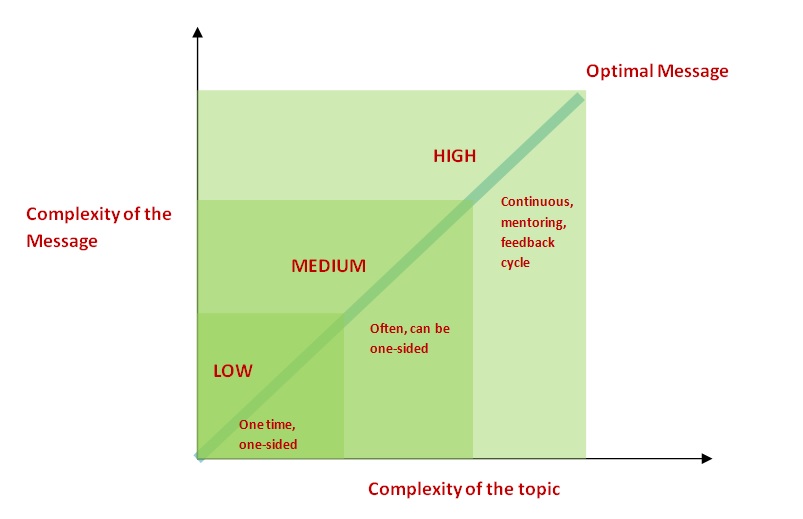
The common thread in communication or solving problems is the emphasis on KISS (Keep It Simple Stupid). However, in an effort to keeping things simple, we often engage in mismatched complexity. Complex ideas should not be exclusively conveyed as simple statements. The ideal state is that we use the optimal message – adjust complexity of the message to match the complexity of the content. This is detailed in the schematic below. The optimal message is the 45 degree line between the two axes. A highly complex topic should not be expressed using a low complex message such as a slogan or policy statement. In a similar fashion, a low complexity topic does not need a high complexity message method such as an hour-long meeting to discuss something fundamental.

message diagram

The highly complex topic can use both low and medium message methods to ensure that the complex idea is conveyed properly. The diffusion of the highly complex topic can build upon both low and medium message methods. The diffusion of a highly complex topic also requires redundancy, which means that the message must be conveyed as many times as needed and use of metaphors and analogies. One definition of “communication” from the great Gregory Bateson is – Communication is what the receiver understands, not what the sender says.

A good example to explain this is Toyota Production System. The concept of a production system for the entire plant is a complex concept. Toyota Production System was once called “the Ohno method” since it was not implemented company-wide and there was doubt as to the success of the system being a long-term plan. Ohno’s message was not written down anywhere and the employees did not learn that from a manual or a video. Ohno conveyed his ideas by being at the gemba (actual work place), implementing ideas and learning from them. He also developed employees by constantly challenging them to find a better way with less. Ohno used to draw a chalk circle on the floor for supervisors/engineers to make them see what he saw. He developed the Toyota Production System and with continuous mentoring, nurtured it together with the employees. Today there are over 1000 books at Amazon regarding “Lean Manufacturing”. When top management is looking at implementing lean, the message should match the complexity of the content. Low complex message methods like slogans or placards will not work. Medium complex message methods like newsletters, books etc will not work. This will require constant on-the-floor interactive mentoring. At the same time, slogans and newsletters can aid in the diffusion process.

Final Words:

I have always felt that KISS and Poka-Yoke have a similar story to tell from a respect-for-people standpoint. Poka-Yoke (Error proofing) was initially termed as Baka-Yoke to indicate “fool proofing”. Shigeo Shingo changed it to Poke-Yoke to indicate error proofing after an employee asked him “have I been such a fool?” In a similar fashion, KISS was initially put forth as “Keep It Simple Stupid” (without the comma). Nowadays, this has been changed to “Keep It Short and Simple” and “Keep It Simple Straightforward”.

It is good to keep things simple and to view at a problem from a 10,000 feet level. However, we should not stop there. We need to understand the context and complexity of the problem and then create this information in such a manner that it can be diffused across the organization. This can be repeated as many times as needed. Do not insist on simplicity without understanding the complexity of the problem. Asking to keep things simple is an attempt to keep round pegs in familiar square holes. When there is a mismatch of complexity it leads to incorrect solutions and setbacks. As Einstein may have said,everything should be as simple as it can, but not simpler”.

We can also view the complexity/message diagram in the light of the Feynman (Nobel-prize winning physicist Richard Feynman) technique of studying hard subjects. Feynman came up with a method where he would start studying and making notes pretending to prepare a lecture for a class. He would use simple terms and analogies to explain the subject. When he got stuck he would go back and try to understand it even better. He would then proceed with making notes. He would repeat the steps many times until he got the concept thoroughly. Moving from High to Medium to Low in the diagram, and going back-and-forth helps to connect the dots and gain a better understanding.

I will finish with another quote, attributed to Lotfi Zadeh (father of Fuzzy Logic):

“As complexity rises, precise statements lose meaning and meaningful statements lose precision.”

Always keep on learning…

In case you missed it, my last post was Flat Earth Lean:

Flat Earth Lean:

pipe

How many interpreters does it take to change a light bulb?

It depends on the context!

In today’s post, I will be looking at what I call “Flat Earth Lean” and “Contextual Lean”. I recently came across the concept of “Flat Earth View” in organizational communication. Matthew Koschmann, currently an associate professor at the University of Colorado, talks about the one-dimensional approach to organization communication where the big picture is not used. It is a linear approach without looking at the contexts or the social aspects. Koschmann explains – What I mean by a flat earth approach is a perspective that seems correct from a limited vantage point because it works for much of our day to day lives, but ultimately it fails to account for the complexity of a situation. For much of human history we got by just fine thinking the earth was flat, even though it was always round. And even with our 21st century sophistication where we know the earth is round, most of us can actually get by with flat earth assumptions much of the time. But what about when things get more complex? If you want to put a satellite into space or take a transcontinental flight, flat earth assumptions are not going to be very helpful. Remember in elementary school when you compared a globe to a map and realized, for example, that it s quicker to fly from New York to Moscow by flying over the North Pole instead of across the Atlantic? What seems counter intuitive from a flat earth perspective actually makes perfect sense from a round earth perspective.”

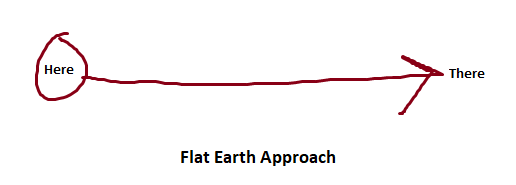
I would like to draw an analogy to Lean. Perhaps, the concept of flat earth exists in Lean as well. This could be looked at as the tools approach or copying Toyota’s solutions to apply them blindly. The linear approach implies a direct cause and effect relationship. From the Complexity Science standpoint, the linear relationship makes sense only in the simple and complicated domains. This is the view that everything is mechanistic, utilizing the metaphor of a machine – press this button here to make something happen on the other side with no unintended consequence or adverse effects. In this world, things are thought to be predictable, they can be standardized with one-glove-fits-all solutions, and every part is easily replaceable. Such a view is very simplistic and normally cares only about efficiency. This is an approach that is used for technical systems. There is limited or no focus on context. Hajime Ohba, a Toyota veteran, used to say that simply copying Toyota’s methods is like creating the image of Buddha and forgetting to inject soul in it. In Flat Earth Lean, the assumption is that end goal is clearly visible and that it is as easy as going from HERE to THERE. The insistence is always to KISS (keep it simple stupid). In many regards, this reductionist approach was working in the past. Information generation was minimal and the created information was kept local in the hands of the experts. In today’s global economy, organizations do not have the leisure to keep using the reductionist approach. Today, organizations not only have to ensure that information is diffused properly, they also have to rely on their employees to generate new information on a frequent basis. The focus needs to be shifted to organizations being socio-technical systems where things are not entirely predictable.

Here to There

Karl Weick, an American organizational theorist, advises to “complicate yourself”. He cautions us to not rely on oversimplification. We need to understand the context of what we are doing, and then challenge our assumptions. We have to look for contradictions and paradoxes. They are the golden nuggets that help us to understand our systems. In Contextual Lean, we have to understand our problems first and then look for ways to make things better. Implementing 5S with the aim of being “Lean” is the Flat Earth Approach. Implementing 5S and other visualization methods to make sense of our world, and making problems visible so that we can address them is “Contextual Lean”. If there is such a thing as “going Lean” for an organization, it is surely a collective expression. “Lean” does not exist in isolation in a department or in a cabinet; let alone in one Manager or an employee. To paraphrase the great philosopher, Ludwig Wittgenstein, the meaning of an expression exists only in context. Context gives meaning. Toyota’s “Lean” has limited meaning in relation to your organization since it makes sense only in the context of the problems that Toyota has. Thus, when the Top Management pushes for Lean initiation, it has to be in the context of the problems that the organization has. Understanding context requires self-reflection and continuous learning for the organization. This again is a collective expression and does not exist without involving the employees. Interestingly, Contextual Lean has to utilize Flat Earth approach as needed.

Flat Earth and Contextual Lean have some similarities to the late American business theorist Chris Argyris’ ideas of Single and Double Loop learning. Single Loop learning is the concept of correcting an error by using the existing mental models, norms and practices. Argyris gives the example of a thermostat to explain this – Single loop learning can be compared with a thermostat that learns when it is too hot or too cold and then turns the heat on or off. The thermostat is able to perform this task because it can receive information (the temperature of the room) and therefore take corrective action. Double Loop Learning, on the other hand, involves a reflective phase that challenges the existing mental models, norms and practices, and modifies them to correct the error. In Chris Argyris’ words –If the thermostat could question itself about whether it should be set at 68 degrees, it would be capable not only of detecting error but of questioning the underlying policies and goals as well as its own program. That is a second and more comprehensive inquiry; hence it might be called double loop learning. Single Loop Learning has some similarities to Flat Earth Lean in that it wants to take a simplistic approach and does not want to modify the mental models. It wants to keep doing what is told and to use an old analogy – only bring your hands to work and leave your brains outside. Single Loop Learning is a superficial approach to solve problems symptomatically. Double Loop Learning has some similarities to Contextual Lean in that it is not one-dimensional and results in modifying the mental models as needed. It is a continuous learning and adapting cycle. Argyris also believed that organizations learn when its people learn – Organizational learning occurs when individuals, acting from their times and maps, detect a match or mismatch of outcome to expectation which confirms or disconfirms organizational theory-in-use.

I will finish with a fitting contextual story about change.

Mulla Nasrudhin was now an old man. People used to gather around to hear him talk. One day a young man asked for some words of wisdom.

Mulla replied, “When I was young I was very strong minded- I wanted to awaken everyone. I prayed to God to give me the strength to change the world. As time went on, I became middle aged and I realized that I did not change the world. Then I prayed to God to give me strength so that I can at least change those close around me. Now that I am older and perhaps wiser, my prayer has become simpler. I say – God, please grant me the strength to change at least myself.”

Always keep on learning…

In case you missed it, my last post was The Purpose of Visualization:

A Fuzzy 2018 Wish:

2018

I wanted to write a good post for the New Year (2018). I have been thinking about a good “New Year’s” subject to write about for a while now. It is not easy to find topics to write about, and even if I find good topics, it has to pass my threshold level. As I was meditating on this, I came to think about procrastination and ambiguity. With these thoughts, I came to the topic for the post today. My post today is about the importance of “fuzzy concepts”. I am using the term fuzzy concept in a loose sense and will not go into depth or specifics.

We like to think in boxes or categories. It makes it easy for us to make inferences and aids in decision-making. “She is tall” or “He is short”; “this is hard” or “this is easy”. This is a reductionist approach and from a logic standpoint, this type of thinking is called “Boolean logic” and is based on a dichotomy of true or false (0 or 1). Something is either “X” or “not X”. This type of thinking has its merits sometimes.

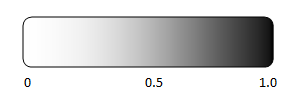
In contrast, Fuzzy logic helps us in seeing the “in-between”. The fuzzy logic approach utilizes a spectrum viewpoint. It starts as 0 at one end and slowly increases bit by bit all the way to 1. We can express any point between 0 and 1 as a decimal value.

spectrum

In the picture above, the left most point is white (0), and as we go towards right it changes the color to black (1.0) at the extreme right. Any point in between is neither white nor black. It is just in-between and we can identify the gradient as a value between 0 and 1.

In this vein, if I am to get myself to write a post for the New Year, I could be either prepared and ready OR not prepared and ready. I could wait for a long time for the inspiration to strike or to have an epiphany that would add value to the post. From a Boolean standpoint, this is black and white thinking. I have to wait until I am fully ready (1) to write the post. If I am not ready (0), I should not write the post.

The fuzzy thinking is not recent. In fact, there is an old Greek paradox called Sorites paradox, which is attributed to Megarian logician Eubulides of Miletus. The word “Sorites” is derived from the Greek word soros, which means “heap”. The paradox is as follows – if you have a heap of sand, and you take away a grain, would that heap still be a heap? What would happen if you keep taking grains away? At what point does it cease being a heap? We can express this in the Boolean logic as:  (1) = Heap, and (0) = No Heap. However, if we use the fuzzy logic, we could define what a full heap means and what “no heap” means. Anything in between can be defined as a “partial heap”. Fuzzy logic helps us to add a matter of degree to any statement.

The fuzzy logic concept goes really well with continuous improvement philosophy and the thought that lean is a journey and not a destination. We will never be 100% complete with our improvement. We are always incomplete with our improvement, and it is okay that we are incomplete. We have to keep on improving. We do not have to wait until we have the perfect idea or the expensive machinery or tool to start improving our processes. We do not have to wait for others to start on the improvement journey. In a Zen-like fashion, wherever we are, there we are – the right place to start improving. We will always be between 0 and 1 in terms of perfection of the process. We will always be on the journey and never at the destination. Taiichi Ohno, the father of Toyota Production System, had a great saying that encapsulates the fuzzy concept – Don’t seek perfection. 60 percent is good enough!

I will finish with a story I read online from an anonymous source.

The family was driving to their destination for their holiday. The child asked his father, “Are we there yet?”

The father replied, “No son. We are always here.”

I wish all of my readers a Fuzzy 2018. You are exactly where you are to start exactly what you want to start. Wherever you are, there you are!

Always keep on learning…

In case you missed it, my last post was A Merry Happy Christmas and Attractors:

Divine Wisdom and Paradigm Shifts:

cancer

One of the best books I have read in recent times is The Emperor of All Maladies by the talented Siddhartha Mukherjee. Mukherjee won the 2011 Pulitzer Prize for this book. The book is a detailed history of Cancer and humanity’s battle with it. Amongst many things that piqued my interest, was one of the quotes I had heard attributed to Dr. Deming – In God we trust, all others must bring data.

To tell this story, I must first talk about William S. Halsted. Halsted was a very famous surgeon from John Hopkins who came up with the surgical procedure known as the “Radical Mastectomy” in the 1880’s. This is a procedure to remove the breast, the underlying muscles and attached lymph nodes to treat breast cancer. He hypothesized that the breast cancer spreads centrifugally from the breast to other areas. Thus, the removal of the breast, underlying muscles and lymph nodes would prevent the spread of cancer. He called this the “centrifugal theory”. Halsted called this procedure as “radical” to notate that the roots of the cancer are removed. Mukherjee wrote in his book that the intent of radical mastectomy was to arrest the centrifugal spread by cutting every piece of it out of the body. Physicians all across America identified the Radical Mastectomy as the best way to treat breast cancer. The centrifugal theory became the paradigm for breast cancer treatment for almost a century.

There were skeptics of this theory. The strongest critics of this theory were Geoffrey Keynes, a London based surgeon in the 1920s, and George Barney Crile, an American surgeon who started his career in the 1950s. They noted that even with the procedures that Halsted had performed, many patients died within four or five years from metastasis (cancer spreading to different organs). The surgeons overlooked these flaws, as they were firm believers in the Radical Mastectomy. Daniel Dennett, the famous American Philosopher, talks about the concept of Occam’s Broom, which might explain the thinking process for ignoring the flaws in a hypothesis. When there is a strong acceptance of a hypothesis, any contradicting information may get swept under the rug with Occam’s Broom. The contradictory information gets ignored and not confronted.

Keynes was even able to perform a local surgery of the breast and together with radiation treatment achieve some success. But Halsted’s followers in America ridiculed this approach, and came up with the name “lumpectomy” to call the local surgery. In their minds, the surgeon was simply removing “just” a lump, and this did not make much sense. They were aligning themselves with the paradigm of Radical Mastectomy. In fact, some of the surgeons even went further to come up with “superradical” and “ultraradical” procedures that were morbidly disfiguring procedures where the breast, underlying muscles, axillary nodes, the chest wall, and occasionally the ribs, part of the sternum, the clavicle and the lymph nodes inside the chest were removed. The idea of “more was better” became prevalent.

Another paradigm with clinical studies during that time was trying to look only for positive results – is treatment A better than treatment B? However, this approach did not show that treatment A was no better than treatment B. Two statisticians, Jerry Neyman and Egon Pearson, changed the approach with their idea of using the statistical concept of power. The sample size for a study should be based on the power calculated. Loosely stated, more independent samples mean higher power. Thus, with a large sample size of randomized trials, one can make a claim of “lack of benefit” from a treatment. The Halsted procedure did not get challenged for a long time because the surgeons were not willing to take part in a large sample size study.

A Philadelphia surgeon named Dr. Bernard Fisher was finally able to shift this paradigm in the 1980s. Fisher found no reason to believe in the centrifugal theory. He studied the cases put forth by Keynes and Crile. He concluded that he needed to perform a controlled clinical trial to test the Radical Mastectomy against Simple Mastectomy and Lumpectomy with radiation. The opposition from the surgeons slowly shifted with the strong advocacy from the women who wanted a less invasive treatment. Mukherjee cites the Thalidomide tragedy, the Roe vs Wade case, along with the strong exhortation from Crile to women to refuse to submit to a Radical Mastectomy, and the public attention swirling around breast cancer for the slow shift in the paradigm. Fisher was finally able to complete the study, after ten long years. Fisher stated that he was willing to have faith in divine wisdom but not in Halsted as divine wisdom. Fisher brusquely told a journalist – “In God we trust. All other must have data.”

The results of the study proved that all three cases were statistically identical. The group treated with Radical Mastectomy however paid heavily from the procedure but had no real benefits in survival, recurrence or mortality. The paradigm of Radical Mastectomy shifted and made way to better approaches and theories.

While I was researching this further, I found that the quote “In God we trust…” was attributed to another Dr. Fisher. Dr. Edwin Fisher, brother of Dr. Bernard Fisher, when he appeared before the Subcommittee on Tobacco of the Committee on Agriculture, House of Representatives, Ninety-fifth Congress, Second Session, on September 7, 1978. As part of presentation Dr. Fisher said – “I should like to close by citing a well-recognized cliche in scientific circles. The cliche is, “In God we trust, others must provide data. This is recorded in “Effect of Smoking on Nonsmokers. Hearing Before the Subcommittee on Tobacco of the Committee on Agriculture House of Representatives. Ninety-fifth Congress, Second Session, September 7, 1978. Serial Number 95-000”. Dr. Edwin Fisher unfortunately was not a supporter of the hypothesis that smoking is bad for a non-smoker. He even cited that people traveling on an airplane are more bothered by crying babies than the smoke from the smokers.

fisher

Final Words:

This past year, I was personally affected by a family member suffering from the scourge of breast cancer. During this period of Thanksgiving in America, I am thankful for the doctors and staff who facilitated her recovery. I am thankful for the doctors and experts in the medical field who were courageous to challenge the “norms” of the day for treating breast cancer. I am thankful for the paradigm shift(s) that brought better and effective treatments for breast cancer. More is not always better! I am thankful for them for not accepting a hypothesis based on just rationalism, an intuition on how things might be working. I am thankful for all the wonderful doctors and staff out there who take great care in treating all cancer patients.

I am also intrigued to find the quote of “In God we trust…” used with the statement that smoking may not have a negative impact on non-smokers.

I will finish with a story of another paradigm shift from Joel Barker in The Business of Paradigms.

A couple of Swiss watchmakers in Centre Electronique Horloger (CEH) in Neuchâtel, Switzerland, developed the first Quartz based watch. They went to different Swiss watchmakers with the technology that would later revolutionize the watch industry. However, the paradigm at that time was the intricate Swiss watch making process with gears and springs. No Swiss Watch company was interested in this new technology which did not rely on gears or springs for keeping time. The Swiss watchmakers with the new idea then went to a Clock convention and set up a booth to demonstrate their new idea. Again, no Swiss watch company was interested in what they had to offer. Two representatives, one from the Japanese company Seiko, and the other from Texas Instruments took notice of the new technology. They purchased the patents and as they say – the rest is history. The new paradigm then became Quartz watches. The Swiss, who were on the top of watch making with over 50% of the watch market in the 1970s, stepped aside for the Quartz watch revolution marking the decline of their industry. This was later termed as the Quartz Revolution.    

Always keep on learning…

In case you missed it, my last post was The Best Attribute to Have at the Gemba:

The Best Attribute to Have at the Gemba:

blindmen and elephant

Recently, I was playing around with the question – what is the best attribute to have at the gemba? At first, I thought that perhaps it could be creativity. I soon realized that this is like Superman, a superhero with all of the answers. This does not align with the idea of the people system or the thinking production system – generating ideas bottom-up. Then I thought, perhaps the best attribute to have at the gemba is the ability to listen. I felt that I was on the right track with this thought. I soon came to the realization that the best attribute to have at the gemba is “Anekantvada”.  Anekantvada is a Sanskrit word that translates as “many + ends + -ness” or “many sidedness”. This idea comes from one of the ancient religions from India called Jainism. Jainism is also famous for its other contribution – Ahimsa or non-violence. We can view anekantvada as cognitive ahimsa – in other words, not being violent or hostile to others’ ideas. The main idea of anekantvada is that Reality lies outside of your mind. What you have inside your mind is your perspective or your own version of a narrative regarding the reality outside. Thus, your perspective is a poorly translated and limited copy of the reality outside and your understanding of the reality is incomplete. Anekantvada requires you to look at multiple perspectives from other people to truly understand reality, as one perspective alone is incomplete. All knowledge is contextual. We cannot separate the object and the viewer, when we are creating knowledge about something. This means that if there is more than one viewer, the knowledge created will be different.

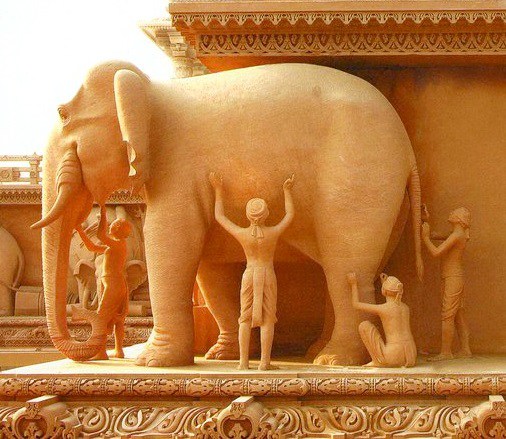
The story of the blind men and the elephant is a very common story that explains the different perspectives of reality. The story originated with Jainism to explain anekantvada. In the Jain version of the story, there were six blind men who came to “see” the elephant, and each person felt one part of the elephant and described the elephant from his perspective. Each perspective was different because each person felt a different part of the elephant. One person felt the ear and said that the elephant was like a fan, while another felt the tail and said that the elephant was like a rope. The king happened to be there at that time, and listened to the blind men fighting on who was correct. The king told them that while each of them was partially correct, when taken one perspective at a time the truth was incomplete.

From the Jain philosophy, reality and thus the truth itself is complex and always has multiple aspects. Even if you can experience reality, you cannot express the reality completely. The best we can do is like one of the blind men – give our version, a partial expression of truth. In Jain philosophy, this idea can be explained by “Syadvada”. The root word “Syad” can be translated as “perhaps”. Using this approach, we can express anekantavada by adding “perhaps” in front of our expression of reality. An example would be to say – “perhaps the dress is blue and black”.

dress

The two quotations below add more depth to what we have discussed so far:

“To deny the coexistence of the mutually conflicting viewpoints about a thing would mean to deny the true nature of reality.” – Acharang Sutra

“The water from Ocean contained in a pot can neither be called an ocean or a non-ocean, but simply a part of the ocean. Similarly, a doctrine, though arising from absolute truth can neither be called a whole truth or a non-truth.” – Tattvarthaslokavartikka.

The idea of anekantvada requires you to respect others’ ideas. It also makes you realize that your version of reality is incomplete. Thus, when you are at the gemba telling others what to do, you are not open to others’ viewpoints. You are going with your version of the story –  it should be easy to do this, the way I tell you. Anekantvada brings a new layer of meaning to Respect for People, one of the two pillars of the Toyota Way. Take the example of Standard Work – Do you create it in vacuum and ask the operators to follow it? When there is a problem on the floor, do you figure out what happened and then require the operators to follow your one “true” way?

All knowledge, judgment and decisions we make depends upon the context of the reality, and it may make sense only when viewed in that context. Why did the operator omit step 2 of the work instructions that led to all of these rejects? This reminds me of the principle of Local Rationality, an idea that I got from Sidney Dekker [1]. Local Rationality refers to the idea that people do what make the most sense to them, at any given time. This decision may have led to some disaster, but the operator(s) did what made sense to them at that time. When you look at things this way, you start to view it from the operator’s standpoint, and finally may be able to understand what happened from a different perspective.

I will finish with a story about context:

Two students came to study under the master. They were both fond of smoking. The first day itself, the first student went to the teacher and asked whether he could smoke when he was meditating. The teacher told him that he could not do that.

Feeling sad, the first student went outside to meditate under the tree. There he saw the second student under a tree smoking. The first student asked him, “Why are you smoking? Don’t you know that our teacher does not like it when you smoke and meditate?”

The second student responded that he had asked the teacher and the teacher said that he could smoke.

The first student was confused and asked the second student, what exactly did he ask the teacher.

The second student said, “I asked him if I can meditate when I smoke.”

The first student replied, “That makes sense. I asked him if I can smoke when I meditated.”

Always keep on learning…

In case you missed it, my last post was The Socratic Method:

[1] http://sidneydekker.com/

The Socratic Method:

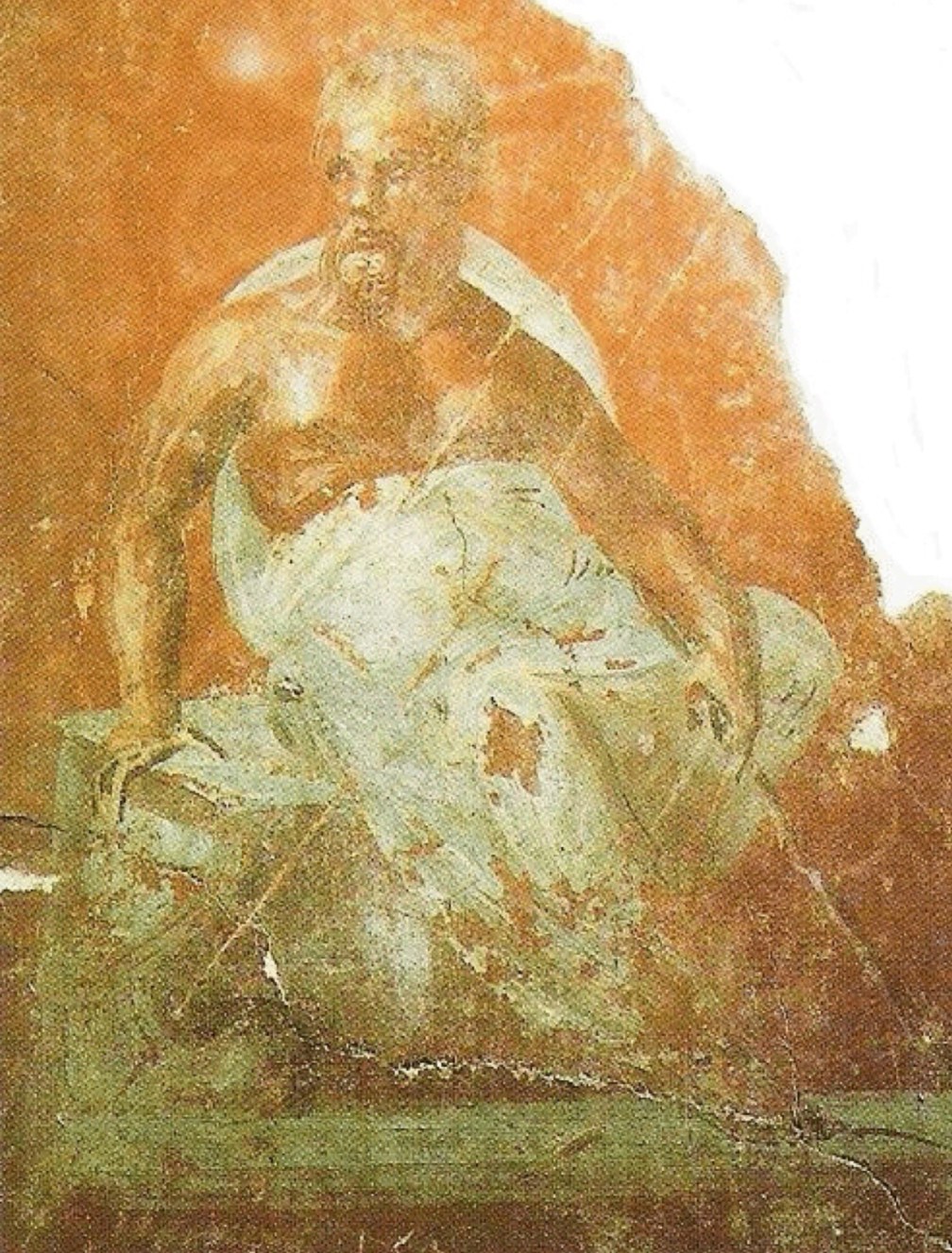
Socrates Mural

In today’s post, I am looking at the Socratic Method. Socrates was one of the early founders of Western Philosophy. Marcus Cicero (106–43 BCE), a Roman politician, wrote that it was Socrates who brought philosophy down from heaven to earth.

“Socrates however (was the) first (who) called philosophy down from heaven, and placed it in cities, and introduced it even in homes, and drove (it) to inquire about life and customs and things good and evil.”

I have always been curious about the Socratic Method. I have heard it mentioned in many books as the method to teach by asking. In my mind, I drew the analogy of guiding a horse to the pond so that it can drink water. The “guiding” is done through the questions so that the teacher does not provide the answer to the student directly. Instead, the student comes up with the answer.  This is not the same as the normal teaching in schools (“lecturing”), where the teacher will give the answers, while the students remain passive. Socrates used the analogy of a midwife who helps others to deliver their thoughts in a clear and meaningful manner.

There are three terms commonly seen to describe the Socrates Method.

  • Elenchos
  • Dialectic
  • Aporia

Elenchos is a Greek term, which can be translated as “cross-examination”. There is a negative connotation to this term. Socrates’ method has been described as an Elenctic method. The negative connotation comes from pointing out to the interlocutor that he does not have the knowledge that he thought he did, puncturing the conceit of wisdom. Socrates would start out by saying that he does not know about something, for example, the concept of virtue. Then he would ask for help from the person of interest to define what virtue is. From that point onwards, once the person of interest commits to a definition, Socrates will continue to ask questions, and each question will point out a weakness that refutes the definition. After a round of questions, the person of interest gets very confused and recognizes that he did not understand the subject as he thought he did and feels that he embarrassed himself.

 Dialectic is another Greek term that can be translated as “discussion”. Dialectic does not have the negative connotation that Elenchos has. Any complex idea contains contradictions, inconsistencies and even portions of ignorance. The Dialectic method is a way to reveal the contradictions or inconsistencies, to go back and forth between contrasting ideas to refine the topic on hand.

What Socrates is trying to achieve from his questions is “Aporia”. Aporia is another Greek term that can be translated as “perplexity” or “impasse”. Once the interlocutor realizes that he does not know as much as he thought he did, he achieves aporia. He feels the discomfort cognitively because he was sure that he knew about the subject. The interlocutor is outside of his comfort zone. However, Socrates was able to find fault with his knowledge. Aporia is the starting point for the interlocutor to examine himself and reflect so that new knowledge can be gained.

Combining the three ideas above, we can loosely explain the Socratic Method as follows:

  1. Make the person of interest (POI) at ease, and ask the question in the form of “what is X?”
  2. If POI defines “X” as “Y”, find examples where “X” is not “Y”
  3. Ask questions to further define “X” in light of the new information. Repeat (2) and (3).
  4. Each round of questions must move the POI further away from their first definition.
  5. POI achieves aporia.

Socrates would plead ignorance and ask for specific definitions when asking questions. The questions can also be in other forms such as “what is the purpose of X” or “How does one obtain X” etc. The first question forces the POI to define the boundary of his conception of the idea. This can be thought of as a box. However, with each refutation, the POI realizes that the boundary he first drew is not enough, and that he has to redefine the boundary – perhaps make it larger or smaller, or draw the boundary in a whole other area.

One of the best examples I have seen to explain this is that of a chair. How would one define a chair? One possible definition is that a chair is something for a person to sit upon.
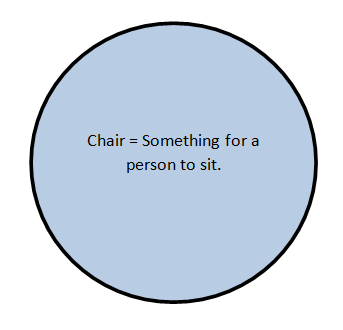
chair 1

However, there are many other things that people sit on, for example – a step on a stair.

With this refutation, the definition may now be changed to “a chair is something designed for a person to sit.”
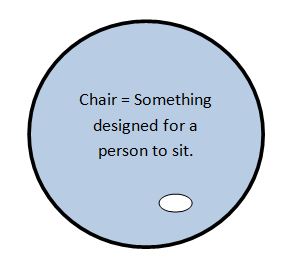
chair 2

The new refutation might be that a bench is something that is designed for a person to sit, and so is a stool. These are not chairs.

Perhaps, the chair can be now defined as “piece of furniture designed for only one person with a back and four legs”. This is similar to the definition in Merriam Webster dictionary.

Even with the new definition, there are still inconsistencies. There are chairs such as decorative chairs that are not supposed to be sat on. There are chairs like a bean bag chair that do not have a back or legs.
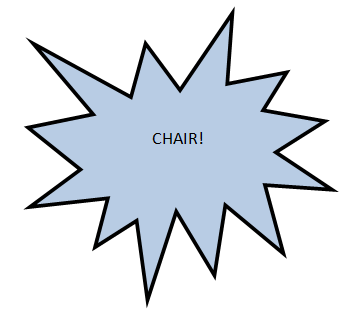
chair 3

Compared to defining a chair, it is harder to define ideas that are not tangible. There are many phrases in Lean like “Respect for People” and “flow” that are thrown around. How would you define “Respect for People”? Would you define it as being nice to your workers? How would you define “flow”? Would you define it as production with one-piece at a time?

On a side note, you can use the Socratic Method on yourself. This can be compared to Hansei in Toyota Production System. What are your beliefs and worldviews? Can you identify any contradictions or inconsistencies that might refute this? Actively seeking out to disprove your belief system helps you in your pursuit for wisdom. Seek out aporia!

Final words:

Socrates did not write any books. Plato, his disciple, wrote about Socrates a lot in his books. Most of what we know about Socrates came from Plato’s books. Socrates never defined or explained his method, nor did Plato write it down as a method. What we have come to know as the Socratic Method is from reading Plato’s books and noting the patterns of dialogues that Socrates engaged in. In Plato’s book, “Apology”, Socrates talks about the reason for going around and asking questions. Socrates’ friend, Chaerephon went to Delphi and asked the Pythian priestess Is there anybody wiser than Socrates?” The Pythian priestess responded that there was no one wiser. This really confused Socrates, and he took this to mean that the Gods are commanding him to examine himself as well as others. He came to the realization that while others were pretending to possess knowledge, he knows nothing, and this knowledge is what sets him apart from others. Socrates said that the unexamined life is not worth living. The pursuit of knowledge starts with questions.

I will finish with a story of Diogenes and Plato. Diogenes was one of the founders of Cynic Philosophy. Diogenes asked Plato for a definition of man. Knowing Diogenes’ cynical nature, Plato gave the tongue-in-cheek definition from Socrates – “Man is a featherless biped.” Diogenes went outside, and bought a chicken. He then plucked all of its feathers, brought it to Plato, and said, “Behold. Here is a man.”

Plato then ordered his academy to add “with broad flat nails” to the definition.

Always keep on learning…

In case you missed it, my last post was Which Way You Should Go Depends on Where You Are:

Which Way You Should Go Depends on Where You Are:

compass

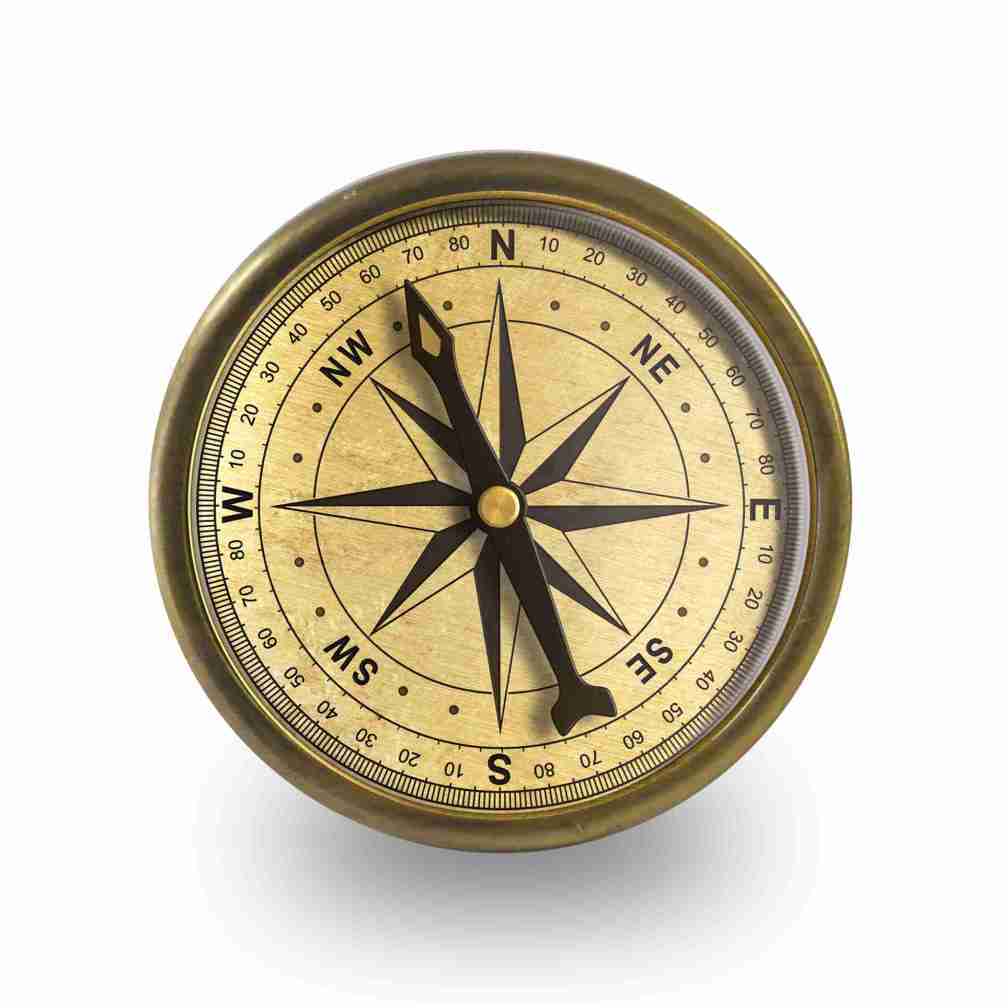
I recently read the wonderful book “How Not To Be Wrong, The Power of Mathematical Thinking” by Jordan Ellenberg. I found the book to be enlightening and a great read. Jordan Ellenberg has the unique combination of being knowledgeable and capable of teaching in a humorous and engaging way. One of the gems in the book is – “Which way you should go depends on where you are”. This lesson is about the dangers of misapplying linearity. When we are thinking in terms of abstract concepts, the path from point A to point B may appear to be linear. After all, the shortest path between two points is a straight line. This type of thinking is linear thinking.

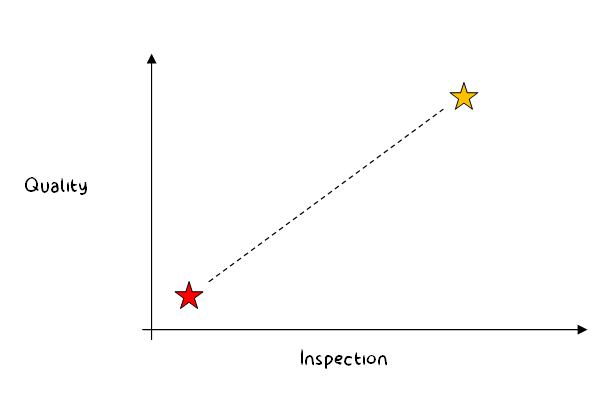
To illustrate this, let’s take the example of poor quality issues on the line. The first instinct to improve quality is to increase inspection. In this case, point A = poor quality, and point B = higher quality. If we plot this incorrect relationship between Quality and Inspection, we may assume it as a linear relationship – increasing inspection results in better quality.

Inspection and Quality

However, increasing inspection will not result in better quality in the long run and will result in higher costs of production. We must build quality in as part of the normal process at the source and not rely on inspection. In TPS, there are several ways to do this including Poka Yoke and Jidoka.

In a similar fashion, we may look at increasing the number of operators in the hopes of increasing productivity. This may work initially. However, increasing production at the wrong points in the assembly chain can hinder the overall production and decrease overall productivity. Taiichi Ohno, the father of Toyota Production System, always asked to reduce the number of operators to improve the flow. Toyota Production System relies on the thinking of the people to improve the overall system.

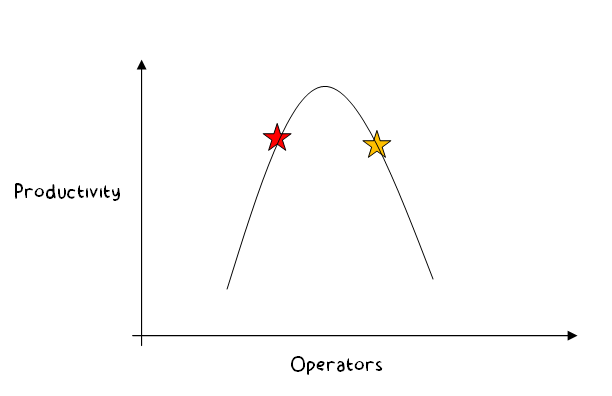
The two cases discussed above are nonlinear in nature. Thus increasing one factor may increase the response factor initially. However, continually increasing the factor can yield negative results. One example of a non-linear relationship is shown below:

productivity

The actual curve may of course vary depending on the particularities of the example. In nonlinear relationships, which way you should go depends on where you are. In the productivity example, if you are at the Yellow star location on the curve, increasing the operators will only decrease productivity. You should reduce the number of operators to increase productivity. However, if you are at the Red star, you should look into increasing the operators. This will increase productivity up to a point, after which the productivity will decrease. Which Way You Should Go Depends on Where You Are!

In order to know where you are, you need to understand your process. As part of this, you need to understand the significant factors in the process. You also need to understand the boundaries of the process where things will start to breakdown. The only way you can truly learn your process is through experimentation and constant monitoring. It is likely that you did not consider all of the factors or the interactions. Everything is in flux and the only constant thing is change. You should be open for input from the operators and allow improvements to happen from the bottom up.

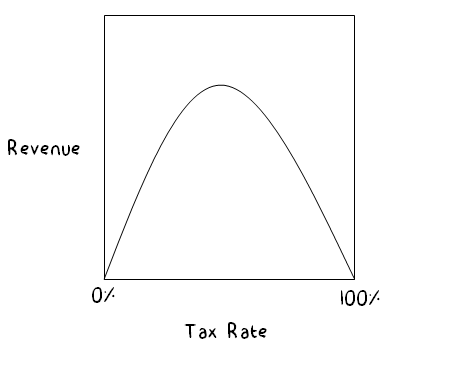
I will finish off with the anecdote of the “Laffer curve” that Jordan Ellenberg used to illustrate the concept of nonlinearity. One polical party in America have been pushing for lowering taxes on the wealthy. The conservatives made this concept popular using the Laffer curve. Arthur Laffer was an economics professor at the University of Chicago. The story goes that Arthur Laffer drew the curve on the back of a napkin during dinner in 1974 with the senior members of then President Gerald Ford’s administration. The Laffer Curve is shown below:

Laffer curve

The horizontal axis shows the tax rate and the vertical axis shows the revenue that is generated from taxation. If there is no taxation, then there is no revenue. If there is 100% taxation, there is also no revenue because nobody would want to work and make money, if they cannot hold on to it. The argument that was raised was that America was on the right hand side of the curve and thus reducing taxation would increase revenue. It has been challenged whether this assumption was correct. Jordan used the following passage from Greg Manikiw, a Harvard economist and a Republican who chaired the Council of Economic Advisors under the second President Bush:

Subsequent history failed to confirm Laffer’s conjecture that lower tax rates would raise tax revenue. When Reagan cut taxes after he was elected, the result was less tax revenue, not more. Revenue from personal income taxes fell by 9 percent from 1980 to 1984, even though average income grew by 4 percent over this period. Yet once the policy was in place, it was hard to reverse.

The Laffer curve may not be symmetric as shown above. The curve may not be smooth and even as shown above and could be a completely different curve altogether. Jordan states in the book – All the Laffer curve says is that lower taxes could, under some circumstances, increase tax revenue; but figuring out what those circumstances are requires deep, difficult, empirical work, the kind of work that doesn’t fit on a napkin.

Always keep on learning…

In case you missed it, my last post was Epistemology at the Gemba:

Epistemology at the Gemba:

plato 2

In today’s post, I will be looking at Epistemology at the Gemba. Epistemology is the part of philosophy that deals with the theory of knowledge. It tries to answer the questions – how do we know things and what are the limits of our knowledge? I have been learning about epistemology for a while now and I find it an enthralling subject.

The best place to start this topic is with “Meno’s paradox”. Plato wrote about Meno’s paradox as a conversation between Socrates and Meno in the book aptly called “Meno”.  This is also called the “paradox of inquiry”. The paradox starts with the statement that if you know something, then you do not need to inquire about it. And if you do not know something, then the inquiry is not possible since you do not know what you are looking for. Thus, in either case inquiry is useless. Plato believed that we are all born with complete knowledge and all we need to do is recollect what we know as needed.

Today, philosophers point out that knowledge is possible through two ways;

  • Rationalism –knowledge comes from within and does not need to rely on experience.
  • Empiricism – knowledge comes from experience using our senses.

One of the great empiricist philosophers, David Hume classified all objects of human inquiries into two categories, which aligned with the two above-mentioned sources of knowledge.

  • Relation of Ideas – These are tautological statements that are true by themselves. These can also be called “analytical statements” or “necessary statements”. Examples are “all bachelors are unmarried men” or “dogs are mammals”. We can know this just by looking at the statement and no further inquiry is needed. These ideas and observations do not rely on the world.
  • Matters of Facts – These are statements that needs further confirmation by evidence. These can also be called “synthetic” or “contingent” statements. Examples are “it is sunny today” or “the Eiffel Tower is 15 cm taller in the summer”. These rely on the world and experience in the particular matter.

As Science progressed, epistemology also progressed. There was more value placed on empiricism and one of the most famous of these philosophical movements was Logical Positivism. The central theme of Logical Positivism was verificationism which meant that all claims must be verifiable to make sense cognitively. This approach required an objective look at science and empiricism, and relied on the concept of positivism. Positivism was an approach to explain the world objectively and deterministically. It treated the nature of reality as objective, single and fragmentable. This promoted the idea of reductionism where everything can be taken apart and studied. The world was viewed as a machine where direct cause and effect relationships existed. One of the main criticisms of Logical Positivism was that the claim of verificationism itself was not empirically verifiable. Another main criticism was ignoring the observer as being part of the system. The world cannot be viewed independently of the observer. The world is in fact a social construct relying on multiple interpretations. The knowing and the knower are always interacting, and cannot be separated. This type of approach to creating the reality of the world is called interpretivism.

Stephen Pepper was one of the critics of Logical Positivism. He believed that it is not possible to have pure objective facts. He proposed the idea of worldviews or world hypotheses through which we create the meaning to reality in his 1942 book, World Hypotheses: a study in evidence. Four of his worldviews are:

  • Formism – the worldview where we make sense of things by identifying similarities and differences, and thus putting things in categories.
  • Mechanism – the worldview where we make sense of the world as if it were a machine. We assume that there are direct cause and effect relationships and we can take things apart to make sense of things.
  • Organicism – the worldview where importance is placed on creating an organic perspective of the world, where parts come together to create a coherent whole.
  • Contextualism – the worldview where we place value in the context of the world and its parts. This allows us to see the complexity of the world. Pepper identified the context through the two fundamental categories – quality and texture. Quality refers to the total character of an event and texture refers to the details and relations that make up this total character. Viewing the world in terms of context helps us to adopt the required strategies to meet the unpredictability of the world.

My own thoughts on epistemology favors empiricism but also relies on interpretivism. The four worldviews proposed by Pepper helps us to understand the reality from multiple perspectives. This brings me to some concepts in Toyota Production System. One of the main tenets of Toyota Production System is “Grasp the Situation”. This is preceded by going to the gemba, the actual work place where the action is. Once at the gemba, one has to grasp the reality – what is really going on. This requires one to keep personal biases aside and view gemba through the eyes of the operators. I like the use of the verb “grasp” – this indicates a tactile nature, as if you are actually trying to physically “feel out” the problem. Observation is the first step for empiricism. This can be achieved only by going to gemba.

Most of the time when we are informed of a problem, we do not have a clear understanding. Sometimes, the problem statement can be – “it does not work. Again!” This vague problem statement does not help us much. The problem is experienced by the operator and is external to you. Once we are at the gemba, we can start asking questions and even feel the operations by working at the station where the problem occurred. One of the Toyotaisms is – look with your feet and think with your hands. This tactile nature of learning helps us understand the implicit knowledge of the operator.

Another Toyotaism that is meaningful to this discussion is – There is a difference between Toyota Production System and Toyota’s Production System. Toyota Production System is static. It can be treated as explicit knowledge where every single tenet, every single tool and every single concept is written down. However, what Toyota does on a day-to-day basis is personal to the Toyota plant. This cannot be written down. Toyota’s Production System is dynamic where the solutions are unique to the problems that the specific Toyota plant experiences. Another concept that Toyota emphasizes is gaining consensus. This ensures that multiple perspectives are utilized to create the common reality. The concept of “wa” or harmony is important in the Japanese culture.

Final Words:

How do you know what you know? This is an epistemological question. If you are asked to implement 5S or any other lean tool, you need to know why it needs to be implemented. Do you know which problem it is trying to address? If you are asked to help solve a problem on the floor, how would you know what needs to be done? Empiricism is a great way to gain knowledge. This implies using your senses to gain knowledge. The best way to do this is to go to the actual place where the action is. In addition to this, be open to others’ perspectives. The reality must be built upon multiple perspectives.

I will finish with a Zenful story of mine.

The student was in awe of his master. One day, he told the master, “Master, you are truly wise. Do you have any words of wisdom for me?”

The master replied, “I may be wise today. However, wisdom is a habit. Wisdom comes with knowledge only through experience. Thus, I may no longer be a wise man tomorrow.”

Always keep on learning…

In case you missed it, my last post was Meditations at the Gemba: