
Ubuntu At the Gemba:

Ubuntu

“My humanity is tied to yours. I am because you are.” 

In today’s post I will be looking at the African philosophical concept of Ubuntu. The word “Ubuntu” is best explained by the Nguni aphorism – Umuntu Ngumuntu Ngabantu, which means “a person is a person because of or through others.” Ubuntu is a key African philosophy and can be translated as humanity. It emphasizes the group solidarity, sharing, caring and the idea of working together for the betterment of everybody. Ubuntu has many derivatives in Bantu languages and this concept is spread across the many nations in Africa.

Ubuntu is the humanness in us. It is said that a solitary human being is a contradiction. We remain human as part of a community. We get better through the betterment of our community. Our strength comes from being part of a community. To quote Archbishop Desmond Tutu:

One of the sayings in our country is Ubuntu – the essence of being human. Ubuntu speaks particularly about the fact that you can’t exist as a human being in isolation. It speaks about our interconnectedness. You can’t be human all by yourself, and when you have this quality – Ubuntu – you are known for your generosity. 

We think of ourselves far too frequently as just individuals, separated from one another, whereas you are connected and what you do affects the whole world. When you do well, it spreads out; it is for the whole of humanity. 

An interesting part about African philosophy is that most of it was not written down. The ideas were transmitted through oral traditions, which depended upon having strong communal roots. Some of the key ideas that are part of the Ubuntu philosophy are:

  • Always aim for the betterment of the community over self.
  • When we treat others with dignity, all of us are able to perform and contribute better.
  • The strength of the community lies in the interconnectedness of the members.
  • The survival of one person is dependent upon the survival of the community.
  • Ubuntu philosophy aims for harmony and consensus in decision making.
  • Ubuntu requires us to be open and make ourselves available to others.
  • Ubuntu requires us to coach and mentor those younger than us. This also helps us become better at what we do.
  • Respect and dignity, as part of ubuntu, ensure that we provide an environment where everybody is able to contribute and bring value.
  • Ubuntu is a philosophy focused on people, and promotes working together as a team towards the common goal. At the same time, it promotes healthy competition and challenges people to keep growing.
  • Ubuntu points out that aiming for individual goals over common goals is not good. System optimization is the end goal.
  • Ubuntu facilitates a need to have a strong communication system.
  • As a management system, Ubuntu puts the focus on local conditions and context. How does what we do impact those around us? How does what we do impact our environment? How does what we do impact our society?
  • Another key concept is the Ubuntu philosophy is forgiveness or short memory of hate!

As I was researching and learning about Ubuntu, I could not help but compare it against the concept of “Respect for Humanity” in Toyota Production System.  I see many parallels between the two concepts. Respect for Humanity (People) is one of the two pillars of the Toyota Way. The other pillar being Continuous Improvement. Japan is an island with limited resources, and the concept of harmony is valued in the Japanese culture. Toyota Production System and Lean are famous for its many tools. Tools are easy to identify since they have physical attributes like kanban, Visual work place, standard work etc. However, respect for people was not understood or looked at by the Toyota outsiders. Most of the Japanese literature about Toyota Production System mentioned Respect for Humanity (people) while it took a while for the western authors to start discussing Respect for Humanity.

Toyota’s view of Respect for People is to ensure that its employees feel that they are bringing value and worth to the organization. Fujio Cho, the pioneer of the Toyota Way 2001, expressed Respect for People as:

Creating a labor environment “to make full use of the workers’ capabilities.” In short, treat the workers as human beings and with consideration. Build up a system that will allow the workers to display their full capabilities by themselves.

Toyota has built up a system of respect for human, putting emphasis on the points as follows: (1) elimination of waste movements by workers; (2) consideration for workers’ safety; and (3) self-display of workers’ capabilities by entrusting them with greater responsibility and authority.

Final Words:

Paul Bate, Emeritus Professor of Health Services Management in University College London, said:

Nothing exists, and therefore can be understood, in isolation from its context, for it is context that gives meaning to what we think and we do.

Our context is in the interconnectedness that we share with our fellow beings. It is what gives meaning to us. In this regard, Ubuntu sheds light on us as humans. Respect for people begins by developing them and providing them an opportunity to grow so that they can help with the common goal and causes.

I will finish with the great Nelson Mandela’s explanation of Ubuntu:

A traveler through a country would stop at a village and he didn’t have to ask for food or for water. Once he stops, the people give him food and attend him. That is one aspect of Ubuntu, but it will have various aspects. Ubuntu does not mean that people should not enrich themselves. The question therefore is:

Are you going to do so in order to enable the community around you to be able to improve?

Always keep on learning…

In case you missed it, my last post was Clausewitz at the Gemba:
Clausewitz at the Gemba:

vonClausewitz

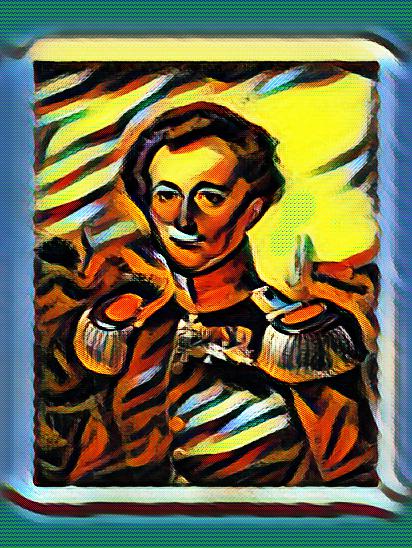
In today’s post, I will be looking at Clausewitz’s concept of “friction”. Carl von Clausewitz (1780-1831) was a Prussian general and military philosopher. Clausewitz is considered to be one of the best classical strategy thinkers and is well known for his unfinished work, “On War.” The book was published posthumously by his wife Marie von Brühl in 1832.

War is never a pleasant business and it takes a terrible toll on people. The accumulated effect of factors, such as danger, physical exertion, intelligence or lack thereof, and influence of environment and weather, all depending on chance and probability, are the factors that distinguish real war from war on paper. Friction, Clausewitz noted, was what separated war in reality from war on paper. Friction, as the name implies, hindered proper and smooth execution of strategy and clouded the rational thinking of agents. He wrote:

War is the realm of uncertainty; three quarters of the factors on which action in war is based are wrapped in a fog of greater or lesser uncertainty.

Everything in war is very simple, but the simplest thing is difficult. The difficulties accumulate and end by producing a kind of friction that is inconceivable unless one has experienced war.

Friction is the only conception which, in a general way, corresponds to that which distinguishes real war from war on paper. The military machine, the army and all belonging to it, is in fact simple; and appears, on this account, easy to manage. But let us reflect that no part of it is in one piece, that it is composed entirely of individuals, each of which keeps up its own friction in all directions.

Clausewitz viewed friction as impeding our rational abilities to make decisions. He cleverly stated, “the light of reason is refracted in a manner quite different from that which is normal in academic speculation… the ordinary man can never achieve a state of perfect unconcern in which his mind can work with normal flexibility.” In a tense situation, as most often the case is in combat, the “freshness” or usefulness of the available information is quickly decaying and reliability of the information is also in question.

Friction is what happens when reality differs from your model. Although Clausewitz’s concept of friction contains other elements, I am interested in is the friction coming from ambiguous information. Uncertainty and information are related to each other. In fact, one is the absence of the other. The only way to reduce uncertainty (be certain) is to have the required information that counters the uncertainty. To quote Wikipedia, Uncertainty refers to epistemic situations involving imperfect or unknown information. If we have full information then we don’t have uncertainty. It’s a zero-sum game.

We have two options to deal with the uncertainty due to informational friction:

  1. Reduce uncertainty by making useful information readily available to required agents when needed and where needed
  2. Come up with ways to tolerate uncertainty when we are not able to reduce it further.

As Moshe Rubinstein points out in his wonderful book, Tools for Thinking and Problem Solving, uncertainty is reduced only by acquisition of information and you need to ask three questions, in the order specified, when acquiring information.

  1. Is the information relevant? (is it current, and is the context applicable?)
  2. Is the information credible? (is it accurate?)
  3. Is the information worth the cost?

How should we proceed to minimize the friction?

  1. We should try to get the total picture, an understanding of the forest before we get lost in the trees. This helps us in realizing where our epistemic boundaries might be, and where we need to improve our learning.
  2. We should have the courage to ask questions and cast doubts on our world views. Even with our belief system, we can ask whether it is relevant and credible. We should try to ask – what is wrong with this picture? What am I missing?
  3. We should always keep on learning. We should not shy away from “hard projects.” We should see the challenges as learning experiences.
  4. We should know and be ready to have our plan fail. We should understand what the “levers” are in our plan. What happens when we push on one lever versus pulling on another? We should have models with the understanding that they are not perfect but they help us understand things better. We should rely on heuristics and flexible rules of thumbs. They are more flexible when things go wrong.
  5. We should reframe our understanding from a different perspective. We can try to draw things out or write about it or even talk about it to your spouse or family. Different viewpoints should be welcomed. We should generate multiple analogies and stories to help tell our side of the story. These will only help in further our understanding.
  6. When we make decisions under uncertainty and risk, each action can result in multiple outcomes, and most of the times, these are unpredictable and can have large-scale consequences. We should engage in fast and safe-to-fail experiments and have strong feedback loops to change course and adapt as needed.
  7. We should have stable substructures when things fail. This allows us to go back to a previous “safe point” rather than go back all the way to the start.
  8. We should go to gemba to grasp the actual conditions and understand the context. Our ability to solve a problem is inversely proportional to the distance from the gemba.
  9. We should take time, as permissible, to detail out our plan, but we should be ready to implement it fast. Plan like a tortoise and run like a hare.
  10. We should go to the top to take a wide perspective, and then come down to have boots on ground. We should take time to reflect on what went wrong and what went right, and what our impact was on ourselves and others. This is the spirit of Hansei in Toyota Production System.

Final Words:

Although not all of us are engaged in a war at the gemba, we can learn from Clausewitz about the friction from uncertainty, which impedes us on a daily basis. Clausewitz first used the term “friction” in a letter he wrote to his future wife, Marie von Brühl, in 1806. He described friction as the effect that reality has on ideas and intentions in war. Clausewitz was a man ahead of his time, and from his works we can see elements of systems thinking and complexity science.

We propose to consider first the single elements of our subject, then each branch or part, and, last of all, the whole, in all its relations—therefore to advance from the simple to the complex. But it is necessary for us to commence with a glance at the nature of the whole, because it is particularly necessary that in the consideration of any of the parts the whole should be kept constantly in view. The parts can only be studied in the context of the whole, as a “gestalt.

Clausewitz realized that each war is unique and thus what may have worked in the past may not work this time. He said:

Further, every war is rich in particular facts; while, at the same time, each is an unexplored sea, full of rocks, which the general may have a suspicion of, but which he has never seen with his eye, and round which, moreover, he must steer in the night. If a contrary wind also springs up, that is, if any great accidental event declares itself adverse to him, then the most consummate skill, presence of mind and energy, are required; whilst to those who only look on from a distance, all seems to proceed with the utmost ease.

Clausewitz encourages us to get out of our comfort zone, and gain as much variety of experience as we can. The variety of states in the environment always is larger than the variety of states we can hold. He continues to advise the following to reduce the impact of friction:

The knowledge of this friction is a chief part of that so often talked of, experience in war, which is required in a good general. Certainly, he is not the best general in whose mind it assumes the greatest dimensions, who is the most overawed by it (this includes that class of over-anxious generals, of whom there are so many amongst the experienced); but a general must be aware of it that he may overcome it, where that is possible; and that he may not expect a degree of precision in results which is impossible on account of this very friction. Besides, it can never be learnt theoretically; and if it could, there would still be wanting that experience of judgment which is called tact, and which is always more necessary in a field full of innumerable small and diversified objects, than in great and decisive cases, when one’s own judgment may be aided by consultation with others. Just as the man of the world, through tact of judgment which has become habit, speaks, acts, and moves only as suits the occasion, so the officer, experienced in war, will always, in great and small matters, at every pulsation of war as we may say, decide and determine suitably to the occasion. Through this experience and practice, the idea comes to his mind of itself, that so and so will not suit. And thus, he will not easily place himself in a position by which he is compromised, which, if it often occurs in war, shakes all the foundations of confidence, and becomes extremely dangerous.

US President Dwight Eisenhower said, “In preparing for battle I have always found that plans are useless, but planning is indispensable.” The act of planning helps us to conceptualize our future state. We should strive to minimize the internal friction, and we should be open to keep learning, experimenting, and adapting as needed to reach our future state. We should keep on keeping on:

“Perseverance in the chosen course is the essential counter-weight, provided that no compelling reasons intervene to the contrary. Moreover, there is hardly a worthwhile enterprise in war whose execution does not call for infinite effort, trouble, and privation; and as man under pressure tends to give in to physical and intellectual weakness, only great strength of will can lead to the objective. It is steadfastness that will earn the admiration of the world and of posterity.”

Always keep on learning…

In case you missed it, my last post was Exploring The Ashby Space:

Nietzsche’s Overman at the Gemba:

Overman

In today’s post, I am looking at Nietzsche’s philosophy of Übermensch. Friedrich Wilhelm Nietzsche is probably one of the most misunderstood and misquoted philosophers. The idea of Übermensch is sometimes mistranslated as Superman. A better translation is “Overman”. The German term “mensch” means “human being” and is gender neutral. Nietzsche spoke about overman first in his book, “Thus Spoke Zarathustra.” In the prologue of this book, Nietzsche through Zarathustra asks:

I teach you the overman. Man is something that shall be overcome. What have you done to overcome him?

Nietzsche provides further clarification that, “Man is a rope, fastened between animal and Übermensch – a rope over an abyss.Übermensch is an idea that represents a being who has overcome himself and his human nature – one who can break away from the bondage of ideals and create new ones in place of the old stale ones.

Nietzsche came to the conclusion that humanity was getting stale by maintaining status quo through adhering to ideals based in the past. He also realized that the developments in science and technology, and the increase in collective intelligence was disrupting the “old” dogmatic ideals and the end result was going to be nihilism – a post-modern view that life is without meaning or purpose. Nietzsche famously exclaimed that; God is dead! He was not rejoicing in that epiphany. Nietzsche proposed the idea of Übermensch as a solution to this nihilistic crisis. Übermensch is not based on a divine realm. Instead Übermensch is a higher form on Earth. Overcoming the status quo and internal struggles with the ideals is how we can live our full potential in this earth and be Übermensch.

Nietzsche contrasted Übermensch with “Last Man”. The last man embraces status quo and lives in his/her comfort zone. The last man stays away from any struggle, internal or external. The last man goes with the flow as part of a herd. The last man never progresses, but stays where he is, clutching to the past.

Nietzsche used the metaphors of the camel, the lion and the child to detail the progress towards becoming an Übermensch. As the camel, we should seek out struggle, to gain knowledge and wisdom through experience. We should practice self-discipline and accept more duties to improve ourselves. As the lion, we should seek our independence from the ideals and dogmas. Nietzsche spoke of tackling the “Thou Shalt” dragon as the lion. The dragon has a thousand scales with the notation, “thou shalt”. Each scale represents a command, telling us to do something or not do something. As the lion, we should strongly say, “No.” Finally, as the child, we are free. Free to create a new reality and new values.

At the Gemba:

Several thoughts related to Übermensch  and Lean came to my mind. Toyota teaches us that we should always strive toward True North, our ideal state. We are never there, but we should always continue to improve and move towards True North. Complacency/the push to maintain status quo is the opposite of kaizen, as I noted in an earlier post.

I am reminded of a press article about Fujio Cho. In 2002, when Fujio Cho was the President of Toyota Motor Corporation, Toyota became the third largest automaker in the world and had 10.2% of share of world market. Cho unveiled a plan to be world’s largest automaker with 15% global market share. Akio Matsubara, Toyota’s managing director in charge of the corporate planning division, stated:

“The figure of 15 percent is a vision, not a target,” he said. “Now that we’ve achieved 10 percent, we want to bring 15 percent into view as our next dream. We don’t see any significance in becoming No. 1.”

The point of the 15 percent figure, he said, is to motivate Toyota employees to embrace changes to improve so they would not become complacent with the company’s success.

My favorite part of the article was Morgan Stanley Japan Ltd. auto analyst Noriaki Hirakata’s remarks about Fujio Cho. Toyota’s executives, he said, believe Toyota is “the best in the world, but they don’t want to be satisfied.”

It’s as if Cho’s motto has become “Beat Toyota,” Hirakata said.

I am also reminded of a story that the famous American Systems Thinker, Russel Ackoff shared. In 1951, he went to Bell Labs in Murray Hill, New Jersey, as a consultant. While he was there, all the managers were summoned to an impromptu urgent meeting by the Vice President of Bell Labs. Nobody was sure what was going on. Everyone gathered in a room anxious to hear what the meeting was about. The Vice President walked in about 10 minutes late and looked very upset. He walked up to the podium and everyone became silent. The Vice President announced:

“Gentlemen, the telephone system of the United States was destroyed last night.”

He waited as everyone started talking and whispering that it was not true. The Vice President continued:

“The telephone system was destroyed last night and you had better believe it. If you don’t by noon, you are fired.”

The room was silent again. The Vice President then started out laughing, and everyone relaxed.

“What was that all about? Well, in the last issue of the Scientific American,” he said, “there was an article that said that these laboratories are the best industrially based scientific laboratories in the world. I agreed, but it got me thinking.”

The Vice President went to on to state that all of the notable inventions that Bell Lab had were invented prior to 1900. This included the dial, multiplexing, and coaxial cable. All these inventions were made prior to when any of the attendees were born. The Vice President pointed out that they were being complacent. They were treating the parts separately and not improving the system as a whole. His solution to the complacency? He challenged the team to assume that the telephone system was destroyed last night, and that they were going to reinvent and rebuilt it from scratch! One of the results of this was the push button style phones that reduced the time needed to dial a number by 12 seconds. This story reminds me of breaking down the existing ideals and challenging the currently held assumptions.

Nietzsche challenges us to overcome the routine monotonous ideas and beliefs. Instead of simply existing, going from one day to the next, we should challenge ourselves to be courageous and overcome our current selves. This includes destruction and construction of ideals and beliefs. We should be courageous to accept the internal struggle, when we go outside our comfort zone. The path to our better selves is not inside the comfort zone.

Similar to what Toyota did by challenging the prevalent mass production system and inventing a new style of production system, we should also challenge the currently held belief system. We should continue evolving toward our better selves. As Nietzsche said:

What is great in man is that he is a bridge and not an end.

I say unto you: One must still have chaos in oneself to be able to give birth to a dancing star.

Always keep on learning…

In case you missed it, my last post was Solving a Lean Problem versus a Six Sigma Problem:

Solving a Lean Problem versus a Six Sigma Problem:

Model

I must confess upfront that the title of this post is misleading. Similar to the Spoon Boy in the movie, The Matrix, I will say – There is no Lean problem nor a Six Sigma problem. All these problems are our mental constructs of a perceived phenomenon. A problem statement is a model of the actual phenomenon that we believe is the problem. The problem statement is never the problem! It is a representation of the problem. We form the problem statement based on our vantage point, our mental models and biases. Such a constructed problem statement is thus incomplete and sometimes incorrect. We do not always ask for the problem statement to be reframed from the stakeholder’s viewpoint. A problem statement is an abstraction based on our understanding. Its usefulness lies in the abstraction. A good abstraction ignores and omits unwanted details, while a poor abstraction retains them or worse omits valid details. Our own cognitive background hinders our ability to frame the true nature of the problem. To give a good analogy, a problem statement is like choosing a cake slice. The cake slice represents the cake, however, you picked the slice you wanted, and you still left a large portion of the cake on the table, and nobody wants your slice once you have taken a bite out of it.

When we have to solve a problem, it puts tremendous cognitive stress on us. Our first instinct is to use what we know and what we feel comfortable with. Both Lean and Six Sigma use a structured framework that we feel might suit the purpose. However, depending upon what type of “problem” we are trying to solve, these frameworks may lack the variety they need to “solve” the problem. I have the used the quotation marks on purpose. For example, Six sigma relies on a strong cause-effect relationship, and are quite useful to address a simple or complicated problem. A simple problem is a problem where the cause-effect relationship is obvious, whereas a complicated problem may require an expert’s perspective and experience to analyze and understand the cause-effect relationship. However, when you are dealing with a complex problem, which is non-linear, the cause-effect relationship is not entirely evident, and the use of a hard-structured framework like Six sigma can actually cause more harm than benefit. All human-centered “systems” are complex systems. In fact, some might say that such systems do not even exist. To quote Peter Checkland, In a certain sense, human activity systems do not exist, only perceptions of them exist, perceptions which are associated with specific worldviews.

We all want and ask for simple solutions. However, simple solutions do not work for complex problems. The solutions must match the variety of the problem that is being resolved. This can sometimes be confusing since the complex problems may have some aspects that are ordered which give the illusion of simplicity. Complex problems do not stay static. They evolve with time, and thus we should not assume that the problem we are trying to address still has the same characteristics when they were identified.

How should one go from here to tackle complex problems?

  • Take time to understand the context. In the complex domain, context is the key. We need to take our time and have due diligence to understand the context. We should slow down to feel our way through the landscape in the complex domain. We should break our existing frameworks and create new ones.
  • Embrace diversity. Complex problems require multidisciplinary solutions. We need multiple perspectives and worldviews to improve our general comprehension of the problem. This also calls to challenge our assumptions. We should make our assumptions and agendas as explicit as possible. The different perspective allows for synthesizing a better understanding.
  • Similar to the second suggestion, learn from fields of study different from yours. Learn philosophy. Other fields give you additional variety that might come in handy.
  • Understand that our version of the problem statement is lacking, but still could be useful. It helps us to understand the problem better.
  • There is no one right answer to complex problems. Most solutions are good-enough for now. What worked yesterday may not work today since complex problems are dynamic.
  • Gain consensus and use scaffolding while working on the problem structure. Scaffolding are temporary structures that are removed once the actual construction is complete. Gaining consensus early on helps in aligning everybody.
  • Go to the source to gain a truer understanding. Genchi Genbutsu.
  • Have the stakeholders reframe the problem statement in their own words, and look for contradictions. Allow for further synthesis to resolve contradictions. The tension arising from the contradictions sometimes lead us to improving and refining our mental models.
  • Aim for common good and don’t pursue personal gains while tackling complex problems.
  • Establish communication lines and pay attention to feedback. Allow for local context while interpreting any new information.

Final Words:

I have written similar posts before. I invite the reader to check them out:

Lean, Six Sigma, Theory of Constraints and the Mountain

Herd Structures in ‘The Walking Dead’ – CAS Lessons

A successful framework relies on a mechanism of feedback-induced iteration and keenness to learn. The iteration function is imperative because the problem structure itself is often incomplete and inadequate. We should resist the urge to solve a Six Sigma or a Lean problem. I will finish with a great paraphrased quote from the Systems Thinker, Michael Jackson (not the famous singer):

To deal with a significant problem, you have to analyze and structure it. This means, analyzing and structuring the problem itself, not the system that will solve it. Too often we push the problem into the background because we are in a hurry to proceed to a solution. If you read most texts thoughtfully, you will see that almost everything is about the solution; almost nothing is about the problem.

Always keep on learning…

In case you missed it, my last post was Maurice Merleau-Ponty’s Lean Lessons:

Maurice Merleau-Ponty’s Lean Lessons:

Merleau-Ponty

In today’s post, I am writing about three great Lean lessons inspired by the late French philosopher, Maurice Merleau-Ponty. Merleau-Ponty was a phenomenologist who believed that our conceptual framework is inherently flawed. He wanted to develop a framework that accurately reflected the nature of things it described. His insight was that we perceive things by interacting with them. The more we interact, the deeper our perception becomes, and the more we can enjoy the richness of the object we are interacting with. Merleau-Ponty believed that being in the world is the embodied experience of perception. The world does not present itself “all at once” to the perceiver. The perceiver has to go through an ongoing process of exploration and discovery and a deeper understanding emerges gradually through this ongoing process.

The three lessons I have chosen are interrelated and are about perception. Lean teaches us the importance of Genchi Genbutsu or Go to See and Grasp the Situation. The following three ideas align really well with the idea of Genchi Genbutsu.

  • The philosopher is a perpetual beginner…

Merleau-Ponty’s point here is that a true philosopher does not take things for granted. I will replace the word “philosopher” with “Lean leader”. Thus, the Lean leader is a perpetual beginner. As Lean leaders, we are ready to learn everyday from the gemba. We are continually improving our perception from the gemba. We must resist the urge to feel that we have completed our learning and that there is nothing left to learn. To paraphrase Merleau-Ponty, we need to learn to see the world (and gemba) as something new every single day. We must start to “see” with a beginner’s mind to learn.


  • In order to see the world, we must break with our familiar acceptance of it:

Our ability to observe depends on our preconceived notions and biases. Understanding of a phenomenon lies under the surface in the nuances and the contradictions. Our familiarity based on our prior biases cloud our ability to “see”, and Merleau-Ponty advises us to break our familiar acceptance in order to see the world. We must put aside our assumptions and relearn to see the world with fresh eyes.


  • Nothing is more difficult than to know precisely what we see:

This idea to me is simply wonderful. When we are at the Gemba to see or observe, we jump to conclusions. We believe that we “see” the problem and know how to fix it. The act of observing and perceiving requires a vantage point. This vantage point comes with prejudices. We believe that what we see is quite simple and straightforward, and that we have a clear perspective. This actually hinders our ability to know and understand the phenomenon we are perceiving. From a philosophy standpoint, we believe that what we perceive is reality. This of course is incomplete and most of the time a faulty notion.

Final Words:

The three ideas of Merleau-Ponty advises us to go to the Gemba more and interact with it to improve our understanding. We should look at the real workplace with the eyes of a beginner, and keep interacting with an open mind without preconceived notions to learn. We should resist the urge to believe that we know precisely what we see.

Taiichi Ohno was famous for his Ohno circles. Taiichi Ohno drew chalk circles and made the supervisor or the engineer stand in the circle to observe an operation until he was able to “see” the waste that Ohno saw. Similar to Merleau-Ponty, Ohno also advises us to go and see without preconceived notions. Go and see a lot. This helps us to improve our perception. The more we do it, the better we get at it. And yet, we should strive to remain a perpetual beginner.

Always keep on learning…

In case you missed it, my last post was Toyota Physics:

Chekhov’s Gun at the Gemba:

chekhov

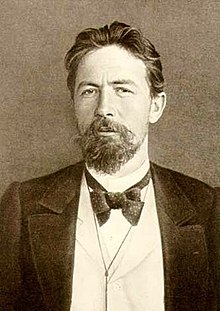
One of my favorite things to do when I learn a new and interesting information is to apply it into a different area to see if I can gain further insight. In today’s post, I am looking at Chekhov’s gun, named after the famous Russian author, Anton Chekhov (1860-1904), and how it relates to gemba. Anton Chekhov is regarded as a master short story writer. In the short story genre, there is a limited amount of resources to tell your story. Chekhov’s gun is a principle that states that everything should have a purpose. Checkhov said:

Remove everything that has no relevance to the story. If you say in the first chapter that there is a rifle hanging on the wall, in the second or third chapter it absolutely must go off. If it’s not going to be fired, it shouldn’t be hanging there.

Chekhov also stated:

“One must never place a loaded rifle on the stage if it isn’t going to go off. It’s wrong to make promises you don’t mean to keep.” [From Chekhov’s letter to Aleksandr Semenovich Lazarev in 1889]. Here the “gun” is a monologue that Chekhov deemed superfluous and unrelated to the rest of the play.

“If in the first act you have hung a pistol on the wall, then in the following one it should be fired. Otherwise don’t put it there.” [From Gurlyand’s Reminiscences of A. P. Chekhov, in Teatr i iskusstvo 1904, No. 28, 11 July, p. 521]. Source: Wikipedia.

How does this relate to Gemba? Gemba is the actual place where you do your work. When you design the work station with the operator, you need to make sure that everything has a place and everything has a purpose. Do not introduce an item to the station that has no need to be there. Do not introduce a step or an action that does not add value. This idea also applies to the Motion Economy. Let’s look at some of the Industrial Engineering maxims from the Principles of Motion Economy that are akin to Chekhov’s gun:

  • There should be a definite and fixed place for all tools and materials.
  • Tools, materials, and controls should be located closely in and directly in front of the operator.
  • Materials and tools should be located to permit the best sequence of motions.
  • Two or more jobs should be worked upon at the same time or two or more operations should be carried out on a job simultaneously if possible.
  • Number of motions involved in completing a job should be minimized.

Chekhov’s gun is not necessarily talking about foreshadowing in a movie or a book. A gun should not be shown on the wall as a decoration. It needs to come into the story at some point to be value adding. The author should make use of every piece introduced into the story. Everything else can be removed. I loved this aspect of Chekhov’s gun. In many ways, as a lean practitioner, we are also doing the same. We are looking at an operation or a process, and we are trying to eliminate the unwanted steps/items/motions. When you work in a strictly regulated industry such as medical devices, the point about line clearance also comes up when you ponder about Chekhov’s gun. Line clearance refers to removal of materials, documentation, equipment etc. from the previous shop order/work order to prevent any inadvertent mix-ups that can be quite detrimental to the end user. Only keep things that are necessary at the station.

I will finish with a great lesson from Anton Chekhov that is very pertinent to improvement activities.

Instructing in cures, therapists always recommend that “each case be individualized.” If this advice is followed, one becomes persuaded that those means recommended in textbooks as the best, means perfectly appropriate for the template case, turn out to be completely unsuitable in individual cases.

Always keep on learning…

In case you missed it, my last post was The Confirmation Paradox:

The Confirmation Paradox:

albino raven

In today’s post I will be looking at Confirmation Paradox or Black Raven Paradox by Carl Hempel. Let’s suppose that you have never seen a raven in your life. You came across a raven one fine morning, and observe that it is black in color. Now that you have seen one, you suddenly start paying more attention and you start seeing ravens everywhere. Each time you see a raven, you observe that its color is black. Being the good scientist that you are, you come to a hypothesis – All ravens are black. This is also called induction, coming to a generalization from many specific observations.

Now you would like to confirm your hypothesis. You ask your good friend, Carl Hempel, to help. Carl suggests that you start looking at things around his house that are not black and not raven, like his red couch, the yellow tennis ball etc. He suggests that each of those observations support your hypothesis that all ravens are black. You are rightfully puzzled by this. This is the confirmation paradox. Carl Hempel was a German born philosopher who later immigrated to America.

Carl Hempel is correct with this claim. Let’s look at this further. All ravens are black can be restated as “Whatever is not black is not a raven”. This is a logical equivalence of your hypothesis. This would mean that if you observe something that is not black and is not a raven, it would support your hypothesis. Thus, if you observe a red couch, it is not black and it is also not a raven, therefore it supports your hypothesis that all ravens are black.

How do we come in terms with this? Surely, it does not make sense that a red couch supports the hypothesis that all ravens are black. The first point to note here is that one can never prove a hypothesis via induction. Induction requires the statement to be provided with a level of confidence or certainty. This would mean that the level of “support” that each observation makes depends upon the type of information gained from that observation.

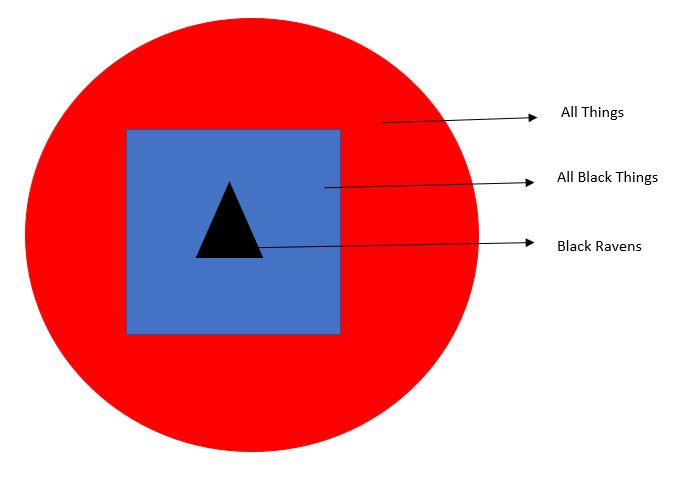
I will explain this further with the concept of information from Claude Shannon’s viewpoint. Information is all around us. Where ever you look, you can get information. Claude Shannon quantified this in terms of entropy with the unit as a bit. He described this as the amount of surprise or reduction of uncertainty. Information is inversely proportional to probability of an event. The less probable an event is, the more information it contains. Let’s look at the schematic below:

ravens

The black triangle represents all the black ravens in our observable universe. The blue square represents all of the black things in our observable universe. The red circle represents all the things in the observable universe. Thus, the set of black ravens is a subset of all black things, which in turn is a subset of all things. From a probability standpoint, the probability of observing a black raven is much smaller than the probability of observing a black thing since there are proportionally a lot more black things in existence. Similarly, the probability of observing a non-black thing is much higher since there are lot more non-black things in existence. Thus, from an information standpoint, the information you get from observing a non-black thing that is not a raven is very very small. Logically, this observation does provide additional support, however, the information content is miniscule. Please note that, on the other hand, observing a black raven is also supporting the statement that all non-raven things are non-black.

When you first saw a black raven, you had no idea about such a thing existing. The information content of that observation was high. After you started observing more ravens, the information you got from each observation started diminishing. Even if you made 10,000 observations of black ravens, you cannot prove (100% confirm) that all ravens are black. This is the curse of induction. This is where Karl Popper comes in. Karl Popper, an Austrian-British philosopher, had the brilliant insight that good hypotheses should be falsifiable. We should try to look for observations that would fail our hypothesis. His insight was in the asymmetry of falsifiability. You may have 100,000 observations supporting your hypothesis. All you need is a single observation to fail it. The most popular example for this is the case of the black swan. The belief that all swans are white was discredited when black swans were discovered in Australia. To come back to the information analogy, the observation of a white raven has lot more information content that is powerful enough to break down your hypothesis since the occurrence of a white raven(albino) is very low in nature. Finding a white raven is quite rare and thus have the most information or surprise.

This also brings up the concept of Total Evidence. The concept of Total Evidence was put forth by Rudolf Carnap, a German born philosopher. He stated that in the application of inductive logic to a given knowledge situation, the total evidence available must be taken as basis for determining the degree of confirmation. Let’s say that as we learned more about ravens and other birds, we came across the concept of albinism in other animals and birds. This should make us challenge our hypothesis since we know that albinism can occur in nature, and thus it is not farfetched that it can occur in ravens as well. The concept of Total Evidence is interesting because even though it has the term “Total” in it, it is beckoning us to realize that we cannot ever have total information. It is a reminder for us to consider all possibilities and to understand where our mental models break down. In theory, one could also make whimsical statements such as “All unicorns are rainbow colored”, and say that the observation of a white shoe supports it based on the confirmation paradox. Total evidence in this case would require us to have made at least one observation of a rainbow colored unicorn.

I will finish with another paradox that is similar to the confirmation paradox – the 99-foot (feet) man paradox by Paul Berent. Up to this point, we have been looking at qualitative data (black versus not black, or raven versus not raven). Let’s say that you have a hypothesis that says all men are less than 100 feet. You surveyed over 100,000 men and found all of them to be less than 100 feet. One day you heard about a new circus company coming to town. Their main attraction is a 99-foot man. You go to see him in person and sure enough, he is 99 feet tall. Now, your hypothesis is still intact since the 99-foot man is technically less than 100 feet. However, this adds doubt to your mind. You realize that if there is a 99-foot man, then the occurrence of a 100-foot man is not farfetched. The paradox occurs since the observation of a 99-foot man strengthens your hypothesis, but at the same time it also weakens it.

Always keep on learning…

In case you missed it, my last post was Know Your Edges:

A “Complex” View of Quality:

Q

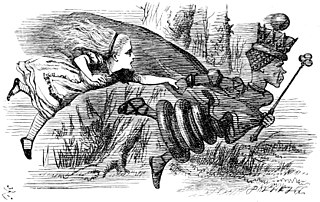
I am a Quality Manager by profession. Thus, I think about Quality a lot. How would one define “Quality”? A simple view of quality is – “conformance to requirements.” This simplistic view of quality lacks the complexity that it should have. This assumes that everything is static, the customer will always have the same requirements and will be happy if the specifications/requirements are met. Customer satisfaction is a complex thing. Customers are external to the plant manufacturing the widget. Thus, the plant will always lack the variety that the external world will impose on it. For example, lets look at a simple thing like a cellphone. Theoretically, the purpose of a cellphone used to be to allow the end user to make a phone call. Think of all the variety of requirements that the end user has for a cellphone these days – internet, camera, ability to play games, ability to use productivity apps, stopwatch, alarms, affordability etc. Additionally, the competition is always coming out with a newer, faster, and maybe cheaper cellphone. To paraphrase the red queen from Alice in Wonderland – the manufacturer has to do a lot of running to stay in the same place – to maintain the share of market.

320px-Alice_queen2

In this line of thinking, quality can be viewed as matching the complexity imposed by the consumer. There are two approaches in Quality that differs from the concept of just meeting the requirements.

1) Taguchi’s idea of quality:

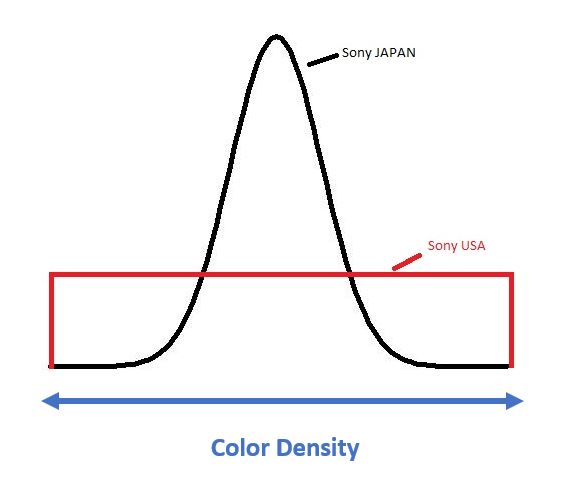
Genichi Taguchi, a Japanese engineer and statistician, came up with the idea of a “loss function”. The main idea behind this is that anytime a product deviates from the target specification, the customer experiences a loss function. Every product dimensional specification has a tolerance for manufacturability. When all of the dimensions are near the target specification, the loss function is minimal resulting in a better customer experience. One of the best examples to explain this is from Sony. The story goes that Sony had two television manufacturing facilities, one in Japan and one in the USA. Both facilities used the same design specifications for television. Interestingly, the televisions manufactured in the USA facility had a lower satisfaction rating than the televisions manufactured in Japan. It was later found that the difference was in how the two facilities approached quality for the color density. The paradigm that the USA facility had was that as long as the color density was within the range, the product was acceptable, whereas, the Japanese facility made a point to meet the nominal value for the color density. Thus, the Japanese Sony televisions were deemed superior to the American Sony televisions.

TV

2) Kano’s idea of quality:

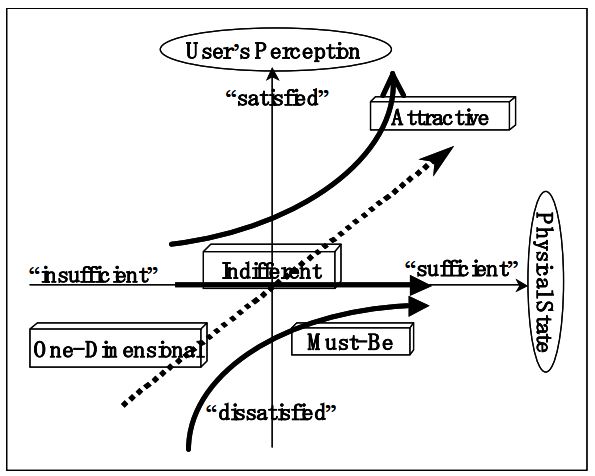
Noriaki Kano is another Japanese Quality Management pioneer who came up with the idea of the Kano model. The Kano model is a great way of looking at a characteristic from the point of the customer. The Kano model has two axes – customer satisfaction and feature implementation. The customer satisfaction goes from satisfied to dissatisfied, and the feature implementation goes from insufficient to sufficient. This two-dimensional arrangement leads to various categories of “quality” such as Attractive quality, One-dimensional quality, Must-be quality and Indifferent quality. Although there are more categories identified by Kano, I am looking at only the four categories identified above.

  • Attractive quality – this is something the customer would find attractive if it is present, and indifferent if it is absent. For example, let’s say that you went to get a car wash, and the store gave you free beverage and snack. You were not expecting this, and getting the free beverage and snack made the experience pleasant. If you were not aware of the free beverage and snack, you would not be dissatisfied because you were not expecting to get the free beverage and snack.
  • One-dimensional quality – this is something that customer would view on a one-dimension. If there is more of it, the customer is more happy, and if there is less of it, the customer is less happy. For example, let’s look at the speed of your internet connection at home. The faster the internet, the happier you are, and the slower the internet, the sadder you are.
  • Must-be quality – this is something that the customer views as an absolute must-have. If you go into a store to buy eggs, you expect the carton to have eggs in it. If the eggs are not there, you are not happy.
  • Indifferent – this is something that a particular customer truly does not care about. The example that Kano gives to explain this in his 2001 paper was the “I-mode” feature on some Japanese cellphones. This feature allowed the user to connect to the internet. When a survey was conducted, most of the middle-aged people viewed this feature indifferently. They could care less that the cellphone could be used to connect to the internet.

Kano

The brilliant insight from the Kano model is that the perception of quality is not linear or static. The perception of quality is non-linear and it evolves with time. Kano hypothesizes that a successful quality element goes through a lifecycle detailed below:

Indifferent => Attractive => One-Dimensional => Must-Be.

A feature that began as indifferent could become an attractive feature, which would then evolve into a one-dimensional feature and finally it becomes a must-be feature. Take for example, the ability to take pictures on your cellphone. This was treated indifferently at the beginning, and then it became an attractive feature. The better the resolution of the pictures taken, the happier you became. Finally, the ability to take sharp pictures became a must-have on your cellphone.

The customer is not always aware of what the attractive feature could be on a product. This is akin to what Ford said – “If I had asked people what they wanted, they would have said faster horses.” Steve Jobs added on to this and said – “People don’t know what they want until you show it to them. That’s why I never rely on market research. Our task is to read things that are not yet on the page.”

Kano had a brilliant insight regarding this as well. In the 2001 paper, “Life Cycle and Creation of Attractive Quality”, he gave the Konica model. Kano talked about the camera that Konica came out with in the 1970s that had built-in flash and the capability to auto focus. At that time, the camera was treated as a mature product and to survive the competition Konica decided to come up with a new camera. Konica engaged in a large survey with the customers with the expectation of coming out with a completely new camera. The R&D team was disappointed with the survey results which only suggested minor changes to the existing designs. The team decided to visit a photo processing lab to examine the prints and negative films taken by consumers and to evaluate the quality of prints and developed films. This is the spirit of genchi genbutsu in lean (go and see to grasp the situation). The team learned that the two main issues the users had were to do with underexposures due to lack of flash and out-of-focus.

Kano notes that:

To solve these problems, Konica developed and released cameras with auto focus and a built-in flash as well as auto film loading and winding functions from the middle to the end of 1970s. This prompted consumers to buy a second and even a third camera. Thereafter, Konica’s business considerably grew and completely changed the history of camera development in the world.

As long as customers are around, quality should be viewed as non-linear, complex and evolving.

Always keep on learning…

In case you missed it, my last post was Lessons from Genkan:

Kufu Eyes:

Huike_thinking-big-569924185f9b58eba49ede26

I came across an interesting phrase recently. I was reading Kozo Saito’s paper, “Hitozukuri and Monozukuri”, and I saw the phrase “kufu eyes”. Kufu is a Japanese word that means “to seek a way out of a dilemma.” This is very well explained in K. T. Suzuki’s wonderful book, “Zen and Japaense Culture.” Suzuki talks about kufu in three sections of the book, and each time he adds a little more detail.

“Kufu is not just thinking with the head, but the state when the whole body is involved and applied to the solving of a problem.”

 “Kufu means ‘employing oneself assiduously to discover the way to the objective.’ One may say that this is literally groping in the dark, there is nothing definite indicated… I am afraid this is as far as any master of Zen or swordsmanship can go with his disciples. He leads them until no more leading is possible, and the rest is left to their own devices. If it is a matter of intellection, the way to the goal may be ‘definitely’ prescribed… The students must resort to something very much deeper than mere intellection – something which they cannot obtain from another.”

‘‘The term kufu is the most significant word used in connection with Zen and also in the fields of mental and spiritual discipline. Generally, it means ‘to seek the way out of a dilemma’ or ‘to struggle to pass through a blind alley.’ A dilemma or a blind alley may sound somewhat intellectual, but the fact is that this is where the intellect can go no further, having come to its limit, but an inner urge still pushes one somehow to go beyond. As the intellect is powerless, we may enlist the aid of the will; but mere will, however pressing, is unable to break through the impasse. The will is closer to fundamentals than the intellect, but it is still on the surface of consciousness. One must go deeper yet, but how? This how is kufu. No teaching, no help from the outside is of any use. The solution must come from the most inner part of oneself. One must keep knocking at the door until all that makes one feel an individual being crumbles away. That is, when the ego finally surrenders itself, it finds itself. Here is a newborn baby. Kufu is a sort of spiritual birth pang. The whole being is involved. There are physicians and psychologists who offer a synthetic medicinal substance to relieve one of this pang. But we must remember that, while man is partially mechanistic or biochemical, this does not by any means exhaust his being; he still retains something that can never be reached by medicine. This is where his spirituality lies, and it is kufu that finally wakes us to our spirituality.’’

In his paper, Saito talked about kufu eyes to explain the process of having a curious scientific mind. Kufu eyes looks at the whole and uses personal intuition than just the analytical thinking process. Kufu eyes pushes you to think further perhaps through thought experiments, and to experiment to truly understand the whole picture. One interesting note I would like to make here is of the great American philosopher Dan Dennett’s “intuition pumps.” An intuition pump is a thought experiment structured to allow the thinker to use their intuition to develop an answer to a problem. Just like a mechanical device, if you can model your thought in a thought experiment, you can push on different buttons and pull on different levers and see what happens.

With kufu eyes, you can observe to gain insight. Siato talked about Taiichi Ohno, the father of Toyota Production System, to explain the concept of kufu eyes further:

… learning engineering and science is not enough. There is a third element: professional intuition, probably the most important, yet most difficult to master, but required for the engineering problem solving process. Taichi Ohno, one of the pioneers who developed Toyota Production System, once declared that the essence of TPS is to develop the well trained ‘‘eyes’’ that can see waste which is invisible to the untrained.

Taiichi Ohno took the task of catching up to the American market when the Japanese worker was assumed to be only 1/8th productive as his American counterpart. The most recent development in manufacturing at that time was the idea of mass manufacturing, which is essentially a push system that led to lots of inventory. Toyota could not afford to carry a lot of inventory. The thinking in those days was to combine similar equipment together and perform operations in isolation. Ohno rearranged the entire layout of the plant he was in charge of, so that the equipment was set to follow the process. The practice at that time was to have one operator manning one piece of equipment. Ohno had one operator man multiple equipment at a time. This led to autonomation or Jidoka. To control the amount of parts produced, Ohno came up with the idea of Kanban. Looking back, Ohno definitely had to employ himself assiduously to discover the way to his objective. He could not just rely on his analytical mind, it was more complex than that. His thinking is clearly stated when he said that efficiency must be improved at every step and at the same time, for the plant as a whole. This is the big picture view that is needed in kufu.

Saito combines the different ideas of total-unit, dedication to the team, holistic view, dialectic approach, and nonlinear thinking to explain kufu. Logic and words have limits. I am inspired by the phrase “kufu eyes”. To me, it means looking outward and inward, looking at the big picture, thinking inside and outside of the “box”, and always pushing to go to the edge of a problem. It means to look with the determination to gain insight. It also means to not fall for status-quo, and to always improve. It also means to go slow but deliberately. It means to not stop until you have solved the problem. And at the same not stop there but keep on improving. This is further explained by Suzuki.

This may be difficult , but when you go on exercising kufu toward the subject, you will after some time come to find this state of mind exercising kufu toward the subject, you will after some time come to find this state of mind actualized without noticing each step of progress. Nothing, however, can be accomplished hurriedly.

I will stop with a wonderful lesson from Suzuki’s book:

When we tie a cat, being afraid of its catching a bird, it keeps on struggling for freedom. But train the cat so that it would not mind the presence of a bird. The animal is now free and can go anywhere it likes. In a similar way, when the mind is tied up, it feels inhibited in every move it makes, and nothing will be accomplished with any sense of spontaneity.  Not only that, the work itself will be of a poor quality, or it may not be finished at all.

Always keep on learning…

In case you missed it, my last post was Hitozukuri:

Distrust Simplicity:

whitehead_painting

In today’s post, I will be looking at the famous quote from the famous English mathematician and philosopher, Alfred Whitehead.

Seek simplicity, and then distrust it.

This quote comes from his 1920 collection of lectures, The Concept of Nature. The quote is embedded in the paragraph below:

Nature appears as a complex system whose factors are dimly discerned by us. But, as I ask you, Is not this the very truth? Should we not distrust the jaunty assurance with which every age prides itself that it at last has hit upon the ultimate concepts in which all that happens can be formulated? The aim of science is to seek the simplest explanations of complex facts. We are apt to fall into the error of thinking that the facts are simple because simplicity is the goal of our quest. The guiding motto in the life of every natural philosopher should be, Seek simplicity and distrust it.

I like this idea a lot. We are all asked to keep things simple, and to not make things complicated. Whitehead is asking us to seek simplicity first, and then distrust it. Whitehead talks about “bifurcation of nature” – nature as we perceive it, and the nature as it is. Thus, our perception of reality is an abstraction or a simplification based on our perceptions. We need this abstraction to start understanding nature. However, once we start this understanding process, we should not stop. We should build upon it. This is the scientific method – plan the prototype, build it, assess the gap, and continue improving based on feedback.

As I was reading The Concept of Nature, several other concepts came to my mind. The first one was Occam’s razor – the idea that Entities should not be multiplied unnecessarily. Seek the simplest explanation, when all things are equal. At the same time, we should keep Epicurus’ Principle of Multiple Explanations in mind – If more than one theory is consistent with the observations, keep all theories. I also feel that Whitehead was talking about systems and complexity. As complexity increases, our ability to fully understand the numerous relationships decreases. As the wonderful American Systems thinker Donella Meadows said:

We can’t impose our will on a system. We can listen to what the system tells us and discover how its properties and our values can work together to bring forth something much better than could ever be produced by our will alone.

Seeking simplicity is about the attempt to have a starting point to understand complexity. We should continue to evolve our understanding and not stop at the first abstraction we developed. One of the famous Zen story is about the teacher pointing his finger at the moon. I have talked about this here. We should not look at the finger and stop there. We should look at where the finger is pointing. The finger is the road sign and not the destination itself. The simplicity is a representation and not the real thing. We should immediately distrust it because it is a weak copy. Seeking simplicity is not a bad thing but stopping there is. Simplicity is our comfort zone, and Whitehead is asking us to distrust it so that can keep improving our situation – continuous improvement. Whitehead in his later 1929 book, The Function of Reason, states:

The higher forms of life are actively engaged in modifying their environment… (to) (i) to live, (ii) to live well, (iii) to live better.

Final Words:

In seeking simplicity, we are trying to be “less wrong”. In distrusting our simplified abstraction, we are seeking to be “more right”. I will finish with a Zen story.

A Zen master lay dying. His monks had all gathered around his bed, from the most senior to the most novice monk. The senior monk leaned over to ask the dying master if he had any final words of advice for his monks.

The old master slowly opened his eyes and in a weak voice whispered, “Tell them Truth is like a river.”

The senior monk passed on this bit of wisdom in turn to the monk next to him, and it circulated around the room from one monk to another.

When the words reached the youngest monk he asked, “What does he mean, ‘Truth is like a river?’”

The question was passed back around the room to the senior monk who leaned over the bed and asked, “Master, what do you mean, ‘Truth is like a river?’” Slowly the master opened his eyes and in a weak voice whispered, “OK, truth is not like a river.”

Always keep on learning…

In case you missed it, my last post was Cannon’s Polarity Principle: