The Truths of Complexity:

The Covid 19 pandemic has given me an opportunity to observe, meditate and learn about complexity in action. In today’s post, I am looking at “truths” in complexity. Humans, more than any other species, have the ability to change their environment at a faster pace. They are also able to maintain belief systems over time and act on them autonomously. These are good reasons to call all “human systems” complex systems.

The Theories of Truth:

Generally, there are three theories of truth in philosophy. They are as follows:

  1. Correspondence theory of truth – very simply put, this means that what you have internally in your mind corresponds one-to-one with the external world. The statement you might make such as – “the cat is on the mat” is true, if there are truly a cat and a mat, and if that cat is on that mat. The main objection to this theory is that we don’t have access to have an objective reality. What we have is a sensemaking organ, our brain, that is trying to make sense based on the data provided by the various sensory organs. The brain over time generates stable correlations which allows it to abstract meanings from the filtered information from the sensory data. The correspondence theory is viewed as a “static” picture of truth, and fails to explain the dynamic and complex nature of reality.
  2. Coherence theory of truth – In this approach, a statement is true if it is coherent with the different specified set of beliefs and propositions. Here the idea is more about a fit and harmony with existing beliefs. The coherence theory is about consistency. An objection to this theory is that the subjective nature of a statement can “bend” to match the existing strong belief systems. Perhaps, a good example of this is the recent poll that found that the majority of democrats fear that the worst is yet to come for the Covid 19 pandemic, while the majority of republicans believe that the worst is over. Another criticism against this is that we can be inconsistent in our beliefs as indicated by cognitive dissonance.
  3. Pragmatic Theory of truth – The pragmatic theory of truth was put forth as an alternative to the static correspondence theory of truth. In this theory, the value of truth is dependent on the utility it brings. Pragmatic theories of truth have the effect of shifting attention away from what makes a statement true and toward what people mean or do in describing a statement as true. As one of the proponents of Pragmatic theory, William James, put it – True beliefs are useful and dependable in ways that false beliefs are not:‘You can say of it then either that “it is useful because it is true” or that “it is true because it is useful”. Both these phrases mean exactly the same thing.’ One of my favorite explanations of pragmatic theory comes from Richard Rorty, who viewed it as coping with reality, rather than copying reality. One of the criticisms against the pragmatic theory of truth is how it explains truth in terms of utility. As John Capps notes, utility, long-term durability, and assertibility (etc.) should be viewed not as definitions but rather as criteria of truth, as yardsticks for distinguishing true beliefs from false ones.

Sensemaking Complexity:

From the discussion of truth, we can see that seeking truth is not an easy task, especially when we deal with complexity of human systems. Our natural tendency is to find order as pleasing and reassuring. We try to find order in all we can, and we try our best to maintain order as long as we can. In this attempt, we often neglect the actual complexity we are dealing with. A common way to distinguish complexity of a phenomenon is – ordered, complicated or complex. We can say a square peg in a square hole is an ordered phenomenon. The correspondence theory of truth is quite apt here because we have a one to one relationship. We have a very good working knowledge of cause and effect. As complexity increases, we get to complicated phenomenon where there is still somewhat a good cause and effect relationship. A car can be viewed as a complicated phenomenon. The correspondence theory is still apt here. Once we add a human to the mix, we get to complexity. Imagine the driver of a car. Now imagine thousands of drivers all at once. The correspondence theory of truth falls apart fast here.

The main source of complexity in the example discussed above comes from humans. We are autonomous, and we are able to justify our own actions. We may go faster than the speed limit because we are already late for the appointment. We may overtake on the wrong side because the other driver is driving slowly. We assign meanings and we also assign purposes for others. We do not always realize that other humans also have the same power.

We have seen varying responses and behavior in this pandemic. We have seen the different justifications and hypotheses. We agree with some of them and strongly disagree with others depending on how they cohere with our own belief systems. The actual transmission of the virus is fairly constrained. It transmits mainly from person to person. The transmission occurs mainly through respiratory droplets. Every human interaction carries some risk of becoming infected if the other person is a carrier of the virus. However, the actual course of the pandemic has been complex.

Philosophical Insights to Sensemaking Complexity:

I will use the ideas of Friedrich Nietzsche and William. V.O. Quine to further look at truth and how we come to know about truth. Nietzsche had a multidimensional view of truth. He viewed truth as:

A mobile army of metaphors, metonyms, and anthropomorphisms—in short, a sum of human relations which have been enhanced, transposed, and embellished poetically and rhetorically, and which after long use seem firm, canonical, and obligatory to a people: truths are illusions about which one has forgotten that this is what they are; metaphors which are worn out and without sensuous power; coins which have lost their pictures and now matter only as metal, no longer as coins.

He emphasized on the abstract nature of truth. One comes to view the abstractions/metaphors as stand in for reality, and eventually falsely equate them to reality.

Every word immediately becomes a concept, in as much as it is not intended to serve as a reminder of the unique and wholly individualized original experience to which it owes its birth, but must at the same time fit innumerable, more or less similar cases—which means, strictly speaking, never equal—in other words, a lot of unequal cases. Every concept originates through our equating what is unequal.

Nietzsche advised us against using a cause-effect, correspondence type viewpoint in sensemaking complexity:

It is we alone who have devised cause, sequence, for-each-other, relativity, constraint, number, law, freedom, motive, and purpose; and when we project and mix this symbol world into things as if it existed ‘in itself’, we act once more as we have always acted—mythologically. 

As Maureen Finnigan notes in her wonderful essay, Nietzsche’s Perspective: Beyond Truth as an Ideal:

As truth is not objective, in like manner, it is not subjective. Since thinking is not wholly rational, disconnected from the body, or independent of the world, the subjective perception, or conception, of truth through the intellect alone is impossible. “The ‘pure spirit’ is pure stupidity: if we subtract the nervous system and the senses—the ‘mortal shroud’—then we miscalculate—that is all!” Inasmuch as the individual is not independent from the world, one can neither subjectively nor objectively explain the world as if detached, but must interpret the world from within. Subjective and objective, like True and apparent, soul and body, thinking thing and material thing, intellect and sense, noumena and phenomena, are dualities that Nietzsche aspires to overcome. Thus, although Nietzsche is not a rationalist, this does not mean he falls into the irrationalist camp. He does not abolish reason but instead situates it within life, as an instrument, not as an absolute.

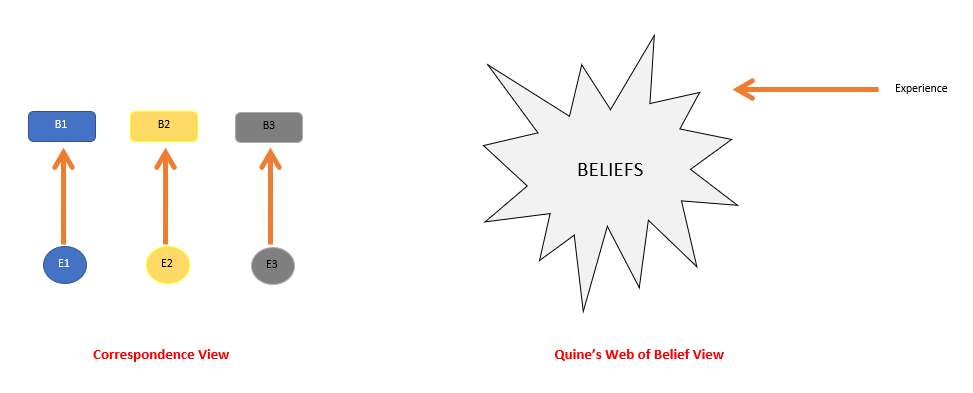
With complexity, we should not look for correspondence but coherence. Correspondence forces categorization while coherence forces connections. This follows nicely into Quine’s Web of Belief idea. Quine’s idea is a holistic approach. We make meanings in a holistic fashion. When we observe a phenomenon, our sensory experience and the belief it generates do not standalone in our entire belief system. Instead, Quine postulates that we make sense holistically with a web of belief. Every belief is connected to other beliefs like a web.

For example, we can say Experience1(E1) led to Belief1(B1), and Experience2(E2) led to Belief2(B2) etc. This has the correspondence nature we discussed earlier. This view prefers the ordered static approach to sensemaking. However, in Quine’s view, it is more dynamic, interconnected and complex. This has the coherence nature we discussed earlier. The schematic below, inspired by a lecture note from Bryan. Van. W. Norden, shows this in detail.
The idea of Web of Belief is clearly explained by Thomas Kelly:

Quine famously suggests that we can picture everything that we take to be true as constituting a single, seamless “web of belief.” The nodes of the web represent individual beliefs, and the connections between nodes represent the logical relations between beliefs. Although there are important epistemic differences among the beliefs in the web, these differences are matters of degree as opposed to kind. From the perspective of the epistemologist, the most important dimension along which beliefs can vary is their centrality within the web: the centrality of a belief corresponds to how fundamental it is to our overall view of the world, or how deeply implicated it is with the rest of what we think. The metaphor of the web of belief thus represents the relevant kind of fundamentality in spatial terms: the more a particular belief is implicated in our overall view of the world, the nearer it is to the center, while less fundamental beliefs are located nearer the periphery of the web. Experience first impinges upon the web at the periphery, but no belief within the web is wholly cut off from experience, inasmuch as even those beliefs at the very center stand in logical relations to beliefs nearer the periphery.

The idea of degrees rather than a concrete distinction between beliefs is very important to note here. Additionally, Quine proposes that when we counter an experience contradicting our belief, we seek to restore consistency/coherence in the web by giving up beliefs that are located near the periphery rather than the ones near the center.

Final Words:

The dynamic nature of complexity is not just applicable to a pandemic but also to scientific paradigms. This is beautifully explained in the quote from Jacob Bronowski below:

“There is no permanence to scientific concepts because they are only our interpretations of natural phenomena … We merely make a temporary invention which covers that part of the world accessible to us at the moment”

Our beliefs shape our experience as much as our experiences shape our beliefs in a recursive manner. The web gets more complex as time goes on, where some of the nodes become more distinct and some others get hazier. We are prone to getting perpetually frustrated if we try to apply a static framework to the dynamic everchanging domain of complexity. It gets more frustrating because patterns emerge on a continuous basis providing an illusion of order. The static and rigid frameworks break because of their rigidity and inflexibility to tackle the variety thrown upon them.

With this in mind, we should come to realize that we do not have a means to know the external world as-is. All we can know is how it appears to us based on our web of belief. The pragmatic tradition of truth advises us to keep going on our search for truth, and that this search is self-corrective. The correspondence theory fails us because the meaning we create is not independent of us, but very much a product of our web of belief. At the same time, if we don’t seek to understand others, coherence theory will fail us because we would lack the requisite variety needed to make sense of a complex phenomenon. I will finish with an excellent quote from Maureen Finnigan:

Human beings impose their own truth on life instead of seeking truth within life.

Stay safe and Always keep on learning… In case you missed it, my last post was Korzybski at the Gemba:
Korzybski at the Gemba:

Alfred_Korzybski

In today’s post, I am looking at the ideas of Alfred Korzybski, a Polish American philosopher and the father of General Semantics. General Semantics is a doctrine and educational discipline intended to improve the habits of response of human beings, to their environment and one another. Korzybski wanted to understand humanity and why we don’t always get along.

If a visitor from Mars should come, Korzybski showed, and on a tour of inspection should see our bridges, our skyscrapers, our subways, and other engineering feats, and were to ask, “How often does one of these collapse?” man here would say that if the engineering of these projects were correct in all respects, the material used in their construction carefully inspected, and the work well done, they would never collapse. 

Taken to our libraries the visitor from Mars, he declared, shown the histories of the world, would be appalled that the same men who could engineer non-collapsible bridges and skyscrapers could build a civilization which was collapsing at some point every year. And the reason, he pointed out, for the difference, lay in the fundamental beginnings of the logic that had built each.

Korzybski is most famous for his idea – the map is not the territory. He wrote his magnum opus “Science and Sanity” in 1933. In reading his ideas, we can find many aspects of systems thinking. Korzybski’s main idea can be expressed by one word – “abstraction”. His view was that what we know is based on the structure of our nervous system and the structure of our language (dependent on the nervous system). Our brain cannot directly access the world outside. Our brain understands the world outside through our sensory organs. Our sensory organs do not directly transfer the “what”, but the amount of the stimuli received. The brain abstracts meaning based on all the previous correlations. The brain selects the data to make the most meaningful abstraction at that point in time. For example, the eyes do not tell the brain that there is a black cat on the mat. The entire experience of sensory data is abstracted into “black cat”.

Korzybski stated:

The only link between the verbal and objective world is exclusively structural, necessitating the conclusion that the only content of all “knowledge” is structural. Now structure can be considered as a complex of relations, and ultimately as multi-dimensional order. From this point of view, all language can be considered as names for unspeakable entities on the objective level, be it things or feelings, or as names of relations. In fact… we find that an object represents an abstraction of a low order produced by our nervous system as the result of a sub-microscopic events acting as stimuli upon the nervous system.

800px-StructuralDifferential.svg

Image source – WIkipedia

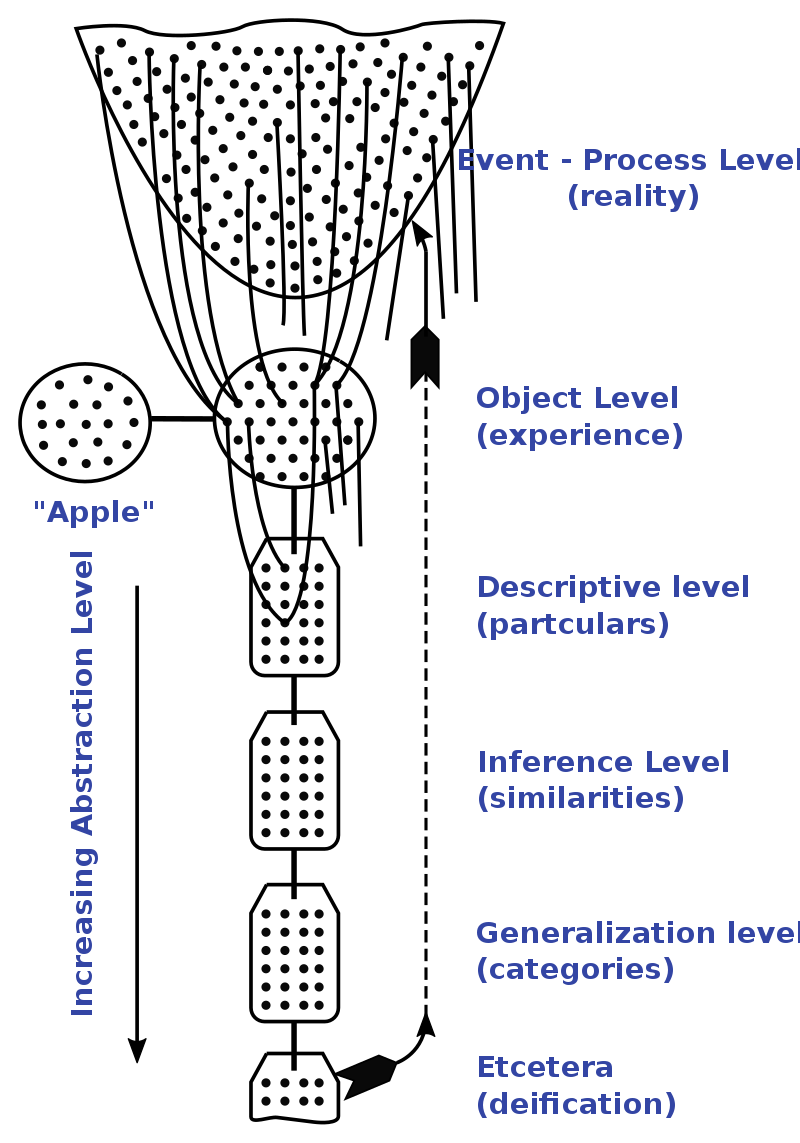
An important outcome of this idea is that objective reality is lost in translation. All that we have and can have access to are abstractions. Thus, two observers can come to two different conclusions while witnessing the same phenomenon. Both may have some access to the same phenomenon but not to each other’s abstractions. This idea is very well articulated in the famous “the map is not the territory.” Korzybski came up with a structural differential, a multilayered structure for abstraction. The higher you are on the structure differential, the closer you are to the phenomenon/event and the closer you are to the “reality.” The further down you go, the level of abstraction increases. The loss of the data was shown by holes in the structure. We use words to express real things, forgetting that the words are not the real things. They are abstractions.

Korzybski wrote:

‘Say whatever you choose about the object, and whatever you might say is not it.’ Or, in other wordsː ‘Whatever you might say the object “is”, well it is not.’

When we assume that an abstraction is a real thing, it leads to “allness”. We start to believe that we have access to the Truth and that we know all there is to know about something. We also engage in taking things apart, falsely assuming that the collective holistic meaning is maintained. Korzybski called this elementalism. Korzybski advised that we should not verbally separate what we would not empirically separate. The ideas of holism/reductionism in Systems Thinking can be viewed here. Elementalism leads to false dichotomies and linear thinking. “If you are not with me, you are against me.” Or “If I put the best players, we will have the best team.”

Korzybski believed that humans are time binding. This meant that as a species, we are able to transfer knowledge that allow us to stand on the shoulders of the giants and build on what others have done so far. Korzybski wrote:

“All human achievements are cumulative; no one of us can claim any achievement exclusively as his own; we all must use consciously or unconsciously the achievements of others, some of them living but most of them dead.”

This is also applicable for the individual. I build my ideas based on what I already know from the past. An important idea from this is to understand that a thing from yesterday is not the same as the thing from the present. Similar to the Heraclitus quote, “you cannot step into the same river twice”, Korzybski adviced that we should not mistake that things would remain the same. Some of the ideas he proposed to address this were:

  • Indexes – This is the idea in mathematics, where we write x1, x2 etc. Korzybski advised that we should differentiate things with indexes. Each one of us is unique. Korzybski wrote – “When I talk about humanity, I am always conscious that every member of our species is absolutely unique.”
  • Dating – Similar to the idea of indexes, Korzybski advised using dates for anything we write down or document. My knowledge is based on what I know already. My knowledge last month is different from what I know now. Everything changes and change is the only constant. Thus, dating is a way to differentiate and keep track of our understanding.

When we become aware of the structure differential, we can influence how we make meanings and how we react to things. Some more ideas he proposed in this regard were:

  • Quotation mark – When you talk about an abstraction and you really want to point out that it is an abstraction and to be careful in how it is understood, we can use quotation marks. For example, I can say – “Systems” do not exist.
  • Hyphen – Korzybski was influenced a lot by Albert Einstein and his idea of space-time. Einstein went against the existing paradigm that space and time are different, which could be viewed as elementalistic, and came up with space-time, where the three-dimensional space and time are intertwined and time is the fourth dimension. The use of a hyphen can sometimes alleviate the confusion that arises from false dichotomies.
  • Multiordanality – This is the idea that words can have different interpretations depending on the level of abstraction on the structural differential. This is a way to ensure that we don’t lose the context when we assign meaning to words.

Final Words:

Philosophers tends to take positions such as the correspondence theory of truth (our experience should correspond to the actual reality of the world), and the coherence theory of truth (our experience should cohere with what we already know). It appears to me that Korzybski’s ideas are a mix of correspondence in terms of structures and coherence in terms of the holistic notions. We are all different and alike at the same time depending on the abstraction level we use. Korzybski’s ideas resonate wonderfully with the ideas of Soft Systems theory. We humans cocreate the social reality. The purpose and meaning for an individual should not be stipulated by another. I will finish with wonderful reminders from Korzybski. I see them as his ‘ethical imperatives.’

Any organism must be treated as-a-whole; in other words, that an organism is not an algebraic sum, a linear function of its elements, but always more than that. It is seemingly little realized, at present, that this simple and innocent-looking statement involves a full structural revision of our language.

Korzybski, in 1933, called his theory “general semantics” because it deals with the nervous reactions of the human organism-as-a-whole-in-environments, and is much more general and organismally fundamental than the “meanings” of words as such, or Significs.

To regard human beings as tools — as instruments — for the use of other human beings is not only unscientific but it is repugnant, stupid and short sighted. Tools are made by man but have not the autonomy of their maker — they have not man’s time-binding capacity for initiation, for self-direction, and self-improvement.

Stay safe and Always keep on learning…

In case you missed it, my last post was Storytelling at the Gemba:

I also encourage the reader to check out the ideas of Korzybski and General Semantics.

You may also want to check out my related posts:

Newton’s Eye/Bodkin Experiment and the Principle of Undifferentiated Coding:

The Map at the Gemba:

Hermeneutics at the Gemba:

Hgadamer

In today’s post, I am looking at Hermeneutics. Hermeneutics is a branch of philosophy that deals with interpretation. It started off as a study of interpreting religious texts. The word has its origin from the Greek God Hermes, who was also the messenger of the Gods (herald) to humans. Hermes’ job was to interpret the words of the many Greek gods to humans. As you go back in time, there was only one interpretation to a religious text, and it was usually provided by the chief priest in charge. The common folk were not allowed to read or contemplate the text and try to interpret the meaning. As time went by, this view changed. The readers were encouraged to be in the shoes of the author and try to interpret the meaning by contemplating what the author meant by trying to be in the same mindset as the author. Important contributions from philosophers such as Heidegger and Gadamer emphasized the role of the observer or the interpreter in seeking understanding. This meant that the prejudices, biases, belief systems, traditions etc. of the interpreter are important in the act of interpretation. It is meant to be a tango, rather than merely watching a solo dance. My post is heavily inspired by the German philosopher Hans-Georg Gadamer.

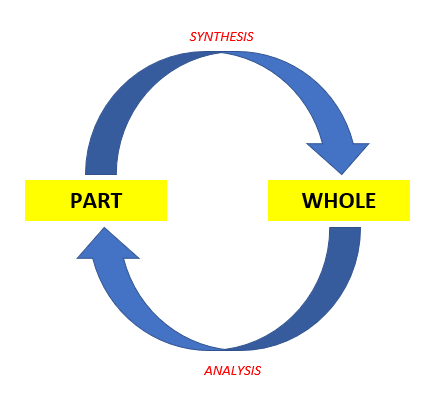
One of the ideas in Hermeneutics is that of the Hermeneutic circle. A good example to explain this is to imagine an interpreter reading a sentence of a text. He starts with a word and as he reads the word, he is trying to figure out what the word means in the context of a sentence. He has an idea of what the word means. As he finishes reading the sentence, he re-evaluates the meaning of the word in the context of the full sentence, and he gains an additional understanding of the word, which in turn yields an additional understanding of the sentence. Contrast this with the idea of the parts to a whole. Understanding a part provides an understanding of the whole, which in turn provides an understanding to the part, and so on the circle goes. One can use the same idea with a sentence and the paragraph, a paragraph and the chapter, and a chapter and the book. The meaning is truly holistic and greater than the sum of individual meanings of the words. The order of the words matters very much in the final meaning of the sentence. The relationship of the part to the whole is depicted in the hermeneutic circle below. Analysis is the act of taking things apart, while synthesis is the act of putting things together.

Hermeneutic Circle

Today, hermeneutics does not stand for interpreting texts alone. It has come to represent the art of interpreting to improve understanding. This could be in relation to what another person is saying or related to learning a subject and so on. The most important act of hermeneutics is the act of asking questions. From this standpoint, the guiding principle to keep in mind is that the most important question is the one that has not yet been asked. This aligns with the hermeneutic circle, in the sense that we have to keep going back and forth to generate improved understanding. This is an ongoing process and never meant to be just one iteration. I like the representation of the hermeneutic circle as a spiral, where the spiral gets smaller and smaller, indicating a churning or generation of improved understanding. I have also seen it as a diverging spiral where the coil gets larger and larger to indicate an expansion of understanding.

Spiral

The circle or the spiral depicts a dialectic movement that the interpreter has to take. Each turn of this movement should result in a better understanding of both the part and the whole. Gadamer was strongly against the idea of viewing this as an objective act where the text author is outside and the meaning of the text can be obtained objectively without engaging in introspection. Gadamer wanted the interpreter to bring his prejudices, pre-understanding, fore-meanings etc. to the act of understanding. Above all, Gadamer wanted the interpreter to have openness to meaning.

Gadamer believed that the prejudices or fore-judgments are the source of all our learning. This does not mean that the act of learning will leave the prejudices untouched. The act of learning will in turn modify/update our prejudices for our next hermeneutic act. Gadamer did not belive prejudices to be bad or assign the negative connotation that we normally project.

One analogy that Gadamer used in his hermeneutics was a “horizon.” Much like in the horizon of a landscape that we see, Gadamer used the horizon to depict the limits of our understanding. Gadamer expressed the horizon as the totality of all that can be realized or thought about by a person at a given time in history and in a particular culture. Gadamer said:

The horizon is the range of vision that includes everything that can be seen from a particular vantage point… A person who has no horizon is a man who does not see far enough and hence overvalues what is nearest to him. On the other hand, “to have a horizon” means not being limited to what is nearby, but to being able to see beyond it

The concept of horizon suggests itself because it expresses the superior breadth of vision that the person who is trying to understand must have. To acquire a horizon means that one learns to look beyond what is close at hand – not in order to look away from it but to see it better.

Similar to the landscape, the epistemic horizon changes depending on where we stand and what our perspective is. Where we are situated is based on our tradition, history, belief system etc. and is also bounded by the cultural and societal underpinnings. One may have an urge to see the horizon as a constraint holding us back, but Gadamer, similar to his view or prejudices, expresses horizons as fertile constraints enabling us to further our understanding rather than limiting our understanding. We are bringing something to the new understanding, something that is internal to us rather than relying solely on the experts or the people around us. This is the idea of Hermeneutics for Gadamer. An important idea that Gadamer talks about is the fusion of horizons. This is such a beautiful expression. We should resist the urge to explain this away as simply combining two different horizons or perspectives or the larger idea swallowing up the smaller idea or the weak idea giving way to the stronger idea. Gadamer views the fusion as a transformation which is prompted by the differences in the horizons. Gadamer wants input from both horizons to generate the fusion. This can happen only if we are open and willing to understand while at the same time not ignoring that we have our own perspectives that might need to be changed to gain a better understanding of the phenomenon in question.

Contrast this with the view of just doing as we are told or learning subjects in a rote fashion. Gadamer wants us to bring something from us, our horizon to the hermeneutic act. We should do so, so that we can change ourselves in the process. Gadamer wrote:

What I described as a fusion of horizons was the form in which this unity [of the meaning of a work and its effect] actualizes itself, which does not allow the interpreter to speak of an original meaning of the work without acknowledging that, in  understanding it, the interpreter’s own meaning enters in as well.

We will never be able to stand in another person’s shoes or try to interpret their perspective in an objective fashion. Gadamer is pointing out that we have to do it from our own horizon since that is all that we have access to. When we hear about “respect for people”, we should start with the question, “what does it mean to me?” What does it mean from where I am situated right now? With an open mind, if I start reading about this subject, I may gain a better understanding. This understanding is made better when I allow my horizon to be transformed. The transformation also requires the understanding of what “respect for people” means to Toyota. I cannot ignore my prejudices but rather I should use them to my benefit. The label “handle with care” does not mean that I should not handle the box at all. But rather that my interaction or my handling of the box should be with care. The hermeneutic act is dynamic, personal and perpetual.

I will finish with a quote from Gadamer to reflect further:

“Understanding does not occur when we try to intercept what someone wants to say to us by claiming we already know it. We cannot understand without wanting to understand, that is, without wanting to let something be said.”

Stay safe and Always keep on learning…

In case you missed it, my last post was Newton’s Eye/Bodkin Experiment and the Principle of Undifferentiated Coding:

Newton’s Eye/Bodkin Experiment and the Principle of Undifferentiated Coding:

INewton

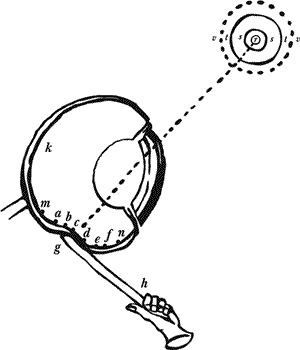
I work in the field of ophthalmic medical devices. I recently came across one of Sir Isaac Newton’s set of notes at the Newton project. In the notes, one particular experiment stood out to me. Newton pushed against his eye ball using a bodkin (a blunt needle) and recorded the optical sensations produced by the pressure on the eye. The schematic below drawn by Newton himself denotes the experiment. He noted:

Newton

I took a bodkin gh and put it between my eye & the bone as near to the backside of my eye as I could: and pressing my eye with the end of it (soe as to make the curvature a, bcdef in my eye) there appeared several white dark & colored circles r, s, t, &c. Which circles were plainest when I continued to rub my eye with the point of the bodkin, but if I held my eye & the bodkin still, though I continued to press my eye with it yet the circles would grow faint & often disappear until I renewed them by moving my eye or the bodkin.

He went on to note that there were different colors and types of sensations depending on if he was in a dark room or a well-lit room. I enjoyed reading through his notes because of my profession and also because it was an opportunity to peek inside a genius mind such as Newton. The experiment remined me of another great idea in Cybernetics called ‘the principle of undifferentiated coding’. This idea was proposed by another brilliant mind and one of my heroes, Heinz von Foerster. Von Foerster said:

The response of a nerve cell does not encode the physical nature of the agents that caused its response. Encoded is only ‘how much’ at this point in my body, but not what.

The brain does not perceive light, sound, heat, touch, taste or smell. It receives only neuronal impulses from sensory organs. Thus, the brain does not “see light,” “hear sounds,” etc.; it can perceive only “this much stimulation at this point on my body.” The practical consequence is that all perceptions, let alone “thoughts,” are deductions from sensory stimuli. They cannot be otherwise. All observations are therefore partly the function of the observer. This situation renders complete objectivity impossible in principle.

Ernst von Glasersfeld, the proponent of Radical Constructivism stated:

In other words, the phenomenological characteristics of our experiential world – color, texture, sounds, tastes and smells – are the result of our own computations based on co-occurrence patterns of signals that differ only with regard to their point of origin in the living system’s nervous network.

Cognition is an autonomous activity of the observer. The state of agitation of a nerve cell only codifies the intensity, not the nature of its cause. What is understood or constructed is unique to the observer. This goes against the idea that if we provide information to a person, he or she will understand what is being provided. Von Foerster would say that the hearer not the utterer determines what is being said. In Newton’s experiment, the sensations were not caused by the eye seeing lights, but due to the physical interaction on the eye. This idea is further explored by Humberto Maturana and Francisco Varela with the idea of autopoiesis. As an autopoietic being, we are all organizationally closed and any information generated is an autonomous activity of our cognitive apparatus.

Bernard Scott expands this idea further:

Von Foerster begins his epistemology, in traditional manner, by asking, “How do we know?” The answers he provides-and the further questions he raises-have consequences for the other great question of epistemology, “What may be known?”

there is no difference between the type of signal transmitted from eye to brain or from ear to brain. This raises the question of how it is we come to experience a world that is differentiated, that has “qualia”, sights, sounds, smells. The answer is that our experience is the product of a process of computation : encodings or “representations” are interpreted as being meaningful or conveying information in the context of the actions that give rise to them. What differentiates sight from hearing is the proprioceptive information that locates the source of the signal and places it in a particular action context.

Another key aspect to add to this is the idea of circularity, where the output is fedback into the cognitive apparatus.  We continue to learn based on what we already know. Thus, we can say that learning is a recursive activity. What we learn now helps further our learning tomorrow. There is no static nature when it comes to knowledge and learning. The great French philosopher Montesquieu said, “If triangles made a god, they would give him three sides.” The properties of the world (seen and unseen) are dependent on the constructor/observer. The construction/observation is ongoing and reflexive. Montesquieu also said, “You have to study a great deal to know a little.” In other words, the more you learn, the more you realize how less you know. Or simply put, “the more you know, the less you know.”

I will finish with a wonderful von Foerster story from Maturana.

Maturana tells of a time when Heinz von Foerster and the famous anthropologist, Margaret Mead went to visit Russia. While there, they went to visit a museum. Mead was using a walking stick at that time. At the entrance they learned that she could not carry her walking stick inside. Mead decided that she would not go in since she could not walk long without using the walking stick. Von Foerster convinced her to go with him. He suggested that he would hide the stick in his clothing, and once inside he would give the stick back to her. His thinking was as follows:

ln this country, whether by perfection or by design, people do not commit mistakes, therefore, any guard that sees us Inside with the walking stick will be forced to admit that we were granted a special permit because otherwise we would not be Inside with it.’

 As the story goes, they were able to visit the museum without any problems. Maturana concluded:

Heinz, by not asking beyond the entrance whether they could or not carry a walking stick, behaved as if he considered that through his interactions with the guards he could either interact with the protection system of the museum as a whole, or with its components as Independent entities, and as if he had chosen the latter. He, thus, revealed that he understood that the guards realized through their properties two non-intersecting phenomenal domains, and that they could do this without contradiction because they operated only on neighborhood relations. This allowed Heinz and Margaret Mead to move through the museum carrying what a meta- observer would have called an invisible forbidden walking stick.

Stay safe and Always keep on learning…

In case you missed it, my last post was The System in the Box:

The System in the Box:

W

In today’s post, I am looking at the brilliant philosopher Ludwig Wittgenstein’s “The Beetle in the Box” analogy.

Wittgenstein rose to fame with his first book, Tractatus Logico-Philosophicus, in which he proposed the idea of a picture theory for words. Very loosely put, words correspond to objects in the real world, and any statement should be a picture of these objects in relation to one another. For example, “the cat is on the mat.” However, in his later years Wittgenstein turned away from his ideas. He came to see the meaning of words in how they are used. The meaning is in its use by the public. He came to realize that private language is not possible. To provide a simple explanation, we need an external reference to calibrate meanings to our words. If you are experiencing pain, all you can say is that you experience pain. While the experience of pain is private, all we have is a public language to explain it in. For example, if we experience a severe pain on Monday and decided to call it “X”. A week from that day, if you have some pain and you decide to call it “Y”, one cannot be sure if “X” was the same as “Y”.

The beetle in the box analogy is detailed in his second book released posthumously, Philosophical Investigations:

Suppose everyone had a box with something in it: we call it a ‘beetle’. No one can look into anyone else’s box, and everyone says he knows what a beetle is by looking at his beetle. Here it would be quite possible for everyone to have something different in his box. One might even imagine such a thing constantly changing. But suppose the word ‘beetle’ had a use in these people’s language? If so, it would not be used as the name of a thing. The thing in the box has no place in the language-game at all; not even as a something: for the box might even be empty. No one can ‘divide through’ by the thing in the box; it cancels out, whatever it is.

The beetle in the box is a thought experiment to show that private language is not possible. The beetle in my box is visible to only me, and I cannot see the beetle in anybody else’s box. All I can see is the box. The way that I understand the beetle or the word “beetle” is by interacting with others. I learn about the meaning only through the use of the word in conversations with others and how others use that word. This is true, even if they cannot see my beetle or if I cannot see their beetle. I can never experience and thus know their pain or any other private sensations. But we all use the same words to explain how each of us experience the world. The word beetle becomes whatever is in the box, even if the beetles are of different colors, sizes, types etc. Sometimes, the beetles could even be absent. The box in this case is the public language we use to explain the beetle which is the private experience. The meaning of the word beetle then is not what it refers to, but the meaning is determined by how it is used by all of us. It is an emergent phenomenon. And sometimes, the meaning itself changes over time. There is no way for me to know what your beetle looks like. The box comes to represent the beetle.

I love this thought experiment because we all assume that we can tell what others feel like. We talk as if we are all talking about the same world. We talk about the beetle as if everybody has the same beetle in their boxes. Everyone’s world is different, and their worlds are constructed based on their worldviews, mental models, schemas, biases etc. The construction is a dynamic and ongoing process. The construction is a recursive process in the sense, our construction influences how we interact in the world, which in turn influences the ongoing construction of the world. From this standpoint, we can see that reality is multidimensional and that there are as many realities as the number of participants. There is no one reality, and we cannot assume that our reality is the correct one. What exists is a cocreated reality with others, and this co-constructing activity is on a delicate balance. Nobody knows everything, but everybody knows something. Nobody has access to a true reality. To paraphrase Heinz von Foerster, we do not see it as it is, it is as we see it.

We all talk about systems as if we all know what they mean. We say that we need to think about the purpose of the system or that it is the system, not the people. Systems are mental constructs we create based on our worldviews to make sense of phenomena around us. Most of the time when we talk about systems, we are speaking about a “part”. For example, when we talk about the “transportation system”, we are actually meaning the bus that is running late. Similar to the beetle in the box, my system is not the same as your system. My view of the healthcare system changes when I become sick versus when I am healthy. The same system has a different meaning and purpose if you are a healthcare worker versus if you are on the board of the hospital. We cannot stipulate a purpose for the system because systems do not have an ontological status. We cannot also stipulate a purpose for a co-creator. To do so will be to assume that we can see the beetle in their box. The great Systems Thinker West Churchman said that systems approach starts when one sees the world through another person’s eyes. Wittgenstein would say that this is impossible. But I think what Churchman was getting at is to realize that our “system” is not the only system. What we need is to seek understanding. With this view, Churchman also said that, there are no experts in the systems approach. Werner Ulrich, who built upon the ideas of Churchman said the following:

The systems idea, provided we take it seriously, urges us to recognize our constant failure to think and act rationally in a comprehensive sense. Mainstream systems literature somehow always manages to have us forget the fact that a lack of comprehensive rationality is inevitably part of the conditio humana. Most authors seek to demonstrate how and why their systems approaches extend the bounds of rational explanation or design accepted in their fields. West Churchman never does. To him, the systems idea poses a challenge to critical self-reflection. It compels him to raise fundamental epistemological and ethical issues concerning the systems planner’s claim to rationality. He never pretends to have the answers; instead, he asks himself and his readers a lot of thoroughly puzzling questions.

Even though systems are not real, we still use the word to further explain our thoughts and ideas. Ulrich continues:

What matters is ultimately not that we achieve comprehensive knowledge about the system in question (an impossible feat) but rather, that we understand the reasons and implications of our inevitable lack of comprehensive knowledge.

 The crucial issue, then, is no longer “What do we know?” but rather “How do we deal with the fact that we don’t know enough?” In particular, uncertainty about the whole systems implications of our actions does not dispense us from moral responsibility; hence, “the problem of systems improvement is the problem of the ‘ethics of the whole system’.”

 A book on morals is not moral. We cannot assume full access to the real world and stipulate purposes for our fellow cocreators. The purpose of language is to not expose our thoughts, but to make them presentable. In today’s world where complexity is ever increasing due to increasing connections, the beetle in the box analogy is important to remember.

 Similar to the famous credit card ad, I ask, “What is in your box?

Stay safe and Always keep on learning…

In case you missed it, my last post was The Map at the Gemba:

The Map at the Gemba:

Map

This is available as part of a book offering that is free for community members of Cyb3rSynLabs. Please check here (https://www.cyb3rsynlabs.com/c/books/) for Second Order Cybernetics Essays for Silicon Valley. The e-book version is available here (https://www.cyb3rsyn.com/products/soc-book)

 Stay safe and Always keep on learning…

In case you missed it, my last post was The Cybernetics of Respect for People:

Magician at the Gemba:

157281886840401048HJ

In today’s post, I will be discussing magic, one of my passions. My inspiration for today’s post comes from the great Cybernetician Heinz von Foerster, the wonderful mentalist Derren Brown and the silent partner of Penn & Teller, Raymond Teller. When I was a young kid, I believed that true magic was real. I saw the great American Illusionist David Copperfield on TV, where he did amazing illusions and as a finale act flew around the whole stage and the arena. I also heard about him vanishing the Statue of Liberty in front of spectators. These amazing feats led me to believe that magic was indeed real. I started learning about magic from that young age onward. I became disillusioned quickly when I came across the many secrets of magic. I am thankful for this early disillusionment since it made me a skeptic from a young age.

Magicians can sometimes view themselves as a God-like figure, someone who is superior and can do things that others cannot. They go into theatrics with the belief that they are improving the craft of magic. Derren Brown warns against this approach:

Magic is massively flawed as theatre… Magic is performance, and performance should have an honesty, a relevance and a resonance if it is to be offered to spectators without insulting them… The magician’s role must change from a whimsical god-figure who can click his fingers and have something change in the primary world, to a hero-figure who, with his skills and intriguing character, provides a link with a secondary world of esoteric power. He must arrange circumstances in the primary world – such, as the correct participation of his small audience – in such a way that if that precarious balance is held, a glimmer of magic (only just held under control for a while) will shine through and illuminate the primary world with wonder. That requires investment of time and energy from him and from his audience, and involves the overcoming of conflict. When the routine is over, something has shifted in the world, for both spectator and performer. There is a true sense of catharsis.

Heinz von Foerster, the Socrates of Cybernetics, was also an accomplished magician as a youth. Von Foerster provides his views on magic:

We did it (magic) in such a way that the spectator constructs a world for himself, in which what he wished for takes place. That has led me to the sentence: “The hearer, not the speaker, determines the meaning of an utterance.”

The other thing we saw is: When one succeeds in creating the world in which one can give rise to miracles, it is the fantasy, the imagination, the mind’s eye of the spectator that you support and nourish.

We are letting the spectator construct the experience of magic. We should not construct it for them. There is a difference between a magician saying, “See there is nothing in my hand,” and the spectator saying, “I see nothing in your hand.” The magic occurs in the minds of the spectator. Great magicians allow the spectator to construct the magic. There is no magic without a spectator.

At the Gemba:

How does all this matter to us at the gemba? During my undergrad studies, I first heard about this magical new production system called ‘Lean Manufacturing’. Apparently, Toyota was doing magical things with this approach and all automakers were trying to copy them. Just like with magic tricks, if one is curious enough, the secret of a trick can be found out. But that will not let you be like David Copperfield or Derren Brown. To paraphrase the Toyota veteran, Hajime Ohba, copying what Toyota does is like creating a Buddha image and forgetting to put a soul in it. Later on, when I started working, I was advised by a senior manager that the only book I need to read is ‘The Goal’ by Eliyahu Goldratt. Supposedly, the book had all the answers I would ever need. Luckily, I was already disillusioned once with magic. As I have written a lot in the past, copying Toyota’s solutions (tricks) will not help if you don’t have Toyota’s problems.  The solution to a problem should be isomorphic. That is, the key should match the lock it opens. Toyota developed its production system over decades of trial and error. We cannot simply copy the tools without understanding what problems they were trying to solve. To paraphrase another Toyotaism, Toyota’s Production System is different from the Toyota Production System (TPS).

This brings me to the idea of constructivism. I have talked about this before as well. A bad magician tries to sell the idea of a Superbeing who can do things that don’t seem to belong to the natural realm. He is trying to force his constructed reality onto others. A good magician on the other hand invites the spectator to create the magic in their mind. This is evident in the statements from Heinz von Foerster. The role of the observer is of utmost importance because he is the one doing the description of the phenomenon. What he describes is based on what he already knows. The properties of the “observed” are therefore the properties infused by the observer. The emphasis is then about epistemology (study of knowledge), not ontology (study of reality). Multiple perspectives and continued learning are important. One cannot optimize a complex system. It is dynamic, nonlinear and multidimensional. There are at least as many realities as the number of participants in the complex system. What optimization means depends upon the observer. There may never be a “perfect” answer to a complex problem. There are definitely wrong answers. There are definitely ‘less wrong’ answers. We should seek understanding and learn from multiple perspectives. Humility is a virtue. To paraphrase von Foerster: “Only when you realize you are blind can you see!” This is such a powerful statement. If we don’t know that our understanding is faulty, we cannot improve our understanding. This touches on the idea of Hansei or “self-reflection” in TPS.

We should be aware that everybody has a view of what is out there (reality). We all react to an internally constructed version of reality built of our internal schema/mental models/biases/what we know etc. We cannot be God-like and assume that our version is the true reality. We should not force our version on others as well. We should allow our cocreators/participants to co-construct our social reality together. This touches on the idea of Respect for Humanity in TPS.

To keep with the theme of this post, I will post some of my old videos of magic below, and end with a funny magician joke.

A Spanish magician told everyone he would disappear.

He said, “Uno, dos….” Poof! He disappeared without a tres.

Always keep on learning…

In case you missed it, my last post was The Free Energy Principle at the Gemba:

My performance videos from a long time ago (pardon the video quality)…

Nature of Order for Conceptual Models:

251

I have recently been reading upon the renowned British-American architect and design theorist, Christopher Alexander.

Alexander is known for the idea of pattern languages. A pattern is a collection of a known problem discussed with a solution for the problem. As Alexander explains it:

Now, a pattern is an old idea. The new idea in the book was to organize implicit knowledge about how people solve recurring problems when they go about building things.

For example, if you are building a house you need to go from outside to inside and there are centuries of experiments on how to do this in a “just so” way. Sometimes the transition is marked not by just a door but by a change in elevation (steps, large, small, straight, or curved), or a shaded path, or through a court yard.

We wrote up this knowledge in the form of a pattern about entrance transitions.

I was very much inspired by what Alexander was pointing at. Alexander’s view is that a construction should always promote social interactions and thus life. He would ask the question, which building has more life? In a city or a village or even in your house, where do you see life? Is there a particular room that you really love in your house? Why do you like that room? Alexander was after this question. He and his team came up with 253 patterns that they observed by studying the world around them. They noticed that certain buildings and locations had more “life” than others. People were engaged in more interactions and they were enjoying being with one another. These buildings and locations add to the wholeness of the surrounding and also to the people themselves. They promote the nature of order.

For example, one of the patterns Alexander’s team came up with was “SMALL PUBLIC SQUARES” (Alexander’s team used capital letters to denote a pattern.) This pattern provides guidelines for the width of the public squares to less than 70 feet.

A town needs public squares; they are the largest, most public rooms, that the town has. But when they are too large, they look and feel deserted.

It is natural that every public street will swell out at those important nodes where there is the most activity. And it is only these widened, swollen, public squares which can accommodate the public gatherings, small crowds, festivities, bonfires, carnivals, speeches, dancing, shouting, mourning, which must have their place in the life of the town.

But for some reason there is a temptation to make these public squares too large. Time and again in modern cities, architects and planners build plazas that are too large. They look good on drawings; but in real life they end up desolate and dead.

Our observations suggest strongly that open places intended as public squares should be very small. As a general rule, we have found that they work best when they have a diameter of about 6o feet – -at this diameter people often go to them, they become favorite places, and people feel comfortable there. When the diameter gets above 70 feet, the squares begin to seem deserted and unpleasant.

They reasoned that a person’s face is still recognizable at 70 feet, and the voice can also be heard at this distance. In other words, any distance further than 70 feet reduces interactions, and thus does not promote “life”.

Conceptual Models:

I am not an architect by trade or by passion. However, I noticed that the ideas that Alexander was talking about has much wider use. His ideas were behind the wiki movement.

We generally construct conceptual models to explain how things work in our mind. For example, when we look at a car, we may construct a conceptual model in our mind to explain how the car works. It could be as simple as – put gasoline, and the engine runs making the car move. When we talk about problem solving and problem structuring, we are in many regards constructing a conceptual model in our mind.

Alexander stated:

One of the things we looked for was a profound impact on human life. We were able to judge patterns, and tried to judge them, according to the extent that when present in the environment we were confident that they really do make people more whole in themselves.

The allegory of “constructing a model” works well with Alexander’s ideas. Alexander would propose that one should not construct a building that does not add to the existing surroundings. Furthermore, it should add to the wholeness, and it should promote life via social interactions. I am sometimes guilty of coming to a problem with a preconceived bias and notion. When I am informed of a problem, I may construct the problem statement immediately. I come to the source with the problem model already constructed.  This hinders “life” and promotes “unwholeness”, as Alexander would say.

Similar to Marie Kondo’s question of “Does it spark joy?”, Alexander asks the question, “Does it promote life?” and “Does it add to the wholeness?”

Alexander defines wholeness as “the source of coherence in any part of the world.”

When you build a thing you cannot merely build that thing in isolation, but must also repair the world around it, and within it so that the larger world at that one place becomes more coherent and more whole; and the thing which you make take its place in the web of nature as you make it.

When we are constructing a problem model, we should not come with the box already prepared. Instead, we should construct the box around the problem as we find it at the source, the gemba. We often talk about lean problems and six sigma problems. This is not the correct approach. We should construct the box around the problem making sure to match the conceptual surroundings. The model should add to the wholeness. This in my mind is regarding correspondence and coherence. The problem model should correspond to the reality, and should promote coherence to other ideas and models that we have in our epistemological toolbox. In other words, the problem model should make sense.

Each pattern is connected to certain larger patterns which come above it in the language; and to certain smaller patterns which come below it in the language.

No pattern is an island… Each pattern can exist in the world, only to the extent that it is supported by other patterns.

A thing is whole according to how free it is of inner contradictions. When it is at war with itself, and gives rise to forces which act to tear it down, it is unwhole.

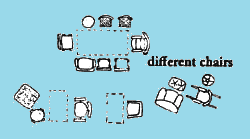
In this post, we will look at one additional pattern that Alexander’s team came up with called “DIFFERENT CHAIRS” to discuss this further. This patterns adds further clarity to the multidimensional and multireality nature of complex problems.

People are different sizes; they sit in different ways. And yet there is a tendency in modern times to make all chairs alike. Never furnish any place with chairs that are identically the same. Choose a variety of different chairs, some big, some small, some softer than others, some rockers, some very old, some new, with arms, without arms, some wicker, some wood, some cloth.

In my mind, this alludes to the multiple perspectives that we should consider. Problem structuring is extremely difficult (and sometimes not possible) for complex problems mainly because of the numerous connected parts, numerous perspectives and due to the fact that there are portions of a complex phenomenon that we are not able to completely grasp. We should always welcome multiple perspectives. The great American Systems Thinker, Russell Ackoff said:

Effective research is not disciplinary, interdisciplinary, or multidisciplinary; it is transdisciplinary.

In our case, we can paraphrase this and say that effective construction of a conceptual model is transdisciplinary.

The same idea of conceptual model is applicable in Systems Thinking. A “system” is also a conceptual model. This is very well articulated by Weber Ulrich:

‘Systems’ are essentially conceptual constructs rather than real-world entities. Systems concepts and other constructs help us describe and understand the complex realities of realworld situations, including natural, technical, social, psychological or any other aspects that might potentially or actually be relevant at any one time. 

Alexander proposed an 8-step approach for promoting “wholeness”. As we look at the steps, we can see that it requires deep questioning and thinking. How can we use this approach to promote constructing better conceptual models?

  1. At every step of the process—whether conceiving, designing, making, maintaining, or repairing—we must always be concerned with the whole within which we are making anything. We look at this wholeness, absorb it, try to feel its deep structure.
  2. We ask which kind of thing we can do next that will do the most to give this wholeness the most positive increase of life.
  3. As we ask this question, we necessarily direct ourselves to centers, the units of energy within the whole, and ask which one center could be created (or extended or intensified or even pruned) that will most increase the life of the whole.
  4. As we work to enhance this new living center, we do it in such a way as also to create or intensify (by the same action) the life of some larger center.
  5. Simultaneously we also make at least one center of the same size (next to the one we are concentrating on), and one or more smaller centers— increasing their life too.
  6. We check to see if what we have done has truly increased the life and feeling of the whole. If the feeling of the whole has not been deepened by the step we have just taken, we wipe it out. Otherwise we go on.
  7. We then repeat the entire process, starting at step 1 again, with the newly modified whole.
  8. We stop altogether when there is no further step we can take that intensifies the feeling of the whole.

Final Words:

The title of this post is adopted from the title of a Christopher Alexander book, “The Nature of Order”. I welcome the readers to take upon reading and learning his wonderful works. I will finish with the complete description of pattern 252, DIFFERENT CHAIRS:

251 - Diff Chairs

People are different sizes; they sit in different ways. And yet there is a tendency in modern times to make all chairs alike.

Of course, this tendency to make all chairs alike is fueled by the demands of prefabrication and the supposed economies of scale. Designers have for years been creating “perfect chairs” – chairs that can be manufactured cheaply in mass. These chairs are made to be comfortable for the average person. And the institutions that buy chairs have been persuaded that buying these chairs in bulk meets all their needs.

But what it means is that some people are chronically uncomfortable; and the variety of moods among people sitting gets entirely stifled.

Obviously, the “average chair” is good for some, but not for everyone. Short and tall people are likely to be uncomfortable. And although situations are roughly uniform – in a restaurant everyone is eating, in an office everyone is working at a table – even so, there are important distinctions: people sitting for different lengths of time; people sitting back and musing; people sitting aggressively forward in a hot discussion; people sitting formally, waiting for a few minutes. If the chairs are all the same, these differences are repressed, and some people are uncomfortable.

What is less obvious, and yet perhaps most important of all, is this: we project our moods and personalities into the chairs we sit in. In one mood a big fat chair is just right; in another mood, a rocking chair; for another, a stiff upright; and yet again, a stool or sofa. And, of course, it isn’t only that we like to switch according to our mood; one of them is our favorite chair, the one that makes us most secure and comfortable; and that again is different for each person. A setting that is full of chairs, all slightly different, immediately creates an atmosphere which supports rich experience; a setting which contains chairs that are all alike puts a subtle straight jacket on experience.

Therefore:

Never furnish any place with chairs that are identically the same. Choose a variety of different chairs, some big, some small, some softer than others, some rockers, some very old, some new, with arms, without arms, some wicker, some wood, some cloth.

In case you missed it, my last post was UX at the Gemba:

Wittgenstein’s Ladder at the Gemba:

ladder

In today’s post, I am looking at Wittgenstein’s ladder at the gemba. Ludwig Wittgenstein is one of the most profound philosophers of the 20th century. His first book was Tractatus Logico-Philosophicus, in which he came up with the picture theory of language. He defined how language and reality relate to each other, and how limits of language corresponded to limits of knowledge to some extent.

Loosely put, the Tractatus explained how language can be used to directly depict reality. Language should mirror exactly the arrangement of objects, and their relationships to each other in the real world. Wittgenstein proposed that what can be said about the world makes sense only if there is a correspondence to the real world out there. Everything else is nonsense. This idea puts limits to how we use language. The real use of language is to describe reality. Anthony Quinton, the late British philosopher, explained the main concepts of Tractatus as:

Tractatus is a theory of declarative sentences, a theory of what can be put in a proposition and what cannot. Anything that can be said can be said clearly or not at all.

The world is all that is the case. The state of affairs around us, the simple facts, are the world for us. Wittgenstein is talking about what we can and cannot sensibly  talk about.

The world consists of facts. Facts are arrangement of objects. Objects must be simple. These ideas appear as dogmatic assertions. Language has to have a definite sense and it can have a definite sense only if it is of a certain structure. And therefore the world must be of that certain structure in order to be capable of being represented in the language.

One of the metaphors, Wittgenstein used in the Tractatus is the idea of a ladder. This has come to be known as “Wittgenstein’s Ladder.”

Wittgenstein said:

My propositions serve as elucidations in the following way: anyone who understands me eventually recognizes them as nonsensical, when he has used them—as steps—to climb beyond them. (He must, so to speak, throw away the ladder after he has climbed up it.)
He must transcend these propositions, and then he will see the world aright.   

This is a fascinating idea because Wittgenstein is cautioning against doctrines as the eternal rules to abide by. If the concepts that Wittgenstein explained in the Tractatus are true, then the assertion of his ideas being true would contradict the ideas themselves. Wittgenstein uses the metaphor of a ladder to have the reader climb to a higher level of understanding and then asks the reader to kick the ladder away.

Let’s see how Wittgenstein’s ladder relates to Lean/Toyota Production System. Taiichi Ohno developed TPS as a production system through decades of trial and error methods. The solutions Ohno came up with were specific to the problems Toyota had at that time. We should learn about these different tools and understand the problems they are trying to solve. We should not exactly copy the tools that Toyota uses just because Toyota is using them. Even within Toyota, each plant is unique and doesn’t use a specific set of tools. As one Toyota veteran put it, Toyota Production System and Toyota’s Production System are different. What each plant does is unique and based on the complexity of problems it has.

There are several doctrines that are set forth by the experts. Let’s look at two examples – zero inventories and one-piece flow. Taiichi Ohno himself tried to correct these two misrepresentations/misunderstandings.

Ohno called the Zero Inventory idea nonsense:

To be sure, if we completely eliminate inventories, we will have shortages of goods and other problems. In fact, reducing inventories to zero is nonsense.

The goal of Toyota Production System is to level the flows of production and goods… In every plant and retail outlet, we strive to have the needed goods arrive in the needed quantities in the needed time. In no way is the Toyota Production System a zero-inventory system.

Similarly, Ohno also cautioned about implementing one-piece flow without thinking and looking at your production system.

The essence of Toyota Production System is found in the saying, “Can we realistically reduce one more?” and then after that “one more?”

The removal of parts or operators is about identifying waste and ways to improve human capital through problem solving. The idea is to develop people and not think only about developing parts. Kaizen is a philosophy of personal improvement (improving oneself) through process improvements. Kaizen begets more kaizen.

Final Words:

The problem with doctrines is that we build a religion out of them. 

Ask yourself – What is the problem that I am trying to solve? Toyota’s solutions work for Toyota’s problems. We should climb the TPS/Lean ladder (understand the ideas) and then throw away the ladder of doctrines. We should solve our problems using solutions that match our problems.

Always keep on learning…

In case you missed it, my last post was Drawing at the Gemba: