
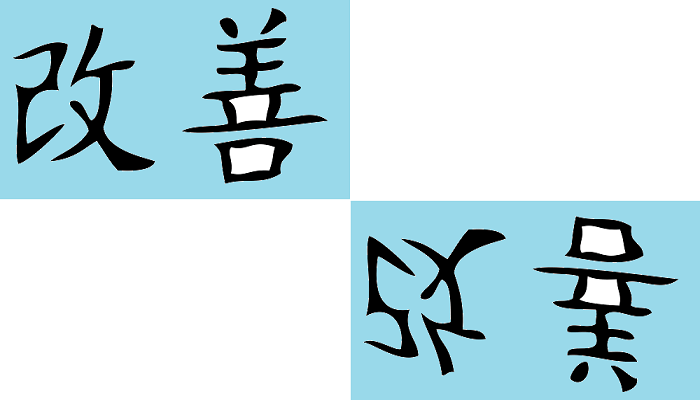
“Kaizen” is the Japanese word that means “change for good”. Kaizen is probably the most used word in lean today. Kaizen has come to mean many things including “Kaizen events” – a week long group activity to improve a process. In today’s post, I am going to look at kaizen – the simple idea of “change for better” and look at what could be the opposite of kaizen. Kaizen is also translated as “continuous improvement”.
What is the Opposite of Kaizen? – Kaiaku
This is an interesting philosophical question. From a Japanese language standpoint, the opposite of kai-zen is kai-aku. In Japanese, Kai means “to change”, zen means “better” or “good” and aku means “bad” or “evil”. Thus kaizen literally means “change to be better” and kaiaku means “change to be worse”.
From a philosophical viewpoint, I do not agree that kaiaku is the opposite of kaizen. A person engaged in the kaizen mindset learns from failures as well. The fear of failure does not stop him from trial and error. Sometimes this activity can result in terrible failures – kaiaku. However, the mindset of kaizen is still alive. In fact, it is said that one learns the most from failures. Thus, kaiaku cannot be the opposite of kaizen. Failures which result in worse-of scenarios act as an impetus to make things even better.
What is the Opposite of Kaizen? – Kaikaku
Kaikaku translates from Japanese to English as “revolutionary change”. This is generally a large scale transformation. The intent behind kaikaku is that it is not a simple small scale change like kaizen. Toyota achieves improvement through both small scale and large scale improvements. They embrace both types. Toyota also embraces innovation (kakushin). From Toyota’s perspective any change that ultimately makes things better is always good! In this regard, the opposite of kaizen cannot be kaikaku either.
What would Ohno Say?
Taiichi Ohno, father of Toyota Production System, said the following about how to begin kaizen:
“You’ve got to assume that things are a mess.”
Ohno’s point behind this is that if you are happy and satisfied with where you are and what you are doing; you will never want to change. You have to be dissatisfied with what you are doing to motivate yourself in order to improve your process. The opposite of kaizen is complacency!
Being complacent means that you are happy where you are, and your goal is to maintain status-quo. In fact, Merriam Webster defines complacency as follows;
Complacency = self-satisfaction especially when accompanied by unawareness of actual dangers or deficiencies
This is the exact opposite of the intent behind kaizen – to improve/make things better. Complacency leads to stagnation, and ultimately this hinders survival. Dr. Deming is often misquoted with “It is not necessary to change. Survival is not mandatory.” His actual quote is;
“Learning is not compulsory; it’s voluntary. Improvement is not compulsory; it’s voluntary. But to survive, we must learn.”(Source: The Age of Stagnation, Satyajit Das)
There is an interesting anecdote in the Harvard Business Review article “What Working for a Japanese Company Taught Me” by John E Rehfeld. John talked about his friend who was in charge of two factories, one in America and one in Japan. The Japanese factory always outperformed the American factory. His friend’s rationale was as follows:
“They both set the same target, and they both may hit it. But when the Japanese hit it, they keep going, whereas the Americans tend to stop and rest on their laurels before pursuing the next goal. So in the end, the Japanese achieve more.” They continuously strive for perfection with the goal of achieving excellence.
Final Words:
It is my view that although the opposite of kaizen from a linguistic standpoint is kaiaku, from a philosophical standpoint it is complacency. Complacency leads to stagnation, and makes one ignorant of the perils around. I talked about Leonardo da Vinci last time. I will finish off with a quote from him, and an anecdote involving Henry Kissinger and Winston Lord.
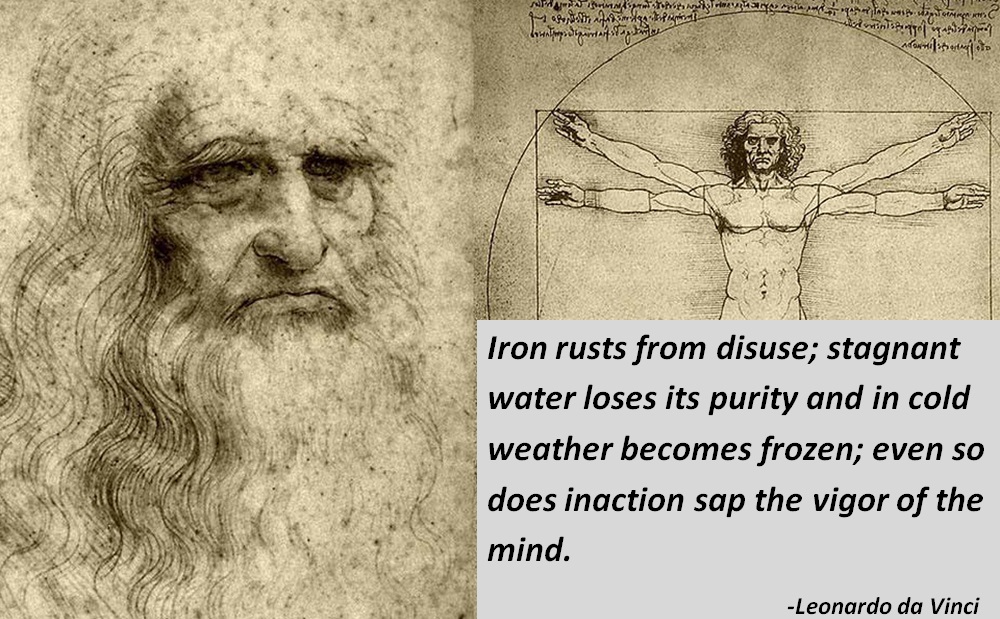
Iron rusts from disuse; stagnant water loses its purity and in cold weather becomes frozen; even so does inaction sap the vigor of the mind. (Source:The Notebooks of Leonardo da Vinci, Richte, 1888)
Winston Lord was working under the then National Security Advisor, Henry Kissinger. There were a lot of high priority national security projects going on at that time. Winston Lord was writing a special report for Henry Kissinger. He worked on it for days knowing how picky and critical Kissinger can be. Lord submitted the report to Kissinger. The report was immediately returned to Lord with a notation by Kissinger – “Is this the best you can do?”
Lord rewrote the report and polished it a little more. The report was again submitted, and almost immediately the report was sent back by Kissinger, again with the same question – “Is this the best you can do?”
Lord rewrote the report one more time and the report was again sent back with the same question. This time Lord snapped at Kissinger, “Damn it, yes, it’s the best I can do.”
“Fine. Then I guess I will read it this time”, Kissinger replied back.
Always keep on learning…
In case you missed it, my last post was Qualities of a Lean Leader.

 Harish's Notebook - My notes... Lean, Cybernetics, Quality & Data Science.