Chekhov’s Gun at the Gemba:

chekhov

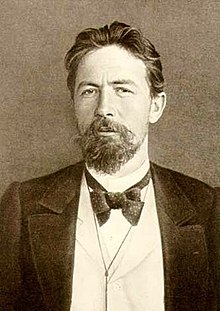
One of my favorite things to do when I learn a new and interesting information is to apply it into a different area to see if I can gain further insight. In today’s post, I am looking at Chekhov’s gun, named after the famous Russian author, Anton Chekhov (1860-1904), and how it relates to gemba. Anton Chekhov is regarded as a master short story writer. In the short story genre, there is a limited amount of resources to tell your story. Chekhov’s gun is a principle that states that everything should have a purpose. Checkhov said:

Remove everything that has no relevance to the story. If you say in the first chapter that there is a rifle hanging on the wall, in the second or third chapter it absolutely must go off. If it’s not going to be fired, it shouldn’t be hanging there.

Chekhov also stated:

“One must never place a loaded rifle on the stage if it isn’t going to go off. It’s wrong to make promises you don’t mean to keep.” [From Chekhov’s letter to Aleksandr Semenovich Lazarev in 1889]. Here the “gun” is a monologue that Chekhov deemed superfluous and unrelated to the rest of the play.

“If in the first act you have hung a pistol on the wall, then in the following one it should be fired. Otherwise don’t put it there.” [From Gurlyand’s Reminiscences of A. P. Chekhov, in Teatr i iskusstvo 1904, No. 28, 11 July, p. 521]. Source: Wikipedia.

How does this relate to Gemba? Gemba is the actual place where you do your work. When you design the work station with the operator, you need to make sure that everything has a place and everything has a purpose. Do not introduce an item to the station that has no need to be there. Do not introduce a step or an action that does not add value. This idea also applies to the Motion Economy. Let’s look at some of the Industrial Engineering maxims from the Principles of Motion Economy that are akin to Chekhov’s gun:

  • There should be a definite and fixed place for all tools and materials.
  • Tools, materials, and controls should be located closely in and directly in front of the operator.
  • Materials and tools should be located to permit the best sequence of motions.
  • Two or more jobs should be worked upon at the same time or two or more operations should be carried out on a job simultaneously if possible.
  • Number of motions involved in completing a job should be minimized.

Chekhov’s gun is not necessarily talking about foreshadowing in a movie or a book. A gun should not be shown on the wall as a decoration. It needs to come into the story at some point to be value adding. The author should make use of every piece introduced into the story. Everything else can be removed. I loved this aspect of Chekhov’s gun. In many ways, as a lean practitioner, we are also doing the same. We are looking at an operation or a process, and we are trying to eliminate the unwanted steps/items/motions. When you work in a strictly regulated industry such as medical devices, the point about line clearance also comes up when you ponder about Chekhov’s gun. Line clearance refers to removal of materials, documentation, equipment etc. from the previous shop order/work order to prevent any inadvertent mix-ups that can be quite detrimental to the end user. Only keep things that are necessary at the station.

I will finish with a great lesson from Anton Chekhov that is very pertinent to improvement activities.

Instructing in cures, therapists always recommend that “each case be individualized.” If this advice is followed, one becomes persuaded that those means recommended in textbooks as the best, means perfectly appropriate for the template case, turn out to be completely unsuitable in individual cases.

Always keep on learning…

In case you missed it, my last post was The Confirmation Paradox:

Bootstrap Kaizen:

bootstrap

I am writing today about “bootstrap kaizen”. This is something I have been thinking about for a while. Wikipedia describes bootstrapping as “a self-starting process that is supposed to proceed without external input.” The term was developed from a 19th century adynaton – “pull oneself over a fence by one’s bootstraps.” Another description is to start with something small that overtime turns into something bigger – a compounding effect from something small and simple. One part of the output is feedback into the input loop so as to generate a compounding effect. This is the same concept of booting computers, where a computer upon on startup starts with a small code that is run from the BIOS which loads the full operating system. I liked the idea of bootstrapping when viewed with the concept of kaizen or “change for the better” in Lean. Think about how the concept of improvement can start small, and eventually with iterations and feedback loops can make the entire organization better.

As I was researching along these lines, I came across Doug Engelbart. Doug Engelbart was an American genius who gave us the computer mouse and he was part of the team that gave us internet. Engelbart was way ahead of his time. Engelbart was also famous for the Mother of All Demos, which he gave in 1968 (way before Windows or Apple Events). Engelbart’s goal in life was to help create truly high performance human organizations. He understood that while population and gross product were increasing at a significant rate, the complexity of man’s problems were growing still faster. On top of this, the urgency with which solutions must be found became steadily greater. The product of complexity and urgency had surpassed man’s ability to deal with it. He vowed to increase the effectiveness with which individuals and organizations work at intelligent tasks. He wanted better and faster solutions to tackle the “more-complex” problems. Engelbart came up with “bootstrapping our collective IQ.”

He explained:

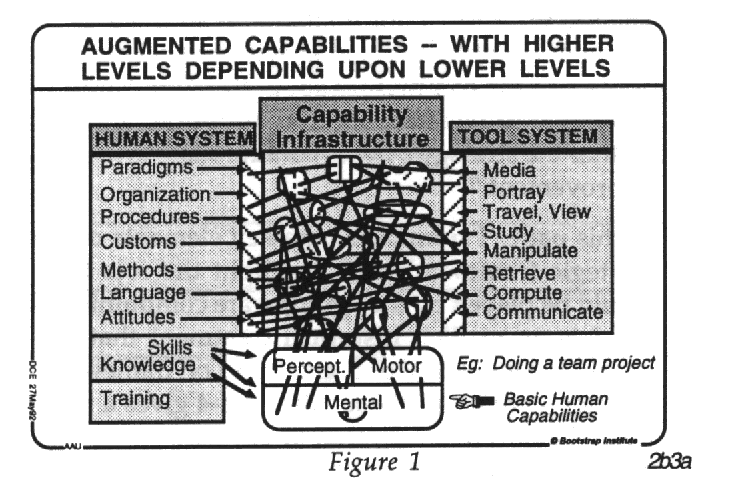
Any high-level capability needed by an organization rests atop a broad and deep capability infrastructure, comprised of many layers of composite capabilities. At the lower levels lie two categories of capabilities – Human-based and Tools-based. Doug Engelbart called this the Augmentation System.
Augmentation system

The human-based capability infrastructure is boosted by the tool-based capability infrastructure. As we pursue significant capability improvement, we should orient to pursuing improvement as a multi-element co-evolution process of the Tool System and Human System. Engelbart called this a bootstrapping strategy, where multi-disciplinary research teams would explore the new tools and work processes, which they would all use immediately themselves to boost their own collective capabilities in their lab(s).

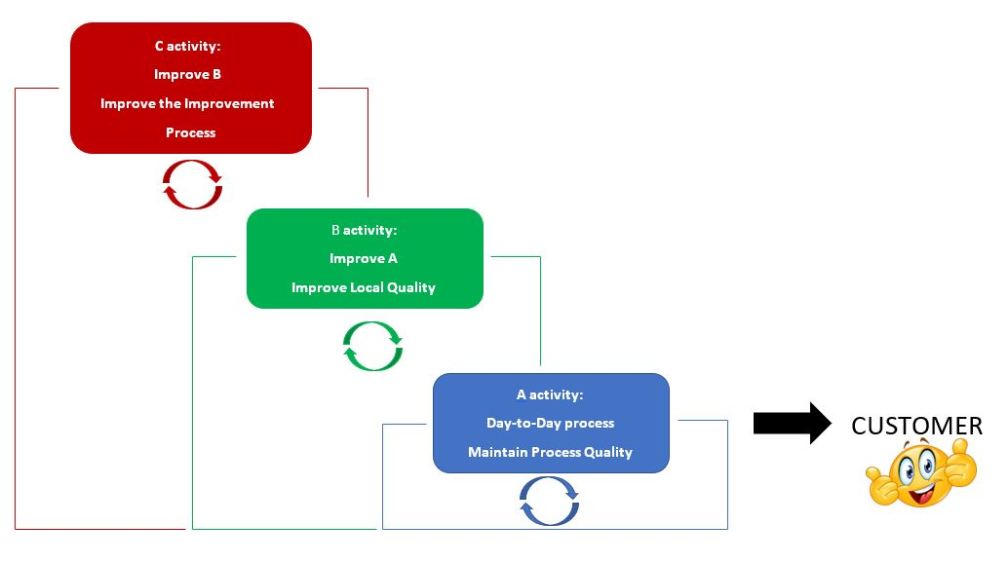
Doug Engelbart’s brilliance was that he identified the link between the human system and the tool system. He understood that developing new tools improves our ability to develop even more new tools. He came up with the idea of “improving the improvement process.” I was enthralled by this when I read this because I was already thinking about “bootstrap kaizen.” He gave us the idea of “ABC model of Organizational Improvement.” In his words:

    A Activity: ‘Business as Usual’. The organization’s day to day core business activity, such as customer engagement and support, product development, R&D, marketing, sales, accounting, legal, manufacturing (if any), etc. Examples: Aerospace – all the activities involved in producing a plane; Congress – passing legislation; Medicine – researching a cure for disease; Education – teaching and mentoring students; Professional Societies – advancing a field or discipline; Initiatives or Nonprofits – advancing a cause.

    B Activity: Improving how we do that. Improving how A work is done, asking ‘How can we do this better?’ Examples: adopting a new tool(s) or technique(s) for how we go about working together, pursuing leads, conducting research, designing, planning, understanding the customer, coordinating efforts, tracking issues, managing budgets, delivering internal services. Could be an individual introducing a new technique gleaned from reading, conferences, or networking with peers, or an internal initiative tasked with improving core capability within or across various A Activities.

    C Activity: Improving how we improve. Improving how B work is done, asking ‘How can we improve the way we improve?’ Examples: improving effectiveness of B Activity teams in how they foster relations with their A Activity customers, collaborate to identify needs and opportunities, research, innovate, and implement available solutions, incorporate input, feedback, and lessons learned, run pilot projects, etc. Could be a B Activity individual learning about new techniques for innovation teams (reading, conferences, networking), or an initiative, innovation team or improvement community engaging with B Activity and other key stakeholders to implement new/improved capability for one or more B activities.

This approach can be viewed as a nested set of feedback loops as below:
ABC

Engelbart points out that, Bootstrapping has multiple immediate benefits:

1) Providers grow increasingly faster and smarter at:

  • Developing what they use – providers become their own most aggressive and vocal customer, giving themselves immediate feedback, which creates a faster evolutionary learning curve and more useful results
  • Integrating results – providers are increasingly adept at incorporating experimental practices and tools of their own making, and/or from external sources, co-evolving their own work products accordingly, further optimizing usefulness as well as downstream integratability
  • Compounding ROI – if the work product provides significant customer value, providers will start seeing measurable results in raising their own Collective IQ, thus getting faster and smarter at creating and deploying what they’re creating and deploying – results will build like compounding interest
  • Engaging stakeholders – providers experience first-hand the value of deep involvement by early adopters and contributors, blurring the distinction between internal and external participants, increasing their capacity to network beneficial stakeholders into the R&D cycle (i.e. outside innovation is built in to the bootstrapping strategy)
  • Deploying what they develop – as experienced users of their own work product, providers are their own best customers engaging kindred external customers early on, deployment/feedback becomes a natural two-way flow between them

2) Customers benefit commensurately:

  • End users benefit in all the ways customers benefit through outside innovation
  • Additionally, end users can visit provider’s work environment to get a taste and even experience firsthand how they’ve seriously innovated the way they work, not in a demo room, but in their actual work environment
  • Resulting end products and services, designed by stakeholders, and rigorously co-evolved, shaken down and refined by stakeholders, should be easier and more cost-effective to implement, while yielding greater results sooner than conventionally developed products and services

Final Notes:

I love that Engelbart’s Augmentation System points out that tools are to be used to augment the human capability, and that this should be ultimately about the system level development. His idea of bootstrapping explains how the “kaizen” thinking should be in Lean.

Interestingly, Engelbart understood that the Human side of the Augmentations System can be challenging. A special note on the Human System: Of the two, Engelbart saw the Human System to be a much larger challenge than the Tool System, much more unwieldy and staunchly resistant to change, and all the more critical to change because, on the whole, the Human System tended to be self-limiting, and the biggest gating factor in the whole equation. It’s hard for people to step outside their comfort zone and think outside the box, and harder still to think outside whatever paradigm or world view they occupy. Those who think that the world is flat, and science and inquiry are blasphemous, will not consider exploring beyond the edges, and will silence great thinkers like Socrates and Gallileo.

As I was researching for this post, I also came across the phrase “eating your own dog food.” This is an idea made famous by the software companies. The idea behind the phrase is that we should use our own products in our day-to-day business operations (Deploying what they develop). In a similar vein, we should engage in improvement activities with tools that we can make internally. This will improve our improvement muscles so that we may be able to tweak off-the-shelf equipment to make it work for us. This is the true spirit of the Augmentation System.

When you are thinking about getting new tools or equipment for automation, make sure that it is to strictly to augment the human system. Unless we think in these terms, we will not be able to improve the system as a whole. We should focus more on the C activities. I highly encourage the reader to learn more about Doug Engelbart. (http://www.dougengelbart.org/)

Always keep on learning…

In case you missed it, my last post was A “Complex” View of Quality:

A “Complex” View of Quality:

Q

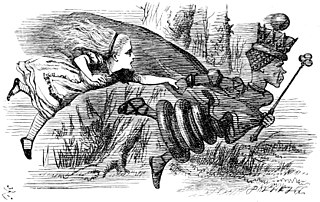
I am a Quality Manager by profession. Thus, I think about Quality a lot. How would one define “Quality”? A simple view of quality is – “conformance to requirements.” This simplistic view of quality lacks the complexity that it should have. This assumes that everything is static, the customer will always have the same requirements and will be happy if the specifications/requirements are met. Customer satisfaction is a complex thing. Customers are external to the plant manufacturing the widget. Thus, the plant will always lack the variety that the external world will impose on it. For example, lets look at a simple thing like a cellphone. Theoretically, the purpose of a cellphone used to be to allow the end user to make a phone call. Think of all the variety of requirements that the end user has for a cellphone these days – internet, camera, ability to play games, ability to use productivity apps, stopwatch, alarms, affordability etc. Additionally, the competition is always coming out with a newer, faster, and maybe cheaper cellphone. To paraphrase the red queen from Alice in Wonderland – the manufacturer has to do a lot of running to stay in the same place – to maintain the share of market.

320px-Alice_queen2

In this line of thinking, quality can be viewed as matching the complexity imposed by the consumer. There are two approaches in Quality that differs from the concept of just meeting the requirements.

1) Taguchi’s idea of quality:

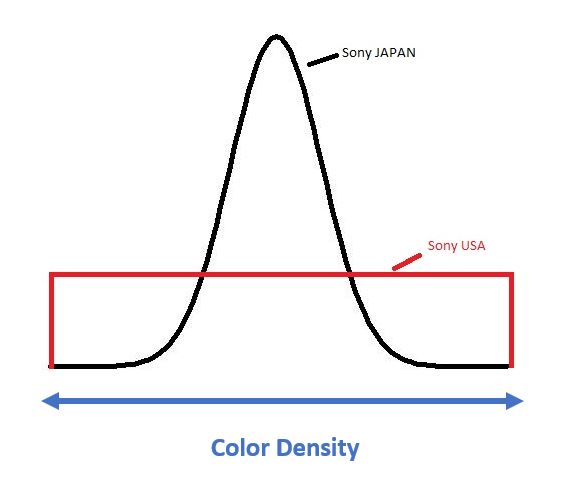
Genichi Taguchi, a Japanese engineer and statistician, came up with the idea of a “loss function”. The main idea behind this is that anytime a product deviates from the target specification, the customer experiences a loss function. Every product dimensional specification has a tolerance for manufacturability. When all of the dimensions are near the target specification, the loss function is minimal resulting in a better customer experience. One of the best examples to explain this is from Sony. The story goes that Sony had two television manufacturing facilities, one in Japan and one in the USA. Both facilities used the same design specifications for television. Interestingly, the televisions manufactured in the USA facility had a lower satisfaction rating than the televisions manufactured in Japan. It was later found that the difference was in how the two facilities approached quality for the color density. The paradigm that the USA facility had was that as long as the color density was within the range, the product was acceptable, whereas, the Japanese facility made a point to meet the nominal value for the color density. Thus, the Japanese Sony televisions were deemed superior to the American Sony televisions.

TV

2) Kano’s idea of quality:

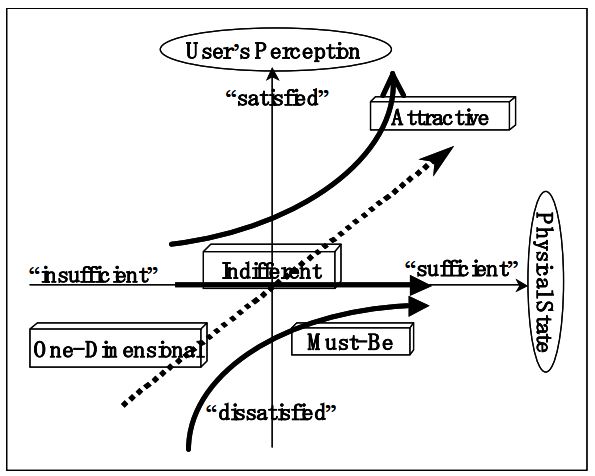
Noriaki Kano is another Japanese Quality Management pioneer who came up with the idea of the Kano model. The Kano model is a great way of looking at a characteristic from the point of the customer. The Kano model has two axes – customer satisfaction and feature implementation. The customer satisfaction goes from satisfied to dissatisfied, and the feature implementation goes from insufficient to sufficient. This two-dimensional arrangement leads to various categories of “quality” such as Attractive quality, One-dimensional quality, Must-be quality and Indifferent quality. Although there are more categories identified by Kano, I am looking at only the four categories identified above.

  • Attractive quality – this is something the customer would find attractive if it is present, and indifferent if it is absent. For example, let’s say that you went to get a car wash, and the store gave you free beverage and snack. You were not expecting this, and getting the free beverage and snack made the experience pleasant. If you were not aware of the free beverage and snack, you would not be dissatisfied because you were not expecting to get the free beverage and snack.
  • One-dimensional quality – this is something that customer would view on a one-dimension. If there is more of it, the customer is more happy, and if there is less of it, the customer is less happy. For example, let’s look at the speed of your internet connection at home. The faster the internet, the happier you are, and the slower the internet, the sadder you are.
  • Must-be quality – this is something that the customer views as an absolute must-have. If you go into a store to buy eggs, you expect the carton to have eggs in it. If the eggs are not there, you are not happy.
  • Indifferent – this is something that a particular customer truly does not care about. The example that Kano gives to explain this in his 2001 paper was the “I-mode” feature on some Japanese cellphones. This feature allowed the user to connect to the internet. When a survey was conducted, most of the middle-aged people viewed this feature indifferently. They could care less that the cellphone could be used to connect to the internet.

Kano

The brilliant insight from the Kano model is that the perception of quality is not linear or static. The perception of quality is non-linear and it evolves with time. Kano hypothesizes that a successful quality element goes through a lifecycle detailed below:

Indifferent => Attractive => One-Dimensional => Must-Be.

A feature that began as indifferent could become an attractive feature, which would then evolve into a one-dimensional feature and finally it becomes a must-be feature. Take for example, the ability to take pictures on your cellphone. This was treated indifferently at the beginning, and then it became an attractive feature. The better the resolution of the pictures taken, the happier you became. Finally, the ability to take sharp pictures became a must-have on your cellphone.

The customer is not always aware of what the attractive feature could be on a product. This is akin to what Ford said – “If I had asked people what they wanted, they would have said faster horses.” Steve Jobs added on to this and said – “People don’t know what they want until you show it to them. That’s why I never rely on market research. Our task is to read things that are not yet on the page.”

Kano had a brilliant insight regarding this as well. In the 2001 paper, “Life Cycle and Creation of Attractive Quality”, he gave the Konica model. Kano talked about the camera that Konica came out with in the 1970s that had built-in flash and the capability to auto focus. At that time, the camera was treated as a mature product and to survive the competition Konica decided to come up with a new camera. Konica engaged in a large survey with the customers with the expectation of coming out with a completely new camera. The R&D team was disappointed with the survey results which only suggested minor changes to the existing designs. The team decided to visit a photo processing lab to examine the prints and negative films taken by consumers and to evaluate the quality of prints and developed films. This is the spirit of genchi genbutsu in lean (go and see to grasp the situation). The team learned that the two main issues the users had were to do with underexposures due to lack of flash and out-of-focus.

Kano notes that:

To solve these problems, Konica developed and released cameras with auto focus and a built-in flash as well as auto film loading and winding functions from the middle to the end of 1970s. This prompted consumers to buy a second and even a third camera. Thereafter, Konica’s business considerably grew and completely changed the history of camera development in the world.

As long as customers are around, quality should be viewed as non-linear, complex and evolving.

Always keep on learning…

In case you missed it, my last post was Lessons from Genkan:

Lessons from Genkan:

Bodhidharma.and.Huike-Sesshu.Toyo

Readers of my blog know by now that I am a “Japanophile”. Keeping up with that theme, I will be talking about “genkan” today. Genkan is a small sunken area behind the front door of a Japanese house. This vestibule has a great significance in the Japanese culture. A guest coming to a Japanese house should open the front door to enter genkan, and calls out “Gomen kudasai” (“Anybody home?”) The house owner can then come out and carry a conversation while the guest stays in the genkan. The genkan allows the opportunity to conduct any informal business like paying bills or having a short conversation. The genkan allows the opportunity to not engage in any formal etiquette that will be required if the guest enters the house. If the guest is welcomed inside the house, the guest is expected to remove his shoes while inside the genkan and have the shoes facing towards the door.

The word genkan means is made up of two characters “gen” and “kan”; “gen” stands for mysterious or profound, while “kan” stands for barrier or connection point, Genkan stands for dark and mysterious entrance. The concept of genkan comes from the Zen temples. The term genkan was used metaphorically to remind everyone entering a Zen temple that it is the path to the realm of enlightenment. When a student wishes to join a Zen temple/monastery, he is supposed to stand in the genkan in a bowing posture sometimes for days. During this period, his desire to join the monastery will be tested in many different ways. This ritual is called as “niwazume”. The concept of genkan was adopted by the samurai and included in the houses.

As Michael Lazarin explains in his paper, “A Phenomenology of Japanese Architecture: Heidegger and Derrida”:

We can see that the genkan is not simply a way of getting into or out of the house, a place for changing and storing shoes. lt serves an important social function; it provides a way of getting around the excessive formalities of Japanese social life. lt provides a way of being familiar with someone who, as visitor, is also estranged. lt de-ranges the formalities in order to arrange social communication. Without such a space, people raised according to traditional standards of politeness would be at a loss.

I was very enthralled when I learned about genkan. I loved the idea of a place where the formalities can be ignored. This idea can be of great use at a workplace. In many workplaces, innovation and creativity are stymied due to the rigid policies and procedures in place. The thinking behind the  rigid rules and procedures is that they promote standardization and structure. Unfortunately, if they cannot match the local variety needed, they will break or worse create a stymied workplace that people want to leave. The inflexibility of the procedures causes stagnation. In such a situation, we can learn from genkan. We can create an “informal” area or space where rules are not applicable, and where we can experiment safely and fail as many times as needed. The failures will be in a controlled environment and this leads to innovation, creativity and learning. This brings to my mind, the ideas of the Soviet engineer, Peter Palchinsky. Palchinsky was killed in 1929 due to his political standings. He was the focus point of the book, “The Ghost of the Executed Engineer” by Loren Graham. Tim Harford also wrote about Palchinsky in the book “Adapt”.

Peter Palchinsky’s ideas can be summarized as follows (from Tim Harford’s Adapt):

  • Seek out new ideas and try new things.
  • When trying something new, do it on a scale where failure is survivable.
  • Seek feedback and learn from your mistakes as you go along.

In “The Ghost of the Executed Engineer”, Loren Graham wrote:

Although Palchinsky praised the idea of central planning, he thought that the central plan should be very general, allowing many local variations. It should allow room for individual initiative.

Another example of having an “informal” program outside of the norm is now defunct (?) Google’s 20 percent initiative. Google’s founders Larry Page and Sergey noted in 2004: “We encourage our employees, in addition to their regular projects, to spend 20% of their time working on what they think will most benefit Google,” the pair wrote. “This empowers them to be more creative and innovative. Many of our significant advances have happened in this manner.” Several successful initiatives like Gmail and Adsense came out of this initiative.

Does your workplace have a genkan?

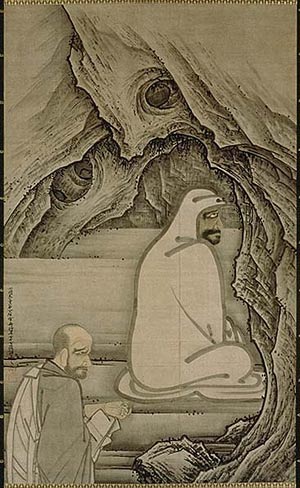
I will finish with the story of Dazu Huike. The custom of niwazume perhaps goes all the way back to Dazu Huike. Dazu Huike was the student of Bodhidharma. Bodhidharma, a south Indian prince, was the first Chinese patriarch for Chan Buddhism, and considered by many to be the creator of Shaolin Kungfu.

Legend has it that Bodhidharma initially refused to teach Huike. Huike stood in the snow outside Bodhidharma’s cave all night, until the snow reached his waist. In the morning Bodhidharma asked him why he was there. Huike replied that he wanted a teacher to “open the gate of the elixir of universal compassion to liberate all beings”.

Bodhidharma refused, saying, “how can you hope for true religion with little virtue, little wisdom, a shallow heart, and an arrogant mind? It would just be a waste of effort.”

Finally, to prove his resolve, Huike cut off his left arm and presented it to the First Patriarch as a token of his sincerity. Bodhidharma then accepted him as a student, and changed his name from Shenguang to Huike, which means “Wisdom and Capacity”.

Always keep on learning…

In case you missed it, my last post was Tesler’s Law of Conservation of Complexity:

Tesler’s Law of Conservation of Complexity:

Tesler

In today’s post, I am looking at Tesler’s Law of Conservation of Complexity. Larry Tesler, who came up with the law, worked at Xerox PARC, Apple, Amazon, and Yahoo in different capacities. He was one of the brains behind “cut/copy and paste” functionality in word processors. The basic premise of the law is as follows:

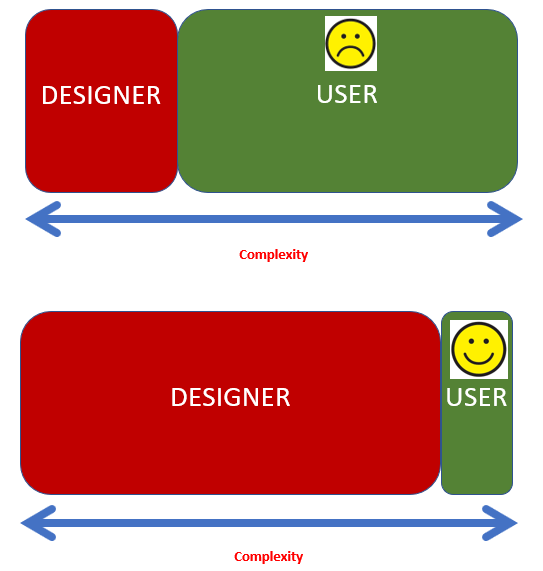
“Every application has an inherent amount of irreducible complexity. The only question is: Who will have to deal with it—the user, the application developer, or the platform developer?”

This is an important idea in the user interaction with a software application. One of the best examples to explain this further comes from Dan Saffer’s excellent book, “Designing for Interaction.” Think of the email application. It needs a “From address” and a “To address”. Without either of these two items, the email cannot be sent. All, if not most, email applications will automatically populate the “From address”, thus not requiring the user to enter it all the time. This “complexity” was addressed by the software application designer. As Dan put it; The complexity isn´t gone, though – instead, some of it has been shifted to the software.

Larry Tesler was a firm believer that the user interaction is almost as important as the application itself.

In the early days of our field, when I worked at Xerox PARC, the idea of user interface consistency was new and controversial. Many of us realized that consistency would benefit not only users, but also developers, because standards could be encapsulated in shared software libraries. We made an economic argument: If we establish standards and encourage consistency, we can reduce time to market and code size.

I postulated that every application must have an inherent amount of irreducible complexity. The only question is who will have to deal with it.

Because computers back then were small, slow and expensive, programs were designed to be compact, not easy to use. The user had to deal with complexity because the programmer couldn’t. But commercial software is written once and used millions of times. If a million users each waste a minute a day dealing with complexity that an engineer could have eliminated in a week by making the software a little more complex, you are penalizing the user to make the engineer’s job easier. (Source: Dan Saffer Interview with Larry Tesler in “Designing for Interaction”)

With this law, we are not trying to make things simple. A complex situation requires that the solution is also complex. This goes back to Ross Ashby’s Requisite Variety principle – “only variety can absorb variety.” The variety is described as the number of possible states of a system. If the “problem” requires that you need 7 states, then the solution should address it by providing at least 7 states. Tesler’s law recommends that we keep this complexity away from the user and absorb it at the programmer’s side. This makes the user interaction favorable leading to a positive user experience. We should focus on making life easy for the user.

The user experience is related to the cognitive load that is placed on the user. The application should try to minimize this load to avoid any potential errors or slips. The more steps a user has to complete, the more likely an error can occur. This may not be a big problem if we are drafting an email, but if the user is a pilot, then the whole scope of the problem changes. Providing a consistent interface and eliminating unnecessary actions minimizes the cognitive load on the user, and ultimately reduces the errors and slips by the user.

This makes me think about the concept of “muri” in Lean. “Muri” refers to the unnecessary burden on the operator or the system. Muri always leads to Muda (waste). When we are designing an interface for the operator at the gemba, we should try to make that interface as user-friendly as possible in order to minimize the cognitive load on the operator. As Tesler’s law suggests, the designer should absorb the complexity so that the operator does not have to worry about it. Many of the concepts of user experience are applicable in designing a work station. The focus is not to make things “simple” but to match the complexity needed and embed it in the interface in an efficient and effective manner so as to reduce cognitive load on the user. This leads to a satisfactory experience for the user and minimizes the chance of errors. When trying to save money, don’t try to cut corners with technology. Think of it from the time saved by the operators and the minimization of cognitive loads leading to better products and processes.

The other side of the coin is an elaboration that Bruce Tognazzini made with Tesler’s law. Bruce is another great User Experience pioneer. He postulated that when we remove the complexity from the user, the user will try to attempt more complex tasks. The reduction in cognitive load on the operator leads to the user engaging in more ideas for improvements that ultimately leads to better and more efficient operator interface. This may also lead to better cross training, and increase in employee morale. There will be more interest in engaging in the improvement culture, which is at the heart of lean.

I will finish with a great Don Norman story about user experience. Don Norman is the director of The Design Lab at University of California, San Diego, and has written numerous books of designing and user experience.

Don Norman is a proponent of designing things so that the conceptual model becomes easy for the user. The conceptual model is the mental model that the user creates when interacting with a designed object. The conceptual model allows the user to understand how the object functions. Don talks about the experience his son had with the first Macintosh computers. At that time, the file storage was mainly done with floppy drives. His son was trying to save a file and got the error message. “Sorry, there is not enough room to save your file.” His son looked at the folder and saw that there were many folders within the folder and they were arranged in a haphazard fashion. His son using the conceptual model he had came up with a solution – rearrange the folder icons in the folder towards the left so that “there was lot more room on the right side.” He tried again saving, and got the same error message. He was puzzled because the folder obviously had more room now. Don stated that his son was using the wrong conceptual model. The “room” on the picture on the folder was not the same as the “room” on the floppy disc.

Always keep on learning…

In case you missed it, my last post was Kufu Eyes:

Kufu Eyes:

Huike_thinking-big-569924185f9b58eba49ede26

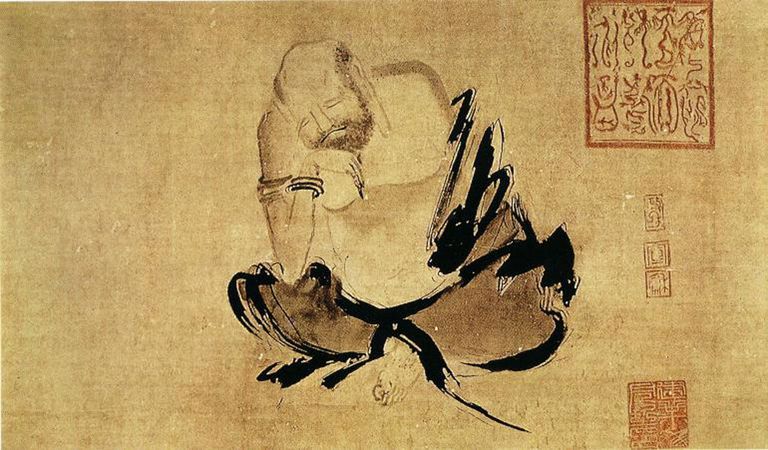
I came across an interesting phrase recently. I was reading Kozo Saito’s paper, “Hitozukuri and Monozukuri”, and I saw the phrase “kufu eyes”. Kufu is a Japanese word that means “to seek a way out of a dilemma.” This is very well explained in K. T. Suzuki’s wonderful book, “Zen and Japaense Culture.” Suzuki talks about kufu in three sections of the book, and each time he adds a little more detail.

“Kufu is not just thinking with the head, but the state when the whole body is involved and applied to the solving of a problem.”

 “Kufu means ‘employing oneself assiduously to discover the way to the objective.’ One may say that this is literally groping in the dark, there is nothing definite indicated… I am afraid this is as far as any master of Zen or swordsmanship can go with his disciples. He leads them until no more leading is possible, and the rest is left to their own devices. If it is a matter of intellection, the way to the goal may be ‘definitely’ prescribed… The students must resort to something very much deeper than mere intellection – something which they cannot obtain from another.”

‘‘The term kufu is the most significant word used in connection with Zen and also in the fields of mental and spiritual discipline. Generally, it means ‘to seek the way out of a dilemma’ or ‘to struggle to pass through a blind alley.’ A dilemma or a blind alley may sound somewhat intellectual, but the fact is that this is where the intellect can go no further, having come to its limit, but an inner urge still pushes one somehow to go beyond. As the intellect is powerless, we may enlist the aid of the will; but mere will, however pressing, is unable to break through the impasse. The will is closer to fundamentals than the intellect, but it is still on the surface of consciousness. One must go deeper yet, but how? This how is kufu. No teaching, no help from the outside is of any use. The solution must come from the most inner part of oneself. One must keep knocking at the door until all that makes one feel an individual being crumbles away. That is, when the ego finally surrenders itself, it finds itself. Here is a newborn baby. Kufu is a sort of spiritual birth pang. The whole being is involved. There are physicians and psychologists who offer a synthetic medicinal substance to relieve one of this pang. But we must remember that, while man is partially mechanistic or biochemical, this does not by any means exhaust his being; he still retains something that can never be reached by medicine. This is where his spirituality lies, and it is kufu that finally wakes us to our spirituality.’’

In his paper, Saito talked about kufu eyes to explain the process of having a curious scientific mind. Kufu eyes looks at the whole and uses personal intuition than just the analytical thinking process. Kufu eyes pushes you to think further perhaps through thought experiments, and to experiment to truly understand the whole picture. One interesting note I would like to make here is of the great American philosopher Dan Dennett’s “intuition pumps.” An intuition pump is a thought experiment structured to allow the thinker to use their intuition to develop an answer to a problem. Just like a mechanical device, if you can model your thought in a thought experiment, you can push on different buttons and pull on different levers and see what happens.

With kufu eyes, you can observe to gain insight. Siato talked about Taiichi Ohno, the father of Toyota Production System, to explain the concept of kufu eyes further:

… learning engineering and science is not enough. There is a third element: professional intuition, probably the most important, yet most difficult to master, but required for the engineering problem solving process. Taichi Ohno, one of the pioneers who developed Toyota Production System, once declared that the essence of TPS is to develop the well trained ‘‘eyes’’ that can see waste which is invisible to the untrained.

Taiichi Ohno took the task of catching up to the American market when the Japanese worker was assumed to be only 1/8th productive as his American counterpart. The most recent development in manufacturing at that time was the idea of mass manufacturing, which is essentially a push system that led to lots of inventory. Toyota could not afford to carry a lot of inventory. The thinking in those days was to combine similar equipment together and perform operations in isolation. Ohno rearranged the entire layout of the plant he was in charge of, so that the equipment was set to follow the process. The practice at that time was to have one operator manning one piece of equipment. Ohno had one operator man multiple equipment at a time. This led to autonomation or Jidoka. To control the amount of parts produced, Ohno came up with the idea of Kanban. Looking back, Ohno definitely had to employ himself assiduously to discover the way to his objective. He could not just rely on his analytical mind, it was more complex than that. His thinking is clearly stated when he said that efficiency must be improved at every step and at the same time, for the plant as a whole. This is the big picture view that is needed in kufu.

Saito combines the different ideas of total-unit, dedication to the team, holistic view, dialectic approach, and nonlinear thinking to explain kufu. Logic and words have limits. I am inspired by the phrase “kufu eyes”. To me, it means looking outward and inward, looking at the big picture, thinking inside and outside of the “box”, and always pushing to go to the edge of a problem. It means to look with the determination to gain insight. It also means to not fall for status-quo, and to always improve. It also means to go slow but deliberately. It means to not stop until you have solved the problem. And at the same not stop there but keep on improving. This is further explained by Suzuki.

This may be difficult , but when you go on exercising kufu toward the subject, you will after some time come to find this state of mind exercising kufu toward the subject, you will after some time come to find this state of mind actualized without noticing each step of progress. Nothing, however, can be accomplished hurriedly.

I will stop with a wonderful lesson from Suzuki’s book:

When we tie a cat, being afraid of its catching a bird, it keeps on struggling for freedom. But train the cat so that it would not mind the presence of a bird. The animal is now free and can go anywhere it likes. In a similar way, when the mind is tied up, it feels inhibited in every move it makes, and nothing will be accomplished with any sense of spontaneity.  Not only that, the work itself will be of a poor quality, or it may not be finished at all.

Always keep on learning…

In case you missed it, my last post was Hitozukuri:

Hitozukuri:

Zenmind

In today’s post, I am looking at “hitozukuri” from the famous Toyota saying, “monozukuri wa hitozukuri.” This can be translated as “making things is about making (developing) people”. To me, this encapsulates the idea of a sociotechnical system. When organizations attempt to business process reengineer, there is a tendency to focus on improving processes only from the technical standpoint. Their focus is on – How to make the process flow better or how to make the operation faster by removing waste? Toyota does focus on this, but at the same time, they also focus on developing their people. Unfortunately, as the lessons from Toyota got copied, the emphasis became more on the tools and not on the people development.

While we can translate monozukuri as craftsmanship, it also represents the spirit of creativity, doing more with less and not wasting valuable resources. Japanese culture has a strong emphasis on harmony, and this can also be seen with monozukuri. Monozukuri is the art of making things in the most harmonious way possible, with minimal waste, and maximum aesthetics. At the same time, we can also look at hitozukuri as lifelong development. Kozo Saito, Director of the Institute of Research for Technology Development at the University of Kentucky, describes hitozukuri as:

Hitozukuri … stresses a life-long process of learning. Hitozukuri emphasizes several different steps of human development, whose original form was emphasized by Confucius in his famous six different human development stages. It goes: ‘‘when I (Confucius) was fifteen years old, I decided to study; at thirty I became independent; at forty I focused; at fifty I realized my mission in my life; at sixty I became able to listen to people without bias and prejudice; finally at seventy I attained the stage that my thinking and action are harmonized with nature. Hitozukuri is a continuous life-long process of human development.

Hitozukuri aligns with the second pillar of the Toyota Way – respect for people. As part of developing people, Toyota focuses on teaching them to see waste and come up with ways to fix the problems. They are challenged with improving their processes, and in the process improve and develop themselves. This is all done in an environment of mutual respect, again based on the concept of harmony.

The technical aspects of monozukuri resides in the simple and complicated domains of order. It is like saying, follow this recipe exactly, and you will make a delicious food item. The social aspects of hitozukuri resides in the complex domain. There is no one best way of “developing” a person. As the famous saying goes, humans do not come with manuals. One heuristic that Toyota uses is – do not tell exactly how to solve a problem. As part of their development, the trainee identifies a problem. The trainer challenges the trainee to start experimenting, identifying patterns and to come up with countermeasures. The trainer provides the various concepts to help the trainee understand the problem, and works with him to find the root cause(s) and thus potential solutions.

In the delightful book, “Not Always So”, about the great Zen Teacher Shunryu Suzuki, Jusan Kanei tells a beautiful anecdote. Kanei was struggling with sitting still for meditation. Suzuki Roshi sat next to him and without saying a word rested his hands on Kanei’s shoulder. Soon, Kanei’s breath softened and lengthened, and he was able to stay with his breath. Kanei later asked Suzuki Roshi what he was doing when he had his hands on Kanei’s shoulders, and Suzuki Roshi responded, “I’m meditating with you.” Suzuki Roshi did not say to do this or do that. His touch did not say “Go over there” or “Get over here”, “Straighten Up” or “Calm down.” Kanei stated that the touch said, “I’ll be here with you wherever you are.”

This is a beautiful story that encapsulates the idea of not telling people what to do, and instead reflects on developing the person. When you have to tell someone what to do, the responsibility of their actions becomes yours. You are also stealing their opportunity to learn from the experience. We learn more from failures than from successes.

Always keep on learning…

In case you missed it, my last post was Distrust Simplicity:

Cannon’s Polarity Principle:

arrows

I recently read the wonderful book “On the Design of Stable Systems”, by Jerry Weinberg and Daniela Weinberg. I came across a principle that I had not heard of before called “Cannon’s Polarity Principle”. Cannon’s Polarity Principle can be stated as the strategy that a system can use to overcome noise by supplying its own opposing actions. If a system relies on an uncertain environment to supply the opposing factor to one of its regulatory mechanisms, that mechanism must have a much more refined model. By supplying its own opposing factor, it can get away with a much simpler model of the environment.

This principle is one of those things that is profound yet very simple. The Weinbergs give the example of a sticky knob on a gas stove to explain this idea. If the knob is sticky then it is tricky to raise the flame to the precise point we would like it to be. Due to the “stickiness” we will try to apply much more force than needed and inadvertently overshoot, going past the desired point. The result is that the flame is at a much higher setting. When we try to turn the flame down we are still in the same situation and again go past the point where we would like to be.

What we can do instead is to use one hand to push against the direction we would like and then slowly try to turn the knob with our other hand. With this approach we can be much more refined and be at our desired position. By working “against” our own goal, we make precise adjustment possible in the face of an unknown, but small, amount of stickiness.

This got me thinking. There are several times where we apply opposing forces to slow us down, to take the time to reach the correct decision (precise adjustment). One of my favorite Toyotaism is – Go slow to go fast. This makes a lot of sense in the light of the Polarity Principle. Any time we are doing a root cause analysis, we are prone to a plethora of biases including confirmation bias – selectively looking for ideas that reinforce our thinking, and availability bias – latching on to the first idea because that was the immediate idea we came up with. These biases might make us jump to unwarranted conclusions to address symptoms, and not addressing the root problem(s). The Polarity Principle would advise us to slow down.

I will finish this short and sweet with an apt Zen saying:

The one who is good at shooting does not hit the center of the arrow.

Always keep on learning…

In case you missed it, my last post was Contextual Why:

Contextual Why:

Láminas_8_y_9_del_Códice_de_Dresden

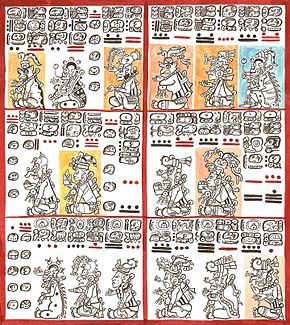
One of the scientists that I have referenced in my posts a lot is the American physicist Richard Feynman. I particularly love his imaginary depiction of Mayan astronomy. Feynman went to Mexico for his second honeymoon and came across a copy of the Dresden Codex (one of the oldest surviving books from the Americas). He was particularly interested in the bars and dots in the codex. He was able to decipher the number system that the Mayans used to depict Venus’ trajectory in the solar system. He was so good at it that he was able to find that some of the versions were actually fakes. Feynman imagined the Mayans counting and putting nuts in a pot to make predictions of where Venus would be on a given day. Feynman was curious whether the Mayans actually knew what was happening (why it was happening) or whether they were going by the rules and making predictions based on a rule-based system of counting and manipulating numbers. Feynman stated that the Mayans may have gotten really good with counting but they must not have understood how the celestial bodies worked.

The push for following rules without understanding the context is unfortunate. Yet this is very prevalent. The rigidity of the rules cannot be sustained when a complex situation arises. The rigidity of rules indicates a direct linear relationship where cause and effect are clearly noted. This is the push for standardization and having one best way of doing things. This leads to stagnation, since this stymies creativity and the push for innovation. Rigid rules always break. Another way to look at this is as the push for robustness – avoiding failure by any means. We will put redundant steps, perform multiple inspections and implement punishments for not following rules. In the complex world, we should accept that things will fail – the push should be for resilience, getting back up in a short time. The rules are dictated top-down since the rules are created by the experts. These rules do not have the requisite variety to tackle the uncertainties of day-to-day dealings. The contexts of these rules do not match the actual context where the action takes place – the context at the gemba. Context is what brings out the meaning in a situation. The focus on rules and efficiency through best practice does not lead to having the requisite variety to change the context as needed to address a problem when it arises. We are involved in complex adaptive systems on a day-to-day basis. We need to change context as needed and adapt to respond to unanticipated events. Evolution requires that we have variety. This response is not always rule-based and is developed depending upon the context. We should allow room for bottom-up heuristics, since these are based on experience and local context.

As a simple example, let’s look at 5S, one of the most commonly identified lean tools, to look into this more. 5S is translated from Japanese as Sort, Straighten, Shine, Standardize and Sustain. The rules are provided to us and they are clear cut. Similar to the Mayan story, do we actually know the context for 5S? Toyota did not have 5S. The last few S’s were added on later. This has now changed into 6S and even 7S. The “sort” step in 5S is to have only the required tools needed at the station. The “straighten” step is to identify/label the tools so that operators from other shifts or job rotations can easily find the tools. The third step is “shine” where the work station is cleaned by the operator. This allows the operator to find any spills or other signs of wear and tear that may not be seen by a cleaning crew. These three steps help the operator to identify problems as they occur, raises awareness and helps to take pride in the work. The fourth step is “standardize” and this is mainly a regulatory function to ensure that the first three steps are followed. The last step is “sustain”, which means to integrate the first three steps so that they become the normal routine and if they are not followed, one feels like something is missing. The context is to help the operator do his or her job better and be effective. The context is that a problem is made visible immediately so that it can be addressed and people can be developed. The context is not following rules. The context is not applying 5S in areas where it does not make sense. The context certainly is not policing people. When the context of what the operator does is not made clear, they do what makes sense to them in their context – at that time with the limited information they have. Empty actions do not have context and are thus meaningless and non-value adding.

Seek to understand the perspectives of your employees. Seek to understand their local context. Seek to make them understand your context, and the context of the shared goals and objectives. Heed to their stories. Develop your employees to see problems.

I will finish with an interesting question that was posed by some French researchers in the late 1970’s.

“On a boat, there are 26 sheep and 10 goats. What is the age of the captain?”

Perhaps, you might see this as a trick question. Perhaps, you may use the two numbers given and come up with the answer as 36. The answer 36 sounds right. The answer that the researchers expected was “I do not have enough information to give the answer.”

To the researchers’ surprise, very few subjects challenged the question. Most of them reasoned in their context and came up with a number that made sense in their mind. We are not trained to ask the contextual questions.

Always keep on learning and ask contextual questions…

In case you missed it, my last post was MTTF Reliability, Cricket and Baseball:

Flat Earth Lean:

pipe

How many interpreters does it take to change a light bulb?

It depends on the context!

In today’s post, I will be looking at what I call “Flat Earth Lean” and “Contextual Lean”. I recently came across the concept of “Flat Earth View” in organizational communication. Matthew Koschmann, currently an associate professor at the University of Colorado, talks about the one-dimensional approach to organization communication where the big picture is not used. It is a linear approach without looking at the contexts or the social aspects. Koschmann explains – What I mean by a flat earth approach is a perspective that seems correct from a limited vantage point because it works for much of our day to day lives, but ultimately it fails to account for the complexity of a situation. For much of human history we got by just fine thinking the earth was flat, even though it was always round. And even with our 21st century sophistication where we know the earth is round, most of us can actually get by with flat earth assumptions much of the time. But what about when things get more complex? If you want to put a satellite into space or take a transcontinental flight, flat earth assumptions are not going to be very helpful. Remember in elementary school when you compared a globe to a map and realized, for example, that it s quicker to fly from New York to Moscow by flying over the North Pole instead of across the Atlantic? What seems counter intuitive from a flat earth perspective actually makes perfect sense from a round earth perspective.”

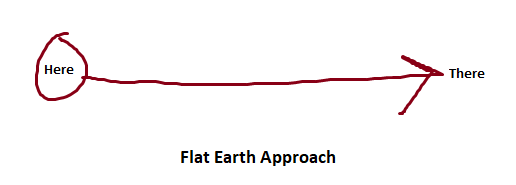
I would like to draw an analogy to Lean. Perhaps, the concept of flat earth exists in Lean as well. This could be looked at as the tools approach or copying Toyota’s solutions to apply them blindly. The linear approach implies a direct cause and effect relationship. From the Complexity Science standpoint, the linear relationship makes sense only in the simple and complicated domains. This is the view that everything is mechanistic, utilizing the metaphor of a machine – press this button here to make something happen on the other side with no unintended consequence or adverse effects. In this world, things are thought to be predictable, they can be standardized with one-glove-fits-all solutions, and every part is easily replaceable. Such a view is very simplistic and normally cares only about efficiency. This is an approach that is used for technical systems. There is limited or no focus on context. Hajime Ohba, a Toyota veteran, used to say that simply copying Toyota’s methods is like creating the image of Buddha and forgetting to inject soul in it. In Flat Earth Lean, the assumption is that end goal is clearly visible and that it is as easy as going from HERE to THERE. The insistence is always to KISS (keep it simple stupid). In many regards, this reductionist approach was working in the past. Information generation was minimal and the created information was kept local in the hands of the experts. In today’s global economy, organizations do not have the leisure to keep using the reductionist approach. Today, organizations not only have to ensure that information is diffused properly, they also have to rely on their employees to generate new information on a frequent basis. The focus needs to be shifted to organizations being socio-technical systems where things are not entirely predictable.

Here to There

Karl Weick, an American organizational theorist, advises to “complicate yourself”. He cautions us to not rely on oversimplification. We need to understand the context of what we are doing, and then challenge our assumptions. We have to look for contradictions and paradoxes. They are the golden nuggets that help us to understand our systems. In Contextual Lean, we have to understand our problems first and then look for ways to make things better. Implementing 5S with the aim of being “Lean” is the Flat Earth Approach. Implementing 5S and other visualization methods to make sense of our world, and making problems visible so that we can address them is “Contextual Lean”. If there is such a thing as “going Lean” for an organization, it is surely a collective expression. “Lean” does not exist in isolation in a department or in a cabinet; let alone in one Manager or an employee. To paraphrase the great philosopher, Ludwig Wittgenstein, the meaning of an expression exists only in context. Context gives meaning. Toyota’s “Lean” has limited meaning in relation to your organization since it makes sense only in the context of the problems that Toyota has. Thus, when the Top Management pushes for Lean initiation, it has to be in the context of the problems that the organization has. Understanding context requires self-reflection and continuous learning for the organization. This again is a collective expression and does not exist without involving the employees. Interestingly, Contextual Lean has to utilize Flat Earth approach as needed.

Flat Earth and Contextual Lean have some similarities to the late American business theorist Chris Argyris’ ideas of Single and Double Loop learning. Single Loop learning is the concept of correcting an error by using the existing mental models, norms and practices. Argyris gives the example of a thermostat to explain this – Single loop learning can be compared with a thermostat that learns when it is too hot or too cold and then turns the heat on or off. The thermostat is able to perform this task because it can receive information (the temperature of the room) and therefore take corrective action. Double Loop Learning, on the other hand, involves a reflective phase that challenges the existing mental models, norms and practices, and modifies them to correct the error. In Chris Argyris’ words –If the thermostat could question itself about whether it should be set at 68 degrees, it would be capable not only of detecting error but of questioning the underlying policies and goals as well as its own program. That is a second and more comprehensive inquiry; hence it might be called double loop learning. Single Loop Learning has some similarities to Flat Earth Lean in that it wants to take a simplistic approach and does not want to modify the mental models. It wants to keep doing what is told and to use an old analogy – only bring your hands to work and leave your brains outside. Single Loop Learning is a superficial approach to solve problems symptomatically. Double Loop Learning has some similarities to Contextual Lean in that it is not one-dimensional and results in modifying the mental models as needed. It is a continuous learning and adapting cycle. Argyris also believed that organizations learn when its people learn – Organizational learning occurs when individuals, acting from their times and maps, detect a match or mismatch of outcome to expectation which confirms or disconfirms organizational theory-in-use.

I will finish with a fitting contextual story about change.

Mulla Nasrudhin was now an old man. People used to gather around to hear him talk. One day a young man asked for some words of wisdom.

Mulla replied, “When I was young I was very strong minded- I wanted to awaken everyone. I prayed to God to give me the strength to change the world. As time went on, I became middle aged and I realized that I did not change the world. Then I prayed to God to give me strength so that I can at least change those close around me. Now that I am older and perhaps wiser, my prayer has become simpler. I say – God, please grant me the strength to change at least myself.”

Always keep on learning…

In case you missed it, my last post was The Purpose of Visualization: