Ohno and VUT:

Ohno and Kingsman

One of my favorite “Factory Physics [1] equations” is Kingman’s equation, usually represented as “VUT”. The VUT equation is named after Sir John Kingman, a British mathematician.

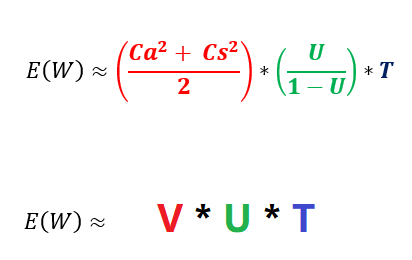
The equation is as follows:
VUT

The first factor represents variability and is a combination of variability factors representing arrival and service times (flow variability and process variability). The second factor represents utilization of the work station or the assembly line. The third factor represents the average processing time in the work station or the assembly line. The VUT equation shows that the average cycle time or wait time is proportional to the product of variability, utilization and process time.

The most important lesson from VUT is:

If a station increase utilization without making any other change, average WIP (work in process) and cycle time will increase in a highly nonlinear fashion.

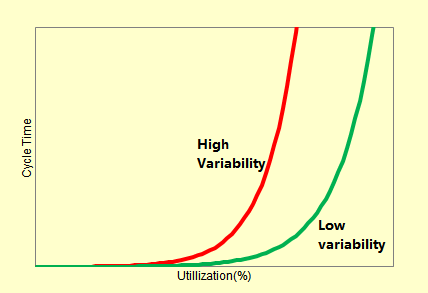
The influence of variability on cycle time is shown below. The red line shows that with high variability, any increase in utilization will results in an exponentially higher cycle time. If the variability is low (indicated by the green line), then the increase in the cycle time happens at a slower rate. If there was no variability, then the cycle time will be a constant. In other words, an increase in variability always degrades the performance of a production system.
VUT chart

Some of the lessons that we can learn from VUT equation are:

  1. To maintain a steady cycle time, reduce utilization if variability cannot be reduced. Reducing utilization means increasing capacity. As demand goes up, do not try to run the line at 100% utilization.
  2. The VUT equation can be used in conjunction with Little’s Law. Little’s Law states that WIP is proportional to the product of Throughput rate and Cycle Time. In other words, WIP is proportional to the product of Throughput and VUT. If you try to reduce WIP without trying to reduce variability, the throughput will go down. Thus, implementing one-piece flow without trying to reduce variability will result in a reduction in throughput.
  3. Reducing process variability will reduce cycle time variability.
  4. Adding buffer space at bottlenecks will improve throughput. Adding buffers at non-bottlenecks will not have a positive impact on throughput.
  5. Variability shall always be buffered either in the form of inventory, capacity or time. If variability is not reduced, you pay in terms of high WIP, underutilized capacity and reduced customer service. This is further explained here.
  6. Utilization effects are not linear but are highly nonlinear. Thus, the effect of variability at 40% utilization is not half of the effect of variability at 80% utilization.
  7. Reducing variability reduces uncertainty regarding cycle time or project lead times.
  8. First reduce variability and then go for increasing throughput.
  9. The rule of thumb is to run a line at or near 80% utilization. You should experiment yourself to learn more about your production system.
  10. In Lean, the variability factor can viewed as Mura (unevenness) and the burden from pushing for 100% utilization can be viewed as Muri (overburdening). Both result in Muda (waste).

VUT and TPS(Lean):

Taiichi Ohno, the father of Toyota Production System (TPS), learned by trial and error and by actively learning from the gemba. Ohno realized early on that the first step in increasing throughput is by achieving stability. The idea of variability is closely tied to the idea of Mura (unevenness) in TPS. Ohno pushed for the idea of standard work for kaizen. He taught that kaizen is not possible without standard work. Standard work is aimed at reduction of variability in the process. In addition, Ohno came up with kanban to minimize variability in the process flow. He further pushed for reduction in WIP once process stability was achieved. Ohno constantly pushed to remove “waste” from the production system through kaizen. This continuous improvement cycle helped to maintain process stability. As Art Smalley puts it, What Toyota (Ohno) learned the hard way is that in the beginning of a transformation you need lots of basic stability before you can succeed with the more sophisticated elements of lean… Veterans of Toyota comment that certain pre-conditions are needed for a lean implementation to proceed smoothly.  These include relatively few problems in equipment uptime, available materials with few defects, and strong supervision at the production line level.[2]

Art Smalley further gives four questions to evaluate stability:

  1. Do you have enough machine uptime to produce customer demand?
  2. Do you have enough material on hand every day to meet your production needs?
  3. Do you have enough trained employees available to handle the current processes?
  4. Do you have work methods, such as basic work instructions, defined or standards in place?

If the answer is emphatically “no” to any of these questions, stop and fix the problem before proceeding. Attempting to flow product exactly to customer demand with untrained employees, poor supervision, or little inventory in place is a recipe for disaster.

It is said that Ohno first go-to method to train the production team to start thinking in terms of improvement is to ask the line to maintain current throughput with one less operator. In many regards, this can be viewed as reducing capacity or increasing utilization. As we learned from VUT, increasing utilization is a bad thing. Why would Ohno do that?

Ohno firmly believed that doing is the main way to learn something. Ohno advises that – “Knowledge is something you buy with the money. Wisdom is something you acquire by doing it.” Ohno was able to “see” wastes in the process that hindered the flow. Ohno had to train others to see the wastes like he did. It is likely that Ohno was able to the see the wastes in the current process that the leads or the operators are not able to see. This could be because they are able to meet the demand with their current process. The only way that Ohno could make them improve further was by asking them to do the same with one less operator. The removal of one operator challenged the team to look at their standard work, and the process to see where excess waste was. This idea of challenge is part of the “respect for people” pillar of the Toyota Way. It is said that TPS also stands for “Thinking Production System”, a system that makes people think! Toyota develops their people to think and be autonomous to see problems and fix them. Fujio Cho, ex-President of Toyota Motor Corporation and a student of Ohno, has said that the Toyota Production System pioneered by Ohno is not just a method of production; it is a different way of looking and thinking about things. Ohno developed the management team by giving genchi genbutsu-based practical tasks through which the team members were matched in a “competition of wits” against him [3]. Cho called it the hands-on human resources “nurturing” that Ohno promoted. Ohno believed that if he was in a position to give orders, he could not do that unless he has had a lot of confidence about what he was asking. Ohno saw that the current condition can be improved, and he challenged the team to do that by knowingly pushing the utilization up.

I welcome to reader to learn more about VUT here and here.

Always keep on learning…

In case you missed it, my last post was The Cybernetic View of Quality Control:

[1] Factory Physics by Wallace Hopp and Mark Spearman

[2] Basic Stability is Basic to Lean Manufacturing Success by Art Smalley

[3] Workplace Management by Taiichi Ohno
Book Review – Measures of Success:

Measures-of-Success-Cover-Dark-Green-Final-copy-1

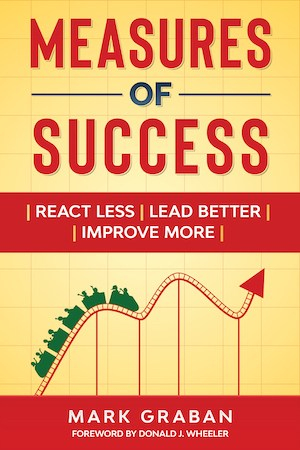
In today’s post, I am reviewing the book, “Measures of Success”, written by Mark Graban. Graban is a Lean thinker and practitioner. Graban has written several books on Lean including Lean Hospitals and Healthcare Kaizen. Graban was kind enough to send me a preview copy of his latest book, Measures of Success. As Graban writes in the Preface, his goal is to help managers, executives, business owners, and improvement specialists in any industry use limited time available more effectively.

The book is about Process Behavior Charts or PBC (Statistical Process Control or SPC). Graban teaches in an easy way how to use Process Behavior Charts to understand a process, and truly see and listen to the process. The use of PBC is a strategy of prevention, and not a strategy of detection alone. PBCs help us see when a process is in control and whether what we see is indicative of normal noise present in a process in control or not. Walter Shewhart, who created and pioneered SPC, defined control as:

A phenomenon is said to be controlled when, through the use of past experience, we can predict at least within limits, how the phenomenon may be expected to vary in the future. Here it is understood that prediction within limits means that we can state, at least approximately, the probability that the observed phenomenon will fall within the given limits.

 Shewhart proceeded to state that a necessary and sufficient condition for statistical control is to have a constant system of chance causes… It is necessary that differences in the qualities of a number of pieces of a product appear to be consistent with the assumption that they arose from a constant system of chance causes… If a cause system is not constant, we shall say that an assignable cause is present.

Graban has written a great book to help us decide what is noise and what is meaningful data. By understanding how the process is speaking to us, we can stop overreacting and use the saved time to actually make meaningful improvements to the process. Graban has a great style of writing which makes a somewhat hard statistical subject easy to read. I enjoyed the narrative he gave of the CEO looking at the Bowling Chart and reacting to it in the third chapter. The CEO was following the red and green datapoints, and reacting by either pontificating as a means of encouragement or yelling “just do things right” at her team. And worse of all, she thinks that she is making a difference by doing it. Just try harder and get to the green datapoint! Graban also goes into detail on Deming’s Red Bean experiment that is a fun way of demonstrating the minimal impact a worker has on normal variation of the process through a fun exercise.

Similar to Deming’s line of questions regarding process improvementHow are you going to improve? By what method? And How will you know?, Graban also provides three insightful core questions:

  1. Are we achieving our target or goal?
  2. Are we improving?
  3. How do we improve?

We should be asking these questions when we are looking at a Process Behavior Chart. These questions will guide in our continual improvement initiatives. Graban has identified 10 key points that help us reflect on our learning of PBCs. They are available at his website. They help us focus on truly understanding what the process is saying – where are we and should we make a change?

Graban provides numerous examples of current events depicted as PBCs. Some of the examples include San Antonio homicide rates and Oscar Ratings. Did the homicide rate significantly go down recently? Did the Oscar ratings significantly go down in the recent years? These are refreshing because they help solidify our understanding. This also provides a framework for us to do our own analysis of current events we see in the news. Graban also provides an in-depth analysis of his blog data. In addition, there are several workplace cases and examples included.

The list of Chapters are as follows:

  • Chapter 1: Improving the Way We Improve
  • Chapter 2: Using Process Behavior Charts for Metrics
  • Chapter 3: Action Metrics, not Overreaction Metrics
  • Chapter 4: Linking Charts to Improvement
  • Chapter 5: Learning From “The Red Bead Game”
  • Chapter 6: Looking Beyond the Headlines
  • Chapter 7: Linear Trend Lines and Other Cautionary Tales
  • Chapter 8: Workplace Cases and Examples
  • Chapter 9: Getting Started With Process Behavior Charts

The process of improvement can be summarized by the following points identified in the book:

  • If we have an unpredictable system, then we work to eliminate the causes of signals, with the aim of creating a predictable system.
  • If we have a predictable system that is not always capable of meeting the target, then we work to improve the system in a systematic way, aiming to create a new a system whose results now fluctuate around a better average.
  • When the range of predictable performance is always better than the target, then there’s less of a need for improvement. We could, however, choose to change the target and then continue improving in a systematic way.

It is clear that Graban has written this book with the reader in mind. There are lots of examples and additional resources provided by Graban to start digging into PBCs and make it interesting. The book is not at all dry and has managed to retain the main technical concepts in SPC.

The next time you see a Metric dashboard either at the Gemba or in the news, you will definitely know to ask the right questions. Graban also provides a list of resources to further improve our learning of PBCs. I encourage the readers to check out Mark Graban’s Blog at LeanBlog.org and also buy the book, Measures of Success.

Always keep on learning…

In case you missed it, my last post was Ubuntu At the Gemba:

Ubuntu At the Gemba:

Ubuntu

“My humanity is tied to yours. I am because you are.” 

In today’s post I will be looking at the African philosophical concept of Ubuntu. The word “Ubuntu” is best explained by the Nguni aphorism – Umuntu Ngumuntu Ngabantu, which means “a person is a person because of or through others.” Ubuntu is a key African philosophy and can be translated as humanity. It emphasizes the group solidarity, sharing, caring and the idea of working together for the betterment of everybody. Ubuntu has many derivatives in Bantu languages and this concept is spread across the many nations in Africa.

Ubuntu is the humanness in us. It is said that a solitary human being is a contradiction. We remain human as part of a community. We get better through the betterment of our community. Our strength comes from being part of a community. To quote Archbishop Desmond Tutu:

One of the sayings in our country is Ubuntu – the essence of being human. Ubuntu speaks particularly about the fact that you can’t exist as a human being in isolation. It speaks about our interconnectedness. You can’t be human all by yourself, and when you have this quality – Ubuntu – you are known for your generosity. 

We think of ourselves far too frequently as just individuals, separated from one another, whereas you are connected and what you do affects the whole world. When you do well, it spreads out; it is for the whole of humanity. 

An interesting part about African philosophy is that most of it was not written down. The ideas were transmitted through oral traditions, which depended upon having strong communal roots. Some of the key ideas that are part of the Ubuntu philosophy are:

  • Always aim for the betterment of the community over self.
  • When we treat others with dignity, all of us are able to perform and contribute better.
  • The strength of the community lies in the interconnectedness of the members.
  • The survival of one person is dependent upon the survival of the community.
  • Ubuntu philosophy aims for harmony and consensus in decision making.
  • Ubuntu requires us to be open and make ourselves available to others.
  • Ubuntu requires us to coach and mentor those younger than us. This also helps us become better at what we do.
  • Respect and dignity, as part of ubuntu, ensure that we provide an environment where everybody is able to contribute and bring value.
  • Ubuntu is a philosophy focused on people, and promotes working together as a team towards the common goal. At the same time, it promotes healthy competition and challenges people to keep growing.
  • Ubuntu points out that aiming for individual goals over common goals is not good. System optimization is the end goal.
  • Ubuntu facilitates a need to have a strong communication system.
  • As a management system, Ubuntu puts the focus on local conditions and context. How does what we do impact those around us? How does what we do impact our environment? How does what we do impact our society?
  • Another key concept is the Ubuntu philosophy is forgiveness or short memory of hate!

As I was researching and learning about Ubuntu, I could not help but compare it against the concept of “Respect for Humanity” in Toyota Production System.  I see many parallels between the two concepts. Respect for Humanity (People) is one of the two pillars of the Toyota Way. The other pillar being Continuous Improvement. Japan is an island with limited resources, and the concept of harmony is valued in the Japanese culture. Toyota Production System and Lean are famous for its many tools. Tools are easy to identify since they have physical attributes like kanban, Visual work place, standard work etc. However, respect for people was not understood or looked at by the Toyota outsiders. Most of the Japanese literature about Toyota Production System mentioned Respect for Humanity (people) while it took a while for the western authors to start discussing Respect for Humanity.

Toyota’s view of Respect for People is to ensure that its employees feel that they are bringing value and worth to the organization. Fujio Cho, the pioneer of the Toyota Way 2001, expressed Respect for People as:

Creating a labor environment “to make full use of the workers’ capabilities.” In short, treat the workers as human beings and with consideration. Build up a system that will allow the workers to display their full capabilities by themselves.

Toyota has built up a system of respect for human, putting emphasis on the points as follows: (1) elimination of waste movements by workers; (2) consideration for workers’ safety; and (3) self-display of workers’ capabilities by entrusting them with greater responsibility and authority.

Final Words:

Paul Bate, Emeritus Professor of Health Services Management in University College London, said:

Nothing exists, and therefore can be understood, in isolation from its context, for it is context that gives meaning to what we think and we do.

Our context is in the interconnectedness that we share with our fellow beings. It is what gives meaning to us. In this regard, Ubuntu sheds light on us as humans. Respect for people begins by developing them and providing them an opportunity to grow so that they can help with the common goal and causes.

I will finish with the great Nelson Mandela’s explanation of Ubuntu:

A traveler through a country would stop at a village and he didn’t have to ask for food or for water. Once he stops, the people give him food and attend him. That is one aspect of Ubuntu, but it will have various aspects. Ubuntu does not mean that people should not enrich themselves. The question therefore is:

Are you going to do so in order to enable the community around you to be able to improve?

Always keep on learning…

In case you missed it, my last post was Clausewitz at the Gemba:

Nietzsche’s Overman at the Gemba:

Overman

In today’s post, I am looking at Nietzsche’s philosophy of Übermensch. Friedrich Wilhelm Nietzsche is probably one of the most misunderstood and misquoted philosophers. The idea of Übermensch is sometimes mistranslated as Superman. A better translation is “Overman”. The German term “mensch” means “human being” and is gender neutral. Nietzsche spoke about overman first in his book, “Thus Spoke Zarathustra.” In the prologue of this book, Nietzsche through Zarathustra asks:

I teach you the overman. Man is something that shall be overcome. What have you done to overcome him?

Nietzsche provides further clarification that, “Man is a rope, fastened between animal and Übermensch – a rope over an abyss.Übermensch is an idea that represents a being who has overcome himself and his human nature – one who can break away from the bondage of ideals and create new ones in place of the old stale ones.

Nietzsche came to the conclusion that humanity was getting stale by maintaining status quo through adhering to ideals based in the past. He also realized that the developments in science and technology, and the increase in collective intelligence was disrupting the “old” dogmatic ideals and the end result was going to be nihilism – a post-modern view that life is without meaning or purpose. Nietzsche famously exclaimed that; God is dead! He was not rejoicing in that epiphany. Nietzsche proposed the idea of Übermensch as a solution to this nihilistic crisis. Übermensch is not based on a divine realm. Instead Übermensch is a higher form on Earth. Overcoming the status quo and internal struggles with the ideals is how we can live our full potential in this earth and be Übermensch.

Nietzsche contrasted Übermensch with “Last Man”. The last man embraces status quo and lives in his/her comfort zone. The last man stays away from any struggle, internal or external. The last man goes with the flow as part of a herd. The last man never progresses, but stays where he is, clutching to the past.

Nietzsche used the metaphors of the camel, the lion and the child to detail the progress towards becoming an Übermensch. As the camel, we should seek out struggle, to gain knowledge and wisdom through experience. We should practice self-discipline and accept more duties to improve ourselves. As the lion, we should seek our independence from the ideals and dogmas. Nietzsche spoke of tackling the “Thou Shalt” dragon as the lion. The dragon has a thousand scales with the notation, “thou shalt”. Each scale represents a command, telling us to do something or not do something. As the lion, we should strongly say, “No.” Finally, as the child, we are free. Free to create a new reality and new values.

At the Gemba:

Several thoughts related to Übermensch  and Lean came to my mind. Toyota teaches us that we should always strive toward True North, our ideal state. We are never there, but we should always continue to improve and move towards True North. Complacency/the push to maintain status quo is the opposite of kaizen, as I noted in an earlier post.

I am reminded of a press article about Fujio Cho. In 2002, when Fujio Cho was the President of Toyota Motor Corporation, Toyota became the third largest automaker in the world and had 10.2% of share of world market. Cho unveiled a plan to be world’s largest automaker with 15% global market share. Akio Matsubara, Toyota’s managing director in charge of the corporate planning division, stated:

“The figure of 15 percent is a vision, not a target,” he said. “Now that we’ve achieved 10 percent, we want to bring 15 percent into view as our next dream. We don’t see any significance in becoming No. 1.”

The point of the 15 percent figure, he said, is to motivate Toyota employees to embrace changes to improve so they would not become complacent with the company’s success.

My favorite part of the article was Morgan Stanley Japan Ltd. auto analyst Noriaki Hirakata’s remarks about Fujio Cho. Toyota’s executives, he said, believe Toyota is “the best in the world, but they don’t want to be satisfied.”

It’s as if Cho’s motto has become “Beat Toyota,” Hirakata said.

I am also reminded of a story that the famous American Systems Thinker, Russel Ackoff shared. In 1951, he went to Bell Labs in Murray Hill, New Jersey, as a consultant. While he was there, all the managers were summoned to an impromptu urgent meeting by the Vice President of Bell Labs. Nobody was sure what was going on. Everyone gathered in a room anxious to hear what the meeting was about. The Vice President walked in about 10 minutes late and looked very upset. He walked up to the podium and everyone became silent. The Vice President announced:

“Gentlemen, the telephone system of the United States was destroyed last night.”

He waited as everyone started talking and whispering that it was not true. The Vice President continued:

“The telephone system was destroyed last night and you had better believe it. If you don’t by noon, you are fired.”

The room was silent again. The Vice President then started out laughing, and everyone relaxed.

“What was that all about? Well, in the last issue of the Scientific American,” he said, “there was an article that said that these laboratories are the best industrially based scientific laboratories in the world. I agreed, but it got me thinking.”

The Vice President went to on to state that all of the notable inventions that Bell Lab had were invented prior to 1900. This included the dial, multiplexing, and coaxial cable. All these inventions were made prior to when any of the attendees were born. The Vice President pointed out that they were being complacent. They were treating the parts separately and not improving the system as a whole. His solution to the complacency? He challenged the team to assume that the telephone system was destroyed last night, and that they were going to reinvent and rebuilt it from scratch! One of the results of this was the push button style phones that reduced the time needed to dial a number by 12 seconds. This story reminds me of breaking down the existing ideals and challenging the currently held assumptions.

Nietzsche challenges us to overcome the routine monotonous ideas and beliefs. Instead of simply existing, going from one day to the next, we should challenge ourselves to be courageous and overcome our current selves. This includes destruction and construction of ideals and beliefs. We should be courageous to accept the internal struggle, when we go outside our comfort zone. The path to our better selves is not inside the comfort zone.

Similar to what Toyota did by challenging the prevalent mass production system and inventing a new style of production system, we should also challenge the currently held belief system. We should continue evolving toward our better selves. As Nietzsche said:

What is great in man is that he is a bridge and not an end.

I say unto you: One must still have chaos in oneself to be able to give birth to a dancing star.

Always keep on learning…

In case you missed it, my last post was Solving a Lean Problem versus a Six Sigma Problem:

Solving a Lean Problem versus a Six Sigma Problem:

Model

I must confess upfront that the title of this post is misleading. Similar to the Spoon Boy in the movie, The Matrix, I will say – There is no Lean problem nor a Six Sigma problem. All these problems are our mental constructs of a perceived phenomenon. A problem statement is a model of the actual phenomenon that we believe is the problem. The problem statement is never the problem! It is a representation of the problem. We form the problem statement based on our vantage point, our mental models and biases. Such a constructed problem statement is thus incomplete and sometimes incorrect. We do not always ask for the problem statement to be reframed from the stakeholder’s viewpoint. A problem statement is an abstraction based on our understanding. Its usefulness lies in the abstraction. A good abstraction ignores and omits unwanted details, while a poor abstraction retains them or worse omits valid details. Our own cognitive background hinders our ability to frame the true nature of the problem. To give a good analogy, a problem statement is like choosing a cake slice. The cake slice represents the cake, however, you picked the slice you wanted, and you still left a large portion of the cake on the table, and nobody wants your slice once you have taken a bite out of it.

When we have to solve a problem, it puts tremendous cognitive stress on us. Our first instinct is to use what we know and what we feel comfortable with. Both Lean and Six Sigma use a structured framework that we feel might suit the purpose. However, depending upon what type of “problem” we are trying to solve, these frameworks may lack the variety they need to “solve” the problem. I have the used the quotation marks on purpose. For example, Six sigma relies on a strong cause-effect relationship, and are quite useful to address a simple or complicated problem. A simple problem is a problem where the cause-effect relationship is obvious, whereas a complicated problem may require an expert’s perspective and experience to analyze and understand the cause-effect relationship. However, when you are dealing with a complex problem, which is non-linear, the cause-effect relationship is not entirely evident, and the use of a hard-structured framework like Six sigma can actually cause more harm than benefit. All human-centered “systems” are complex systems. In fact, some might say that such systems do not even exist. To quote Peter Checkland, In a certain sense, human activity systems do not exist, only perceptions of them exist, perceptions which are associated with specific worldviews.

We all want and ask for simple solutions. However, simple solutions do not work for complex problems. The solutions must match the variety of the problem that is being resolved. This can sometimes be confusing since the complex problems may have some aspects that are ordered which give the illusion of simplicity. Complex problems do not stay static. They evolve with time, and thus we should not assume that the problem we are trying to address still has the same characteristics when they were identified.

How should one go from here to tackle complex problems?

  • Take time to understand the context. In the complex domain, context is the key. We need to take our time and have due diligence to understand the context. We should slow down to feel our way through the landscape in the complex domain. We should break our existing frameworks and create new ones.
  • Embrace diversity. Complex problems require multidisciplinary solutions. We need multiple perspectives and worldviews to improve our general comprehension of the problem. This also calls to challenge our assumptions. We should make our assumptions and agendas as explicit as possible. The different perspective allows for synthesizing a better understanding.
  • Similar to the second suggestion, learn from fields of study different from yours. Learn philosophy. Other fields give you additional variety that might come in handy.
  • Understand that our version of the problem statement is lacking, but still could be useful. It helps us to understand the problem better.
  • There is no one right answer to complex problems. Most solutions are good-enough for now. What worked yesterday may not work today since complex problems are dynamic.
  • Gain consensus and use scaffolding while working on the problem structure. Scaffolding are temporary structures that are removed once the actual construction is complete. Gaining consensus early on helps in aligning everybody.
  • Go to the source to gain a truer understanding. Genchi Genbutsu.
  • Have the stakeholders reframe the problem statement in their own words, and look for contradictions. Allow for further synthesis to resolve contradictions. The tension arising from the contradictions sometimes lead us to improving and refining our mental models.
  • Aim for common good and don’t pursue personal gains while tackling complex problems.
  • Establish communication lines and pay attention to feedback. Allow for local context while interpreting any new information.

Final Words:

I have written similar posts before. I invite the reader to check them out:

Lean, Six Sigma, Theory of Constraints and the Mountain

Herd Structures in ‘The Walking Dead’ – CAS Lessons

A successful framework relies on a mechanism of feedback-induced iteration and keenness to learn. The iteration function is imperative because the problem structure itself is often incomplete and inadequate. We should resist the urge to solve a Six Sigma or a Lean problem. I will finish with a great paraphrased quote from the Systems Thinker, Michael Jackson (not the famous singer):

To deal with a significant problem, you have to analyze and structure it. This means, analyzing and structuring the problem itself, not the system that will solve it. Too often we push the problem into the background because we are in a hurry to proceed to a solution. If you read most texts thoughtfully, you will see that almost everything is about the solution; almost nothing is about the problem.

Always keep on learning…

In case you missed it, my last post was Maurice Merleau-Ponty’s Lean Lessons:

Maurice Merleau-Ponty’s Lean Lessons:

Merleau-Ponty

In today’s post, I am writing about three great Lean lessons inspired by the late French philosopher, Maurice Merleau-Ponty. Merleau-Ponty was a phenomenologist who believed that our conceptual framework is inherently flawed. He wanted to develop a framework that accurately reflected the nature of things it described. His insight was that we perceive things by interacting with them. The more we interact, the deeper our perception becomes, and the more we can enjoy the richness of the object we are interacting with. Merleau-Ponty believed that being in the world is the embodied experience of perception. The world does not present itself “all at once” to the perceiver. The perceiver has to go through an ongoing process of exploration and discovery and a deeper understanding emerges gradually through this ongoing process.

The three lessons I have chosen are interrelated and are about perception. Lean teaches us the importance of Genchi Genbutsu or Go to See and Grasp the Situation. The following three ideas align really well with the idea of Genchi Genbutsu.

  • The philosopher is a perpetual beginner…

Merleau-Ponty’s point here is that a true philosopher does not take things for granted. I will replace the word “philosopher” with “Lean leader”. Thus, the Lean leader is a perpetual beginner. As Lean leaders, we are ready to learn everyday from the gemba. We are continually improving our perception from the gemba. We must resist the urge to feel that we have completed our learning and that there is nothing left to learn. To paraphrase Merleau-Ponty, we need to learn to see the world (and gemba) as something new every single day. We must start to “see” with a beginner’s mind to learn.


  • In order to see the world, we must break with our familiar acceptance of it:

Our ability to observe depends on our preconceived notions and biases. Understanding of a phenomenon lies under the surface in the nuances and the contradictions. Our familiarity based on our prior biases cloud our ability to “see”, and Merleau-Ponty advises us to break our familiar acceptance in order to see the world. We must put aside our assumptions and relearn to see the world with fresh eyes.


  • Nothing is more difficult than to know precisely what we see:

This idea to me is simply wonderful. When we are at the Gemba to see or observe, we jump to conclusions. We believe that we “see” the problem and know how to fix it. The act of observing and perceiving requires a vantage point. This vantage point comes with prejudices. We believe that what we see is quite simple and straightforward, and that we have a clear perspective. This actually hinders our ability to know and understand the phenomenon we are perceiving. From a philosophy standpoint, we believe that what we perceive is reality. This of course is incomplete and most of the time a faulty notion.

Final Words:

The three ideas of Merleau-Ponty advises us to go to the Gemba more and interact with it to improve our understanding. We should look at the real workplace with the eyes of a beginner, and keep interacting with an open mind without preconceived notions to learn. We should resist the urge to believe that we know precisely what we see.

Taiichi Ohno was famous for his Ohno circles. Taiichi Ohno drew chalk circles and made the supervisor or the engineer stand in the circle to observe an operation until he was able to “see” the waste that Ohno saw. Similar to Merleau-Ponty, Ohno also advises us to go and see without preconceived notions. Go and see a lot. This helps us to improve our perception. The more we do it, the better we get at it. And yet, we should strive to remain a perpetual beginner.

Always keep on learning…

In case you missed it, my last post was Toyota Physics:

Toyota Physics:

newton

In today’s post, I am looking at Factory Physics and Toyota Production System. My main references for the post are the 1977 paper coauthored by ex-Toyota president Fujio Cho [1] and key ideas from Factory Physics [2].

One of my favorite definitions of “Lean” comes from Wallace J. Hopp and Mark L. Spearman (Factory Physics). They defined Lean as:

Lean is fundamentally about minimizing the cost of buffering variability… Production of goods or services is lean if it is accomplished with minimal buffering costs.

Variability is the norm of life. Variability is all around us. Variability impacts the 6Ms of production – Man, Method, Machine, Material, Mother Nature (Environment) and Measurement. Variability degrades the performance of a system. Variability is anything that causes the system to depart from regular, predictable behavior. Variability can be internal in the form of quality issues, operator unavailability, material shortage, skill levels, equipment issues etc. Variability can also be external in the form of irregular flow of customer orders, requests for diverse products, supplier issues, new regulations etc.

Factory Physics teaches us that any system has three buffers to deal with variability – Inventory, Capacity and Time.

Regardless of its source, all variability in a production system will be buffered. A fundamental principle of factory physics is that there are three types of variability buffer: inventory, capacity, and time.

For example, safety stocks represent inventory buffers against variability in demand and/or production. Excess capacity can also provide protection (i.e., a capacity buffer) against fluctuations in demand and/or production. Finally, safety lead times provide a time buffer against production variability. While the exact mix of buffers is a management decision, the decision of whether or not to buffer variability is not. If variability exists, it will be buffered somehow.

A Capacity buffer in the form of overtime is quite familiar to any organization. If there is excess demand, use overtime to get out of the backorder situation. The Inventory buffer in the form of just-in-case or safety stocks is also easy to understand. The last form, time buffer, is unfortunately suffered by the customer. When an organization cannot produce products on time, the lead time goes up and the customer has to wait. The time buffer is automatically enforced by the system when the other two buffers are not used wisely.

Another way to look at these buffers is to see what is waiting to know what buffer is available to use:

                Inventory buffer – parts are waiting

                Capacity buffer – resources (labor, equipment etc.) are waiting

                Time buffer – customers are waiting.

A successful organization is able to swap the right buffer at the right time in the right amount. The success of Taiichi Ohno and Toyota was in developing a production system framework through decades of trial and error that excelled in minimizing the cost of buffering variability.

Toyota could not match Ford or any other competitor in carrying the inventory required by the mass production system. Toyota focused first on the capacity buffer. They modified equipment to match what they needed. They created the Just-in-Time system so that required product is made at the right time and in the right quantity. They also had operators manage more than one piece of equipment at a time. Toyota was also able to bring down the set-up times for their equipment which allowed them to run a variety of parts in smaller lots. They focused on the flow of parts and redid the factory layout to match the process flow. With the development of the kanban system, Ohno was able to create a full-fledged pull system to support the Just-in-Time concept. As Hopp and Spearman point out, Toyota utilized the capacity buffer wisely. [3]

At a time when automotive plants generally ran three shifts a day, Toyota went to a two-shift schedule, with 10-hour shifts separated by 2-hour preventive maintenance (PM) periods. These PM periods served as capacity buffers to allow shifts to make up any shortfalls on their production quotas. With these capacity buffers as backup, Toyota could afford to run much leaner with respect to inventory.

A key part of increasing capacity was also where Toyota shined, with the concept of Respect for Humanity. This is very well described in the 1977 paper – Toyota production system and Kanban system Materialization of just-in-time and respect-for-human system (Y. Sugimori, K. Kusunoki, F. Cho & S. Uchikawa). The authors document that Toyota recognized the need for producing better quality goods having higher added value and at an even lower production cost than those of the other countries. Toyota focused on a system that would allow the workers to display their full capabilities by themselves. The authors detailed the “requirements” that existed at the time for the automotive industry – the need to carry large inventory of many different components.

The ordinary production control system in such an industry consists of fulfilling the production schedules by holding work-in-process inventory over all processes as a means of absorbing troubles in the processes and changes in demand. However, such a system in practice often creates excessive unbalance of stock between the processes, which often leads to dead stock. On the other hand, it can easily fall into the condition of having excessive equipment and surplus of workers, which is not conformable to Toyota’s recognition.

This section in the paper identifies the inventory buffer and capacity buffer quite well. Toyota was not keen on carrying inventory and having extra equipment and surplus of labor since that would increase the cost of production. Ohno realized that focusing on value added work would allow them to utilize the capacity buffer efficiently.

In order to improve their capacity buffer, Toyota focused on Respect for Humanity. The paper states:

The just-in-time production is a method whereby the production lead time is greatly shortened by maintaining the conformity to changes by having ” all processes produce the necessary parts at the necessary time and have on hand only the minimum stock necessary to hold the processes together”. In addition, by checking the degree of inventory quantity and production lead time as policy variables, this production method discloses existence of surplus equipment and workers. This is the starting point to the second characteristic of Toyota Production System (the first being Just-In-Time production), that is, to make full use of the workers’ capability.

Toyota clearly identified that they were not going to utilize the inventory buffer or the time buffer in the form of production lead time.

Toyota has succeeded in reducing the lot size through greatly shortening the· setup time, improving production methods including the elimination of in-process inventory within the process resulting from ordering of multipurpose machining equipment in accordance with the processing requirements for a product line, and improving conveyance resulting from repetitive mixed loading.

In fact, Toyota specifically called out not using the inventory buffer.

In the conventional production control system, existence of inventory is appreciated as a means to absorb troubles and fluctuations in demand and to smooth fluctuations in load of processes. In contrast to this, Toyota sees the stock on hand as being only a collection of troubles and bad causes.

Toyota went on to clearly state that carrying an inventory buffer goes against their need for respect for humanity.

Such latency of waste makes it difficult for workers to display their capability and it even becomes obstructive of an ever-lasting evolution of a company.

The paper also goes into detail on the formulation of number of the kanbans needed. They identify that the capacity buffer in the form of overtime and inventory buffer can be used initially while the plant focuses on making improvements.

Toyota defined themselves as an organization where conditions are enforced to make the necessity for improvement immediately visible. This is in a sense a pull system for improvements.

Any employee at Toyota has a right to make an improvement on the waste he has found. In the just-in-time production, all processes and all shops are kept in the state where they have no surplus so that if trouble is left, unattended, the line will immediately stop running and will affect the entire plant. The necessity for improvement can be easily understood by anyone. Therefore, Toyota is endeavouring to make up a working place where not only the managers and foremen but also all workers can detect trouble. This is called ‘ visible control ‘. Through visible control, all workers are taking positive steps to improve a lot of waste they have found. And the authority and responsibility for running and improving the workshop have been delegated to the workers themselves, which is the most distinctive feature of Toyota’s respect for human system.

Always keep on learning…

In case you missed it, my last post was My recent tweets…

[1] Y. SUGIMORI , K. KUSUNOKI , F. CHO & S. UCHIKAWA (1977) Toyota production system and Kanban system Materialization of just-in-time and respect-for-human system, THE INTERNATIONAL JOURNAL OF PRODUCTION RESEARCH, 15:6, 553-564, DOI:10.1080/00207547708943149

[2] Factory Physics, 3rd edition

[3] Wallace J. Hopp, Mark L. Spearman, (2004) To Pull or Not to Pull: What Is the Question? Manufacturing & Service Operations Management 6(2):133-148.

Is Lean the Medium or the Message?

IMG_7255

In today’s post, I am looking at the profound phrase of Marshall McLuhan, “The medium is the message.” Marshall McLuhan was a Canadian philosopher and a media theorist. McLuhan noted that: [1]

Each medium, independent of the content it mediates, has its own intrinsic effects which are its unique message… The message of any medium or technology is the change of scale or pace or pattern that it introduces into human affairs… It is the medium that shapes and controls the scale and form of human association and action.

The simplest understanding of the phrase, “the medium is the message”, is that it does not matter what we say, it matters how we say it. However, this is a simplistic view. McLuhan’s insight was that any medium is an extension of ourselves. For example, the telephone is an environment, and it affects everybody. The smartphone, which is a further advancement of the telephone, has a much larger impact on us and what we do. McLuhan realized that as we shape the media, the media shapes us. It is a complex interactive phenomenon. McLuhan said that it does not matter what you print, as long as you keep going with that activity. Every medium helps us to do much more that what we can do physically. For example, McLuhan talked about language being an extension of our thoughts, and written language is a further extension of our speech. The ability to print replaced the need for us to be there physically to extend our thoughts via speech. The ability to print had a profound impact on us much more than all the printed media combined. The medium is the message simply because the impact the media has on our social life.

McLuhan realized that media has an impact on our environment, and sadly we are most of the time unaware of our changing environment. He noted that people in any environment are less privileged to observing themselves than those slightly outside. McLuhan explained this phenomenon with a catchy phrase – the fish did not discover water. He postulated that fish may not be aware of the water, the very thing their life depend on. Another way to look at this is by looking at tweets from a politician. The tweets themselves are beside the point. The medium of Twitter has a far reaching impact on our social media. McLuhan would ask us to look beyond the obvious content in a tweet and look at the social impact the medium is generating.

I wanted to view this idea with Lean. As Lean Leaders, we are trying to propagate the good messages of Lean – “Banish waste”, “respect for Humanity”, “kaizen” etc. We need to realize that the message is not the content, but the medium and the context of our actions. As the aphorism goes, our actions speak louder than our words. The medium, as extensions of us, reaches into our lives and shape ourselves. We should concentrate on the medium to make a larger favorable impact. A good example is kanban. Kanban is a simple mechanism for a pull system, a paper slip that triggers production in a quantity that is needed at the time it is needed. However, the use of kanban leads to an awareness of the problems at the gemba, which leads to a need for a kaizen culture.

The ideas of revealing waste as it occurs, challenging ourselves to continuously improve by elimination of waste and develop people as part of a value adding function are integral to any Lean implementation. This complex intermingled set of ideas cannot be made understood by an edict top down from the CEO – “implement Lean.” What is needed is an understanding of the medium and the environment. The medium of daily board meetings for example has an impact on the social aspects in an organization because of involvements at different levels. The medium of QC circles or daily or weekly kaizen groups are another example. The content of fixing problems is not as important as the medium itself and the long-lasting impact it has by developing people to see wastes and improving their own ability to fix problems.

Sometimes we focus more on the content of the message, as in implementing “Lean”, without trying to understand what is the need that we are trying to address. McLuhan explained this focus on the content as a juicy piece of meat carried by the burglar to distract the watchdog of the mind. We are focusing on the wrong thing. The top down push for lean, six sigma etc. without changing medium may not have a lasting effect. The medium itself has to be changed to change the meaning and impact. The medium is the message, which is context driven! If you want to make “change”, don’t just change the message, change the medium itself. Hence, the title of this post – Is Lean the Medium or the Message?

Final Words:

It is said that the typesetters mistakenly printed, “The medium is the massage” on the cover of his book [2]. McLuhan loved the changed phrasing because it had additional interpretations that he appreciated. He said, “Leave it alone! It’s great, and right on target!” [3]

I will finish with a great insight that McLuhan made in 1964 [1], that foreshadowed the medium of internet and social media:

Archimedes once said, “Give me a place to stand and I will move the world.” Today he would have pointed to our electric media and said, “I will stand on your eyes, your ears, your nerves, and your brain, and the world will move in any tempo or pattern I choose.” We have leased these “places to stand” to private corporations.

Always keep on learning…

In case you missed it, my last post was Purpose of a System in Light of VSM:

[1] Understanding Media, Marshall McLuhan

[2] The Medium is the Massage, Marshall McLuhan

[3] https://www.marshallmcluhan.com/common-questions/

Cultural Transmission at Toyota:

Ohno_Eiiji_paint

One of my favorite stories related to statistics is of Abraham Wald. During World War II, American military sought the help of the Statistical Research Group (SRG) for their bomber planes. The problem was how to reinforce the planes to improve the chances of survival in an attack. The story goes that the military had done an analysis of the damages on all the planes returned from attacks. The different parts of the planes were the fuselage, the wings, the tail and the engine. The question was where should the reinforcement be done on the plane, because more reinforcement meant more weight, which impacted the performance of the plane. The data showed that the most damage was found on the fuselage. The military wanted to start working on reinforcing the fuselage. Wald, however, cautioned against it, and advised on reinforcing the least hit part that was most vulnerable part of the plane. It turned out that this part was the engine. Wald’s logic was that the military was looking at the planes that got hit and yet managed to come back safe. The data that was most important was on the planes that did not make it back home safe. This story is often used to explain the survivorship bias – the logical error of using the cherrypicked data of the very few that made the cut while ignoring the very high numbers of those who did not make the cut.

My main takeaway from the Wald story is about looking at what is not there. Sometimes this information is the most important and yet it is not readily visible. I will try to use this concept with Lean. Lean is often perceived as a set of tools. When Toyota opened the doors for the rest of the world, many like the Military in the Wald story saw only what was in front of them – 5S, Kanban, andon cords etc. The unseen part, the culture of Toyota, the Toyota Way, was missed. One of the words that sticks out when one reads the first books on Toyota Production System is “rationality.” Rationality is coming up with innovative ideas to meet the required challenge primarily with what you got – with your wit and what you have on hand already. Rationality is doing just what is right. Rationality is the root of kaizen.

I am interested in looking at how Taiichi Ohno was able to develop the Toyota Production System and most importantly make “it” stick, over the generations. Taiichi Ohno was inspired by the challenge issued by Kiichiro Toyoda, the founder of Toyota Motor Corporation. The challenge was to catch up with America in 3 years in order to survive.  Ohno built his ideas with inspirations from Sakichi Toyoda, Kiichiro Toyoda, Henry Ford and the supermarket system. The two pillars of the Toyota Production System are Just-in-Time and Jidoka. Just-in-time or “Exactly-in-time”, as Ohno calls it [1], is the idea of producing just what is needed at the right time in the right quantity. The concept of Just-in-Time was the brainchild of Kiichiro Toyoda. Kiichiro Toyoda had written a 4” thick pamphlet that detailed his ideas of a system to produce every day exactly what was needed in the quantity needed. Piror to Ohno’s kanban concept, Toyota was already using tickets as part of Just-in-Time system. The concept of Jidoka was based on the automatic loom developed by Sakichi Toyoda (father of Kiichiro Toyoda). The automatic loom that Sakichi built also had a weft-breakage automatic stopping device, which ensured that the loom stopped when a thread breakage occurred. This allowed one operator to handle multiple looms at a time. Thus, we can see that the two pillars of Toyota Product System were based on the concepts of two parental figures in the Toyoda family.

Toyota Global’s website details the roots of Toyota Production System: [2]

The Toyota Production System (TPS), which is steeped in the philosophy of “the complete elimination of all waste” imbues all aspects of production in pursuit of the most efficient methods, tracing back its roots to Sakichi Toyoda’s automatic loom. The TPS has evolved through many years of trial and error to improve efficiency based on the Just-in-Time concept developed by Kiichiro Toyoda, the founder (and second president) of Toyota Motor Corporation.

Taiichi Ohno rose to the occasion of increasing the productivity of Toyota by developing a production system to improve productivity. The concept of Jidoka he learned from the Toyota Automatic Loom Works company, allowed him to have one operator man multiple machines at a time. He rearranged the facility in order to allow the process to flow better. By expanding on the Just-in-Time idea and the American Supermarket system, he developed a kanban system that ensured a pull system to make product only in the right quantity at the right time. There was a lot of resistance against his ideas. It was initially termed as the “Ohno system” instead of “Toyota Production System.” Ohno however had the full support of his superiors, Eiji Toyoda and Naiichi Saito [1]. They absorbed all the discontent and grumbling directed at Mr. Ohno from the factory and never mentioned to him. They only wanted him to continue finding ways to reduce manufacturing costs.

Implementing a production system like Toyota’s, can be viewed as a cultural transmission phenomenon in the organization. As the great population geneticist Luca Cavalli-Sforza puts it [3]Cultural transmission is the process of acquisition of behaviors, attitudes, or technologies through imprinting, conditioning, imitation, active teaching and learning, or combinations of these. Cavalli-Sforza expands on this idea [4]: the ability to accumulate knowledge by cultural means, that is by exchange of information between individuals within and across generations, is a powerful mechanism for adapting to new situations… Culture allows the spread of targeted solutions to problems affecting a population.

Cavalli-Sforza’s research indicates that the essence of cultural transmission is learning from other individuals. Ohno taught his methods to the production team most of the time by directly going to the required personnel. Ohno was famous for drawing a circle on the production floor and making the engineer or the supervisor stand in it to observe an operation so that he can “see” the wastes. Ohno’s methods were based on the “reality” present only at the gemba. He sometimes used trial and error methods. As he stated [1]: To confirm hypotheses through experimentation is not confined to the academic world. In industry as well, ideas are tested through continuous trial and error.

As I was reading Cavalli-Sforza’s works, one particular concept stayed with me. He noted that transmission through a social leader or teacher results in greater homogeneity in a population than transmission through a parental figure. The social leader has great influence over others in an organization. At the same time, the parental figure can have a long-lasting effect. [5]The culture created by the organization’s initial leaders forms a “genetic imprint” for the organization’s ontogeny; it will be clung to until it becomes unworkable or the group fails and breaks up. The two aspects of the cultural transmission from a social leader (Taiichi Ohno) and parental figures (Sakichi Toyoda and Kiichiro Toyoda) resonates well with any student of the Toyota Production System.  The cultural transmission over time allows for better ideas and practices to replace the less effective ones while at the same time maintaining the core concepts of the system.

Always keep on learning…

In case you missed it, my last post was Herd Structures in ‘The Walking Dead’ – CAS Lessons:

[1] Just-In-Time For Today and Tomorrow, Taiichi Ohno and Setsuo Mito

[2] Toyota Global Website

[3] Theory and Observation in Cultural Transmission, L. L. Cavalli-Sforza, M. W. Feldman et al.

[4] Cultural Transmission and Adaptation, L. Luca Cavalli-Sforza

[5] A Complex Adaptive Systems Model of Organization Change, Kevin J. Dooley

Conceptual Metaphors in Lean:

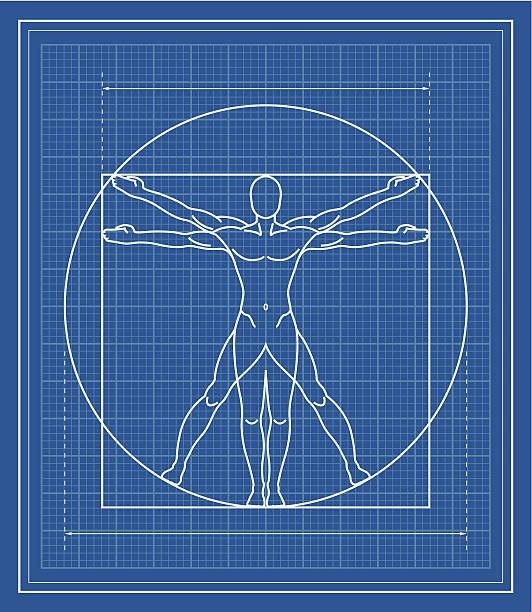
Vitruvian Man blueprint.

In today’s post, I am looking at conceptual metaphors in Lean. A Conceptual metaphor is a concept in conceptual linguistics, first introduced by George Lakoff and Mark Johnson in their 1980 book, Metaphors We Live By. They noted that:

Human beings structure their understanding of their experiences in the world via “conceptual metaphors” derived from basic sensorimotor and spatial concepts (spatial primitives and image schemata) learned during infancy and early childhood. 

Metaphors are normally thought of as a way to explain something further. Aristotle noted that metaphors made learning pleasant. “To learn easily is naturally pleasant to all people, and words signify something, so whatever words create knowledge in us are most pleasant.” However, the conceptual metaphor theory goes beyond the metaphor being just a linguistic/artistic phenomenon. The conceptual metaphor theory notes that metaphors are primarily used to understand abstract concepts, and that these are used subconsciously on an everyday basis. The conceptual metaphors are treated as an inevitable part of our thinking and reasoning. Lakoff and Johnson note that:

The essence of metaphor is understanding and experiencing one kind of thing in terms of another… Metaphors are fundamentally conceptual in nature; metaphorical language is secondary. Conceptual metaphors are grounded in everyday experience. Abstract thought is largely, though not entirely, metaphorical. Metaphorical thought is unavoidable, ubiquitous, and mostly unconscious. Abstract concepts have a literal core but are extended by metaphors, often by many mutually inconsistent metaphors. Abstract concepts are not complete without metaphors. For example, love is not love without metaphors of magic, attraction, madness, union, nurturance, and so on.

One form of conceptual metaphor is an “Ontological Metaphor” – a metaphor in which an abstraction, such as an activity, emotion, or idea, is represented as something concrete, such as an object, substance, container, or person. A good example of an ontological metaphor in lean is waste. We are taught that we should seek total elimination of waste in lean. We are giving a physical representation to the abstract concept of “waste”. Waste is an adversary that can hurt us, steal from us, and destroy us. To paraphrase Lakoff: (I have inserted Waste in his example)

The ontological metaphor of waste allows us to make sense of phenomena in the world in human terms—terms that we can understand on the basis of our own motivations, goals, actions, and characteristics. Viewing something as abstract as waste in human terms has an explanatory power of the only sort that makes sense to most people. When we are suffering substantial economic losses, WASTE IS AN ADVERSARY metaphor at least gives us a coherent account of why we’re suffering these losses.

It is also interesting to see how the concept of waste got translated as it was transplanted from Toyota to the West. Taiichi Ohno, the father of TPS, saw waste in terms of man-hours and labor density. Outside Toyota, elimination of waste was seen as a means to increase capacity, a pursuit of efficiency alone.

Labor density is the ratio of work and motion.

Work/Motion = Labor Density

In the equation, work indicates the action carried out to forward a process or enhance the added value. Ohno realized that the correct way to improve labor density is to keep the numerator (work) the same, while decreasing the non-value added portion of motion. The denominator is an impersonal motion and the numerator is work with a human touch. The act of intensifying labor density or of raising the labor utility factor means to make the denominator smaller (by eliminating waste) without making the numerator larger.

Kiichiro Toyoda, Toyota’s president in 1949, issued the challenge to catch up with the United States within three years. America’s productivity was thought to be eight or nine times better than Japan’s. Ohno realized that this was not because the Americans were physically exerting ten times more than the Japanese. “It was probably that the Japanese are wasteful in their production system”, Ohno thought. Ohno’s view was that the total elimination of waste should result in man-hour reduction. Toyota’s man-hour reduction movement is aimed at reducing the overall number of man-hours by eliminating wasted motions and transforming them into work. Toyota succeeded because they realized that elimination of waste was an expression of their respect for humanity. The respect of humanity portion may have gotten lost in translation when the ontological metaphor of “waste” was spread outside Toyota.

Employees give their valuable energy and time to the company. If they are not given the opportunity to serve the company by working effectively, there can be no joy. For the company to deny that opportunity is against the principle of respect for humanity. People’s sense of value cannot be satisfied unless they know they are doing something worthwhile.

Ohno’s first go-to training tool was to ask the supervisor to try doing the same work with less operators. The elimination of waste becomes easier when the operators have a visual control system for seeing waste as either time on hand or stock on hand, and when they avoid overproduction via Kanban. Ohno’s view of elimination of waste was to be effective and efficient by producing only what is needed. The idea of elimination of waste in the West may have become pursuing just efficiency and dropping effectiveness. The waste elimination can be viewed as a means to increase capacity, and this leads to the question – why should we stop at the daily required quantity of 100 units now that the improvement activities have yielded us more capacity to produce up to 125 units a day? Lean has become “doing more with less”, while Ohno’s goal was “doing just what is needed with less.” Ohno’s goal was being efficient and effective, even if it meant machines remained idle.

Final Words:

The term “Lean” itself is a conceptual metaphor. “Lean” refers to being fit, as opposed to being obese. In “Lean”, elimination of waste is about “trimming the fat”. The metaphor of “lean” represents the aesthetics of being beautiful and healthy – perhaps a notion of being in charge and knowing what needs to be done. This could be viewed as the Western philosophy of outwardly focus on external beauty, whereas the Eastern philosophy is more inwardly focused. In Japanese culture, the concept of harmony is imperative. This is part of the ‘respect for humanity’ side of the Toyota Production System.

I welcome the reader to explore the concept of conceptual metaphor. You may also like one of my older posts – Would Ohno Change the Term “Lean”?

Always keep on learning…

In case you missed it, my last post was Chekhov’s Gun at the Gemba: