
Magician at the Gemba:

157281886840401048HJ

In today’s post, I will be discussing magic, one of my passions. My inspiration for today’s post comes from the great Cybernetician Heinz von Foerster, the wonderful mentalist Derren Brown and the silent partner of Penn & Teller, Raymond Teller. When I was a young kid, I believed that true magic was real. I saw the great American Illusionist David Copperfield on TV, where he did amazing illusions and as a finale act flew around the whole stage and the arena. I also heard about him vanishing the Statue of Liberty in front of spectators. These amazing feats led me to believe that magic was indeed real. I started learning about magic from that young age onward. I became disillusioned quickly when I came across the many secrets of magic. I am thankful for this early disillusionment since it made me a skeptic from a young age.

Magicians can sometimes view themselves as a God-like figure, someone who is superior and can do things that others cannot. They go into theatrics with the belief that they are improving the craft of magic. Derren Brown warns against this approach:

Magic is massively flawed as theatre… Magic is performance, and performance should have an honesty, a relevance and a resonance if it is to be offered to spectators without insulting them… The magician’s role must change from a whimsical god-figure who can click his fingers and have something change in the primary world, to a hero-figure who, with his skills and intriguing character, provides a link with a secondary world of esoteric power. He must arrange circumstances in the primary world – such, as the correct participation of his small audience – in such a way that if that precarious balance is held, a glimmer of magic (only just held under control for a while) will shine through and illuminate the primary world with wonder. That requires investment of time and energy from him and from his audience, and involves the overcoming of conflict. When the routine is over, something has shifted in the world, for both spectator and performer. There is a true sense of catharsis.

Heinz von Foerster, the Socrates of Cybernetics, was also an accomplished magician as a youth. Von Foerster provides his views on magic:

We did it (magic) in such a way that the spectator constructs a world for himself, in which what he wished for takes place. That has led me to the sentence: “The hearer, not the speaker, determines the meaning of an utterance.”

The other thing we saw is: When one succeeds in creating the world in which one can give rise to miracles, it is the fantasy, the imagination, the mind’s eye of the spectator that you support and nourish.

We are letting the spectator construct the experience of magic. We should not construct it for them. There is a difference between a magician saying, “See there is nothing in my hand,” and the spectator saying, “I see nothing in your hand.” The magic occurs in the minds of the spectator. Great magicians allow the spectator to construct the magic. There is no magic without a spectator.

At the Gemba:

How does all this matter to us at the gemba? During my undergrad studies, I first heard about this magical new production system called ‘Lean Manufacturing’. Apparently, Toyota was doing magical things with this approach and all automakers were trying to copy them. Just like with magic tricks, if one is curious enough, the secret of a trick can be found out. But that will not let you be like David Copperfield or Derren Brown. To paraphrase the Toyota veteran, Hajime Ohba, copying what Toyota does is like creating a Buddha image and forgetting to put a soul in it. Later on, when I started working, I was advised by a senior manager that the only book I need to read is ‘The Goal’ by Eliyahu Goldratt. Supposedly, the book had all the answers I would ever need. Luckily, I was already disillusioned once with magic. As I have written a lot in the past, copying Toyota’s solutions (tricks) will not help if you don’t have Toyota’s problems.  The solution to a problem should be isomorphic. That is, the key should match the lock it opens. Toyota developed its production system over decades of trial and error. We cannot simply copy the tools without understanding what problems they were trying to solve. To paraphrase another Toyotaism, Toyota’s Production System is different from the Toyota Production System (TPS).

This brings me to the idea of constructivism. I have talked about this before as well. A bad magician tries to sell the idea of a Superbeing who can do things that don’t seem to belong to the natural realm. He is trying to force his constructed reality onto others. A good magician on the other hand invites the spectator to create the magic in their mind. This is evident in the statements from Heinz von Foerster. The role of the observer is of utmost importance because he is the one doing the description of the phenomenon. What he describes is based on what he already knows. The properties of the “observed” are therefore the properties infused by the observer. The emphasis is then about epistemology (study of knowledge), not ontology (study of reality). Multiple perspectives and continued learning are important. One cannot optimize a complex system. It is dynamic, nonlinear and multidimensional. There are at least as many realities as the number of participants in the complex system. What optimization means depends upon the observer. There may never be a “perfect” answer to a complex problem. There are definitely wrong answers. There are definitely ‘less wrong’ answers. We should seek understanding and learn from multiple perspectives. Humility is a virtue. To paraphrase von Foerster: “Only when you realize you are blind can you see!” This is such a powerful statement. If we don’t know that our understanding is faulty, we cannot improve our understanding. This touches on the idea of Hansei or “self-reflection” in TPS.

We should be aware that everybody has a view of what is out there (reality). We all react to an internally constructed version of reality built of our internal schema/mental models/biases/what we know etc. We cannot be God-like and assume that our version is the true reality. We should not force our version on others as well. We should allow our cocreators/participants to co-construct our social reality together. This touches on the idea of Respect for Humanity in TPS.

To keep with the theme of this post, I will post some of my old videos of magic below, and end with a funny magician joke.

A Spanish magician told everyone he would disappear.

He said, “Uno, dos….” Poof! He disappeared without a tres.

Always keep on learning…

In case you missed it, my last post was The Free Energy Principle at the Gemba:

My performance videos from a long time ago (pardon the video quality)…
Karakuri Kaizen:

karakuri doll tea

As the readers of my blog know, I am an ardent student of Toyota Production System (TPS). One of the core philosophies of TPS is kaizen, often translated from Japanese as continuous improvement. It is the idea that one should continuously find ways to eliminate non-value adding activities, and in the process develop oneself and others to get better at kaizen. The idea of kaizen begetting more kaizen. Kaizen is a human capital enrichment philosophy. As Eiji Toyoda, Toyota Motor Corporation President from 1967 to 1982, said – “It is people that make things, and so people must be developed before work can start.

One of the ways Toyota inspire their employees to nurture their creativity is Karakuri Kaizen. It is said that in the early seventeenth century, during the Edo period, European clocks were introduced in Japan. This sparked a wide curiosity amongst the Japanese craftsmen. The idea of developing motion mechanisms with elaborate sets of springs and gears was new to them. This led to the development of karakuri ningyō, or mechanized dolls. These were dolls that moved around and did several tasks such as bring tea to a guest and then bring it back to the owner, or climb a set of stairs. There was even a magician doll that performed a cups and balls routine.

What set the karakuri dolls of Japan separate from the European clockwork mechanism was the humanization of the dolls. The dolls were created with high importance to its physical features such as face, movement of head and limbs; in an effort to the make the doll life-like. Aesthetics was of utmost importance. All the mechanisms were cleverly hidden beneath clothing such that no mechanism was visible from outside. The doll moved around as if it is alive. The karakuri dolls brought fascinated delight to its spectators.

All the motion was achieved using simple springs, gravity and gears. No external power source was used. How does this all relate to the manufacturing floor? One of the challenges that is often posed to an organization is to increase its production. This is often tackled by either hiring more employees or by using automation. Automation is highly attractive even though it is sometimes cost prohibitive. It might make sense that the nonvalue added activities such as transportation and repeated motions could be replaced with a robot. Most modern manufacturing operations are riddled with automation. However, this comes with its own problems. The main one is that the automation becomes the focus of manufacturing rather than the employees. The high cost, large equipment becomes a monument that everything has to work around the monument. It is an expensive way to ensure that the status quo is maintained. To get the most out of the high expense, the new machine is run around the clock increasing the unwanted inventory and it raises the cost of the operation.

This is where karakuri kaizen comes in. Karakuri, as explained before, is a low-cost automation that does not utilize external power resources. It is comparatively small and works solely based on gravity, counterweights, springs, gears etc. The key point of karakuri kaizen is that it should inspire more kaizen. Generally, a challenge is posed to the operators to come up with a means to remove unwanted strain and motion, and to eliminate waste. Normally, this would be task where a heavy part(s) is lifted and moved to another location or where a part is turned around and operated on. The first impulse is to automate the process. This would require an expensive piece of equipment. Karakuri kaizen focuses on solving the problem on hand with what is readily available and using minimal resources. This might be construed as pushing to minimize capital expenditure. However, the most important part is that the operators are being challenge to use their wit and brains. As Fujio Cho, Toyota Motor Corporation President from 1999 to 2005, said – “Human ingenuity has no bounds.” The karakuri mechanism does not become the center of focus. Instead, the operator does. The mechanism generally is such that it can easily be modified if needed, and even replaced with another karakuri. Unlike, a heavy piece of machinery, a karakuri does not become a monument. It is built specifically to achieve a purpose, and thus it is highly customized. It is also designed in-house. The “challenge” portion is a core ingredient for kaizen.

When Toyota started car manufacturing, it did not have a lot of capital or resources. They modified existing machinery to achieve its needs. They first used what they had in-house before going outside for solutions. They relied on their employees to come up with ingenious solutions to their problems. This meant that the solutions were made specifically for their problems. Generally, when an equipment or a software is purchased, it is not always made specific to the need of the customer. The customer often has to work with what was offered. Toyota had to come up with ingenious solutions to solve their problems without spending much capital. The only capital they would come up with was human capital. Even after Toyota became successful, this mindset was maintained.

As Toyota veteran Kazuhiko Furui explained:

Toyota has tried to use as little external power as possible in its car manufacturing since its foundation. Karakuri kaizen is one of the Toyota Way values. Karakuri is a mechanism that uses gravity, springs and gears instead of external power sources to manipulate objects. A karakuri does not always work well on the first try. If something breaks, we rebuild it, trying continuously to make it better, always reforming the mechanism. For us, when we succeed, there is a great sense of achievement: “we did it!” And that brings a drive to try making yet another mechanism. Developing karakuri is also about developing people. 

Final Words:

What is the point of kaizen? The simple answer is often to make things better. If kaizen does not beget more kaizen and if it does not improve the thinking of the persons involved, then it is missing the meaning of kaizen. Kaizen should lead the employees to develop their abilities to see and identify waste, and come up with ways to eliminate waste. It should lead them to second order thinking where they don’t just what is my goal, but also ask what is the purpose of my goal. This means that the employee becomes part of the meta-system rather than just doing what they are told.

I will finish with some fine words from the great philosopher, Immanuel Kant:

The human being can either be merely trained, broken in, mechanically instructed, or really enlightened. One trains dogs and horses, and one can also train human beings. Training, however, does little; what matters above all is that they learn to think. The aim should be the principles from which all actions spring.

In case you missed it, my last post was Weber’s Law at the Gemba:


Weber’s Law at the Gemba:

Ernst_Heinrich_Weber

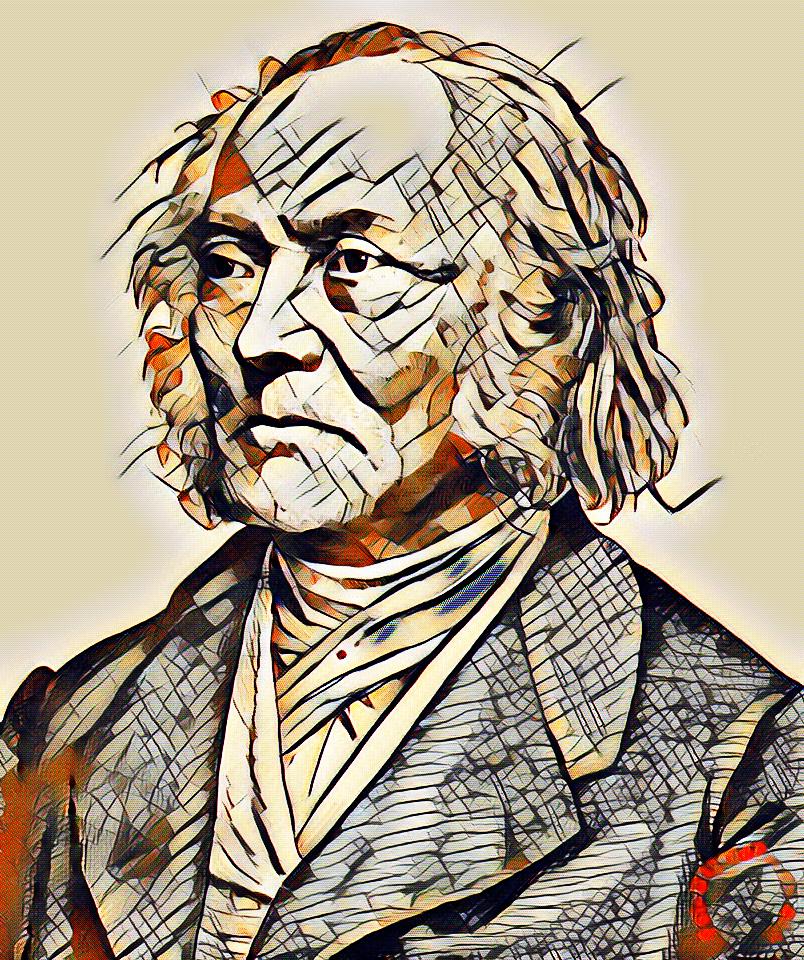
In today’s post, I am looking at Weber’s Law. Weber’s Law is named after Ernst Heinrich Weber (24 June 1795 – 26 January 1878), a German physician who was one of the pioneers of experimental psychology. I highly recommend the Numberphile YouTube video that explains this in detail.

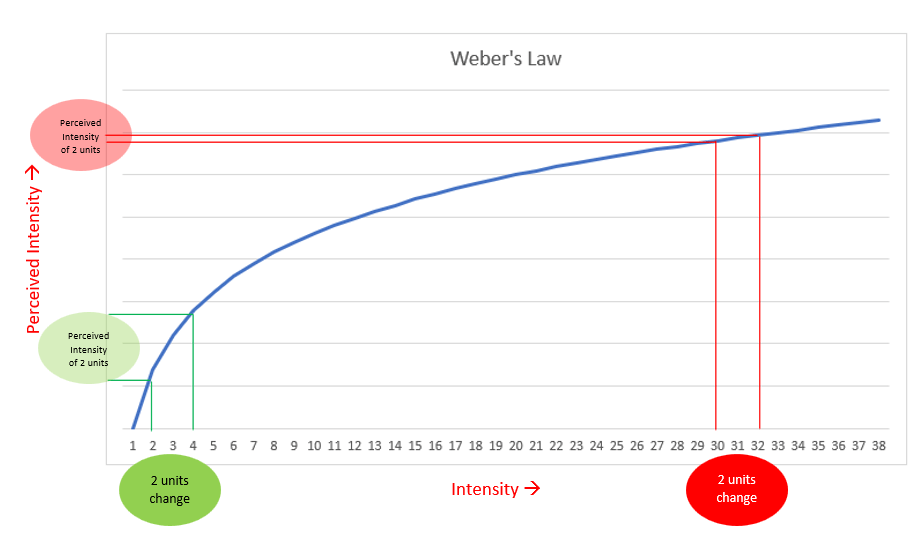
A simple explanation of Weber’s Law is that we notice things more at a lower intensity than at a higher intensity. For example, the light from your phone in a dark room may appear very bright to you. At the same time, the light from your phone in a bright room may seem insignificant. This type of perception is logarithmic in nature. This means that a change from 1 to 2 feels about the same as a change from 2 to 4, or 4 to 8. The perception of change for an increment of one unit, depends on whether you are experiencing it at a low intensity or a high intensity. At low intensity, a slight change feels stronger.

This is explained in the graph below. The green ovals represent the change of 2 units (2 to 4) and the red ovals represent the same change of 2 units (30 to 32). It can be seen that the perceived intensity is much less for the change from 30 to 32 than for the change from 2 to 4. These are represented by the oval shapes on the Y-axis. To achieve the same level of perceived intensity (change from 2 to 4), we need to create a large amount of intensity (~ change from 30 to 60, a difference of 30 units).

Weber

All of this fall under Psychophysics. Per Wikipedia; Psychophysics quantitatively investigates the relationship between physical stimuli and the sensations and perceptions they produce. What does all this have to do with Gemba and Lean?

How often were you able to see problems differently when you came to the production floor as an outsider? Perhaps, you were asked by a friend or colleague for help. You were able to see the problem in a different perspective and you saw something that others missed or you had a better perception of the situation. Most often, we get used to the problems on the floor that we miss seeing things. We do not notice problems until things get almost out of hand or the problems become larger. Small changes in situations do not alert us to problems. This to me is very similar to what Weber’s law teaches us. Small changes in intensity do not appear in our radar unless we are at the low intensity area.

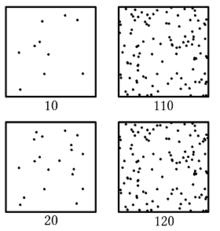
A good example is to imagine a white sheet of paper. If there is one black spot on the paper, it jumps out to us. But if there are many spots on the paper, an additional dot does not jump out to us. It takes a lot of dots before we realize things have changed. One of the experiments that is used to demonstrate Weber’s law is to do with dots. It is easier to see the change from 10 to 20 dots, rather than the change from 110 to 120 dots.

Weber-Fechner_law_demo_-_dots

Ohno and Weber’s Law:

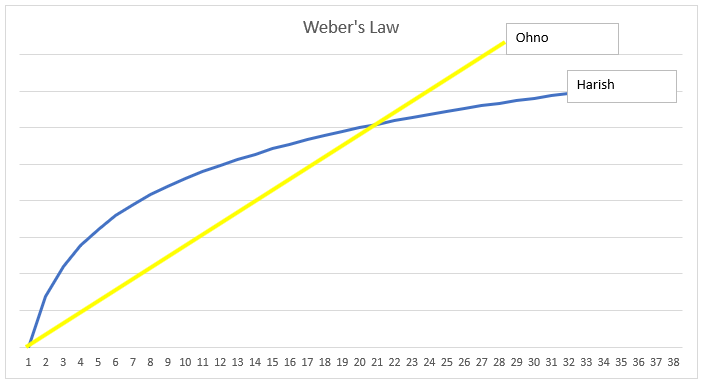
Taiichi Ohno was the father of Toyota Production System. I wonder how Taiichi Ohno’s perceptive skills were and whether his skillset followed Weber’s Law. I would like to imagine that his perceptive skillset was linear rather than logarithmic. He trained his perceptive muscles to see a small change no matter what the intensity was. Even if he was used to his gemba, he was able to see waste no matter if it was small, medium or large. Ohno is famous for his Ohno circle, which was a chalk circle he drew on the production floor for his supervisors, engineers etc. He would have them stand in the circle to observe an operation, trying to see waste in the operation. Waste is anything that has no value. Ohno was an expert who could differentiate a little amount of waste. Ohno’s Weber’s Law plot might appear to be linear instead of being logarithmic, when compared to a student like me.

Weber Ohno

What we can learn from Weber’s Law is that we need to improve our perception skills to perceive waste as it happens. We should not get used to “waste”. When there is already so much waste, the ability to perceive it is further diminished. It would take a larger event to make us notice of problems on the floor. We lack the ability to perceive waste accurately. We can only understand it based on what has been perceived already. This would mean that we should go to gemba more often, and each time try to see things with a fresh set of eyes. As the Toyota saying goes, we should think with our hands and see with our feet. Change spots from where you are observing a process. Understand that gemba not only means the actual place, but it also includes people, equipment, parts and the environment. We should avoid going with preconceived notions and biases. As we construct our understanding try to include input from the actual users/operators as much as possible. Learn to see differently.

Final Words:

One of the examples I came up with for this post is about cleaning rooms. Have you noticed that cleaner rooms get messy fast? Actually, we perceive a slight increase in messiness when the room is clean versus when it is not. The already messy room requires a larger amount of mess to have a noticeable difference. What Weber’s law shows us is that our natural instinct is not to think linearly.

Humans evolved to notice and minimize relative error. As noted on an article on the Science20 website:

One of the researchers’ assumptions is that if you were designing a nervous system for humans living in the ancestral environment, with the aim that it accurately represents the world around them, the right type of error to minimize would be relative error, not absolute error. After all, being off by four matters much more if the question is whether there are one or five hungry lions in the tall grass around you than if the question is whether there are 96 or 100 antelope in the herd you’ve just spotted.

The STIR researchers demonstrated that if you’re trying to minimize relative error, using a logarithmic scale is the best approach under two different conditions: One is if you’re trying to store your representations of the outside world in memory; the other is if sensory stimuli in the outside world happen to fall into particular statistical patterns.

Perhaps, all this means that we learn to see waste and solve problems on a logarithmic scale. And as we get better, we should train to see and solve problems on a linear scale. Any small amount of waste is waste that can be eliminated and the operation to be improved. It does not matter where you are on the X-axis of the Weber’s law plot. I will finish with an excellent anecdote from one of my heroes, Heinz von Foerster, who was also a nephew of Ludwig Wittgenstein. I have slightly paraphrased the anecdote.

Let me illustrate this point. I don’t know whether you remember Castaneda and his teacher, Don Juan. Castaneda wants to learn about things that go on in the immense expanses of the Mexican chaparral. Don Juan says, “You see this … ?” and Castaneda says “What? I don’t see anything.” Next time, Don Juan says, “Look here!” Castaneda looks, and says, “I don’t see a thing.” Don Juan gets desperate, because he wants really to teach him how to see. Finally, Don Juan has a solution. “I see now what your problem is. You can only see things that you can explain. Forget about explanations, and you will see.”

You become surprised because you abandoned your preoccupation with explanations. Therefore, you are able to see. I hope you will continue to be surprised.

In case you missed it, my last post was OODA Loop at the Gemba:

I also encourage the readers to check out my other similar posts:

Drawing at the Gemba

The Colors of Waste

Maurice Merleau-Ponty’s Lean Lessons

UX at the Gemba:

joy

In today’s post I am looking at UX (User Experience) at the gemba. Generally, usability (how the end user can effectively and efficiently complete the tasks needed) and UX (the meaningful and relevant experience the user has from effectively and efficiently completing the tasks needed) are two terms that are associated with product design. I would like to see how this applies at the gemba.

ISO 9241 (Ergonomics of human-system interaction) defines Usability as – a measure of the effectiveness, efficiency and satisfaction with which specified users can achieve specified goals in a particular environment.

While UX is defined by ISO 9241 as – a person’s perceptions and responses that result from the use or anticipated use of a product, system or service.

We should use the same ideas at the gemba for the operators. How easy is the operation in making a product? How is the work station laid out? How is the process flow? At the gemba we can view Usability as – the operator making a good product with ease, and UX can be viewed as – the operator enjoying making the good product.

Some of the terms that are associated with usability are:

  • Task oriented – objective values
  • Functional – works as intended
  • Reliable – always works as intended
  • Usable – can be used with without difficulty

Similarly, some of the terms associated with UX are:

  • Experience oriented – subjective values
  • Convenient – easy to work with and does not give grief
  • Pleasurable – an enjoyable experience
  • Meaningful – adds to personal value and significance

At the Gemba:

Marie Kondo, the great Japanese organizing consultant is famous for her question – “does it spark joy?” To me, this is a great UX question. Does your operation/process spark joy?

When you are at the gemba, observe an operation. Take a note of how many times the operator takes a tool and put it down, only to take it again for another step. Take a note of how many times the operator has to look around and reach for a tool. Take a note on whether the operator is in his or her ‘zone’. Or is he or she getting frustrated with the steps?

As Lean leaders/engineers, we owe it to our team to design a good process. This was the theme of Industrial Engineering pioneered by Taylor, Gilbreth et al. At best, this approach falls right under usability. My challenge to my readers is to consider UX for the operators. We should minimize the cognitive load on the operators. The complexity of an operation is generally a constant. A good operation absorbs this complexity through easy to manufacture design, good fixtures, poke yoke, well laid out work stations etc. This way, the operator does not have to absorb the complexity, leading to a good UX model. This idea is explained here.

One of the ideas in UX is visibility. This aligns very well with Lean. This idea is about being able to know the state of a system just by looking. Is it working properly? Does it say what is going on? Are the signals easy to interpret? Are the correct parts visible and are they conveying the correct message? By seeing that something is wrong, we can stop to correct the problem.

We should design the process for the operator and not for the product. This means that we should work with the involved operators from the start, making improvements as we go along. We should be open to their input and ideas. The UX approach requires empathy. The UX view is a big picture holistic view. Making an operation consistent, intuitive and easy for an entry level person can actually make the operation easier for the most experienced person.

Some of the UX based questions you can ask yourself (along with the ones already posed in this post) are:

  • How do people learn to assemble our products?
  • What makes a step easy or hard to remember?
  • Why do people make errors?
  • Are our products easy to manufacture, again and again?
  • Are problems easy to see?
  • Do we have the right tools? Do the tools fit what they are used for?
  • Are they more likely to assemble the product the wrong way? Is it more easier to assemble the right way?
  • Is our product easy to inspect? Do we rely on 100% visual inspection to catch problems?
  • Would you do the operation? What would make it easy for you?
  • Above all, Does it spark joy?

Final Words:

I will finish with the great Don Norman’s words on UX from his wonderful book, “The Design of Everyday Things.” Don Norman is a pioneer of UX.

It is relatively easy to design things that work smoothly and harmoniously as long as things go right. But as soon as there is a problem or a misunderstanding, the problems arise. This is where good design is essential. Designers need to focus their attention on the cases where things go wrong, not just on when things work as planned. Actually, this is where the most satisfaction can arise: when something goes wrong but the machine highlights the problems, then the person understands the issue, takes the proper actions, and the problem is solved. When this happens smoothly, the collaboration of person and device feels wonderful.

The above passage has underpinnings of Jidoka where the idea is to stop the line or the machine when a problem occurs. The same idea is important in UX as well. Norman continues:

Human-centered design is a design philosophy. It means starting with a good understanding of people and the needs that the design is intended to meet. This understanding comes about primarily through observation, for people themselves are often unaware of their true needs, even unaware of the difficulties they are encountering.

My take on this passage again is Lean-oriented. Toyota teaches us to go to gemba to grasp the facts. Going to gemba and observing, identifying waste and solving problems is an excellent way to develop oneself.

Great designers produce pleasurable experiences. Experience: note the word. Engineers tend not to like it; it is too subjective. But when I ask them about their favorite automobile or test equipment, they will smile delightedly as they discuss the fit and finish, the sensation of power during acceleration, their ease of control while shifting or steering, or the wonderful feel of the knobs and switches on the instrument. Those are experiences.

Experience is critical, for it determines how fondly people remember their interactions. Was the overall experience positive, or was it frustrating and confusing? When our home technology behaves in an uninterpretable fashion we can become confused, frustrated, and even angry—all strong negative emotions. When there is understanding it can lead to a feeling of control, of mastery, and of satisfaction or even pride—all strong positive emotions. Cognition and emotion are tightly intertwined, which means that the designers must design with both in mind.

Norman’s above passage to me captures the essence of UX at the gemba. Our processes must be user friendly, and should always yield positive experiences for the operators.

My post has barely covered the basics of UX. I encourage the reader to research further on this topic. Always keep on learning…

In case you missed it, my last post was Wittgenstein’s Ladder at the Gemba:

Wittgenstein’s Ladder at the Gemba:

ladder

In today’s post, I am looking at Wittgenstein’s ladder at the gemba. Ludwig Wittgenstein is one of the most profound philosophers of the 20th century. His first book was Tractatus Logico-Philosophicus, in which he came up with the picture theory of language. He defined how language and reality relate to each other, and how limits of language corresponded to limits of knowledge to some extent.

Loosely put, the Tractatus explained how language can be used to directly depict reality. Language should mirror exactly the arrangement of objects, and their relationships to each other in the real world. Wittgenstein proposed that what can be said about the world makes sense only if there is a correspondence to the real world out there. Everything else is nonsense. This idea puts limits to how we use language. The real use of language is to describe reality. Anthony Quinton, the late British philosopher, explained the main concepts of Tractatus as:

Tractatus is a theory of declarative sentences, a theory of what can be put in a proposition and what cannot. Anything that can be said can be said clearly or not at all.

The world is all that is the case. The state of affairs around us, the simple facts, are the world for us. Wittgenstein is talking about what we can and cannot sensibly  talk about.

The world consists of facts. Facts are arrangement of objects. Objects must be simple. These ideas appear as dogmatic assertions. Language has to have a definite sense and it can have a definite sense only if it is of a certain structure. And therefore the world must be of that certain structure in order to be capable of being represented in the language.

One of the metaphors, Wittgenstein used in the Tractatus is the idea of a ladder. This has come to be known as “Wittgenstein’s Ladder.”

Wittgenstein said:

My propositions serve as elucidations in the following way: anyone who understands me eventually recognizes them as nonsensical, when he has used them—as steps—to climb beyond them. (He must, so to speak, throw away the ladder after he has climbed up it.)
He must transcend these propositions, and then he will see the world aright.   

This is a fascinating idea because Wittgenstein is cautioning against doctrines as the eternal rules to abide by. If the concepts that Wittgenstein explained in the Tractatus are true, then the assertion of his ideas being true would contradict the ideas themselves. Wittgenstein uses the metaphor of a ladder to have the reader climb to a higher level of understanding and then asks the reader to kick the ladder away.

Let’s see how Wittgenstein’s ladder relates to Lean/Toyota Production System. Taiichi Ohno developed TPS as a production system through decades of trial and error methods. The solutions Ohno came up with were specific to the problems Toyota had at that time. We should learn about these different tools and understand the problems they are trying to solve. We should not exactly copy the tools that Toyota uses just because Toyota is using them. Even within Toyota, each plant is unique and doesn’t use a specific set of tools. As one Toyota veteran put it, Toyota Production System and Toyota’s Production System are different. What each plant does is unique and based on the complexity of problems it has.

There are several doctrines that are set forth by the experts. Let’s look at two examples – zero inventories and one-piece flow. Taiichi Ohno himself tried to correct these two misrepresentations/misunderstandings.

Ohno called the Zero Inventory idea nonsense:

To be sure, if we completely eliminate inventories, we will have shortages of goods and other problems. In fact, reducing inventories to zero is nonsense.

The goal of Toyota Production System is to level the flows of production and goods… In every plant and retail outlet, we strive to have the needed goods arrive in the needed quantities in the needed time. In no way is the Toyota Production System a zero-inventory system.

Similarly, Ohno also cautioned about implementing one-piece flow without thinking and looking at your production system.

The essence of Toyota Production System is found in the saying, “Can we realistically reduce one more?” and then after that “one more?”

The removal of parts or operators is about identifying waste and ways to improve human capital through problem solving. The idea is to develop people and not think only about developing parts. Kaizen is a philosophy of personal improvement (improving oneself) through process improvements. Kaizen begets more kaizen.

Final Words:

The problem with doctrines is that we build a religion out of them. 

Ask yourself – What is the problem that I am trying to solve? Toyota’s solutions work for Toyota’s problems. We should climb the TPS/Lean ladder (understand the ideas) and then throw away the ladder of doctrines. We should solve our problems using solutions that match our problems.

Always keep on learning…

In case you missed it, my last post was Drawing at the Gemba:

Drawing at the Gemba:

IMG_9727

In today’s post, I am writing about Genchi Genbutsu and drawing. “Genchi Genbutsu” is an important concept in Lean/Toyota Production System. It can be translated as going to the actual place (gemba) to see, and grasp the situation. There are different translations to this such as “Boots on the ground” and “Go and See”.

I have been recently researching on how artists “see” things. When an arts teacher trains students, the most important lesson the teacher can teach is to not think of the object when you draw. For example, if you are not a natural artist, when you draw a face, you will draw what “you” think an eye looks like in your mind. The same for the nose, lips etc. You are not drawing what you are seeing, instead you are drawing what you think they look like in your mind, even though the subject is right in front of you. Your brain acts as a blinder and blocks what you see and instead points you towards your preconceived notion of the different features of the face. Thus, the final product looks like a bunch of circles, slanted lines and curves, which does not resemble a real face at all.

I think there is an important lesson for a lean leader in this. When we go to the gemba, if we come with preconceived notions, we will miss what is right in front of us. If we go to gemba already armed with the wrong answer, we will not ask the right questions. We should go to the gemba with a fresh mind, and with limited preconceived notions. West Churchman, the great American philosopher and Systems Thinker said, “A systems approach begins when first you see the world through the eyes of another.

When we talk about truth and reality in philosophy, there is an important principle called the Correspondence principle. Loosely put, the Correspondence principle indicates that what we construct in our mind should correspond to what is outside in the real world. We cannot do this effectively, if we hinder the process of construction and fill it with our preconceived notions. This is like an amateur artist drawing a face with his version of eyes, nose, lips etc., and not the actual face.

In TPS, we learn that making things is about making (developing) people. I have seen developing people described as “human capital development.” In order to develop people, Toyota created a production system where problems are forced to surface so that the operators get a chance to learn how to solve problems. A good tool that explains this well is Jidoka or autonomation. Jidoka requires the operation to stop when problems occur. Additionally, Jidoka also requires the operator to stop when the work is done. Nampachi Hayashi, a Toyota veteran, describes this as:

What are the necessary conditions for good products?

Stop when problems occur – build good quality in each process, and stop when the work is done – increase operator’s added-value and productivity.

Kaizen does not progress when there is no need for kaizen.

To add to this, Taiichi Ohno, the father of Toyota Production System, said, “When we study the way we work, there is an endless cycle of improvement. We cannot do this, if we do not go to gemba with a fresh mind and eyes. We should train our brain to not interfere with this process. As Churchman said, we should try to see the operation through the eyes of the operator.

Toyota views problem solving as the most important skill for human capital. Then, our job as the lean leaders is to create conditions for identifying problems as they occur, and develop the operators to see them and solve them on their own. In this regard Hayashi says that managers should go and see gemba, and for each emerging problem, they should give specific challenge and make sure to follow up.

Final words:

Inetrestingly, there is another closely sounding phrase in Japanese for “Genchi Genbutsu”. It is “Genchi Kenbutsu”. Genchi Kenbutsu means “Go and Sightsee.”

I will finish with an interesting anecdote from Betty Edwards wonderful book, “The New Drawing on the Right Side of the Brain.” In the book she talked about getting frustrated with her students. She had given her students the assignment to copy a Pablo Picasso work. The outcomes were not as good as she expected. So, in a flash of genius, she hung the painting upside down, and asked the students to copy. The results were very surprising. The copies of the upside-down painting were far better than the copies of the right-side-up painting. She was quite puzzled by this. She later realized that keeping the painting upside down, changed how the students “saw.” Their brains stopped interfering with how they saw the subject, and they were able to draw much better. Edwards writes:

What prevents a person from seeing things clearly enough to draw them?

The left hemisphere has no patience with this detailed perception and says, in effect, “It’s a chair, I tell you. That’s enough to know. In fact, don’t bother to look at it, because I’ve got a ready-made symbol for you. Here it is; add a few details if you want, but don’t bother me with this looking business.”

And where do the symbols come from? From the years of childhood drawing during which every person develops a system of symbols. The symbol system becomes embedded in the memory, and the symbols are ready to be called out, just as you called them out to draw your childhood landscape.

The symbols are also ready to be called out when you draw a face, for example. The efficient left brain says, “Oh yes, eyes. Here’s a symbol for eyes, the one you’ve always used. And a nose? Yes, here’s the way to do it.” Mouth? Hair? Eyelashes? There’s a symbol for each. There are also symbols for chairs, tables, and hands.

To sum up, adult students beginning in art generally do not really see what is in front of their eyes—that is, they do not perceive in the special way required for drawing. They take note of what’s there, and quickly translate the perception into words and symbols mainly based on the symbol system developed throughout childhood and on what they know about the perceived object.

What is the solution to this dilemma? Psychologist Robert Ornstein suggests that in order to draw, the artist must “mirror” things or perceive them exactly as they are. Thus, you must set aside your usual verbal categorizing and turn your full visual attention to what you are perceiving—to all of its details and how each detail fits into the whole configuration. In short, you must see the way an artist sees.

Always keep on learning…

In case you missed it, my last post was Cybernetics and Design – Poka Yoke, Two Hypotheses and More:

Book Review – Seeing To Understand:

0307b5b1-1b7a-40e1-b72d-7a32be9659b1_D

In today’s post, I am reviewing Panos Efsta’s book, “Seeing to Understand”. Efsta kindly provided me a copy of his book. Efsta has written the book as a scientific thinking lifestyle coach. The book goes in depth on ways to coach yourself to developing intentional practice of scientific thinking using mainly Toyota Kata concepts. He also introduces concepts from Training Within Industry and process behavior charts. Efsta identifies it as a lifestyle regardless of what field you are working in. I have only introductory experience with Toyota Kata. So, reading this book was very helpful for me.

Toyota Kata is Mike Rother’s brainchild. Toyota Kata is based on the research that Rother and his team did from 2004 to 2009. Toyota Kata encapsulates the practice of scientific thinking as part of the management system at Toyota. Please note that this is what Rother and his team captured based on their research and not what Toyota has documented. As Rother puts it:

No one knows what the world will look like in the future, so one of the most valuable skills you can have is the ability to adapt. Scientific thinking is exactly that. It involves a running comparison between what you predict will happen next, seeing what actually happens, and adjusting based on what you learn from the difference. Scientific thinking may be the best way we have of navigating through unpredictable territory to achieve challenging goals. Practiced deliberately for even just 20 minutes a day, scientific thinking can make anyone more adaptive, creative, and successful in the face of uncertainty.

Rother’s research was based on two questions:

1.What are the unseen managerial routines and thinking that lie behind Toyota’s success with continuous improvement and adaption?

2.How can other companies develop similar routines and thinking in their organizations?

Efsta’s book is a great resource to have while learning about Toyota Kata. An example is the chapter on the Storyboard. The storyboard is a tool in Toyota Kata to document the improvement journey. It captures the four steps:

  1. Get the direction – Understand the sense of direction
  2. Grasp the current situation – Understand where we are with facts and data
  3. Establish the next target condition – Target condition focuses our attention and provides guidance. Target condition stretches you beyond your current limited knowledge and aspires you towards a new performance standard.
  4. Conduct experiments – Understand what obstacles are preventing you and experiment to remove the obstacle(s). Document what happened and what we learned along the way. Iterate.

The use of Job Methods from Training Within Industry is a great way to grasp the current condition. As Efsta puts it, during the process of grasping the current condition, we are looking for the specific work patterns that currently represents the focus process and all the behaviors and attributes which lead the process to perform the way it does.

Efsta has detailed an obstacle-hunting map that I found quite useful. The obstacles are identified when we ask the question – what is preventing us from performing at the target condition? There are several tips that Efsta provides that assists in understanding the process better. For example, in Manufacturing, an obstacle should be structured as Fact + Data + “Negative Impact”.

After each chapter, Efsta has a Reflection section where the reader can document their reflections upon reading each chapter. One sentence that Efsta uses across the book is – There is nothing arbitrary or unintentional about scientific thinking. Scientific thinking as detailed by Toyota Kata is a structured framework which helps in tackling the ordered and complicated problems. Efsta provides several examples that helps cement the framework. Efsta also goes into detail on creating IMR Process Behavior Charts in MS Excel that will be useful for the reader.

One of the key concepts I realized while reading Efsta’s book is that solving today’s problem helps you with solving tomorrow’s problem. The more you do it, the thinking sets in and you get better at the thinking itself. This is the basis of kata.

Efsta’s book is available here and here. Mike Rother’s website for Toyota Kata is here. I encourage the reader to check both of them out.

Always keep on learning…

In case you missed it, my last post was Real Lean: