More Notes on Constraints in Cybernetics:

In today’s post, I am looking further at constraints. Please see here for my previous post on this. Ross Ashby is one of the main pioneers of Cybernetics, and his book “Introduction to Cybernetics” still remains an essential read for a cybernetician. Alicia Juarrero is a Professor Emerita of Philosophy at Prince George’s Community College (MD), and is well known for her book, “Dynamics in Action: Intentional Behavior as a Complex System”.

I will start off with the basic idea of a system and then proceed to complexity from a Cybernetics standpoint. A system is essentially a collection of variables that an observer has chosen to make sense of something. Thus, a system is a mental construct and not something that is an objective reality. A system from this standpoint is entirely contingent upon the observer. Ashby’s view on complexity was regarding variety. Variety is the number of possible states of a system. A good example of this is a light switch. It has two states – ON or OFF. Thus, we can state that a light switch has a variety of 2. Complexity is expressed in terms of variety. The higher variety a system has, the more possibilities it possesses. A light switch and a person combined has indefinite variety. The person is able to communicate via messages simply by turning the light switch ON and OFF in a certain logical sequence such as Morse code.

Now let’s look at constraints. A constraint can be said to exist when the variety of a system is said to have diminished or decreased. Ashby gives the example of a boys only school. The variety for sex in humans is 2. If a school has a policy that only boys are allowed in that school, the variety has now decreased to 1 from 2. We can say that a constraint exists at the school.

Ashby indicated that we should be looking at all possibilities when we are trying to manage a situation. Our main job is to influence the outcomes so that certain outcomes are more likely than others. We do this through constraints. Ashby noted:

The fundamental questions in regulation and control can be answered only when we are able to consider the broader set of what it (system) might do, when ‘might’ is given some exact specification.

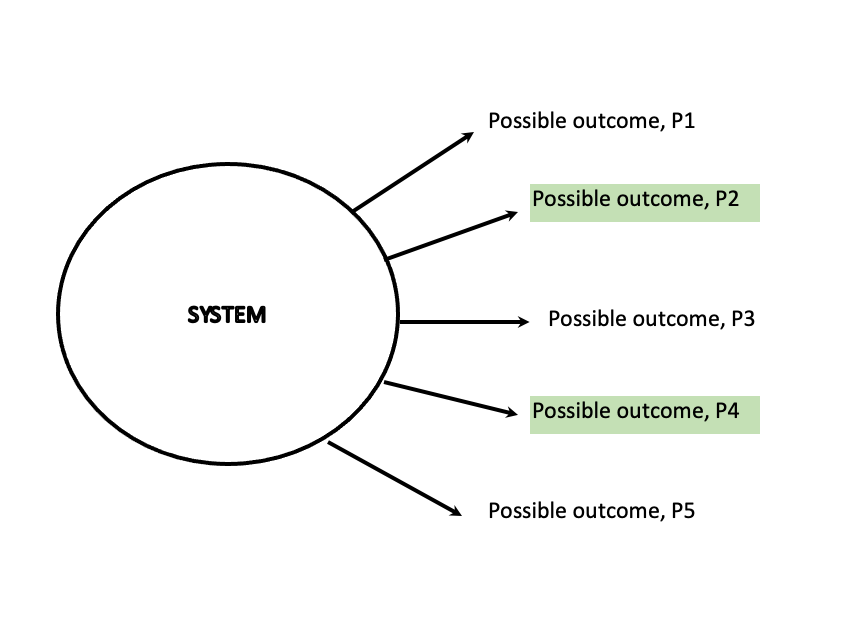
We can describe what we have been talking about so far with a simple schematic. We can try to imagine the possible outcomes of the system when we interact with it and utilize constraints so that certain outcomes, P2 and P4 are more likely to occur. There may be other outcomes that we do not know of or can imagine. Ashby advises that cybernetics is not about trying to understand what a system is, but what a system does. We have to imagine a set of all possible outcomes, so that we can guide or influence the system by managing variety. The external variety is always more than the internal variety. Therefore, to manage a situation, we have to at least match the variety of the system. We do this by attenuating the unwanted variety and by amplifying our internal variety so that we can match the variety thrown at us by the system. This is also represented as Ashby’s Law of Requisite Variety – only variety can absorb variety. Ashby stated:

Cybernetics looks at the totality, in all its possible richness, and then asks why the actualities should be restricted to some portion of the total possibilities.
Ashby talked about several versions of constraints. He talked about slight and severe constraints. He gave an example of a squad of soldiers. If the soldiers are asked to line up without any instructions, they have maximum freedom or minimum constraints to do so. If the order was given that no man may stand next to a man whose birthday falls on the same day, the constraint would be slight, for of all the possible arrangements few would be excluded. If, however, the order was given that no man was to stand at the left of a man who was taller than himself, the constraint would be severe; for it would, in fact, allow only one order of standing (unless two men were of exactly the same height). The intensity of the constraint is thus shown by the reduction it causes in the number of possible arrangements.

Another way that Ashby talked about constraints was by identifying constraint in vectors. Here, multiple factors are combined in a vector such that the resultant constraint is considered. The example that Ashby gave was that of an automobile. He gave the example of the vector shown below:

(Age of car, Horse-power, Color)

He noted that each component has a variety that may or may not be dependent on the other components. If the components are dependent on each other the final constraint will be less than the sum of individual component constraints. If the components are all independent, then the resultant constraints would be the sum of individual constraints. This is an interesting point to further look at. Imagine that we are looking at a team here of say Person A, B and C. Each person here is able to come up with indefinite possibilities, the resultant variety of the team would be also indefinite. If we allow for the indefinite possibilities to emerge, as in innovation or invention of new ideas or products, the constraints could play a role. When we introduce thinking agents to the mix, the number of possibilities goes up.

Complexity is about managing variety – about allowing room for possibilities to tackle complexity. Ashby famously noted that a world without constraints is totally chaotic. His point is that if a constraint exists, it can be used to tackle complexity. Allowing parts to depend upon each other introduces constraints that could cut down on unwanted variety and at the same time allow for innovative possibilities to emerge. The controller’s goal is to manage variety and allow for certain possible outcomes to be more likely than others. For this, the first step to imagine the total set of possible outcomes to best of their abilities. This means that the controller also has to have a good imagination and creative mind. This points to the role of the observer when it comes to seeing and identifying the possibilities. Ashby referred to the set of possibilities as “product space.” Ashby noted that its chief peculiarity is that it contains more than actually exists in the real physical world, for it is the latter that gives us the actual, constrained subset.

The real world gives the subset of what is; the product space represents the uncertainty of the observer. The product space may therefore change if the observer changes; and two observers may legitimately use different product spaces within which to record the same subset of actual events in some actual thing. The “constraint” is thus a relation between observer and thing; the properties of any particular constraint will depend on both the real thing and on the observer. It follows that a substantial part of the theory of organization will be concerned with properties that are not intrinsic to the thing but are relational between the observer and thing.

A keen reader might be wondering how the ideas of constraints stack up against Alicia Juarrero’s versions of constraints. More on this in a future post.  I will finish with a wonderful tribute to Ross Ashby from John Casti:

The striking fact is that Ashby’s idea of the variety of a system is amazingly close to many of the ideas that masquerade today under the rubric “complexity.”

Please maintain social distance and wear masks. Please take vaccination, if able. Stay safe and Always keep on learning… In case you missed it, my last post was Towards or Away – Which Way to Go?

The Reality of Informationally Closed Entities:

In today’s post, I am looking at the idea of “informationally closed”. The idea of informational closure was first proposed by Ross Ashby. Ashby defined Cybernetics as a study of systems that are informationally tight. Ashby wanted cyberneticians to look at all the possibilities that a system can be in. Here the system refers to a selection of variables that the observer has chosen. Ashby noted that we should not look at what individual act a system produces ‘here and now’, but at all the possible behaviors it can produce. For example, he asked why does the ovum grows into a rabbit, and not a dog or a fish? Ashby noted that this is strictly related to information, and not energy:

Growth of some form there will be; cybernetics asks “why should the changes be to the rabbit-form, and not to a dog-form, a fish-form or even to a teratoma-form?” Cybernetics envisages a set of possibilities much wider than the actual, and then asks why the particular case should conform to its usual particular restriction. In this discussion, questions of energy play almost no part – the energy is simply taken for granted. Even whether the system is closed to energy or open is often irrelevant; what is important is the extent to which the system is subject to determining and controlling factors. So, no information or signal or determining factor may pass from part to part without its being recorded as a significant event. Cybernetics might, in fact, be defined as the study of systems that are open to energy by closed to information and control – systems that are information-tight.

Ashby’s main point regarding this is that the machine or the system under observation selects its actions from a set of possible actions, and this will remain the same until there is a significant event that causes it to alter the set of possible actions. The action of the system is entirely based on its structure, and not because an external agent is choosing that action for the system. The external agent is only triggering or perturbing the system, and the system in turn reacts. This idea of informational closure was further taken up by Humberto Maturana and Francisco Varela. The idea of “informationally closed” is a strong premise for constructivism – the idea that all knowledge is constructed rather than perceived through senses. They noted that as cognizant beings, we are informationally closed. We do not have information enter us externally. We are instead perturbed by the environment, and we react in ways that we are accustomed to. Jonathan D. Raskin expands on this further:

People are informationally closed systems only in touch with their own processes. What an organism knows is personal and private. In adhering to such a view, constructivism does not conceptualize knowledge in the traditional manner, as something moving from “outside” to “inside” a person. Instead, what is outside sets off, triggers, or disrupts a person’s internal processes, which then generate experiences that the person treats as reflective of what is outside. Sensory data and what we make of it are indirect reflections of a presumed outside world. This is why different organisms experience things quite differently. How Jack’s backyard smells to his dog is different from how it smells to him because he and his dog have qualitatively different olfactory systems. Of course, how Jack’s backyard smells to him may also differ from how it smells to Sara because not only is each of them biologically distinct but each has a unique history that informs the things to which they attend and attribute meaning. The world does not dictate what it “smells” like; it merely triggers biological and psychological processes within organisms, which then react to these triggers in their own ways. The kinds of experiences an organism has depend on its structure and history. Therefore, what is known is always a private and personal product of one’s own processes.

Raskin gives an example of a toaster or a washing machine to provide more clarity on the informational closure.

Maturana asserts that from the point of view of a biologist living systems are informationally closed–that is, things don’t get in and they don’t get out. From the outside, you can trigger a change, but you cannot directly instruct. Think of it as having a toaster and a washing machine. And, the toaster is going to toast no matter what you do. And, the washing machine is going to wash no matter what you do. And they both can be triggered by electricity. But the electricity doesn’t tell the toaster what to do. The toaster’s structure tells the toaster what to do. So similarly, we trigger organisms, but what they do has to do with their internal structure–including their nervous system–and the way it responds to various perturbations.

The idea of informational closure forces us to bring a new perspective to how we view the world. How are we able to know about reality? From a constructivism standpoint, we do not have a direct access to the external reality. What we can truly say is how we experience the world, not how the world really is. We do not construct a representation of the external world. This is not possible, if we are informationally closed. What we do is actually construct how we experience the world. As Raskin points out, the world is not a construction; only our experience of it is. Distinguishing experiential reality from external reality (even a hypothetical, impossible-to-prove-for-sure external reality) is important in maintaining a coherent constructivist stance.

All knowledge from this standpoint is personal, and cannot be passed on as a commodity. In constructivism, there is an idea called as the myth of instructive interaction. This means that we cannot be directly instructed. A teacher cannot teach a student with a direct and exact impact. All the teacher can do is to perturb the student so that the student can construct their personal knowledge based on their internal structure. Raskin notes – once people’s internal systems are triggered, they organize their experiential responses into something meaningful and coherent. That is to say, they actively construe. Events alone do not dictate what people know; constructive processes play a central role as people impose meaning and order on sensory data. 

The more interactions we have with a phenomenon, the better we can experience the phenomenon, and it aids in our construction of the stable experiential reality of that phenomenon. Repetition is an important ingredient for this. Ernst von Glasersfeld notes:

Without repetition there would be no reason to claim that a given experiential item has some kind of permanence. Only if we consider an experience to be the second instance of the self-same item we have experienced before, does the notion of permanence arise.

From this point, I will try to look at some questions that might help to further our understanding of constructivism.

What is the point of constructivism if it means that we cannot have an accurate representation of the real world? The ultimate point about constructivism is not about an ontological stance, it is about viability. It is about being able to continue to survive. All organisms are informationally closed, and they continue to stay viable. The goal is to fit into the real world. Raskin explains – the purpose of this knowledge is not to replicate a presumed outside world but to help the organism survive. In Cybernetics, we say that we need to have a model of what we are trying to manage or control. This “model” does not have to be an exact representation of the “system” we are trying to control. We can treat it as a black box where we have no idea about the inner workings of the system. As long as we are able to come up with a set of possibilities and possible triggers for possible outcomes, we can manage the system. A true representation is not needed.

How would one account for a social realm if we are informationally closed? If each of us are informationally closed, and our knowledge are personal, how we do account for the social realm, where we all acknowledge a version of stable social reality. Raskin provides some clarity on this. He notes:

Von Glasersfeld held that people create a subjective internal environment that they populate with “repeatable objects.” These repeatable objects are experienced as “external and independent” by the person constructing internal representations of them. Certain repeatable objects–those we identify as sentient, primarily other people–are treated as if they have the same active meaning-making abilities that we attribute to ourselves. Consequently, we are able to experience an intersubjective reality whenever other people respond to us in ways that we interpret as indicating they experience things the same way we do. Once again, this alleviates concerns about constructivism being solipsistic because people do relationally coordinate with one another in confirming and maintaining their constructions. 

For von Glasersfeld, it means that people construe one another as active meaning makers and consequently treat their personal understandings as communally shared when others’ behavior is interpreted as affirming those understandings. As I stated elsewhere, “when experiencing sociality or an intersubjective reality, we come to experience our constructions as socially shared to the extent that they appear to be (and, for all functional purposes, can be treated as if they are) also held by others”.

Each one of us construct an experiential reality of the external world. This external world includes other people in it. Our ongoing interaction with these people enhances and updates our own experiential world. We come to see the external world as a social construction. Our personal construction gets triggered in a social setting resulting in a social version of that construction. The more frequent and diverse interactions we get, the more viable this construction becomes. The other people are part of this experiential reality and thereby become cocreators of the social reality. In many regards, what we construct are not representations of the external world, but more a domain of constraints and possibilities. Making sense of the external world is a question about viability. If it does not affect viability, one may very well believe in a God or think that the world is flat. The moment, the viability is impacted, the constructions of the reality will have to adjusted/modified.

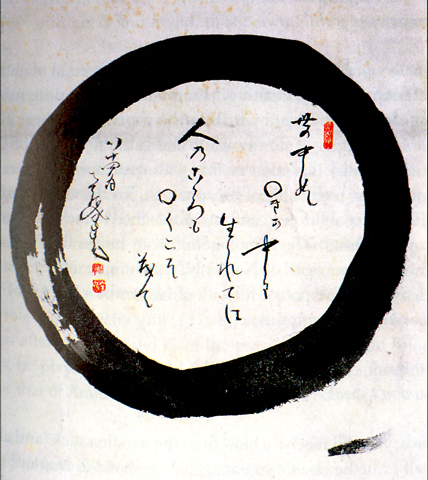
The image I have chosen for the post is an artwork by the Japanese Zen master, Nakahara Nantenbō (1839 – 1925). The artwork is a depiction of ensō (circle). The caption reads:

Born within the ensō (circle) of the world, the human heart must also become an ensō (circle).

Please maintain social distance and wear masks. Please take vaccination, if able. Stay safe and Always keep on learning…

In case you missed it, my last post was The Ghost in the System:

This post is also available as a podcast – https://anchor.fm/harish-jose/episodes/The-Reality-of-Informationally-Closed-Entities-e16ke0d

References:

  1. An Introduction to Cybernetics, Ross Ashby (1956)
  2. An introductory perturbation: what is constructivism and is there a future in it?, Raskin, Jonathan D. (2015)

Observations on Observing, The Case Continues:

Art by Audrey Jose

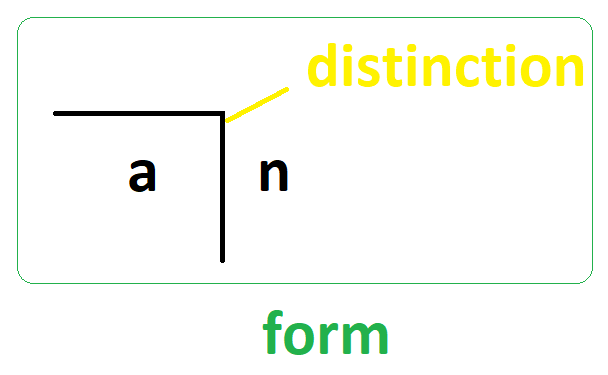
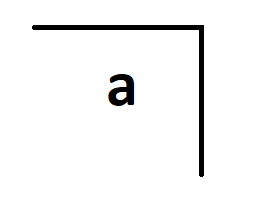
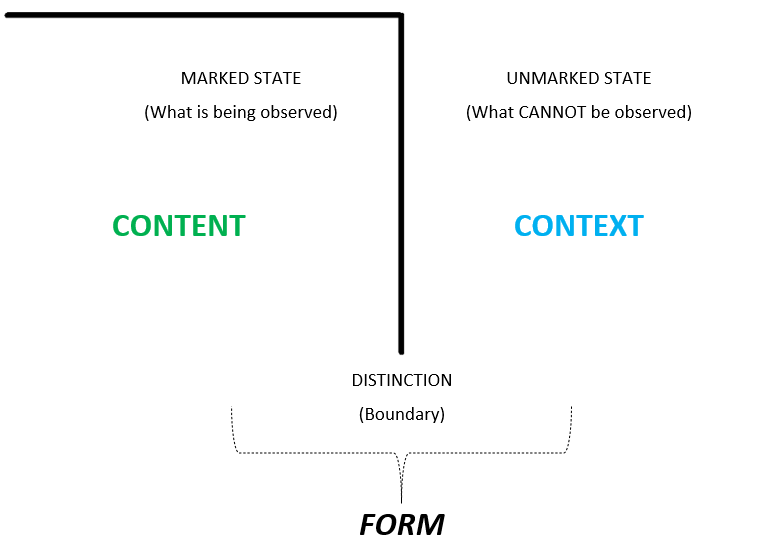
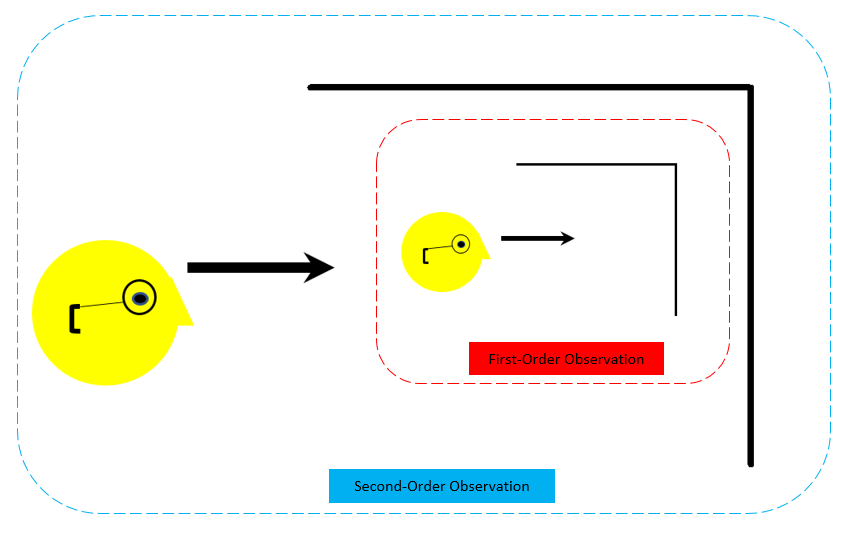
In today’s post, I am continuing from the last post, mainly using the ideas of Dirk Baecker. We noted that every observation is an operation of distinction, where an observer crosses a line, entering a marked state. This is shown in the schematic below. Here “a” refers to the marked state that the observer is interested in. The solid corner of a square is the distinction that was used by the observer, and “n” refers to the unmarked state. The entire schematic with the two sides and the three values (“a”, “n” and the distinction) are notated as a “form”. The first order observer is observing only the marked state “a”, and is not aware of or paying attention to the distinction(s) utilized. They are also not aware of the unmarked state “n”. When a second order observer enters the picture, they are able to see the entire form including the distinction employed by the first order observer.  

However, it is important to note that the observation made by the second order observer is also a first order observation. This means that they also have a distinction and an unmarked state, another “n” that they are not aware of. Baecker explains this:

We have to bring in second-order observers in order to introduce consciousness or self-observation. Yet to be able to operate at all, these second-order observers must also be first-order observers… Second-order observers intervene as first-order observers, thereby presenting their own distinction to further second-order observation.

We also discussed the idea of “reentry” in our last post. Reentry is a means to provide closure so that the first order and second order observations taken together leads to a stable meaning.

So, to recap, the first order observer is interested in “a”.

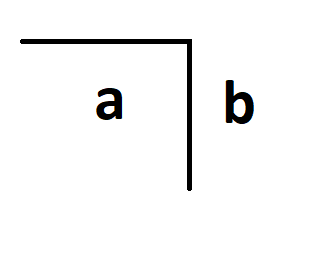
The second order observer observes the first order observer, and understands that the first order observer made a distinction. They see where the first order observer is coming from, and the context of their observation. Let’s call the context as “b”. This will be the unmarked state for the first observer.

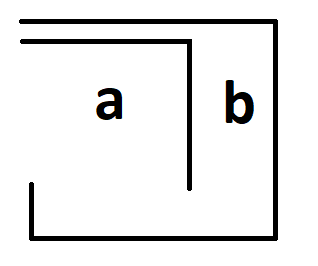
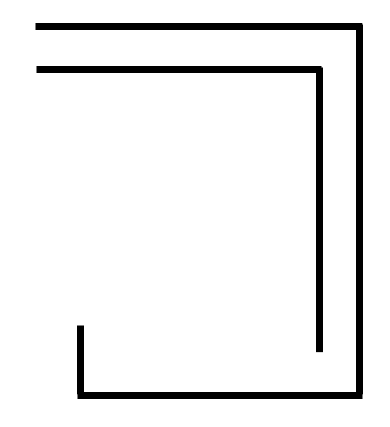
The second order observer engages with the first order observer in an ongoing back and forth discussion. The second order observer is able to combine both their “dealing with the world” approaches and come together to a nuanced understanding. This understanding is an effect of distinguishing “a” from “b”, and also combining “a” and “b” – an action of implication and negation taken together. This is an operation of sensemaking in the medium of meaning. This is depicted as the reentry in the schematic below.

Baecker explains reentry further:

Any operation that is able to look at both sides of the distinction – that is, at its form – is defined by Spencer Brown as an operation of reentry. It consists of reentering the distinction into the distinction, thereby splitting the same distinction into one being crossed and the same one being marked by another distinction that is deferred. The general idea of the reentry is to note and use the fact that distinctions occur in two versions: the distinction actually used, and the distinction looked at or reflected on.

Let’s look further at the form by using a famous syllogism from philosophy to further enhance our understanding:

All Men are Mortals;

Socrates is a man;

Therefore, Socrates is a mortal.

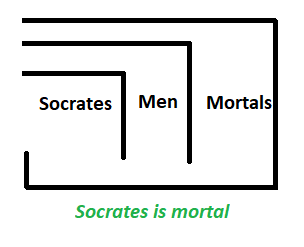
 This can be depicted as a form as shown below:

By distinguishing Socrates from Men, and Men from Mortals, and by putting it all together, we get to “Socrates is Mortal”. In this case, we did not have to do a lot of work to come to the final conclusion. However, as the complexity increases, we will need to perform reentry on an ongoing basis to bring forth a stable meaning. Reentry introduces temporality to the sensemaking operation. No matter how many distinctions we employ, we can only get to a second order observation. All observations are in all actuality first order observations. And what is being distinguished is also dependent entirely on the observer.

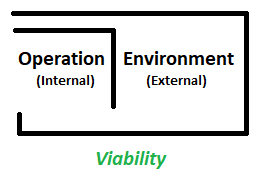
I will also look at another example. A manager is required to maintain the operations of a plant while at the same time they need to make modifications to the operations to ensure that the plant can stay viable in an everchanging environment. In other words, the operations are maintained as consistent as possible until it needs to be changed. This can be depicted as shown below:

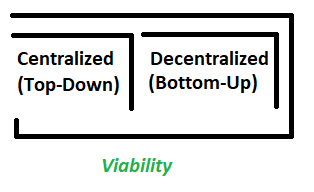
Another way to look at this is to view a plant as needing centralized structure as well as decentralized structure or top-down and bottom-up structure. This can be depicted as shown below. Here the two states are not shown as nested, but adjacent to each other.

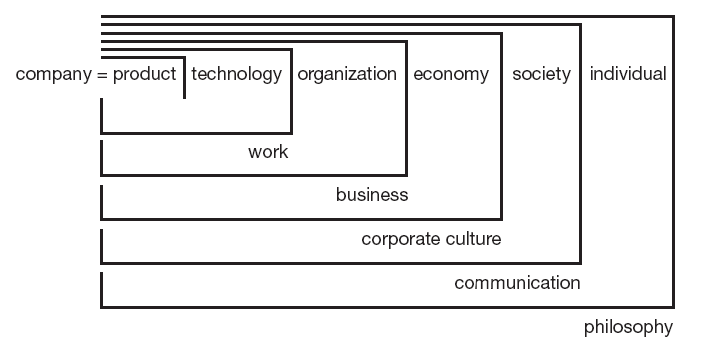
Dirk Baecker saw a firm as follows:

Baecker notes that the product is the first distinction that we have to make. Our first distinction is the distinction of the product. Whatever else the firm may be doing, it has to recursively draw the distinction of which product it is to produce. This may be a material or immaterial, a tangible or intangible, an easy or difficult to define product, but it has to be a product that tells employees, managers and clients alike just what the firm is about. He continues- The technology is part of the form of the first distinction. Indeed, it is the outside or the first context of the first distinction, as observed by a second-order observer who may be the first-order observer observing him/herself. This means that a firm distinguishes only those products for which it has, or hopes to acquire, the necessary technology. Technology here means all kinds of ways of making sure that we can do what we want to do. This includes material access to resources, knowledge of procedures, technologies, availability of people to do the job and ways to convince society that you are doing what you are doing in the proper way.

Baecker explains “work” as follows:

We add the assumption of communication between first-order observers who at the same time act as second-order observers. The firm observes itself. By working, it relates products to technology and technology back to products.

Additional information can be found on Dirk Baecker’s The Form of the Firm.

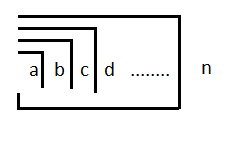
In all that we have seen so far, we have not yet talked about the unmarked state. The unmarked state “n” is always present in the form and is not accessible to the observer. The observation can have as many distinctions as needed, dependent on the observer. The “n” represents everything that can be further added to the distinctions to improve our “meaning” as needed. The more distinctions there are, the more complex the observations. The observers deal with the complexity of the phenomena to be understood by applying as many or as few distinctions as needed.

We are able to better help with someone else’s problems because we can engage in second order observations. As second order observers, we can see the distinctions they made which are not accessible to them in the first order observation. The second order observer is able to understand the distinctions that the first order observer was able to make. The distinctions lay in the blind spots for the first order observer. The second order observation can be completed by the first order observer themselves as an operation of self-reflection. As cognitive beings, we must reproduce existing patterns by continually engaging with the external world, our local environment. We have to keep evaluating and adjusting these patterns on an ongoing self-correcting basis.

The basic structure of what we have discussed so far can be depicted as the following form:

We need to be mindful that there is always “n” that is not part of our observation. We may gain a better understanding of our distinctions if we engage in second order observation, but we will still not be able to access the unmarked state. We will not be able to access the unmarked state unless we create a new distinction in the unmarked state cutting “n” to a marked state and an unmarked state, yielding a new “n”. Second-order observation, noting one’s own distinctions, can lay the groundwork for epistemic humility.

This brings into question – how many distinctions are really needed? We will answer this with going to the first distinction we made. The first cross that we started with leading to the first distinction is the most important thing that we care about. Every other distinction is based on this first one. To answer – how many distinctions are really needed? – we need as many distinctions as needed until we are fully satisfied with our understanding. This includes understanding our blind spots and the distinctions we have made.

I will finish with a Peter Drucker story from Baecker. Peter Drucker was working with a hospital to improve their Emergency Room. Baecker noted that it took the hospital staff two days to come up with the first distinction, their “a”. Their “a” was to bring immediate relief to the afflicted. The afflicted needing relief may not always be the patient. In Drucker’s words:

Many years ago, I sat down with the administrators of a major hospital to think through the mission statement of the emergency room. It took us a long time to come up with the very simple, and (most people thought) too obvious statement that the emergency room was there to give assurance to the afflicted.

To do that well, you have to know what really goes on. And, much to the surprise of the physicians and nurses, it turned out that in a good emergency room, the function is to tell eight out of ten people there is nothing wrong that a good night’s sleep won’t take care of. You’ve been shaken up. Or the baby has the flu. All right, it’s got convulsions, but there is nothing seriously wrong with the child. The doctors and nurses give assurance.

We worked it out, but it sounded awfully obvious. Yet translating that mission statement into action meant that everybody who comes in is now seen by a qualified person in less than a minute. That is the mission; that is the goal. The rest is implementation.

Some people are immediately rushed to intensive care, others get a lot of tests, and yet others are told: “Go back home, go to sleep, take an aspirin, and don’t worry. If these things persist, see a physician tomorrow.” But the first objective is to see everybody, almost immediately — because that is the only way to give assurance.

This post is also available as a podcast – https://anchor.fm/harish-jose/episodes/Observations-on-Observing–The-Case-Continues-e15kpc1

Please maintain social distance and wear masks. Please take vaccination, if able. Stay safe and Always keep on learning…

In case you missed it, my last post was The Case of the Distinguished Observer:

The Case of the Distinguished Observer:

In today’s post, I am looking at observation. This will be a general overview and I will follow up with more posts in the future. I am inspired by the ideas of George Spencer-Brown (GSB), Niklas Luhman, Dirk Baecker and Heinz von Foerster. In Cybernetics, observation does not mean just to utilize your eyes and look at something. It has a deeper “sensemaking” type meaning. Observation in Cybernetics does not follow the rigid subject-object relationship. Toth Benedek explains this:

Heinz von Foerster tried to develop a point of view that replaces the linear and rigid structure of the object-subject (observer-observed) distinction. According to von Foerster, the observer is really constructed by the observed and vice versa: ‘observation’ is nothing else but the circular relation between them. Observation as a relation defines the observer and the observed, so the observer refers not only to the observed, but also to himself by the act of observation.

Observation is an operation of distinction. The role of an observer is to generate information. If no information is being generated, then no observation has been made. An observation is an act of cognition. GSB in his seminal work, Laws of Form noted:

A universe comes into being when a space is severed or taken apart. The skin of a living organism cuts off an outside from an inside. So does the circumference of a circle in the plane. By tracing the way we represent such a severance, we can begin to reconstruct, with an accuracy and coverage that appear almost uncanny, the basic forms underlying linguistic, mathematical, physical, and biological science, and can begin to see how the familiar laws of our own experience follow inexorably from the original act of severance.

GSB advises us to draw a distinction. He proposed a notation called as “mark” to do this. A basic explanation of a mark is shown below. It separates a space into two sections; one part that is observed and the other that is not observed. We can look at a space, and identify a difference, a distinction that allows us to identify a part of the space as something and the remaining of that space as NOT that something. For example, we can distinguish a part of a house as kitchen and everything else is “not kitchen”. At that point in time, we are looking only at the kitchen, and ignoring or not paying attention to anything else. What is being observed is in relation to what is not being observed. A kitchen is identified as “kitchen” only in the context of the remaining of the house.

Dirk Baecker explains this:

Spencer-Brown’s first propositions about his calculus is the distinction being drawn itself, considered to be “perfect continence”, that is to contain everything. A distinction can only contain everything when one assumes that it indeed contains (a) its two sides, that is the marked state and the unmarked state, (b) the operation of the distinction, that is the separation of the two sides by marking one of them, and (c) the space in which all this occurs and which is brought forth by this occurrence.

From the context of GSB, we can view a distinction as a first order observation. We can only see what is inside the box, and not what is outside the box. What is outside the box is our “blind spot.”

Hans-Georg Moeller explains this very well:

A first-order observation can simply observe something and, on the basis of this, establish that thing’s factuality: I see that this book is black—thus the book is black. Second-order observation observes how the eye of an observer constructs the color of this book as black. Thus, the simple “is” of the expression “the book is black” becomes more complex—it is not black in itself but as seen by the eyes of its observer. The ontological simplicity is lost and the notion of “being” becomes more complex. What is lost is the certainty about the “essential” color of this book.

The first order observer is confident about the observation he makes. He may view his observation as necessary and not contingent. However, a second order observer is able to also see what the first order observer is not. The second order observer is able to understand to an extent how the first order observer is making his distinctions. The second order observer thus comes to the conclusion that the distinction made by the first order observer is in fact contingent and somewhat arbitrary.

The most important point about the first order observation is that the first order observer cannot see that he does not see what he does not see. In other words, the first order observer is unaware that he has a blind spot. A second order observer observing a first order observer is able to see what the first order observer is not able to see, and he is also able to see that the first order observer has a blind spot. This is depicted in the schematic below:

As the schematic depicts, the second order observer is also making a distinction. In other words, what he is doing is also a first order observation! This means that the second order observer also has a blind spot, and he not aware that he has a blind spot! As Benedek further notes:

the first order of observation (our eye’s direct observation) is unable to get a coherent and complete image about the world out there. What we can see is something we learnt to see: the image we “see” is a result of computing processes.

The second order observation can also be carried out as a self-observation, where the observer doing the first order observation is also the observer doing the second order observation. This may appear paradoxical. GSB talked about an idea called “reentry” in Laws of Form. Reentry is the idea of reentering the form again. In other words, we are re-introducing the distinction we used onto the form again. The reentry is depicted in the schematic below:

Dirk Baecker explains:

Spencer-Brown’s calculus of form consists in developing arithmetic with distinctions from a first instruction—”draw a distinction”—to the re-introduction (“re-entry”) of the distinction into the form of distinction, in order to be able to show in this way that the apparently simple, but actually already complex beginning involved in making a distinction can only take place in a space in which the distinction is for its part introduced again. The observer who makes this distinction through it becomes aware of the distinction, to which he is himself indebted.

Self-observation requires a reentry. In order to become aware that we have cognitive blind spots, we have to perform reentry. The re-entry includes what was not part of the original distinction. This allows us to understand (to a point) how we make and utilize distinctions. To paraphrase Heinz von Foerster, we come to see when we realize that we cannot see.

The reentry is a continuous operation that is self-correcting in nature. There is no end point to this per-se and it oscillates between the inside and the outside. This leads to an emergent stability as an eigenform. As noted before, the second order observation is still a form of first order observation even with reentry. There are still cognitive blind spots and we are still subject our biases and limitations of our interpretative framework. We are affected by what we observe and we can only observe what our interpretative framework can afford. As noted at the start of the post, the role of the observer is to generate information. If the observer is not able to make a distinction, then no information can be generated. This has the same effect as us being in a closed system where the entropy keeps on increasing. Borrowing a phrase from Stafford Beer, this means that observers are negentropic pumps. We engage in making dynamic distinctions which allows us to gather the requisite information/knowledge to remain viable in an everchanging environment.

The discussion about first order and second order observations may bring up the question – is it possible to have a third order observation? Heinz von Foerster pointed out that there is no need for a third order observation. He noted that a reflection of a reflection is still a reflection. Hans-Georg Moeller explains this further:

While second-order observation arrives at more complex notions of reality or being, it still only observes—it is a second-order observation, because it observes as a first-order observation another first-order observation. It is, so to speak, the result of two simultaneous first-order observations. A third-order observation cannot transcend this pattern—for it is still the first-order observation of a first-order observation of a first-order observation… No higher-order observation—not even a third-order observation—can observe more “essentially” than a lower-order observation. A third-order observation is still an observation of an observation and thus nothing more than a second-order observation. There is no Platonic climb towards higher and higher realities—no observation brings us closer to the single light of truth.

I will finish with some wise words from Dirk Baecker:

Draw a distinction.

Watch its form.

Work its unrest.

Know your ignorance.

Please maintain social distance and wear masks. Please take vaccination, if able. Stay safe and Always keep on learning… In case you missed it, my last post was The Cybernetics of Magic and the Magic of Cybernetics:

The Cybernetics of Magic and the Magic of Cybernetics:

In today’s post, I am looking at magic and cybernetics. From a young age, I have been a fan of magic. I have talked about magic here before. I see magic as the art of paradoxes.  The word paradox stems from the Greek words – “para” and “dokein”, and taken together it means contrary to expectation.

Take for example a simple magic trick where the magician shows you an open empty hand. The magician closes the hand, and does a gentle wiggle and then opens his hand to reveal a coin. He again closes his hands, and does another gentle wiggle and then opens the hand to show that his hand is empty. The magic happens from a self-referential operation. The spectator (or the observer) sees an empty hand and describes it to themselves as an empty hand. Later, when the magician shows their hand again, the hand now contains a coin. The spectator has to reference back to the previous state of empty hand, and face the moment of paradox. The hand that was empty now has a coin. The moment of magic comes only when the spectator can reference back to the empty hand. If we denote the empty hand as A, the value of the hand now is !A or in other words, not an empty hand. If the spectator cannot reference back to their original observation, they will not see the magic. From the magician’s standpoint, he should take care to make sure that this experience is as strong as possible. For example, he should take care to maintain the image of the hand with and without the coin, the same. This means that the position of the fingers, the gap between them, the gesture etc. are all maintained the same for the two states – one where the hand has no coin, and the second where the hand has a coin. This reinforces the “magic” for the spectator.

The idea of self-reference is of great importance in cybernetics. In logic, the idea of self-reference is shunned because it normally leads to paradoxes. A great example for a paradox is the liar paradox. One of the oldest forms of liar paradox is the statement that Epimenides, the Cretan made. He said that, “all Cretans are liars.” Since he himself was a Cretan, that would mean that he is also a liar, but that would mean that what he is saying is true, which means that he must be a liar… and so on. This goes into a paradox from the self-reference. There have been many solutions suggested for this conundrum. One of the ways to resolve any apparent paradox is to introduce temporality into this sentence. We can do this by making the statement slightly ambiguous and add the word “sometimes”. So, the sentence becomes, “all Cretans are liars sometimes.” The temporality suggests that the value for the statement and the person uttering the statement changes with time and this dissolves the paradox.

Paradoxes don’t exist in the “real world.” The reasonable conclusion is that they have something to do with our stubborn and rigid thinking. When we are unwilling to add temporality or ambiguity, we get stuck with our thinking. Another way to look at this is from a programmer’s standpoint. The statement a = a + 1, is valid from a computer program standpoint. Here the variable, “a” does not stand for a constant value. It is a placeholder for a value at a given point in time. Thus, although the equation a = a +1 is self-referential, it does not crash the computer because we introduce temporality to it, and we do not see “a” having one unique value at all times.

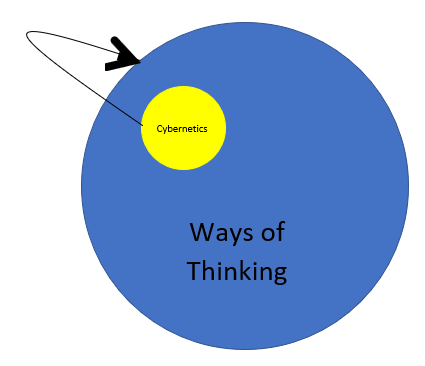
In Cybernetics, self-reference is accepted as a normal operation. Cyberneticians talk about second order concepts such as “understanding understanding” and “observing observing”. One of my favorite description of Cybernetics comes from Larry Richards. He describes cybernetics as a way of thinking about ways of thinking (of which it – cybernetics – is one). This is form of self-reference.

In Cybernetics, self-reference does not lead to paradox. Instead, it leads to a stable outcome. As cognizing agents, we build a stable reality based on self-reference. We can do activities such as thinking about thinking or learning about learning from this approach. Louis Kauffman talks about this:

Heinz von Foerster in his essays has suggested the enticing notion that “objects are tokens for eigen behaviors.” … The short form of this meaning is that there is a behavior between the perceiver and the object perceived and a stability or repetition that “arises between them.” It is this stability that constitutes the object (and the perceiver). In this view, one does not really have any separate objects, objects are always “objects perceived,” and the perceiver and the perceived arise together in the condition of observation.

We identify the world in terms of how we shape it. We shape the world in response to how it changes us. We change the world and the world changes us. Objects arise as tokens of behavior that leads to seemingly unchanging forms. Forms are seen to be unchanging through their invariance under our attempts to change, to shape them.

My post was inspired by the ideas of Spencer-Brown, Francisco Varela and Heinz von Foerster. I will finish with another gem from Heinz von Foerster:

I am the observed relation between myself and observing myself.

This post is also available as a podcast here – https://anchor.fm/harish-jose/episodes/The-Cybernetics-of-Magic-and-the-Magic-of-Cybernetics-e14a257

Please maintain social distance and wear masks. Please take vaccination, if able. Stay safe and Always keep on learning… In case you missed it, my last post was TPS’s Operation Paradox:

Note: The point of a = a+ 1, was made also by Elena Esposito (Kalkul der Form).

View from the Left Eye – Modes of Observing:

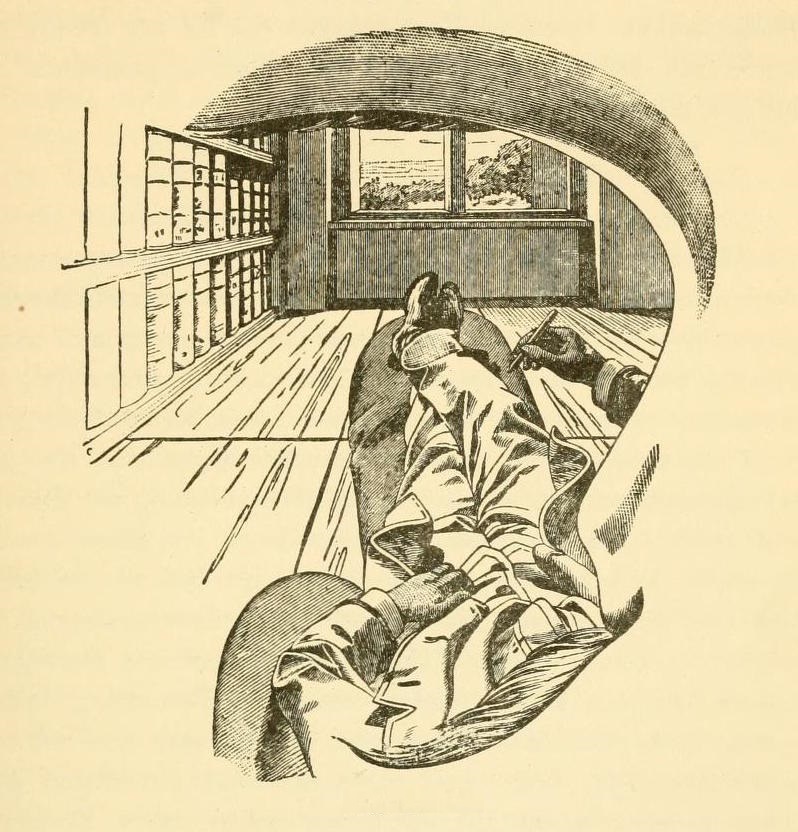
I was introduced to the drawing above through Douglas Harding who wrote the Zen book, “The Headless Way.” The drawing was drawn by Ernst Mach, the 19th Century Austrian physicist. He called the drawing, “the view from the left eye.” What is beautiful about the drawing is that it is sort of a self-portrait. This is the view we all see when we look around (without using a mirror or other reflective surfaces). If we could draw what we see of ourselves, this would be the most accurate picture. This brings me to the point about the different modes of observing.

Right now, you are most likely reading this on a screen of some sort or perhaps you are listening to this as a podcast. You were not paying attention to the phone or computer screen – until I pointed it out to you. You were not paying attention to how your shoes or socks or clothes feel on your body – until I pointed them out to you. This is mostly how we are in the world. We are just being in the world most of the time. Everything that we interact with is invisible to us. They just flow along the affordances we can afford. The keyboard clacks away when we hit on the keys, the door knobs turn when we turn them, etc. We do not see them until we have to see them. The 20th century German philosopher, Martin Heidegger called this ready-to-handedness. Everything is connected to everything else. We interact with the objects in order to achieve something. We open the door to go inside a building to do something else. We get in the car to get to a place. We use a hammer to hammer a nail in order to build something. Heidegger called these things equipment, and he called the interconnectedness, the totality of the equipment. The items are in the background to us. We do not pay attention to them. This is how we generally see the world by simply being in the world.

Now let’s say that the general flow of things breaks down for some reason. We picked up the hammer, and it is heavier than we thought and we pay attention to the hammer. We look at the hammer as a subject looking at an object. We start seeing that it has a red handle and a steel head. The hammer is not ready-to-hand anymore. The hammer has become an object and in the foreground. Heidegger called this as present-at-hand. When we really look at something, we realize that we, the subjects, are looking at something, the object. We no longer have the affordances to interact with it in a nonchalant manner. We have to pay attention in order to engage with the object, if needed.

With this background, I turn to observing again. In my view(no pun intended), there are three modes of observing:

  1. No self – similar to ready-to-hand, you just “are” in the world, enacting in the world. You just see things without any thought to self. There is no distinction of self in what you observe. Perhaps, we can refer to this as the zero person or zero order view.
  2. Seeing self – you make a distinction with this. You draw a line between you the subject, and the world out there. The world is out there and you are separate from the world. This is similar to present-at-hand. The world is out there. This is also the first order in First Order Cybernetics.
  3. Seeing self through self/others – Here you are able to see yourself through self or others. You are able to observe yourself observing. This is the second order in Second Order Cybernetics. In this case, the world is in here, within you, as a constructed stable reality.

In the first mode, you are being in the world. Heidegger would call this as “dasein.” In the second mode, you see the world as being outside. And in the third mode, you see the world as being inside. There are no hierarchies here. Each mode is simply just a mode of observing. In the second and third modes, you become aware of others who are like you in the world. In the third mode, you will also start to see how the others view the world since you are looking through others’ eyes. You realize that just as you construct a world, they too construct a world. Just like you have a perspective, they too have a perspective. The different modes of observing lead to a stable reality for us based on our interpretative framework. We cognize a reality by constructing it based on the stable correlations we infer from our being in the world. Sharing this with others lead to a stable societal realm through our communication with others. A community is formed when we share and something common emerges. It is no accident that the word “community” stems from the root word “common.”

When we observe a system, we also automatically stipulate a purpose for it. Systems are not real-world entities, but a means for the observer to make sense of something. We may call a collection of automobiles on the road as the transportation system just so that we can explain the congestion in the traffic. The same transportation system might be entirely different for the construction worker working on the pavement.

We have to go through the different modes of observation to help further our understanding. Seeing through the eyes of others is a practice for empathy. And this is something that we have to continuously practice to get better at. Empathy requires continuous practice.

I will finish with Ernst Mach’s explanation for his drawing:

Thus, I lie upon my sofa. If I close my right eye, the picture represented in the accompanying cut is presented to my left eye. In a frame formed by the ridge of my eyebrow, by my nose, and by my moustache, appears a part of my body, so far as visible, with its environment. My body differs from other human bodies beyond the fact that every intense motor idea is immediately expressed by a movement of it, and that, if it is touched, more striking changes are determined than if other bodies are touched by the circumstance, that it is only seen piecemeal, and, especially, is seen without a head

It was about 1870 that the idea of this drawing was suggested to me by an amusing chance. A certain Mr L., now long dead, whose many eccentricities were redeemed by his truly amiable character, compelled me to read one of C. F. Krause’s writings, in which the following occurs:

“Problem : To carry out the self-inspection of the Ego.

Solution : It is carried out immediately.”

In order to illustrate in a humorous manner this philosophical “much ado about nothing,” and at the same time to shew how the self-inspection of the Ego could be really “carried out,” I embarked on the above drawing. Mr L.’s society was most instructive and stimulating to me, owing to the naivety with which he gave utterance to philosophical notions that are apt to be carefully passed over in silence or involved in obscurity.

This post is also available as a podcast episode – https://anchor.fm/harish-jose/episodes/View-from-the-Left-Eye–Modes-of-Observing-e1297um

Please maintain social distance and wear masks. Please take vaccination, if able. Stay safe and Always keep on learning…

In case you missed it, my last post was The Stories We Live By:

Round and Round We Go:

In today’s post, I am looking at a simple idea – Loops, and will follow it up with Heinz von Foerster’s ideas on second order Cybernetics. A famous example of a loop is “PDCA”. The PDCA loop is generally represented as a loop – Plan-Do-Check-Act-Plan-Do…, and the loop is represented as an iterative process where it goes on and on. To me, this is a misnomer and misrepresentation. These should be viewed as recursions. First, I will briefly explain the difference between iteration and recursion. I am using the definitions of Klaus Krippendorff:

Iteration – A process for computing something by repeating a cycle of operations.

Recursion – The attribute of a program or rule which can be applied on its results indefinitely often.

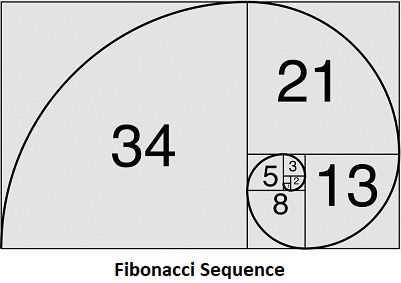
In other words, iteration is simply repetition. In a program, I can say to print the word “Iteration” 5 times. There is no feedback here, other than to keep count of the times the word was printed on screen. On the other hand, in recursion, the value of the first cycle is fed back into the second cycle, the output of which is fed into the third cycle and so on. Here circular feedback is going on. A great example of a recursive function is the Fibonnaci sequence. The Fibonacci sequence is expressed as follows:

Fn = Fn-1 + Fn-2, for n > 1

Fn = 1, for n = 0 or 1

Here, we can see that the previous value is fed into the equation to create a new value, and this is an example of recursion.

From the complexity science standpoint, recursions lead to interesting phenomenon. This is not an iterative non-feedback loop any longer, where you come back to the same point again and again. With recursion, you get to circular causality with each loop, and you enter a new state altogether. Each loop is directly impacted by the previous loop. Anything that leads back to its original starting point doesn’t lead to emergence and can actually lead to a paradox. A great example is the liar paradox. In a version of this, a card has a statement written on both sides of a card. They are as follows:

  1. The statement on the other side of this card is FALSE.
  2. The statement on the other side of this card is TRUE.  

This obviously leads to a paradox when you follow it along a loop. You do not get to a new state with each iteration. Douglas Hofstadter wonderfully explained this as a mirror mirroring itself. However, with recursion, a wonderful emergence can happen, as we see in complexity science. Circular causality and recursion are ideas that have strong footing in Second Order Cybernetics. A great example of this is to look at the question – how do we make sense of the world around us? Heinz von Foerster, the Socrates of Cybernetics, has a lot to say about this. As Bernard Scott notes:

For Heinz von Foerster, the goal of second-order cybernetics is to explain the observer to himself, that is, it is the cybernetics of the cybernetician. The Greek root of cybernetics, kubernetes, means governor or steersman. The questions asked are; who or what steers the steersman, how is the steersman steered and, ethically, how does it behoove the steersman to steer himself? Von Foerster begins his epistemology, in traditional manner, by asking, “How do we know?” The answers he provides-and the further questions he raises-have consequences for the other great question of epistemology, “What may be known?” He reveals the creative, open-ended nature of the observer’s knowledge of himself and his world.

Scott uses von Foerster’s idea of undifferentiated coding to explore this further. I have written about this before here.

Undifferentiated coding is explained as below:

The response of a nerve cell encodes only the magnitude of its perturbation and not the physical nature of the perturbing agent.

Scott continues:

Put more specifically, there is no difference between the type of signal transmitted from eye to brain or from ear to brain. This raises the question of how it is we come to experience a world that is differentiated, that has “qualia”, sights, sounds, smells. The answer is that our experience is the product of a process of computation: encodings or “representations” are interpreted as being meaningful or conveying information in the context of the actions that give rise to them. What differentiates sight from hearing is the proprioceptive information that locates the source of the signal and places it in a particular action context.

Von Foerster explained the circular relationship between sense data and experiences as below:

The motorium (M) provides the interpretation for the sensorium (S) and the sensorium provides the interpretation for the motorium.

How we make sense depends on how we experience, and how we experience depends upon how we make sense. As Scott notes, we can explain the above relationship as follows:

S = F(M). Sensorium, S, is a function of motorium, M.

M = G(S). Motorium, M, is a function of sensorium, S.

Von Foerster pointed out that this is an open recursive loop, since we can replace M with G(S).

S=F(G(S))

With more replacements for the “S”, this equation becomes an open recursive loop as follows:

S=F(G(F(G(F(G(…………G(S)))))……

Scott continues:

Fortunately, the circularity is not vicious, as in the statement “I am a liar”. Rather, it is virtuous or, as von Foerster calls it, it is a creative circle, which allows us to “transcend into another domain”. The indefinite series is a description of processes taking place in sequence, in “time”, with steps t, t+1, t+2 and so on. (I put “time” in quotes as a forward marker for discussion to come). In such indefinite recursive expressions, solutions are those values of the expression which, when entered into the expression as a base, produce themselves. These are known as Eigen values (self-values). Here we have the emergence of stabilities, invariances. The “objects” that we experience are “tokens” for the behaviors that give rise to those experiences. There is an “ultimate” base to these recursions: once upon a “time”, the observer came into being. As von Foerster neatly puts it, “an observer is his own ultimate object”.

The computations that give rise to the experience of a stable world of “objects” are adaptations to constraints on possible behaviors. Whatever else, the organism, qua system, must continue to compute itself, as a product. “Objects” are anything else it may compute (and recompute) as a unitary aspect of experience: things, events, all kinds of abstraction. The possible set of “objects” it may come to know are limited only by the organism’s current anatomy and the culture into which she is born.

I have written about this further here – Consistency over Completeness.

Heinz von Foerster said – The environment contains no information; it is as it is. We are informationally closed entities, which means that information cannot come from outside to inside. We make meanings out of the perturbations and we construct a reality that our interpretative framework can afford.

I will finish with a great observation from the Cybernetist philosopher Yuk Hui:

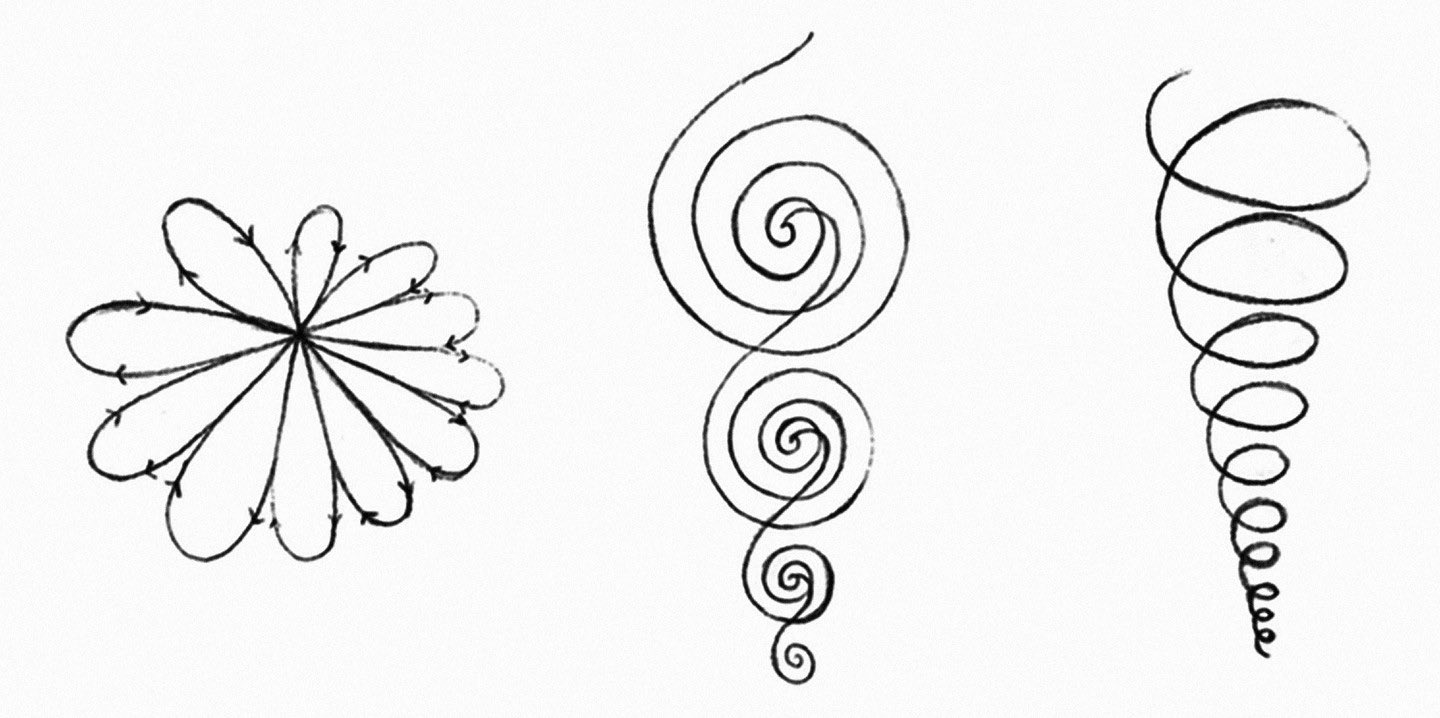
Recursivity is a general term for looping. This is not mere repetition, but rather more like a spiral, where every loop is different as the process moves generally towards an end, whether a closed one or an open one.

Please maintain social distance and wear masks. Stay safe and Always keep on learning…

In case you missed it, my last post was Observing with Your Hands:

References:

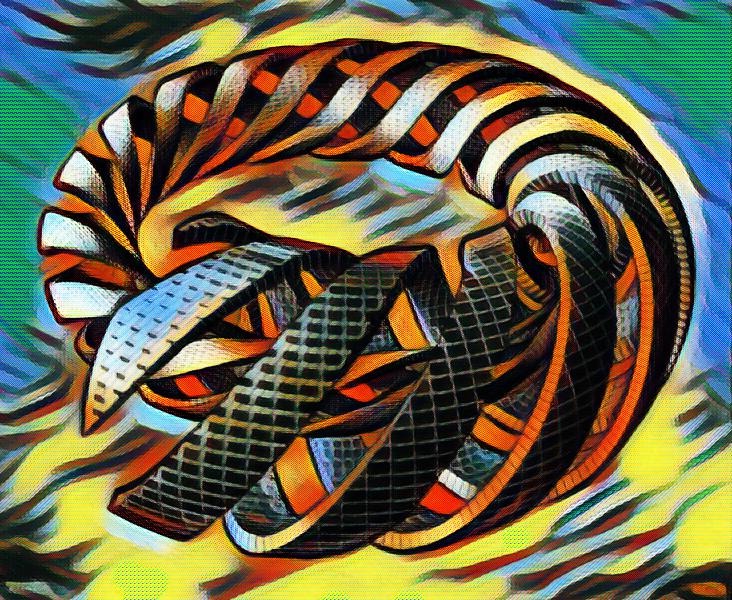
  1. M. C. Escher Spiral
  2. Second Order Cybernetics as Cognitive Methodology. Bernard Scott
  3. A Dictionary of Cybernetics. Klaus Krippendorff