One of the concepts that seems hard to grasp with regards to Cybernetics is the idea of “informational closure”. This idea was introduced by Ross Ashby as “informational tightness”. Ashby defined Cybernetics as the study of systems that are open to energy but closed to information and control – systems that are “information-tight”. Just like something that is described as water-tight, where water does not enter it from outside, information-tight refers to the condition where information does not enter it from outside.
Ashby also said that when a machine breaks, it changes its mind. Ashby referred to “machine” as a collection of parts that interact on one another and an “organization” as the specific way they are put together. For example, when a user pushes on a button, a door opens. The machine in this case is the button together with the wiring that can interact on the door together with the hinges. Ashby would say that Cybernetics in this case is the study of all possible actions that could have happened when the button was pushed, but did not. The cybernetician would ask why of all the possibilities, the action of the door opening happened? That specific action happened due to the specific manner the parts are connected to one another. If the parts were connected differently something else would have happened such as the door staying closed and refusing to open. I use the phrase “refusing to open” to tease the idea of the machine having a mind. As a nod to Descartes, in the case of this machine, its mind is indeed its body. It acts the way it does because of its structure. If there was a loose connection, then the machine would indeed change its mind, and refuse to open.
Here, the reader might be tempted to say that the user is providing an input or information via the press of the button. From a cybernetics standpoint, the user is actually perturbing the machine, and the machine’s behavior to this perturbation is to behave in a specific manner as dictated by its internal structure and organization. This is the reason why if there was a loose connection, the user pressing the button would result in a different behavior altogether. There is no information being received that is processed by the machine. The user could use the same pressing action on a keyboard and it would elicit an entirely different behavior, one that is consistent with the keyboard’s internal structure and organization. The machine’s mind is already made up, so to speak. If one were forced to define information in this regard, it would be something to the effect of “information is that which has the potential to elicit a response.” But here is the catch, what elicits a response is not the information, but the internal structure of the machine. In order to respond, the machine must have a closed organization. Information tight or informational closure means that the machine does not process information from outside. Instead, it is perturbed and this elicits a response based on its internal structure.
Two Chilean cyberneticians Humberto Maturana and Francesco Varela came up with the idea of autopoiesis that brought a new dimension to this. Their perspective is that humans are informationally closed as well. Maturana pointed out that prior to 1950’s, scientists and laypeople used to talk about neurons transferring or transmitting impulses. And after the advent of information theory by Claude Shannon and Warren Weaver, everything was viewed in a new light – that of information and entropy. The idea of conveying information from one person to the other, and information being processed is an attractive one. From a practical standpoint, one can see that this does not make sense. How many times have you conveyed information to another person only to have been misunderstood? As George Bernard Shaw once said, “The single biggest problem with communication is the illusion that it has taken place.”
We are obviously different than machines. We are not wired in order to be to elicited for specific responses. How we respond instead is based on a historical coherence. An easy example is how one responds to their own name. When we were infants, we were called our names, and we did not respond based on our then closed organization. With each repetition, we came to correlate the sound of the name to a response from us guided by reinforcement in the form of attention, love etc. The utterance of our name created a strong correlation in our behavior. There can still be instances where we may behave differently if our names are called such as in the case when your mother was using a stern voice. The history of interactions with others creates a stable response that we generally tend towards to. The more perturbations we have in the form of these interactions, the more we tend to respond in a particular manner. We have an embodied mind, unlike the machine. And unlike the machine, we are autonomous entities. We may still choose to change our mind for no good reason.
One of the examples that Maturana gave to further this idea is that of looking at a flower. The traditional way is to say that the light from the flower reaches our retina and this acts as information, and we see the flower. The informationally closed way is explained by Maturana as follows:
When light reflected by an object that the observer describes as external reaches the retina, an activity is initiated that is enclosed in the structure of the retina itself (and not in the structure of the source of light, nor in the structure of the world). The external world can only trigger such changes in the nervous system of an organism as are determined by the structure of the nervous system itself. The consequence is that there is no possible way, in principle, for the external world to communicate itself in its primordial, true form to the nervous system.
In other words, the flower does not inform the nervous system that it is a flower. Instead, the nervous system constructs an experiential reality of “flower” based on its own structure. It should refer to itself in order to make sense. This aligns with the view that each of us uniquely experience the world. What the color blue is? or what the sound of a hand clap is? – are all different for each of us, and this is based on our history of interactions and our closed interpretative framework. This brings attention to the essential point that what we experience is only one version of a human reality. To exist in a social realm requires us to be respectful of the other participants.
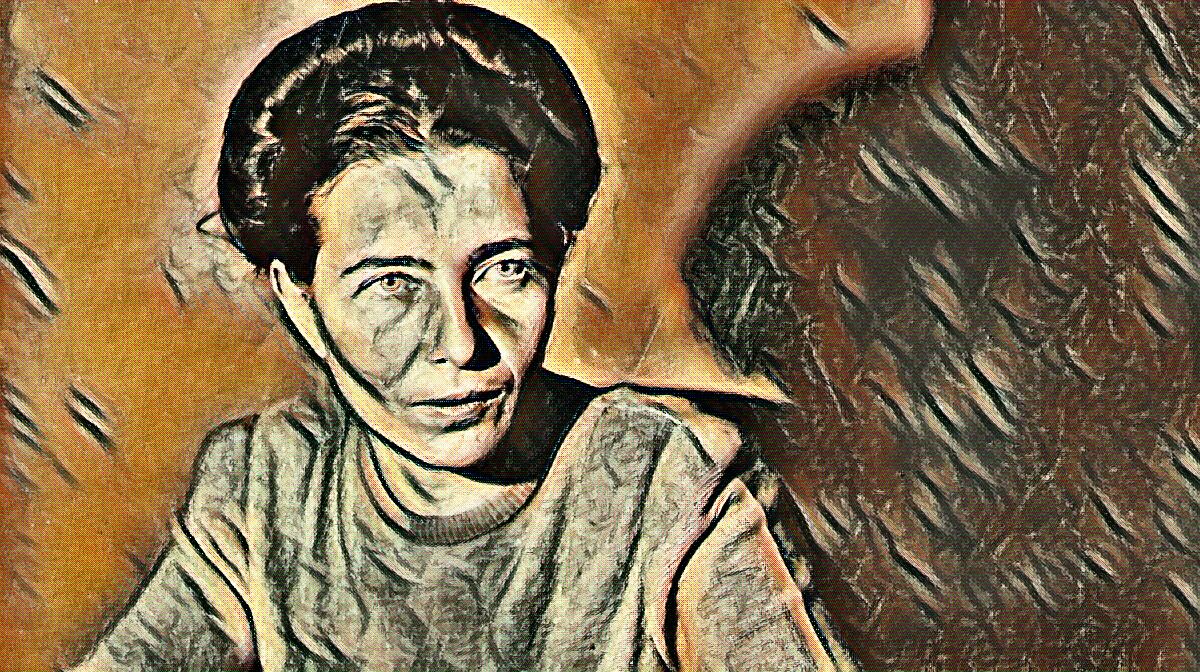
In today’s post, I am looking at the ambiguities in complexity. I am inspired by the brilliant French philosopher, Simone de Beauvoir. She was a proponent of existentialism, the school of philosophy that puts emphasis on human existence first and foremost. Their motto, as noted by Jean Paul Sartre, is “existence precedes essence.” This basically means that we create the meaning of our lives. There is no authority outside of us dictating what our essence must be. We are responsible for our construction of what we become.
The ideas of existentialism have many similarities with the philosophical school of constructivism in Cybernetics. I have written about this before. Similar to existentialism, constructivism says that we construct a version of reality and that we are responsible for our construction. In the social realm, constructivists believe that we aim for consistency through our continuous interactions with the other constructors. If I am constructing a version of reality, this means that others are doing the same. The language and culture act as external frames of references to provide a stable version of reality. The emphasis is not for correctness but consistency.
De Beauvoir realized that the ambiguity of our existence is part of us. We are subjects who engage in ongoing construction of a reality, at the same time we are objects in the construction of others in the social realm. In other words, we are creators while at the same time creations in someone else’s construction. What we identify as selves is in relation to others. We aim to have autonomy in our actions, and this often comes at the cost of others autonomy. The choices we make influences the choices others make and vice versa. There are no moral authorities dictating what everyone’s role is or what everyone should be doing. These ideas resonate strongly with Cybernetics. The ideas of constructivism are at the core of second order cybernetics.
De Beauvoir advised us to identify and withstand the pressures of the constraints that the contingencies of our times such as societal norms and expectations throw at us. We are to use our freedom to maximize our potentialities and shape our own lives. We can do this only when we acknowledge the ambiguities. We find freedom when we recognize the freedom of others.
With these ideas we will look at complexity. Loosely put, complexity is the interconnectedness that we identify or experience. When we pull on a thread here, something else moves in another location. Everything seems to be connected to everything else. Complexity in cybernetics is observer dependent. This means that the magnitude and “quality” of complexity can vary depending on the observer. This is also dynamic. This means that depending on when you are asking, the “what” of complexity can change. This also means that there are no clear demarcations or domains in complexity. There are certain portions that are less “complex” and some that are more “complex”. Cybernetics is not interested in the “what” but in all of the possible behaviors seen by the observer. The observer is able to make certain states occur more often than the others by playing with the constraints. Ernst von Glasersfeld wonderfully defined cybernetics as the art of creating equilibrium in a world of possibilities and constraints.
What does this mean if there are multiple observers? There are so many dimensions and so many possibilities. Cybernetics talks about the constructive dance between the observers. Every interaction is an invitation to understand each other. We need to talk about what we see and what think we see through others eyes. We face complexity as part of facing situations. We seek to obtain a stable state that covers certain desired attributes of the situation. In order to know this, we have to have a good understanding of the possibilities and the available constraints that can be used to achieve some of the possibilities. The constraints can be used to generate attractor states that the dynamic “system” latches onto and those attractor states will cover the desired states. There is a lot of literature about leaders with respect to complexity. Leaders are people who take up the responsibility to create conditions so that attractor states containing certain desired states are generated.
The discussion of complexity demonstrates the presence of ambiguity through and through. Who chooses what the desired outcomes should be? Who decides who should do what? Who decides to utilize the constraints for which some people may have to pay more? As noted, there are no moral authorities in these situations. Taking heed to de Beauvoir’s words, we should not run away from the ambiguities. Instead, we should embrace them. We should understand that there are always others in the social realm. We become a self through the others.
To say that there are rules for complexity would be a terrible idea. However, there are several heuristics that we can use to embrace the ambiguities. We should engage in the cybernetic dance and encourage being openminded to others’ viewpoints. We should practice empathy and try to understand the different perspectives. We should engage in dialogue more with the intent of actively listening. We should understand the power structure that is predominant and work with the marginalized groups so that their voices are also heard. We should celebrate the differences. We should look for similarities in differences and differences in similarities. We should cherish each other’s autonomy.
I will finish with some strong words from Simone de Beauvoir:
Men of today seem to feel more acutely than ever the paradox of their condition. They know themselves to be the supreme end to which all action should be subordinated, but the exigencies of action force them to treat one another as instruments or obstacles, as means. The more widespread their mastery of the world, the more they find themselves crushed by uncontrollable forces. Though they are masters of the atomic bomb, yet it is created only to destroy them. Each one has the incomparable taste in his mouth of his own life, and yet each feels himself more insignificant than an insect within the immense collectivity whose limits are one with the earth’s. Perhaps in no other age have they manifested their grandeur more brilliantly, and in no other age has this grandeur been so horribly flouted. In spite of so many stubborn lies, at every moment, at every opportunity, the truth comes to light, the truth of life and death, of my solitude and my bond with the world, of my freedom and my servitude, of the insignificance and the sovereign importance of each man and all men.
In today’s post, I am looking again at the idea of constraints in relation to Ross Ashby’s ideas and the ideas of second order cybernetics. As far as I know, Ashby did not go into the differentiation of first and second order cybernetics. A lot of what he wrote can be filed away under “First order cybernetics”. But to do so will be missing the forest for the trees. A lot of Ashby’s ideas were ahead of his time and resonate with the ideas of complexity and systems thinking.
Ashby tied the idea of constraints to variety and the observer. Variety, as I have written here before, can be loosely put as the number of possible states differentiated by an observer. So, for example, an analog light switch can be said to have a variety of two – ON and OFF. Constraint is the relational part between an observer and a “system”. A “system” here is a select number of variables chosen by an observer to represent a phenomenon of interest. To elaborate these ideas, I am taking the example of an observer who chooses a Christmas tree as an area of interest. Further, let’s consider that the tree is connected to an analog switch with a variety of two as stated before. The observer can decide they would like to leave the tree ON for the entire Christmas season to reflect the Christmas spirit. The variety of the switch is now reduced to one, barring any unforeseen incidents. The switch is always kept in the ON position. Out of the two possibilities, a constraint was applied so that there is only one possibility.
Ashby was very clear that Cybernetics is about looking at what something is doing, instead of looking at what that “something” is. From this standpoint, we are looking at possibilities, which is a “black box” view. We are looking at how something is behaving and are not really interested in the intricacies of how things are connected together.
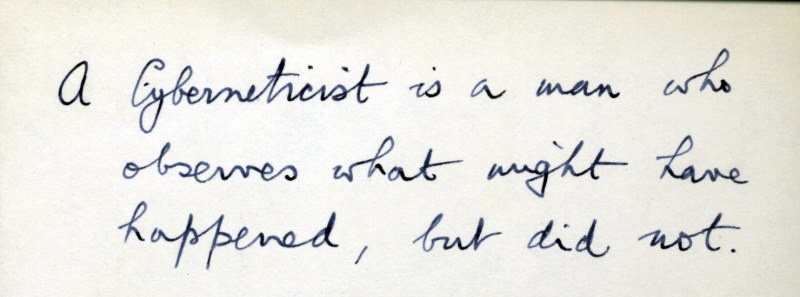
Ashby noted in his private notebook that “A Cyberneticist is a man[sic] who observes what might have happened, but did not.”
This idea of “something that might have happened, but did not” is related to the notion of constraints. Cybernetics is often depicted as a science of teleology. This is the first order Cybernetics. For example, we often depict the idea of a steersman moving towards a goal, where a clear path is set. From the idea of constraints, we should be looking at negative explanations. We may choose the destination, but the path is set by the constraints. Gregory Bateson, another intellectual giant in Cybernetics, noted the following about negative explanation:
Negative explanation is an aspect of cybernetic theory that emphasizes restraints. According to negative explanation, events take a particular course because they are constrained from taking other courses. Alternatively, positive explanation seeks to determine the causes of particular events. Rather than focusing on “Why?”, negative explanation involves describing the constraints under which systems operate.
We consider what alternative possibilities could conceivably have occurred and then ask why many of the alternatives were not followed, so that the particular event was one of those few which could, in fact, occur.
In a similar fashion, Ashby wrote:
Cybernetics looks at the totality, in all its possible richness, and then asks why the actualities should be restricted to some portion of the total possibilities.
The real world gives the subset of what is; the product space represents the uncertainty of the observer. The product space may therefore change if the observer changes; and two observers may legitimately use different product spaces within which to record the same subset of actual events in some actual thing. The “constraint” is thus a relation between observer and thing; the properties of any particular constraint will depend on both the real thing and on the observer. It follows that a substantial part of the theory of organization will be concerned with properties that are not intrinsic to the thing but are relational between the observer and thing.
We often emphasize on having a goal or direction, but we neglect the importance of constraints. Some constraints can be physical such as a ball rolling down a chute. The ball will always follow the same path. Now compare this to a rock falling down a hill. It may not follow the same path if you repeat rolling it down a hill. Some paths are more likely than others. And no matter how many times you roll it down a hill, some paths are never taken due to the physical constraints of the hill. These can be understood from a first order Cybernetics standpoint. From the second order Cybernetics standpoint, it is very important to understand the relational nature of constraints to the observer. What is limiting to one person can be nurturing for another. From the second order Cybernetics standpoint, the constraints are our biases and other epistemic constraints that limit or enable our actions.
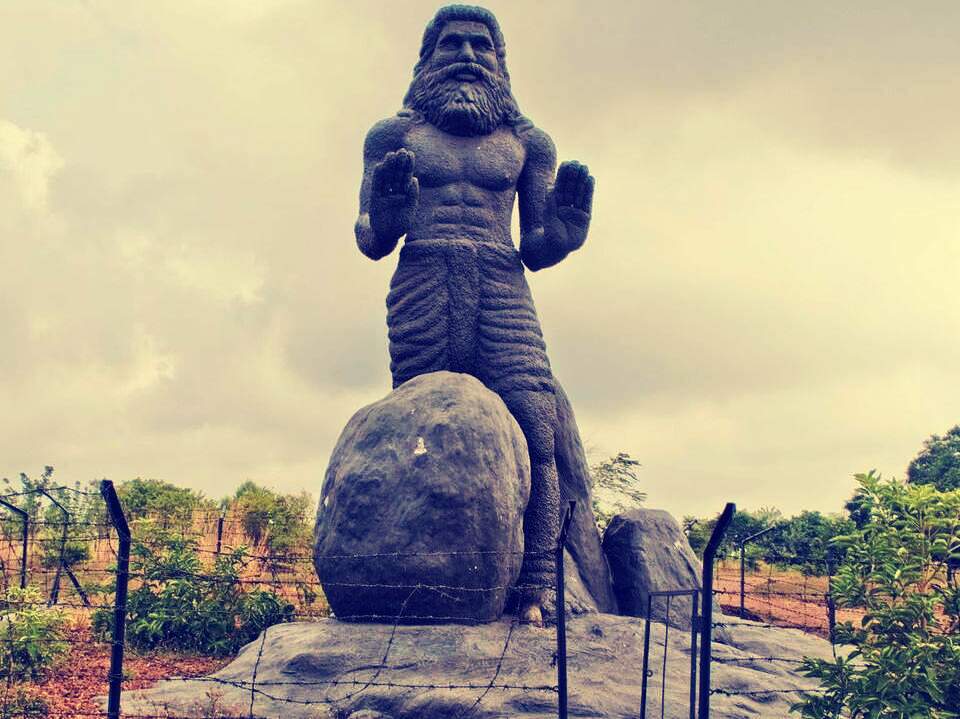
According to Greek mythology, Sisyphus was made to roll a large rock up a hill and have it roll down; only to repeat this exercise again and again for eternity. He was made to do this as a punishment. Curious enough, in another part of the world, in Kerala (India), there is another mythology that talks about another character who rolled a large rock up a hill only to have it roll down. Naranath Branthan (The madman of Naranam) would roll a large rock up a hill and have it roll down. He would repeat this again and again. His reason for doing this was entirely different than Sisyphus. Naranath Branthan was not doing it for punishment. But, he was doing it for fun. The stories about him said that he would laugh with joy and clap his hands as he watched the rock roll down the hill. If Sisyphus would had found joy in what he did, the Gods would have been forced to free him from the punishment since it would cease to be a punishment.
I will finish with a wonderful story about Naranath Brandan.
One day he met Kali, an Indian goddess, as he was retiring for the night. Kali was impressed by the madman and told him that she will give him a boon (blessing).
“I do not want any boons”, the madman said. He just wanted to get on with his night and go to sleep.
Kali informed him that she has to give a boon or a curse, and she insisted that he take a boon.
“I want to increase my life time by a second”, the madman replied. Kali told him that she could not do that.
“Then I want to decrease my life time by a second”, the madman said. Kali told him she could not do that either.
The madman thought for a while and asked Kali to move the elephantiasis from his left leg to the right leg. Kali complied, and the madman lived happily with elephantiasis on his right leg from that day onwards.
In today’s post, I am continuing on my thoughts on stoicism through the lens of cybernetics. In Cybernetics, we call regulation the act (art) of responding to external disturbances in order to maintain selected internal variables in a range. For example, our body maintains the internal temperature in a specific range. We have internal regulations built in through evolution to ensure that this is done. In the language of cybernetics, regulation refers to the act of countering the external variety. In order to counter the external variety, we must have requisite variety. As noted in the last post, only variety can absorb variety. If the external temperature goes up or goes down, our body should have a mechanism to react so that the internal temperature is maintained in a specific range. If it is not able to do this, we will not stay viable. The goal of requisite variety in this instance is about maintaining the status quo.
There are mainly two types of regulations in cybernetics as Ross Ashby noted – direct and indirect regulation. Direct regulation is the type of regulation where there is an established framework of counteractions that the agent can use. In the case of body temperature, heat loss can be promoted in a hot environment by many different mechanisms such as sweating or by reduction of muscular activities. Similarly, heat loss can be minimized in a cold environment using several mechanisms such as shivering or other activities to improve body insulation (reducing blood flow to the skin). There are several other mechanisms used by our bodies that are not listed here. These activities come under direct regulation because these happen without any oversight from us. Our bodies have evolved to do these things. Direct regulation is obviously limited in what it can do. For a low complex organism such as a wasp, direct regulation is adequate for survival. When the environmental conditions change or become extreme, direct regulation will no longer be able to provide requisite variety. In this case, we need indirect regulation. Indirect regulation refers to our ability to achieve requisite variety through second order activities. This involves learning mechanisms. For example, when it gets cold, we learn to move to a warmer location or to put on more clothes or to start a fire. We learned to create warm clothes or generate fire at will. This type of regulation did not come through evolution. What did come through evolution is our ability to learn to adapt. The second order refers to the ability to learn. Direct regulation is first order in nature. Second order is where you realize that the current specification is not working and that we need to change what we are doing or change the specification altogether. First order is simply realizing that there is a gap between the current state and where we want to be, and upon this realization continue on an already prescribed path.
We can see that indirect regulation has much more impact for our continued survival than direct regulation. Both types of regulation involve attenuation and amplification of variety in order to achieve requisite variety. As noted before, external variety is always higher than internal variety. Variety is directly correlated to complexity. The impact that the complexity in the world can have on us is ever increasing mainly because we are getting connected to the world in unprecedented ways. What I am typing here at my home can reach someone else in the farthest corners of the world in a matter of seconds. Something that happens locally in one location can have a direct impact on the entire world, as evidenced by the Covid 19 pandemic. How can we ensure our viability in these conditions?
Stoicism provides a lot of guidance for us in this regard. Stoicism provides us guidelines for us to improve our indirect regulatory activities. I am not discussing the dichotomy of control here since I discussed it last time. Instead, I will look at what Stoicism says about adversities in life. Most of our trouble comes from the fact that we do not orient ourselves properly. We give into direct regulation such as freeze, flight or fight. This worked for our ancestors, but this will not work, say for example, in a workplace environment. It is not easy for us to orient because we are not expecting the variety of the adversity that was thrown at us. It could be that we were put in a challenging situation where we have put ourselves or our company at a huge risk condition. Or something drastic happened that requires immediate action or our lives are in danger. How does one improve our internal variety in these conditions? How does one learn to attenuate the external variety so that we don’t focus on the noise? How do we amplify our variety so that we concentrate only on what is needed?
Stoics talk of a great tool that will help us here. It is called “premeditatio malorum”. This stands for “negative visualization”. When we start our day, think of the many ways, the day could go wrong. Think of driving in the traffic and someone cutting us off or getting into an accident. What can we do in this situation? Think of going into the important meeting and you saying something that would be perceived as silly. What would you do in this situation? Meditating on this is in many regards a way to prepare ourselves to better prepare in case such things do happen. It is obviously easy to go wild with this exercise, so we should keep it as practical as possible.
Another key insight from the stoics is the idea of seeing every experience as an opportunity. Every adversity or challenge that we face is an opportunity to learn. The big project that we are embarking upon work is an opportunity to improve ourselves. The challenges that are thrown at us actually make us better when we welcome them as challenges to finetune our skills. Many a time, stoicism is badly represented as being detached from reality. When something bad happens, the stoics are expected to be emotionless. On the contrary, stoicism is about being able to ground ourselves to reality and reorient ourselves so that we can use every experience as a learning opportunity. As with the premeditation malorum, we must exercise caution and not go out of our way looking for challenges. Instead we must take on the challenges that come our way and not run away from them. We must learn to be practical with the theory.
Seneca presents us with a paradox of fortune and laments those who were not fortunate enough to have gone through any misfortunes:
I judge you unfortunate because you have never lived through misfortune. You have passed through life without an opponent—no one can ever know what you are capable of, not even you.
Epictetus asks us who Hercules might have been without any of his adversities:
“What would have become of Hercules do you think if there had been no lion, hydra, stag or boar – and no savage criminals to rid the world of? What would he have done in the absence of such challenges?
Obviously he would have just rolled over in bed and gone back to sleep. So, by snoring his life away in luxury and comfort he never would have developed into the mighty Hercules.
And even if he had, what good would it have done him? What would have been the use of those arms, that physique, and that noble soul, without crises or conditions to stir into him action?”
Perhaps, at this juncture the reader is reminded of resilience and maybe of antifragility. From a cybernetics standpoint, resilience is a matter of maintaining status quo after a setback. This can be done mainly through first order activities and through second order activities as needed. Antifragility, on the other hand requires second order activities which leads to post traumatic growth (PTG).
I will finish with some wise words from the philosopher king, Marcus Aurelius:
Our actions may be impeded . . . but there can be no impeding our intentions or dispositions. Because we can accommodate and adapt. The mind adapts and converts to its own purposes the obstacle to our acting. The impediment to action advances action. What stands in the way becomes the way.
If you are interested in Stoicism, you might like:


 Harish's Notebook - My notes... Lean, Cybernetics, Quality & Data Science.