The Map at the Gemba:

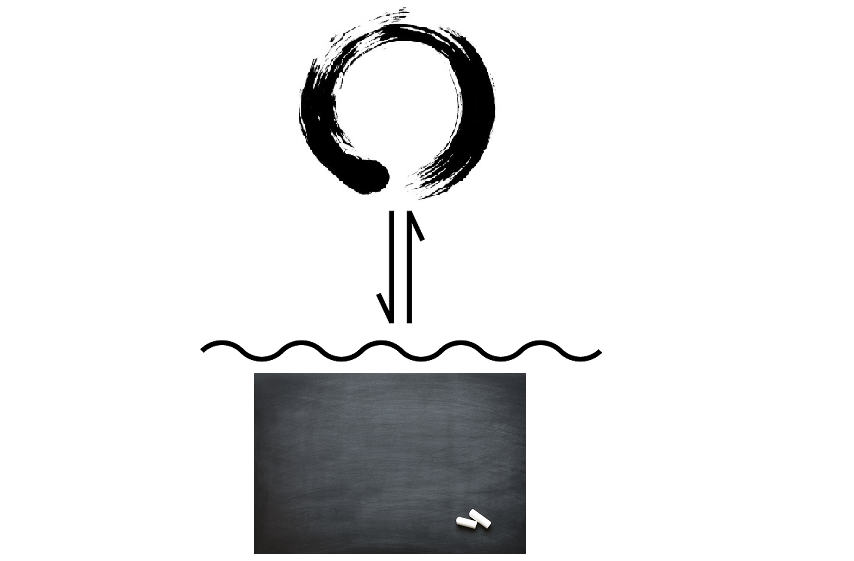
Map

This is available as part of a book offering that is free for community members of Cyb3rSynLabs. Please check here (https://www.cyb3rsynlabs.com/c/books/) for Second Order Cybernetics Essays for Silicon Valley. The e-book version is available here (https://www.cyb3rsyn.com/products/soc-book)

 Stay safe and Always keep on learning…

In case you missed it, my last post was The Cybernetics of Respect for People:

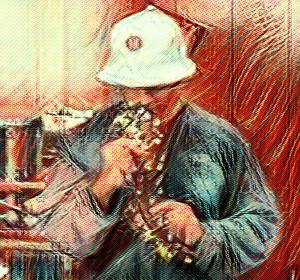
Magician at the Gemba:

157281886840401048HJ

In today’s post, I will be discussing magic, one of my passions. My inspiration for today’s post comes from the great Cybernetician Heinz von Foerster, the wonderful mentalist Derren Brown and the silent partner of Penn & Teller, Raymond Teller. When I was a young kid, I believed that true magic was real. I saw the great American Illusionist David Copperfield on TV, where he did amazing illusions and as a finale act flew around the whole stage and the arena. I also heard about him vanishing the Statue of Liberty in front of spectators. These amazing feats led me to believe that magic was indeed real. I started learning about magic from that young age onward. I became disillusioned quickly when I came across the many secrets of magic. I am thankful for this early disillusionment since it made me a skeptic from a young age.

Magicians can sometimes view themselves as a God-like figure, someone who is superior and can do things that others cannot. They go into theatrics with the belief that they are improving the craft of magic. Derren Brown warns against this approach:

Magic is massively flawed as theatre… Magic is performance, and performance should have an honesty, a relevance and a resonance if it is to be offered to spectators without insulting them… The magician’s role must change from a whimsical god-figure who can click his fingers and have something change in the primary world, to a hero-figure who, with his skills and intriguing character, provides a link with a secondary world of esoteric power. He must arrange circumstances in the primary world – such, as the correct participation of his small audience – in such a way that if that precarious balance is held, a glimmer of magic (only just held under control for a while) will shine through and illuminate the primary world with wonder. That requires investment of time and energy from him and from his audience, and involves the overcoming of conflict. When the routine is over, something has shifted in the world, for both spectator and performer. There is a true sense of catharsis.

Heinz von Foerster, the Socrates of Cybernetics, was also an accomplished magician as a youth. Von Foerster provides his views on magic:

We did it (magic) in such a way that the spectator constructs a world for himself, in which what he wished for takes place. That has led me to the sentence: “The hearer, not the speaker, determines the meaning of an utterance.”

The other thing we saw is: When one succeeds in creating the world in which one can give rise to miracles, it is the fantasy, the imagination, the mind’s eye of the spectator that you support and nourish.

We are letting the spectator construct the experience of magic. We should not construct it for them. There is a difference between a magician saying, “See there is nothing in my hand,” and the spectator saying, “I see nothing in your hand.” The magic occurs in the minds of the spectator. Great magicians allow the spectator to construct the magic. There is no magic without a spectator.

At the Gemba:

How does all this matter to us at the gemba? During my undergrad studies, I first heard about this magical new production system called ‘Lean Manufacturing’. Apparently, Toyota was doing magical things with this approach and all automakers were trying to copy them. Just like with magic tricks, if one is curious enough, the secret of a trick can be found out. But that will not let you be like David Copperfield or Derren Brown. To paraphrase the Toyota veteran, Hajime Ohba, copying what Toyota does is like creating a Buddha image and forgetting to put a soul in it. Later on, when I started working, I was advised by a senior manager that the only book I need to read is ‘The Goal’ by Eliyahu Goldratt. Supposedly, the book had all the answers I would ever need. Luckily, I was already disillusioned once with magic. As I have written a lot in the past, copying Toyota’s solutions (tricks) will not help if you don’t have Toyota’s problems.  The solution to a problem should be isomorphic. That is, the key should match the lock it opens. Toyota developed its production system over decades of trial and error. We cannot simply copy the tools without understanding what problems they were trying to solve. To paraphrase another Toyotaism, Toyota’s Production System is different from the Toyota Production System (TPS).

This brings me to the idea of constructivism. I have talked about this before as well. A bad magician tries to sell the idea of a Superbeing who can do things that don’t seem to belong to the natural realm. He is trying to force his constructed reality onto others. A good magician on the other hand invites the spectator to create the magic in their mind. This is evident in the statements from Heinz von Foerster. The role of the observer is of utmost importance because he is the one doing the description of the phenomenon. What he describes is based on what he already knows. The properties of the “observed” are therefore the properties infused by the observer. The emphasis is then about epistemology (study of knowledge), not ontology (study of reality). Multiple perspectives and continued learning are important. One cannot optimize a complex system. It is dynamic, nonlinear and multidimensional. There are at least as many realities as the number of participants in the complex system. What optimization means depends upon the observer. There may never be a “perfect” answer to a complex problem. There are definitely wrong answers. There are definitely ‘less wrong’ answers. We should seek understanding and learn from multiple perspectives. Humility is a virtue. To paraphrase von Foerster: “Only when you realize you are blind can you see!” This is such a powerful statement. If we don’t know that our understanding is faulty, we cannot improve our understanding. This touches on the idea of Hansei or “self-reflection” in TPS.

We should be aware that everybody has a view of what is out there (reality). We all react to an internally constructed version of reality built of our internal schema/mental models/biases/what we know etc. We cannot be God-like and assume that our version is the true reality. We should not force our version on others as well. We should allow our cocreators/participants to co-construct our social reality together. This touches on the idea of Respect for Humanity in TPS.

To keep with the theme of this post, I will post some of my old videos of magic below, and end with a funny magician joke.

A Spanish magician told everyone he would disappear.

He said, “Uno, dos….” Poof! He disappeared without a tres.

Always keep on learning…

In case you missed it, my last post was The Free Energy Principle at the Gemba:

My performance videos from a long time ago (pardon the video quality)…

The Whole is ________ than the sum of its parts:

Rubin2

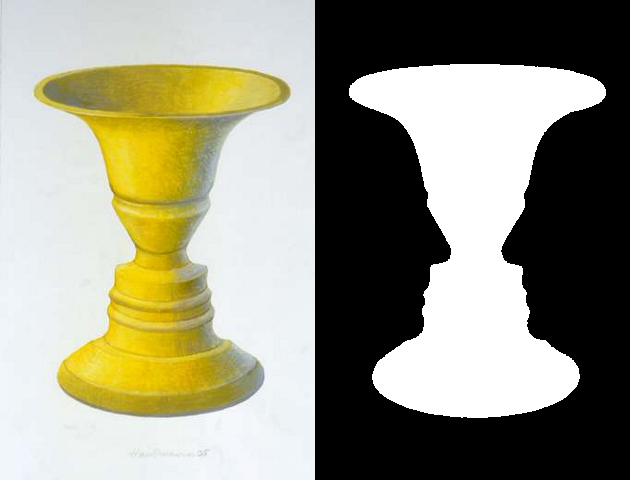
One of the common expressions depicting holistic thinking is – “the whole is larger/greater than the sum of its parts.” In today’s post I would like to look at this expression from a few different perspectives.

Kurt Koffka:

Kurt Koffka (1886 – 1941), the brilliant Gestalt psychologist said, “the whole is other than the sum of its parts.” Koffka was adamant to not misstate him as the whole being larger than the sum of its parts. He was pointing out that the whole is not merely an addition of parts, and that the whole has a separate existence. We humans tend to organize our percepts into wholes. Our mental shortcuts first make us see the whole, rather than the parts. The term “gestalt” itself refers to form or pattern. We are prone to identifying larger patterns from partial data.

Andras Angyal:

Andras Angyal (1902 – 1960) was an American psychiatrist and a Systems Theorist. He emphasized the importance of positional values of parts within a system. He did not view the whole being more than the sum of its parts.

Summation, however, is not organization, but it is of little help simply to say that a system is more than the sum of its parts…“A system is a distribution of constituents with positional values in a dimensional domain.” Functional relationship is the key concept of the reductive approach. For a systems approach a different concept, such as that of positional value, is required which expresses arrangement and compels reference of the parts back to the whole. The value of parts is what they do for the whole. Their function is its maintenance. Only a whole maintained in this way can relate to an environment. To make possible relations with an environment is the function of the whole.

An easy example is to put together three sticks of different lengths. The order of the sticks does not matter for the total length of the three sticks put together. For contrast, let’s look at a car. For a car, the positional value or the order of the parts are of utmost importance. They have to go together in a specific manner for the car to be a car.

Edgar Morin:

Edgar Morin, the brilliant French philosopher says that “the whole is less than the sum of its parts.” This is a powerful statement. The parts lose its freedom when it is constrained to be in a specific form of organization. The whole is more constrained, or has less freedom than the sum of freedoms of the parts put together. The parts give up some of its properties when it organizes to be a whole. At the same time, the whole is also more than the sum of its parts. Morin says:

In order to understand the apparent contradiction of a whole that is simultaneously more and less than the sum of its parts, I claim the heritage of the Greek philosopher Heraclitus, from the 6th century BC: when you reach a contradiction, it doesn’t necessarily mean an error, but rather that you have touched on a fundamental problem. Therefore, I believe that these contradictions should be recognized and upheld, rather than circumvented.

Additionally, Morin stated:

The whole is greater than the sum of the parts (a principle which is widely acknowledged and intuitively recognized at all macroscopic levels), since a macro-unity arises at the level of the whole, along with emergent phenomena, i.e., new qualities or properties.

The whole is less than the sum of the parts, since some of the qualities or properties of the parts are inhibited or suppressed altogether under the influence of the constraints resulting from the organization of the whole.

The whole is greater than the whole, since the whole as a whole affects the parts retroactively, while the parts in turn retroactively affect the whole (in other words, the whole is more than a global entity-it has a dynamic organization).

Morin had strong words about just using holism:

Holism is a partial, one-dimensional, and simplifying vision of the whole. It reduces all other system-related ideas to the idea of totality, whereas it should be a question of confluence. Holism thus arises from the paradigm of simplification (or reduction of the complex to a master-concept or master-category).

Final Words:

The idea that the whole is different or other than the sum of its parts is a different way of thinking. Holism can be as limiting as reductionism. One might say that thinking in terms of wholes is very much thinking in terms of parts since the whole can be construed to be a part of a larger system. The emphasis is on the observer and the purpose that the observer has with the specific perspective that he or she is taking. All humans are purposeful creatures. What one observes, depends upon the properties of the observer. This also means that the other observers, the cocreators or the participants in the system, have their own purposes. We cannot stipulate the purpose(s) for a fellow being. To paraphrase West Churchman, systems thinking begins when one sees through the eyes of another.

The idea that the whole is more important than the part should be challenged, especially when it comes to human systems. All human systems are in a delicate balance with each other, which can tip one way or the other based on emerging attractors. The individual strives for autonomy, while the larger human systems the individual is part of, strive for homonomy. One should not ignore the other.

I will finish with another lesson from Morin:

The parts are at once less and greater than the parts. The most remarkable emergent phenomena within a highly complex system, such as human society, occur not only at the level of the whole (society), but also at the level of the individuals (even especially at that level-witness the fact that self-consciousness only emerges in individuals). In this sense: The parts are sometimes greater than the whole. As Stafford Beer has noted: “[T]he most profitable control system for the parts does not exclude the bankruptcy of the whole.” “Progress” does not necessarily consist in the construction of larger and larger wholes; on the contrary, it may lie in the freedom and independence of small components. The richness of the universe is not found in its dissipative totality, but in the small reflexive entities-the deviant and peripheral units-which have self-assembled within it…

Always keep on learning…

In case you missed it, my last post was Constructivism at the Gemba:

The Cybernetic Aspects of OODA Loop:

Boyd2

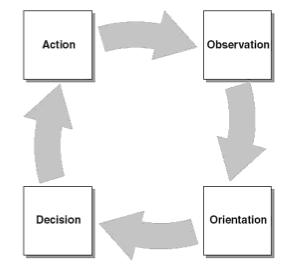
I had briefly discussed OODA loop in my previous post. In today’s post, I will continue looking at OODA loop and discuss the cybernetic aspects of OODA loop. OODA loop was created by the great American military strategist, John Boyd. OODA stands for Observe-Orient-Decide-Act. The simplest form of OODA loop, taken from Francis Osinga, is shown below.

Simple OODA

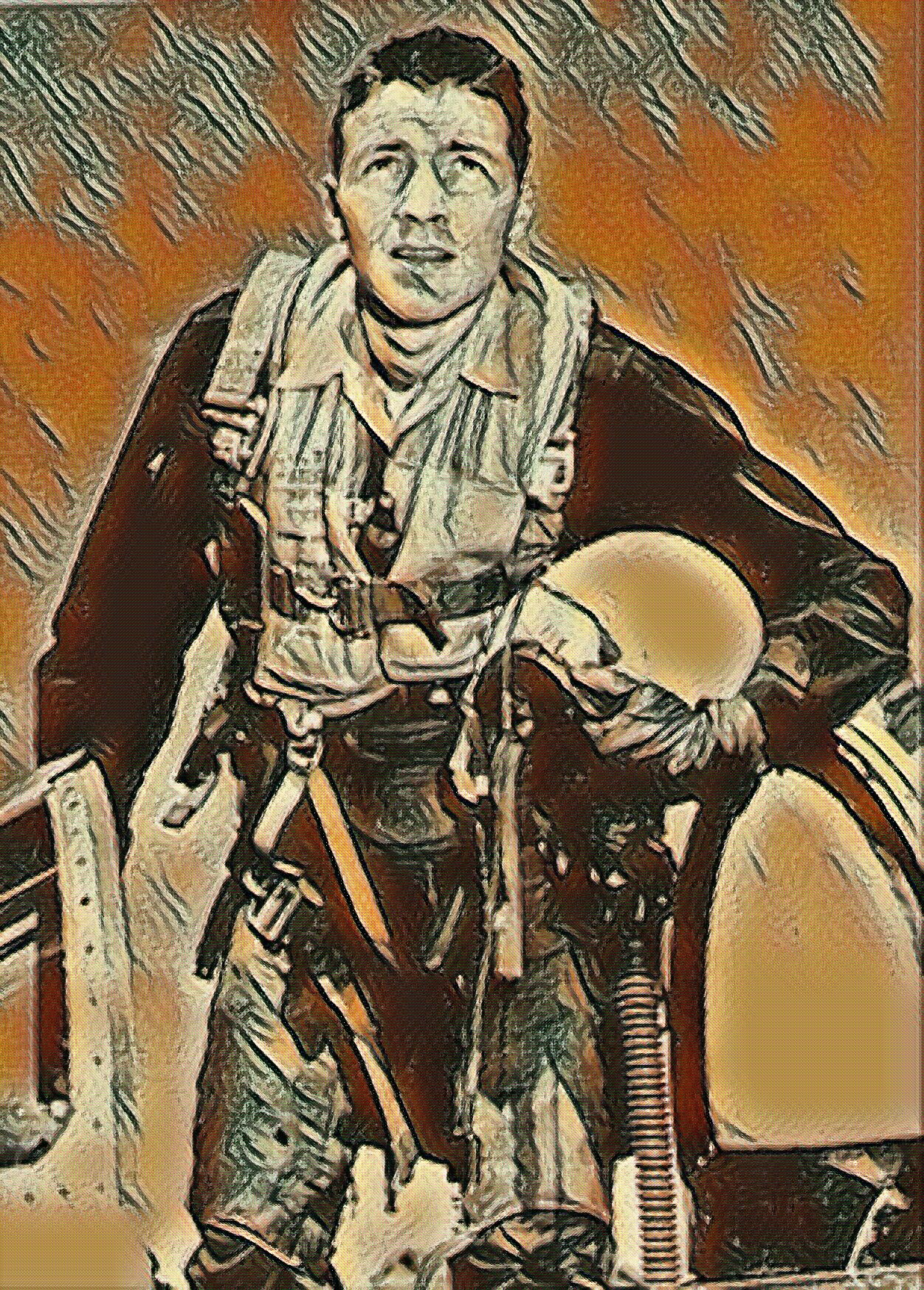
The OODA loop is a framework that can be used to describe how a rational being acts in a changing environment. The first step is to take in the available information as part of Observation. With the newly gathered information, the rational being has to gage the analyzed and synthesized information against the previous sets of information, relevant schema and mental models. The relevant schema and mental models are updated as needed based on the new set of information. This allows the rational being to better Orient themselves for the next step – Decide. The rational being has to decide what needs to be done based on their orientation, and at this point, the rational being Acts. The loop is repeated as the action triggers some reaction, which demands additional observation, orientation, decision and action. The loop has to be repeated until, a stable equilibrium is reached. Boyd was a fighter pilot and was often called as “40 second Boyd” because of his ability to get the better of his opponents in 40 seconds or less. The OODA loop was a formalization of his thoughts. See my previous post for additional information.

The key points of Boyd’s teachings are:

  • A rational being has to have a link with the external world to keep updating their orientation.
  • The absence of this live link will trigger an inward spiral that leads to disorientation and entropy.
  • Based on this, a rational being has to ensure that they maintain their internal harmony, and stay in touch with the external environment.

Osinga summarized this beautifully as:

The abstract aim of Boyd’s method is to render the enemy powerless by denying him the time to mentally cope with the rapidly unfolding, and naturally uncertain, circumstances of war, and only in the most simplified way, or at the tactical level, can this be equated with the narrow, rapid OODA loop idea… This points to the major overarching theme throughout Boyd’s work: the capability to evolve, to adapt, to learn, and deny such capability to the enemy.

In “John Boyd and John Warden – Air Power’s Quest for Strategic Paralysis”, David S. Fadok explained Boyd’s ideas as:

Boyd’s theory of conflict advocates a form of maneuver warfare that is more psychological and temporal in its orientation than physical and spatial.  Its military object is “to break the spirit and will of the enemy command by creating surprising and dangerous operational or strategic situations.” To achieve this end, one must operate at a faster tempo or rhythm than one’s adversaries. Put differently, the aim of Boyd’s maneuver warfare is to render the enemy powerless by denying him the time to mentally cope with the rapidly unfolding, and naturally uncertain, circumstances of war.  One’s military operations aim to: (1) create and perpetuate a highly fluid and menacing state of affairs for the enemy, and (2) disrupt or incapacitate his ability to adapt to such an environment.

Cybernetic Aspects:

The simplest explanation of Cybernetics is (from Paul Pangaro):

Cybernetics is about having a goal and taking action to achieve that goal. Knowing whether you have reached your goal (or at least are getting closer to it) requires “feedback”, a concept that was made rigorous by cybernetics.

The term cybernetics comes from a Greek word than means “steering”. Cybernetics is the art of steering towards the goal. The feedback loop allows for the regulatory component of the system to adjust itself and steer the system towards the goal. An example is a thermostat where a set temperature is inputted as the goal, and the thermostat kicks on when the temperature goes below the set point. It stops once it reaches the set temperature. This is achieved due to the feedback loop in the system. Pangaro continues:

The idea is this: You have goals and I have goals. If we’re in conversation, the way we find a shared goal is through probing, experimentation, alignment on means, revision of the goals, mistakes…and recursion. The recursive process of seeing a goal, aiming for it, seeing the “error” or gap and then moving to close the gap…that’s cybernetics. And the principles of cybernetics really are a way to think about everything. Or, rather…anything that has a purpose, goals, intention. So, orgs that need to shift business models, teams that need to tighten timelines…getting your friends to pick a restaurant for next week…So, everything that really matters!

Any closed loop is capable of feedback and thus has cybernetic functionality. One can see that the OODA loop has cybernetic aspects to it. You, the rational being, are trying to get inside the opponent’s OODA loop. This essentially means that you are working at a tempo faster than your opponent, and that you are able to go through your OODA loop more efficiently and effectively than your opponent. In order to do this, you should have a better equipped orientation which can also adapt as needed to the changing needs of the environment.

A key idea in Cybernetics is Ross Ashby’s Law of requisite variety (LRV). Variety in cybernetics means the number of available states of a system. In order for a system to control and regulate another system, the regulating system should have more variety than the one that is being regulated. For example, a light switch has two varieties (on or off). Depending upon the two states, the switch can control the light bulb to be either lit or not lit. If the demand is to have the brightness dimmed by the switch, the switch lacks the requisite variety. If we can add an adjustable resistor to the switch, then we are increasing the variety of the switch, and the switch now has the requisite variety to have the light’s brightness adjusted in more varieties (on, dim, bright, off).

One of the ways the regulator can handle the excess variety from the environment is to attenuate it or in other words filter out the excess variety. Our brains are very good at this. For example, if you are driving your car, most of the information coming at you gets filtered out by your brain. Your brain does not want you focusing on the color of the shirt of the driver of the car coming in the opposite direction.

Another way the regulator can attempt controlling a system is to amplify its variety so that it has a better capability to control certain factors. An example of this is the use of sabermetric approach to assemble a baseball team as narrated in the book and movie, Moneyball.

Ultimately, in order to regulate a system, the regulating system must attenuate unwanted variety, and amplify its variety so that the requisite variety is achieved.

John Boyd was aware of the power of cutting off the variety of the opponent.

Fadok explains:

Boyd proposes that success in conflict stems from getting inside an adversary’s OODA loop and staying there. The military commander can do so in two supplementary ways.

First, he must minimize his own friction through initiative and harmony of response. This decrease in friendly friction acts to “tighten” his own loop (i.e., to speed up his own decision-action cycle time).

Second, he must maximize his opponent’s friction through variety and rapidity of response. This increase in enemy friction acts to “loosen” the adversary’s loop (i.e., to slow down his decision-action cycle time). Together, these “friction manipulations” assure one’s continual operation within the enemy’s OODA loop in menacing and unpredictable ways. Initially, this produces confusion and disorder within the enemy camp. Ultimately, it produces panic and fear which manifest themselves in a simultaneous paralysis of ability to cope and willingness to resist.

Fadok’s thesis details that Boyd is actually looking at variety attenuation and amplification, referred to as “variety engineering” in Management Cybernetics.

In Cybernetics, information is of paramount importance. Information in many regards can be seen as the fuel in the “feedback engine”. Stale or wrong information can steer the system in the wrong direction sometimes at its own peril. The most important phase of OODA loop is the Orientation phase. This refers to the phase where the internal schema and mental models are reviewed and updated as needed based on incoming information. Boyd identified this really well. From Fadok:

The operational aim should be to ensure the opponent cannot rid himself of these menacing anomalies by hampering his ability to process information, make decisions, and take appropriate action. In consequence, he can no longer determine what is being done to him and how he should respond. Ultimately, the adversary’s initial confusion will degenerate into paralyzing panic, and his ability and/or willingness to resist will cease.

Final Words:

Most of us, I hope, are not engaged in wars. What can we then learn from OODA loop?

OODA loop gives us a good framework to understand how we make decisions and interact. OODA loop points out the utmost importance of staying connected to the source (gemba) and getting “fresh” information as much as possible. We should keep our feedback loops short, and this provides us security even if our decisions are slightly imperfect. The feedback allows us to steer as needed. But having a long feedback loop makes the information stale or incorrect, and we would not be able to steer away from trouble. We should update our mental models to match our reality. We should ensure that the new piece of information coheres well with our constructed schema and mental models. We should understand how to minimize our internal friction. We should attenuate unwanted variety and amplify our variety to better adapt to a changing environment. If we are in an inward spiral and feel disoriented, we should ground ourselves to reality by observing our surroundings, and stop engaging in a perilous inward spiral. Understanding the constraints in the surroundings may help us understand why some people make certain decisions.

I will finish with some wise words from John Boyd (taken from The Essence of Winning and Losing)

Without analyses and synthesis, across a variety of domains or across a variety of competing/independent channels of information, we cannot evolve new repertoires to deal with unfamiliar phenomena or unforeseen change.

 Without OODA loops, we can neither sense, hence observe, thereby collect a variety of information for the above processes, nor decide as well as implement actions in accord with those processes… Without OODA loops embracing all the above and without the ability to get inside other OODA loops (or other environments), we will find it impossible to comprehend, shape, adapt to, and in turn be shaped by an unfolding, evolving reality that is uncertain, everchanging, unpredictable 

In case you missed it, my last post was OODA Loop at the Gemba:

Cybernetics and Design – Poka Yoke, Two Hypotheses and More:

sonic screwdriver

In today’s post I am looking at “Design” from a cybernetics viewpoint. My inspirations for today’s post are Ross Ashby, Stafford Beer, Klaus Krippendorff, Paul Pangaro and Ranulph Glanville. The concept I was originally playing around was how the interface of a device conveys the message to the user on how to interact with the device. For example, if you see a button, you are invited to press on it. In a similar vein, if you see a dial, you know to twist the dial up or down. By looking at the ideas of cybernetics, I feel that we can expand upon this further.

Ross Ashby, one of the pioneers of Cybernetics defined variety as the number of possible elements(states) of a system. A stoplight, for example, generally has three states (Red, Green and Yellow). Additional states are possible, such as (blinking red, no light, simultaneous combinations of two or three lights). Of all the possible states identified, the stoplight is constrained to have only three states. If the stoplight is not able to regulate the traffic in combination with similar stoplights, acting in tandem, the traffic gets heavy resulting in a standstill. Thus, we can say that the stoplight was lacking the requisite variety. Ashby’s Law of Requisite Variety states that only variety can destroy (absorb) variety. This means that the regulator should have enough variety to absorb any perturbations in order to truly manage a system. Unfortunately, the external variety is always larger than the internal variety. In other words, the regulator has to have the means to filter out unwanted external variety and it should amplify the internal variety to stay viable. An important concept to grasp with this idea is that the number of distinguishable states (and thus variety) depends upon the ability of the observer. In this regard, the variety of a system may be dependent on the observer.

With these concepts in mind, I will introduce two ideas (hypotheses) that I have been playing with:

1) Purpose hypothesis: The user determines the purpose/use of a device.

2) Counteraction hypothesis: When presented with a complex situation, the user generally seeks simplicity. When presented with a simple situation, the user generally seeks complexity.

Harish’s Purpose Hypothesis: The user determines the purpose/use of a device.

The user is external to the design of a device. The user at any given point has more variety than the simple device. Thus, the user ultimately determines the purpose of a device. How many times have you used a simple screwdriver for other purposes than screwing/unscrewing a screw?

Harish’s Counteraction hypothesis: When presented with a complex situation, the user generally seeks simplicity. When presented with a simple situation, the user generally seeks complexity.

The user has a tendency to move away from the perceived complexity of a device. If it is viewed as simple, the user will come up with complex ways to use it. If it is viewed as complex, the user will try to come up with simple ways to use the device. Complexity is in the eyes of the beholder. This can be also explained asUpon realizing that something is not working, a rational being, instead of continuing on the same path, will try to do the opposite. A good example is a spreadsheet – in the hands of an expert, the spreadsheet can be used for highly complicated mathematical simulations with numerous macros, and alternately, in the hands of a novice, the spreadsheet is just a table with some data points. In a similar way, if something is perceived as complex, the user will find a way to simplify the work to get the bare minimum output.

The Cybernetic Dance between the Designer and the User:

There is a dance between the designer and the user, and the medium of the dance is the interface of the device. The designer has to anticipate the different ways the user can interface with the device, and make the positive mannerisms attractive and the negative mannerisms unattractive. In the cybernetics terms, the designer has to amplify the desirable variety of the device so that the user is more likely to choose the correct way the device should be used. The designer also has to attenuate the undesirable variety so that the user will not choose the incorrect ways of use. If the design interface is providing a consistent message each time, then the entropy of the message is said to be zero. There is no change in the “message” conveyed by the design. One of the concepts in Lean is poka yoke or error proofing a device. From what we have seen so far, we can say that a successful poka yoke device has the requisite variety. The message conveyed by the device is consistent and the user always chooses the correct sequence of operation.

Krippendorff explains this nicely in terms of affordances of a device: [1]

When an interface works as expected, one can say with James Gibson (1979) that the artifact in question affords the construction that a user has of it; and when it does not work as expected, one can say that the artifact objects to being treated the way it is, without revealing why this is so.

Krippendorff also explains that the interface does not carry a message from the designer to the user. This is an interesting concept. Krippendorff further explains that the user assigns the meaning from how the user interacts with the device. The challenge then to the designer is to understand the problem, and determine the easiest way to solve it.

Different people may interface rather differently with the same artifact. What is a screwdriver for one person, may be an ice pick, a lever to pry a can of paint open, and a way to bolt a door for another. Human-centered designers must realize that they interface with their artifacts in anticipation that the result of their interactions affords others to meaningfully interface with their design—without being able to tell them how.

An interface consists of sequences of ideally meaningful interactions—actions followed by reactions followed by responses to these reactions and so on—leading to a desirable state. This circularity evidently is the same circularity that cybernetics theorizes, including what it converges to, what it brings forth. In human terms, the key to such interactions, such circularities, is their meaningfulness, the understanding of what one does in it, and towards which ends. Probably most important to human-centeredness is the axiom:

Humans do not respond to the physical qualities of things but act on what they mean to them (Krippendorff, 2006a).

Variety Costs Money:

Another concept from the cybernetics viewpoint is that adding variety costs money. In theory, a perfect device could be designed, but this would not be practical from a cost standpoint. Afterall, a low price is one of the ways the designer can amplify variety. A good story to reflect this is the design of the simple USB. A USB cord is often cited as an example for poka yoke. There is only way to insert it into the port. When you think about it, a USB pin has two states for insertion, of which only one is correct. There is no immediate standard way that the user can tell how it can be inserted. Thus, the USB lacks the requisite variety and it can lead to dissatisfaction of the user. Now the obvious question is why this is not an issue on a different connector such as Apple’s lightning cord, which can be inserted either way. It turns out that the lack of variety for the USB was on purpose. It was an effort to save money.[2]

A USB that could plug in correctly both ways would have required double the wires and circuits, which would have then doubled the cost. The Intel team led by Bhatt anticipated the user frustration and opted for a rectangular design and a 50-50 chance to plug it in correctly, versus a round connector with less room for error.

Feedback must be Instantaneous:

Paul Pangaro defines Cybernetics as:

Cybernetics is about having a goal and taking action to achieve that goal. Knowing whether you have reached your goal (or at least are getting closer to it) requires “feedback”, a concept that was made rigorous by cybernetics.

Thus, we can see that the device should be designed so that any error must be made visible to the user immediately and the user can correct the error to proceed. Any delay in this can only further add to the confusion of the user. The designer has to take extreme care to reduce the user’s cognitive load, when the user is interfacing with the device. Paraphrasing Michael Jackson (not the singer), from the cybernetics standpoint, the organization of the device should have the best possible model of the environment relevant to its purposes. The organization’s structure and information flows should reflect the nature of that environment so that the organization is responsive to it.

Final Words:

I will finish with wise words from Krippendorff regarding how the user perceives meaning by interfacing with a device.

Unlike what semiotics conceptualizes, from a cybernetic perspective, artifacts do not “carry” meanings from designers to their users. They do not “contain” messages or “represent” meanings…

For example, the meaning of a button is what pressing it sets in motion: ringing an alarm, saving a file or starting a car. The meaning of a soccer ball is the role it plays in a game of soccer and especially what its players can do with it. The meaning of an architectural space is what it encourages its inhabitants to do in it, including how comfortable they feel. The meaning of a chair is the perceived ability to sit on it for a while, stand on it to reach something high up, keep books on it handy, for children to play house by covering it with a blanket, and staple several of them for storage. For its manufacturer, a chair is a product; for its distributor, a problem of getting it to a retailer; for a merchant it means profit; for its user, it may also be a conversation piece, an investment, a way to complete a furniture arrangement, an identity marker, and more.

Typically, artifacts afford many meanings for different people, in different situations, at different times, and in the context of other artifacts. Although someone may consider one meaning more important than another, even by settling on a definition—like a chair in terms of affording sitting on it—it would be odd if an artifact could not afford its associated uses. One can define the meaning of any artifact as the set of anticipated uses as recognized by a particular individual or community of users. One can list these uses and empirically study whether this set is afforded by particular artifacts and how well. Taking the premise of second-order cybernetics seriously and applying the axioms of human-centeredness to designers and users alike calls on designers to conceive of their job not as designing particular products, but to design affordances for users to engage in the interfaces that are meaningful to them, the very interfaces that constitute these users’ conceptions of an artifact, for example, of a chair, a building or a place of work.

Always keep on learning…

In case you missed it, my last post was A Study of “Organizational Closure” and Autopoiesis:

[1] The Cybernetics of Design and the Design of Cybernetics – Klaus Krippendorff

[2] Ever Plugged A USB In Wrong? Of Course You Have. Here’s Why

My Recent Tweets (7/28/2019):

img_7584-1

I will be posting soon. Meanwhile, here are selected tweets (cybernetics, purpose of a system, complexity etc.):


Always keep on learning…