The Monkey’s Prose – Cybernetic Explanation:

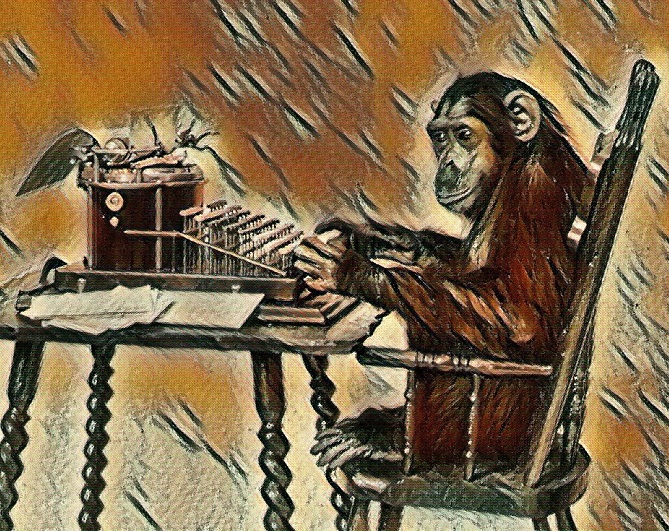
Imagine that you are on your daily walk in the park. You see a monkey on a park bench, busily typing away. You become curious as to what is happening. You slowly approach him from behind, and try to see what is being typed on the paper. Strange enough, what you see typed on the paper so far is legible prose; complete with grammar and semantics. What could be an explanation for this phenomenon?

This example was given by the great anthropologist cybernetician, Gregory Bateson. He used the example to explain “cybernetic explanation”, as he termed it. He said:

Causal explanation is usually positive. We say that billiard ball B moved in such and such a direction because billiard ball A hit it at such and such an angle. In contrast to this, cybernetic explanation is always negative… In cybernetic language, the course of events is said to be subject to restraints, and it is assumed that, apart from such restraints, the pathways of change would be governed only by equality of probability. In fact, the “restraints” upon which cybernetic explanation depends can in all cases be regarded as factors which determine inequality of probability If we find a monkey striking a typewriter apparently at random but in fact writing a meaningful prose, we shall look for restraints, either inside the monkey or inside the typewriter… Somewhere there must have been a circuit which could identify error and eliminate it.

Bateson’s use of the word “restraints” is comparable to “constraints”. Larry Richards notes that Bateson used the term “restraint” referring to the approach of Cybernetics as “negative explanation”, focusing on what is not desirable, rather than what is. When there are no constraints, we can say that all events are equally likely. If we have enough chances, we will see at least one event, where a monkey can type out a work of Shakespeare (sometimes referred to as Infinite Monkey theorem). But here, we are looking at cybernetic phenomenon where constraints are present, and they guide the outcome. In the case of the monkey’s prose, one possibility could be that the typewriter is programmed in such a fashion that no matter what key is pressed, a preprogrammed prose is generated. This would be an example of a circuit that Bateson referred to.

Let’s consider another example. Let’s say that every hour you take two measurements, measurement A and measurement B. What you find is that measurement A goes up and down, while measurement B remains fairly steady. From this dataset, what correlation can you determine between A and B? Without any additional knowledge, the general consensus would that there is no correlation between the two measurements. What if we consider the mechanism of a thermostat? The thermostat does not turn ON until the temperature goes outside a tight range. Only when the temperature goes outside the range does the thermostat turn ON. It maintains the internal temperature of the house based on how the external temperature impacts the internal temperature. In the example above, the external temperature was A and the internal temperature was B. Without a knowledge of thermostat, if we were given just the two datasets, we would not be able to see any connection between the two datasets. This idea is sometimes referred to Friedman’s Thermostat after the American economist, Milton Friedman.

The thermostat is a very basic example of cybernetic explanation. Even though, we may perceive that the thermostat’s goal is to maintain the room temperature at a constant value, the thermostat does not have a goal per se. It does not stay ON to ensure that the temperature is maintained at a constant value. Instead, it turns ON when the temperature goes outside a limit. The thermostat negatively “moves away” from the outside range value of the temperature and stays ON until it is inside a determined range. The thermostat acts only when it hits a constraint or it is guided by the restraint, to use Bateson’s language. It is not a movement towards a goal temperature of say 70 degrees F, but rather a movement away from a current temperature of say 68 degrees F. Larry Richards explained this wonderfully:

Any system with constraints appears to have a purpose as there are outcomes precluded from the set of possibilities. 

Another example we can consider is that of driving a car. When you drive a car, you apply gas or brake only when needed. You don’t steer the car to try to keep it running in a straight line. You engage when the car is moving towards the edges of your lane. To continuously work towards a goal requires high energy, and a person driving is not suitable for this.

This idea of cybernetic explanation brings forth valuable insights when we look at social systems such as an organization. Richards proposes that assigning or designing a purpose for a social system can lead to problems.

I suggest avoiding or suspending… the idea of purpose. The idea of teleological systems – that systems have a purpose first, with structure following – implies that systems are created or evolve to achieve a goal or objective.

The problem in Second Order Cybernetics arises when the observers/designers specify the purpose of their designs, giving conscious intent to their actions. Gregory Bateson (1972a, 1972b) warned of the dysfunctions of conscious purpose when the actions taken do not and cannot account for all the ecological circularities of the situation and the unanticipated consequences inherent in taking such actions. Yet, humans have needs, desires, preferences and values; we are self-aware of our actions and alternatives; and, we can act with intent to satisfy our needs and desires. To act without self-awareness of our desires and the possible consequences of our actions would be irresponsible. 

 Richards advises to look for present constraints that guide actions.

Specifying a set of constraints treats desires as a spatial concept, focusing attention on the states we wish to exclude from happening, leaving open a space of possible outcomes deemed currently acceptable. This approach is present-oriented, merging ends and means: the set of constraints that represent our desires and the actions we take to avoid what we do not want are here and now, and our evaluation of possible consequences is based on current best available knowledge. Our desires, actions and evaluations can change as we experiment, learn and change, making it important to be careful about excluding outcomes that could become useful as circumstances change. Treating desires as constraints and intention as an awareness of desires as constraints opens the door for an alternative to the consciousness of purpose about which Bateson was concerned.

The idea of cybernetic explanation and constrains raise the importance of dialogue amongst the coparticipants of the social realm. Rather than going after a narrow purpose, we may be better served if we can explore the space of constraints to identify conditions that promote outcomes that we desire. When we utilize a constancy of purpose, we are utilizing a narrow view that is not able to accommodate the various interpretations and desires of the many coparticipants of our social realm. Bateson viewed the pursuit of conscious purpose as being damaging to the very ecology that supports being human. (Klaus Krippendorff). Krippendorff came out with an Empirical Imperative to support this idea:

Empirical Imperative: Invent as many alternative constructions as you can and actively explore the constraints on their affordances.

I will finish with more wise words from Richards that provides further insights about cybernetic explanation:

If I know what I want and I know it is possible to achieve it, I do not need cybernetics—I just go and do what I need to do to achieve the outcome. However, when I only have a vague idea about what I want or do not want and I do not know how to pursue or avoid it in the current society, the vocabulary of cybernetics can be useful. Cybernetics is not about success and the achievement of goals; it is about the reconfiguration of constraints (resources) in order to make possible what was not previously possible, including the avoidance of what was previously inevitable. 

Please maintain social distance and wear masks. Stay safe and Always keep on learning…

In case you missed it, my last post was Complexity – Only When You Realize You Are Blind, Can You See:

Complexity – Only When You Realize You Are Blind, Can You See:

In today’s post, I am looking at the idea of complexity from a second order Cybernetics standpoint. The phrase “only when you realize you are blind, can you see”, is a paraphrase of a statement from the great Heinz von Foerster. I have talked about von Foerster in many of my posts, and he is one of my heroes in Cybernetics. There is no one universally accepted definition for complexity. Haridimos Tsoukas and Mary Jo Hatch wrote a very insightful paper called “Complex Thinking, Complex Practice”. In the paper, they try to address how to explain complexity. They refer to the works of John Casti and C. H. Waddington to further their ideas:

Waddington notes that complexity has something to do with the number of components of a system as well as with the number of ways in which they can be related… Casti defines complexity as being ‘directly proportional to the length of the shortest possible description of [a system]’.

Casti’s views on complexity are particularly interesting because complexity is not viewed as being intrinsic to the phenomenon. This is a common idea in Cybernetics, mainly second order cybernetics. There are two ‘classifications’ of cybernetics – first order and second order cybernetics. As von Foerster explained it, first order cybernetics is the study of observed systems, where the basic assumption is that the system is objectively knowable. The second order cybernetics is the study of observing systems, where the basic assumption is that the observer is included in the act of observing, and thus the observer is part of the observed system. This leads to second order thinking such as understanding understanding or observing observing. It is interesting because, as I am typing, Microsoft Word is telling me that “understanding understanding” is syntactically incorrect. This obviously would be a first order viewpoint. The second order cybernetics is a meta discipline and one that generates wisdom.

When we take the observer into consideration, we realize that complexity is in the eyes of the beholder. Complexity is observer-dependent; that is, it depends upon how the system is described and interpreted. If the observer is able to make more varying distinctions in their description, we can say that the phenomenon or the system is being interpreted as complex. In their paper, Tsoukas and Jo Hatch brings up the ideas of language in describing and thus interpreting complexity. They note that:

Chaos and complexity are metaphors that posit new connections, draw our attention to new phenomena, and help us see what we could not see before (Rorty).

This is quite interesting. When we learn the language of complexity, we are able to understand complexity better, and we become better at describing it, in a reflexive manner.

What complexity science has done is to draw our attention to certain features of systems’ behaviors which were hitherto unremarked, such as non-linearity, scale-dependence, recursiveness, sensitivity to initial conditions, emergence (etc.)

From this standpoint, we can say that complexity lies in the interactions we have with the system, and depending on our perspectives (vantage point) and the interaction we can come away with a different interpretation for complexity.

Heinz von Foerster remarked that complexity is not in the world but rather in the language we use to describe the world. Paraphrasing von Foerster, cognition is computation of descriptions of reality. Managing complexity then becomes a cognitive task. How well you can interact or manage interactions depends on how effective your description is and how well it aligns with others’ descriptions. The complexity of a system lies in the description of that system, which entirely rests on the observer/sensemaker. The idea that complexity is in the eyes of beholder is to point out the importance of second order cybernetics/thinking. The world is as it is, it gets meaning only when we assign meaning to it through how we describe/interpret it. To put differently, “the logic of the world is the logic of the descriptions of the world” (Heinz von Foerster)

The idea of complexity not being intrinsic to a system is also echoed by one of the pioneers of cybernetics, Ross Ashby. He noted – “a system’s complexity is purely relative to a given observer; I reject the attempt to measure an absolute, or intrinsic, complexity; but this acceptance of complexity as something in the eye of the beholder is, in my opinion, the only workable way of measuring complexity”.

The ideas of second order cybernetics emphasize the importance of observers. The “system” is a mental construct by an observer to make sense of a phenomenon. The observer based on their needs draw boundaries to separate a “system” from its environment. This allows the observer to understand the system in the context of its environment. At the same time, the observer has to understand that there are other observers in the same social realm who may draw different boundaries and come out with different understandings based on their own needs, biases, perspectives etc.

A phenomenon can have multiple identities or meanings depending on who is describing the desired phenomenon. Let’s use the Covid 19 pandemic as an example. For some people, this has become a problem of economics rather than a healthcare problem, while for some others it has become a problem of freedom or ethics. If we are to attempt tackling the complexity of such an issue, the worst thing we can do is to attempt first order thinking- the idea that the phenomenon can be observed objectively. Issues requiring second order approach get worse by the application of first order methodologies. The danger in this is that we can fall prey to our own narrative being the whole Truth.

As the pragmatic philosopher Richard Rorty points out:

The world does not speak. Only we do. The world can, once we have programmed ourselves with a language, cause us to hold beliefs. But it cannot propose a language for us to speak. Only other human beings can do that.

If we are to understand complexity of a phenomenon, we need to start with realizing that our version of complexity is only one of the many.  Our ability to understand complexity depends on our ability to describe it. We lack the ability to completely describe a phenomenon. The different descriptions that come about from the different participants may be contradictory and can point out apparent paradoxes in our social realm.

In complexity, if we are to tackle it, we need to have coherence of multiple interpretations. As Karl Weick points out, we need to complicate ourselves. By generating and accommodating multiple inequivalent descriptions, practioners will increase the complexity of their understanding and, therefore, will be more likely to match the complexity of the situation they attempt to manage. In complexity, coherence – the idea of connecting ideas together, is important since it helps to create a clearer picture and affords avoiding blind spots. This co-construted description itself is an emergent phenomenon.

In second order Cybernetics, there are two statements that might shed more light on everything we have discussed so far:

Anything said is said BY an observer. (Maturana)

Anything said is said TO an observer. (von Foerster)

A lot can be said between these two statements. The first points out that the importance of the observer, and the second points out that there are other observers, and we coconstruct our social reality.

Our descriptions are abstractions since we are limited by our languages. All our biases, fears, misunderstandings, ignorance etc. lie hidden in the “systems” we construct. We get into trouble when we assume that these abstractions are real things. This is the first order approach, where we are not aware that we do not see due to our cognitive blind spots. When we realize that all we have are abstractions, we get to the second order approach. We include ourselves in our observation and we start looking at how we make these abstractions. We also become aware of other autonomous participants of our social reality engaging in similar constructions of narratives. As we seek their understanding, we become aware of our cognitive blind spots. We realize that everything is on a spectrum, and our thinking of “either/or” is actually a false dichotomy.

At this point, Heinz von Foerster would say that we start to see when we realize that we are blind.

Please maintain social distance and wear masks. Stay safe and Always keep on learning…

In case you missed it, my last post was Causality and Purpose in Systems:

Causality and Purpose in Systems:

This is available as part of a book offering that is free for community members of Cyb3rSynLabs. Please check here (https://www.cyb3rsynlabs.com/c/books/) for Second Order Cybernetics Essays for Silicon Valley. The e-book version is available here (https://www.cyb3rsyn.com/products/soc-book)

Please maintain social distance and wear masks. Stay safe and Always keep on learning…

In case you missed it, my last post was The Conundrum of Autonomy in Systems:

The Conundrum of Autonomy in Systems:

This is available as part of a book offering that is free for community members of Cyb3rSynLabs. Please check here (https://www.cyb3rsynlabs.com/c/books/) for Second Order Cybernetics Essays for Silicon Valley. The e-book version is available here (https://www.cyb3rsyn.com/products/soc-book)

Wear a mask, stay safe and Always keep on learning…

In case you missed it, my last post was Copernican Revolution – Systems Thinking:

Copernican Revolution – Systems Thinking:

In today’s post, I am looking at “Copernican Revolution”, a phrase used by the great German philosopher, Immanuel Kant. Immanuel Kant is one of the greatest names in philosophy. I am an Engineer by profession, and I started learning philosophy after I left school. As an Engineer, I am trained to think about causality in nature – if I do this, then that happens. This is often viewed as the mechanistic view of nature and it is reliant on empiricism. Empiricism is the idea that knowledge comes from experience. In contrast, at the other end of knowledge spectrum lies rationalism. Rationalism is the idea that knowledge comes from reason (internal). An empiricist can quickly fall into the trap of induction, where you believe that there is uniformity in nature. For example, if I clapped my hand twenty times, and the light flickered each time, I can then (falsely) conclude that the next time I clap my hand the light will flicker. My mind created a causal connection to my hand clapping and the light flickering.

David Hume, another great philosopher, challenged this and identified this approach as the problem of induction. He suggested that we, humans, are creatures of habit that we assign causality to things based on repeat experience. His view was that causality is assigned by us simply by habit. His famous example of challenging whether the sun will rise tomorrow exemplifies this:

That the sun will not rise tomorrow is no less intelligible a proposition, and implies no more contradiction, than the affirmation, that it will rise.

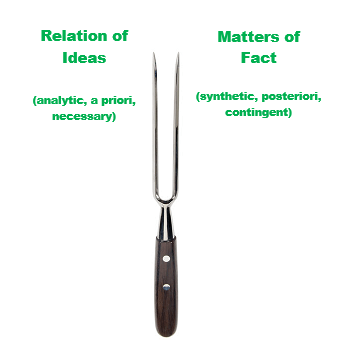
Hume came up with two main categories for human reason, often called Hume’s fork:

  1. Matters of fact – this represents knowledge that we gain from experience (synthetic), and this happens after the fact of experience (denoted by posteriori). An example is – the ball is heavy. Thinking cannot provide the knowledge that the ball is heavy. One has to interact with the ball to learn that the ball is heavy.
  2. Relation of ideas – this represents knowledge that does not rely on experience. This knowledge can be obtained simply through reason (analytic). This was identified as a priori or from before. For example – all bachelors are unmarried. No experience is needed for this knowledge. The meaning of unmarried is predicated in the term “bachelor”.

All the objects of human reason or enquiry may naturally be divided into two kinds, to wit, relations of ideas, and matters of fact. Of the first kind are the sciences of Geometry, Algebra, and Arithmetic … [which are] discoverable by the mere operation of thought … Matters of fact, which are the second object of human reason, are not ascertained in the same manner; nor is our evidence of their truth, however great, of a like nature with the foregoing.

Hume’s fork stipulates that all necessary truths are analytical, the meaning is predicated in the statement. Similarly, knowledge regarding matters of fact indicate that the knowledge is contingent on the experience gotten from the interaction. This leads to further ideas such as – there is a separation between the external world and the knowledge about the world. The knowledge about the world would come only from the world through empiricism. One can view this as the human mind revolving around the world.

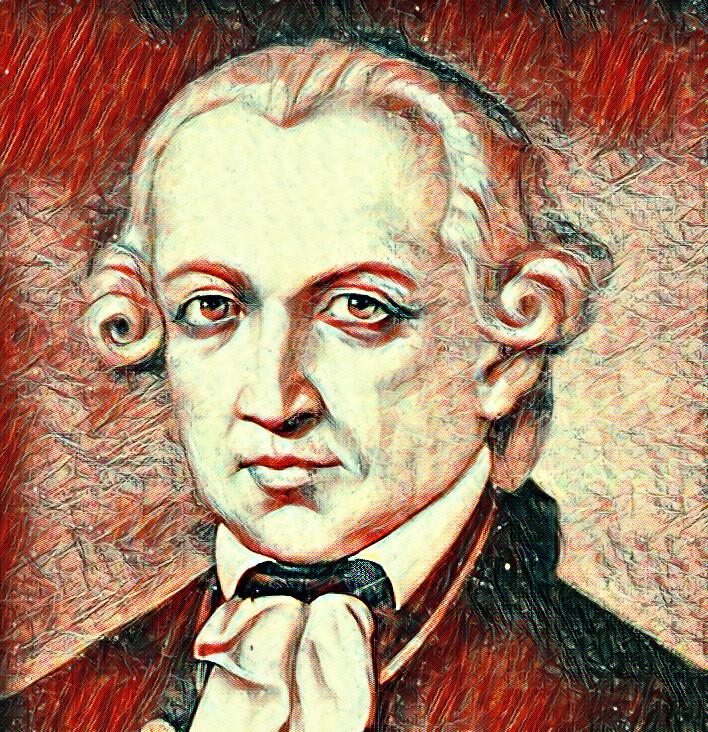
Immanuel Kant challenged the idea of Hume’s fork and came up with the idea of a priori synthetic knowledge. Kant proposed that we, humans, are bestowed with a framework for reasoning that is a priori and yet synthetic. Kant synthesized ideas from rationalism and empiricism, and added a third tine to Hume’s fork. Kant famously stated – That all our knowledge begins with experience there can be no doubt. Kant clarified that it does not follow that knowledge arises out of experience. What we come to know is based on our mental faculty. The mind plays an important role in our knowledge of the world. The synthetic a priori propositions say something about the world, and yet at the same time they say something about our mind.

How the world is to us depends on how we experience it, and thus the knowledge of the external world is dependent on the structure of our mind. This idea is often described as a pair of spectacles that we are born with. We see the world through this pair of spectacles that we cannot take off. What we see forms our knowledge of the world, but it is dependent on the pair of spectacles that is a part of us. Kant’s great idea is that our knowledge of the world does not conform to the world. Our knowledge of the world conforms not to the nature of the world, but to the nature of our internal faculties. To paraphrase Heinz von Foerster, we do not see the world as is, it is as we see it.

Nicholas Copernicus, the Polish astronomer, came up with a heliocentric view of the world. The prevalent idea at the time was that the celestial bodies, including the sun, revolved around the earth. Copernicus challenged this, and showed that the earth actually revolves around the sun. Kant, in a similar fashion, suggested that the human minds do not revolve around the world with the meanings coming into our minds. Instead, the world revolves around our minds, and we assign meanings to the objects in the world. This is explained wonderfully by Julie. E. Maybee:

Naïve science assumes that our knowledge revolves around what the world is like, but, Hume’s criticism argued, this view entails that we cannot then have knowledge of scientific causes through reason. We can reestablish a connection between reason and knowledge, however, Kant suggested, if we say—not that knowledge revolves around what the world is like—but that knowledge revolves around what we are like. For the purposes of our knowledge, Kant said, we do not revolve around the world—the world revolves around us. Because we are rational creatures, we share a cognitive structure with one another that regularizes our experiences of the world. This intersubjectively shared structure of rationality—and not the world itself—grounds our knowledge.

Systems:

We have assumed that the knowledge of the world, our cognition, conforms to the world. Kant proposes that all we have access to is the phenomena, and not the actual world. What we are learning is dependent on us. We use an as-if model to generate meaning based on our interaction with the external world. In this viewpoint, the systems are not real things in the world. The systems are concepts that we construct, and they are as-if models that we use to make sense of the phenomena. What we view as systems are the constructions we make and depends on our need for understanding.  

Alan Stewart uses a similar idea to explain his views on constructivism:

The fundamental premise of constructivism is that we humans are self-regulating organisms who live from the inside out. As a philosophical counterpoint to naive realism, constructivism suggests that we are proactive co-creators of the reality to which we respond. Underlying this concept is that perception is an active process in which we ‘bring forth distinctions’. It is our idiosyncratic distinctions which form the structure of the world(s) which each of us inhabits.”

I will finish with a great lesson from Alan Watts:

“Everything in the world is gloriously meaningless.”

To further elaborate, I will add that all meaning comes from us. From a Hume-ian sense, we are creatures of habit in that we cannot stop assigning meaning. From a Kant-ian sense we are law-makers, not law-discoverers.

From a Systems Thinking perspective, we have unique perspectives and we assign meanings based on this. We construct “systems” “as-if” the different parts work together in a way to have a purpose and a meaning, both of which are assigned by us. The meaning comes inside out, not the other way around. To further this idea, as a human collective, we cocreate an emergent phenomenal world. In this aspect, “reality” is multidimensional, and each one of us has a version that is unique to us.  

Stay safe and Always keep on learning…

In case you missed it, my last post was Hegel, Dialectics and POSIWID:

The Truths of Complexity:

The Covid 19 pandemic has given me an opportunity to observe, meditate and learn about complexity in action. In today’s post, I am looking at “truths” in complexity. Humans, more than any other species, have the ability to change their environment at a faster pace. They are also able to maintain belief systems over time and act on them autonomously. These are good reasons to call all “human systems” complex systems.

The Theories of Truth:

Generally, there are three theories of truth in philosophy. They are as follows:

  1. Correspondence theory of truth – very simply put, this means that what you have internally in your mind corresponds one-to-one with the external world. The statement you might make such as – “the cat is on the mat” is true, if there are truly a cat and a mat, and if that cat is on that mat. The main objection to this theory is that we don’t have access to have an objective reality. What we have is a sensemaking organ, our brain, that is trying to make sense based on the data provided by the various sensory organs. The brain over time generates stable correlations which allows it to abstract meanings from the filtered information from the sensory data. The correspondence theory is viewed as a “static” picture of truth, and fails to explain the dynamic and complex nature of reality.
  2. Coherence theory of truth – In this approach, a statement is true if it is coherent with the different specified set of beliefs and propositions. Here the idea is more about a fit and harmony with existing beliefs. The coherence theory is about consistency. An objection to this theory is that the subjective nature of a statement can “bend” to match the existing strong belief systems. Perhaps, a good example of this is the recent poll that found that the majority of democrats fear that the worst is yet to come for the Covid 19 pandemic, while the majority of republicans believe that the worst is over. Another criticism against this is that we can be inconsistent in our beliefs as indicated by cognitive dissonance.
  3. Pragmatic Theory of truth – The pragmatic theory of truth was put forth as an alternative to the static correspondence theory of truth. In this theory, the value of truth is dependent on the utility it brings. Pragmatic theories of truth have the effect of shifting attention away from what makes a statement true and toward what people mean or do in describing a statement as true. As one of the proponents of Pragmatic theory, William James, put it – True beliefs are useful and dependable in ways that false beliefs are not:‘You can say of it then either that “it is useful because it is true” or that “it is true because it is useful”. Both these phrases mean exactly the same thing.’ One of my favorite explanations of pragmatic theory comes from Richard Rorty, who viewed it as coping with reality, rather than copying reality. One of the criticisms against the pragmatic theory of truth is how it explains truth in terms of utility. As John Capps notes, utility, long-term durability, and assertibility (etc.) should be viewed not as definitions but rather as criteria of truth, as yardsticks for distinguishing true beliefs from false ones.

Sensemaking Complexity:

From the discussion of truth, we can see that seeking truth is not an easy task, especially when we deal with complexity of human systems. Our natural tendency is to find order as pleasing and reassuring. We try to find order in all we can, and we try our best to maintain order as long as we can. In this attempt, we often neglect the actual complexity we are dealing with. A common way to distinguish complexity of a phenomenon is – ordered, complicated or complex. We can say a square peg in a square hole is an ordered phenomenon. The correspondence theory of truth is quite apt here because we have a one to one relationship. We have a very good working knowledge of cause and effect. As complexity increases, we get to complicated phenomenon where there is still somewhat a good cause and effect relationship. A car can be viewed as a complicated phenomenon. The correspondence theory is still apt here. Once we add a human to the mix, we get to complexity. Imagine the driver of a car. Now imagine thousands of drivers all at once. The correspondence theory of truth falls apart fast here.

The main source of complexity in the example discussed above comes from humans. We are autonomous, and we are able to justify our own actions. We may go faster than the speed limit because we are already late for the appointment. We may overtake on the wrong side because the other driver is driving slowly. We assign meanings and we also assign purposes for others. We do not always realize that other humans also have the same power.

We have seen varying responses and behavior in this pandemic. We have seen the different justifications and hypotheses. We agree with some of them and strongly disagree with others depending on how they cohere with our own belief systems. The actual transmission of the virus is fairly constrained. It transmits mainly from person to person. The transmission occurs mainly through respiratory droplets. Every human interaction carries some risk of becoming infected if the other person is a carrier of the virus. However, the actual course of the pandemic has been complex.

Philosophical Insights to Sensemaking Complexity:

I will use the ideas of Friedrich Nietzsche and William. V.O. Quine to further look at truth and how we come to know about truth. Nietzsche had a multidimensional view of truth. He viewed truth as:

A mobile army of metaphors, metonyms, and anthropomorphisms—in short, a sum of human relations which have been enhanced, transposed, and embellished poetically and rhetorically, and which after long use seem firm, canonical, and obligatory to a people: truths are illusions about which one has forgotten that this is what they are; metaphors which are worn out and without sensuous power; coins which have lost their pictures and now matter only as metal, no longer as coins.

He emphasized on the abstract nature of truth. One comes to view the abstractions/metaphors as stand in for reality, and eventually falsely equate them to reality.

Every word immediately becomes a concept, in as much as it is not intended to serve as a reminder of the unique and wholly individualized original experience to which it owes its birth, but must at the same time fit innumerable, more or less similar cases—which means, strictly speaking, never equal—in other words, a lot of unequal cases. Every concept originates through our equating what is unequal.

Nietzsche advised us against using a cause-effect, correspondence type viewpoint in sensemaking complexity:

It is we alone who have devised cause, sequence, for-each-other, relativity, constraint, number, law, freedom, motive, and purpose; and when we project and mix this symbol world into things as if it existed ‘in itself’, we act once more as we have always acted—mythologically. 

As Maureen Finnigan notes in her wonderful essay, Nietzsche’s Perspective: Beyond Truth as an Ideal:

As truth is not objective, in like manner, it is not subjective. Since thinking is not wholly rational, disconnected from the body, or independent of the world, the subjective perception, or conception, of truth through the intellect alone is impossible. “The ‘pure spirit’ is pure stupidity: if we subtract the nervous system and the senses—the ‘mortal shroud’—then we miscalculate—that is all!” Inasmuch as the individual is not independent from the world, one can neither subjectively nor objectively explain the world as if detached, but must interpret the world from within. Subjective and objective, like True and apparent, soul and body, thinking thing and material thing, intellect and sense, noumena and phenomena, are dualities that Nietzsche aspires to overcome. Thus, although Nietzsche is not a rationalist, this does not mean he falls into the irrationalist camp. He does not abolish reason but instead situates it within life, as an instrument, not as an absolute.

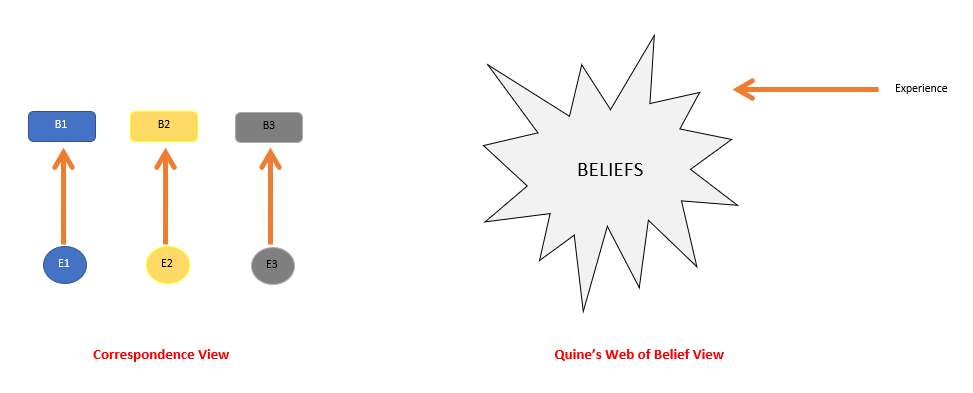
With complexity, we should not look for correspondence but coherence. Correspondence forces categorization while coherence forces connections. This follows nicely into Quine’s Web of Belief idea. Quine’s idea is a holistic approach. We make meanings in a holistic fashion. When we observe a phenomenon, our sensory experience and the belief it generates do not standalone in our entire belief system. Instead, Quine postulates that we make sense holistically with a web of belief. Every belief is connected to other beliefs like a web.

For example, we can say Experience1(E1) led to Belief1(B1), and Experience2(E2) led to Belief2(B2) etc. This has the correspondence nature we discussed earlier. This view prefers the ordered static approach to sensemaking. However, in Quine’s view, it is more dynamic, interconnected and complex. This has the coherence nature we discussed earlier. The schematic below, inspired by a lecture note from Bryan. Van. W. Norden, shows this in detail.

The idea of Web of Belief is clearly explained by Thomas Kelly:

Quine famously suggests that we can picture everything that we take to be true as constituting a single, seamless “web of belief.” The nodes of the web represent individual beliefs, and the connections between nodes represent the logical relations between beliefs. Although there are important epistemic differences among the beliefs in the web, these differences are matters of degree as opposed to kind. From the perspective of the epistemologist, the most important dimension along which beliefs can vary is their centrality within the web: the centrality of a belief corresponds to how fundamental it is to our overall view of the world, or how deeply implicated it is with the rest of what we think. The metaphor of the web of belief thus represents the relevant kind of fundamentality in spatial terms: the more a particular belief is implicated in our overall view of the world, the nearer it is to the center, while less fundamental beliefs are located nearer the periphery of the web. Experience first impinges upon the web at the periphery, but no belief within the web is wholly cut off from experience, inasmuch as even those beliefs at the very center stand in logical relations to beliefs nearer the periphery.

The idea of degrees rather than a concrete distinction between beliefs is very important to note here. Additionally, Quine proposes that when we counter an experience contradicting our belief, we seek to restore consistency/coherence in the web by giving up beliefs that are located near the periphery rather than the ones near the center.

Final Words:

The dynamic nature of complexity is not just applicable to a pandemic but also to scientific paradigms. This is beautifully explained in the quote from Jacob Bronowski below:

“There is no permanence to scientific concepts because they are only our interpretations of natural phenomena … We merely make a temporary invention which covers that part of the world accessible to us at the moment”

Our beliefs shape our experience as much as our experiences shape our beliefs in a recursive manner. The web gets more complex as time goes on, where some of the nodes become more distinct and some others get hazier. We are prone to getting perpetually frustrated if we try to apply a static framework to the dynamic everchanging domain of complexity. It gets more frustrating because patterns emerge on a continuous basis providing an illusion of order. The static and rigid frameworks break because of their rigidity and inflexibility to tackle the variety thrown upon them.

With this in mind, we should come to realize that we do not have a means to know the external world as-is. All we can know is how it appears to us based on our web of belief. The pragmatic tradition of truth advises us to keep going on our search for truth, and that this search is self-corrective. The correspondence theory fails us because the meaning we create is not independent of us, but very much a product of our web of belief. At the same time, if we don’t seek to understand others, coherence theory will fail us because we would lack the requisite variety needed to make sense of a complex phenomenon. I will finish with an excellent quote from Maureen Finnigan:

Human beings impose their own truth on life instead of seeking truth within life.

Stay safe and Always keep on learning… In case you missed it, my last post was Korzybski at the Gemba:

Korzybski at the Gemba:

Alfred_Korzybski

In today’s post, I am looking at the ideas of Alfred Korzybski, a Polish American philosopher and the father of General Semantics. General Semantics is a doctrine and educational discipline intended to improve the habits of response of human beings, to their environment and one another. Korzybski wanted to understand humanity and why we don’t always get along.

If a visitor from Mars should come, Korzybski showed, and on a tour of inspection should see our bridges, our skyscrapers, our subways, and other engineering feats, and were to ask, “How often does one of these collapse?” man here would say that if the engineering of these projects were correct in all respects, the material used in their construction carefully inspected, and the work well done, they would never collapse. 

Taken to our libraries the visitor from Mars, he declared, shown the histories of the world, would be appalled that the same men who could engineer non-collapsible bridges and skyscrapers could build a civilization which was collapsing at some point every year. And the reason, he pointed out, for the difference, lay in the fundamental beginnings of the logic that had built each.

Korzybski is most famous for his idea – the map is not the territory. He wrote his magnum opus “Science and Sanity” in 1933. In reading his ideas, we can find many aspects of systems thinking. Korzybski’s main idea can be expressed by one word – “abstraction”. His view was that what we know is based on the structure of our nervous system and the structure of our language (dependent on the nervous system). Our brain cannot directly access the world outside. Our brain understands the world outside through our sensory organs. Our sensory organs do not directly transfer the “what”, but the amount of the stimuli received. The brain abstracts meaning based on all the previous correlations. The brain selects the data to make the most meaningful abstraction at that point in time. For example, the eyes do not tell the brain that there is a black cat on the mat. The entire experience of sensory data is abstracted into “black cat”.

Korzybski stated:

The only link between the verbal and objective world is exclusively structural, necessitating the conclusion that the only content of all “knowledge” is structural. Now structure can be considered as a complex of relations, and ultimately as multi-dimensional order. From this point of view, all language can be considered as names for unspeakable entities on the objective level, be it things or feelings, or as names of relations. In fact… we find that an object represents an abstraction of a low order produced by our nervous system as the result of a sub-microscopic events acting as stimuli upon the nervous system.

800px-StructuralDifferential.svg

Image source – WIkipedia

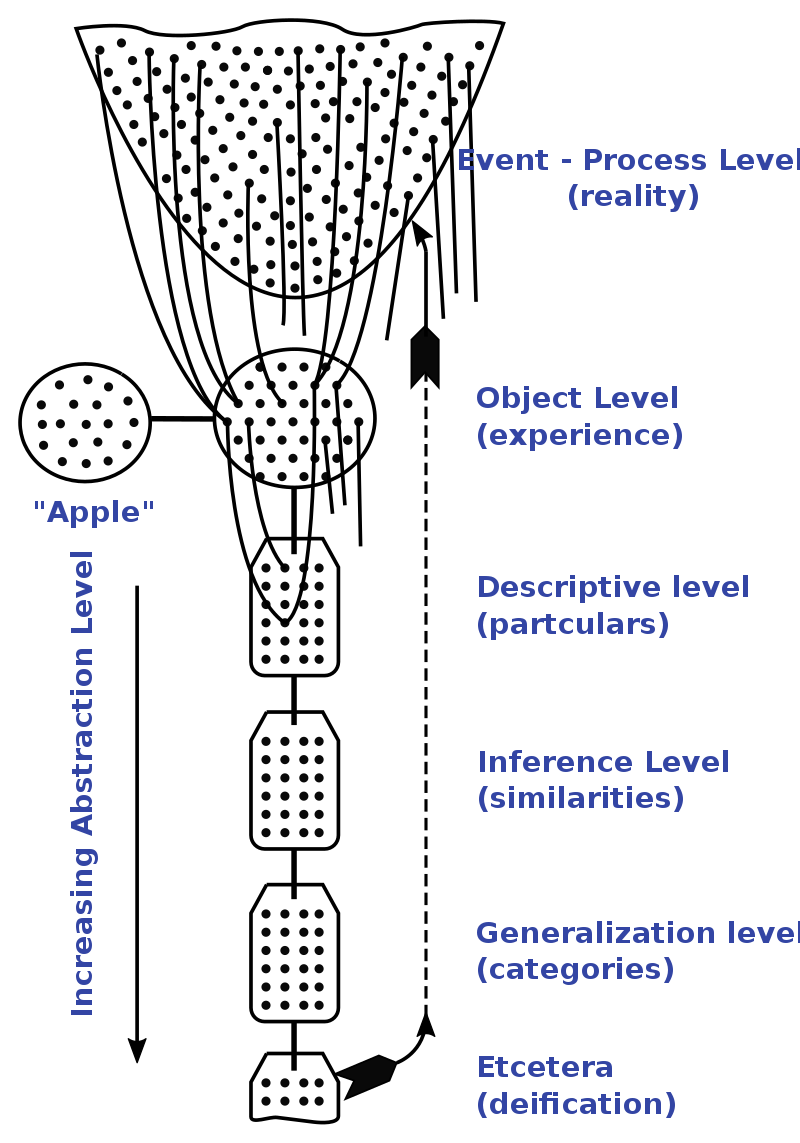
An important outcome of this idea is that objective reality is lost in translation. All that we have and can have access to are abstractions. Thus, two observers can come to two different conclusions while witnessing the same phenomenon. Both may have some access to the same phenomenon but not to each other’s abstractions. This idea is very well articulated in the famous “the map is not the territory.” Korzybski came up with a structural differential, a multilayered structure for abstraction. The higher you are on the structure differential, the closer you are to the phenomenon/event and the closer you are to the “reality.” The further down you go, the level of abstraction increases. The loss of the data was shown by holes in the structure. We use words to express real things, forgetting that the words are not the real things. They are abstractions.

Korzybski wrote:

‘Say whatever you choose about the object, and whatever you might say is not it.’ Or, in other wordsː ‘Whatever you might say the object “is”, well it is not.’

When we assume that an abstraction is a real thing, it leads to “allness”. We start to believe that we have access to the Truth and that we know all there is to know about something. We also engage in taking things apart, falsely assuming that the collective holistic meaning is maintained. Korzybski called this elementalism. Korzybski advised that we should not verbally separate what we would not empirically separate. The ideas of holism/reductionism in Systems Thinking can be viewed here. Elementalism leads to false dichotomies and linear thinking. “If you are not with me, you are against me.” Or “If I put the best players, we will have the best team.”

Korzybski believed that humans are time binding. This meant that as a species, we are able to transfer knowledge that allow us to stand on the shoulders of the giants and build on what others have done so far. Korzybski wrote:

“All human achievements are cumulative; no one of us can claim any achievement exclusively as his own; we all must use consciously or unconsciously the achievements of others, some of them living but most of them dead.”

This is also applicable for the individual. I build my ideas based on what I already know from the past. An important idea from this is to understand that a thing from yesterday is not the same as the thing from the present. Similar to the Heraclitus quote, “you cannot step into the same river twice”, Korzybski adviced that we should not mistake that things would remain the same. Some of the ideas he proposed to address this were:

  • Indexes – This is the idea in mathematics, where we write x1, x2 etc. Korzybski advised that we should differentiate things with indexes. Each one of us is unique. Korzybski wrote – “When I talk about humanity, I am always conscious that every member of our species is absolutely unique.”
  • Dating – Similar to the idea of indexes, Korzybski advised using dates for anything we write down or document. My knowledge is based on what I know already. My knowledge last month is different from what I know now. Everything changes and change is the only constant. Thus, dating is a way to differentiate and keep track of our understanding.

When we become aware of the structure differential, we can influence how we make meanings and how we react to things. Some more ideas he proposed in this regard were:

  • Quotation mark – When you talk about an abstraction and you really want to point out that it is an abstraction and to be careful in how it is understood, we can use quotation marks. For example, I can say – “Systems” do not exist.
  • Hyphen – Korzybski was influenced a lot by Albert Einstein and his idea of space-time. Einstein went against the existing paradigm that space and time are different, which could be viewed as elementalistic, and came up with space-time, where the three-dimensional space and time are intertwined and time is the fourth dimension. The use of a hyphen can sometimes alleviate the confusion that arises from false dichotomies.
  • Multiordanality – This is the idea that words can have different interpretations depending on the level of abstraction on the structural differential. This is a way to ensure that we don’t lose the context when we assign meaning to words.

Final Words:

Philosophers tends to take positions such as the correspondence theory of truth (our experience should correspond to the actual reality of the world), and the coherence theory of truth (our experience should cohere with what we already know). It appears to me that Korzybski’s ideas are a mix of correspondence in terms of structures and coherence in terms of the holistic notions. We are all different and alike at the same time depending on the abstraction level we use. Korzybski’s ideas resonate wonderfully with the ideas of Soft Systems theory. We humans cocreate the social reality. The purpose and meaning for an individual should not be stipulated by another. I will finish with wonderful reminders from Korzybski. I see them as his ‘ethical imperatives.’

Any organism must be treated as-a-whole; in other words, that an organism is not an algebraic sum, a linear function of its elements, but always more than that. It is seemingly little realized, at present, that this simple and innocent-looking statement involves a full structural revision of our language.

Korzybski, in 1933, called his theory “general semantics” because it deals with the nervous reactions of the human organism-as-a-whole-in-environments, and is much more general and organismally fundamental than the “meanings” of words as such, or Significs.

To regard human beings as tools — as instruments — for the use of other human beings is not only unscientific but it is repugnant, stupid and short sighted. Tools are made by man but have not the autonomy of their maker — they have not man’s time-binding capacity for initiation, for self-direction, and self-improvement.

Stay safe and Always keep on learning…

In case you missed it, my last post was Storytelling at the Gemba:

I also encourage the reader to check out the ideas of Korzybski and General Semantics.

You may also want to check out my related posts:

Newton’s Eye/Bodkin Experiment and the Principle of Undifferentiated Coding:

The Map at the Gemba:

Storytelling at the Gemba:

SuperVariety

In today’s post, I am looking at storytelling. We are sometimes referred to as Homo Narrans or humans who tell stories. Storytelling, oral or otherwise, is part of our culture, and part of who we are. Joseph Campbell, the American literary professor, talks about the universal nature of all stories in his famous book, The Hero with a Thousand Faces.  Campbell’s thesis, like those of the ancients—and as put forth also, but in different ways, by Freud, Jung, and others—is that by entering and transforming the personal psyche, the surrounding culture, the life of the family, one’s relational work, and other matters of life can be transformed too. Campbell’s ideas have been distilled into the famous Hero’s Journey. Loosely put, this story structure describes a hero who starts off as ordinary, faces adversities, goes through a transformation, and in the end becomes triumphant. I am inspired by Campbell’s work, but I am looking at the ideas I learned in Cybernetics.

Variety:

One of the most important ideas in Cybernetics is that of variety, a brainchild of the brilliant Ross Ashby. Ashby described variety as:

Given a set of elements, its variety is the number of elements that can be distinguished.

For example, if we consider a set of elements in {g b c g g c}, the variety is 3. Another easy example to consider is that of a light switch. A light switch has a variety of two (ON or OFF). Ashby created his most famous Law of Requisite Variety from this simple idea. The Law of Requisite Variety can be simply stated as “only variety can destroy variety.” If the regulatory agency of a system does not have the requisite variety to match the variety of its environment, it will not be able to adapt and survive. Ashby explained this using the example of a fencer:

If a fencer faces an opponent who has various modes of attack available, the fencer must be provided with at least an equal number of modes of defense if the outcome is to have the single value: attacked parried.

How does this come into play with stories? Stories are interesting only if there are conflicts. The villain is shown to have more variety than the hero. This puts the villain in control of the situation because to be in control means to have the appropriate amount of variety over the situation. The hero has to somehow overcome the lack of variety he has. In a superhero movie, if the superhero has more variety than the supervillain, then the story is not at all interesting. Per the Hero’s Journey structure, the superhero has to face adversities to make the story more interesting. This brings up the idea of variety engineering, proposed by another brilliant mind, Stafford Beer.

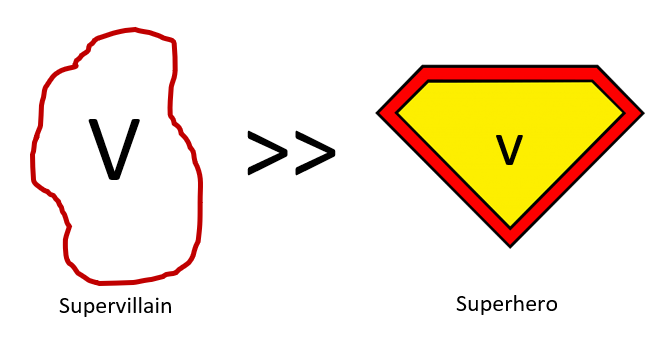
We can depict the varieties as below. The supervillain has much more variety than the superhero. This is shown by the larger font size for “v” depicting the variety. We can see that the variety of the supervillain is much more (>>) than that of the superhero. This is the major adversity that the superhero must overcome. This conflict makes the story interesting.

Hero1

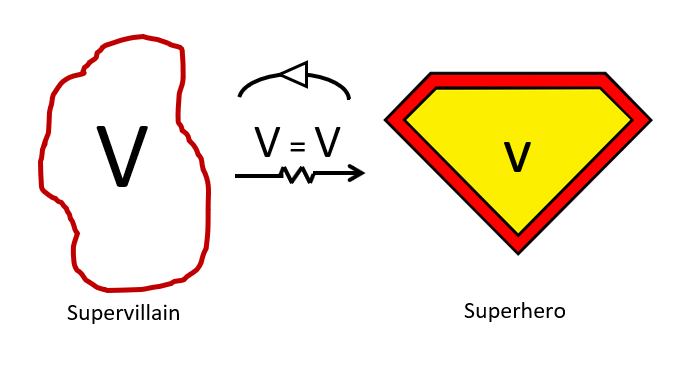
As Stafford Beer might say, the superhero has to find ways to attenuate or reduce the variety of the supervillain, and at the same time find ways to amplify his own variety. This allows him to have the requisite variety to overcome the supervillain. The squiggly line towards right in the schematic below shows the attenuation of the variety coming from the supervillain, while the curved line with the triangle on it shows the amplification of the variety from the superhero. In the below schematic, the varieties are shown to match, as indicated by the same font size for “v” in the middle. This also is an important part of the story since the final fight should not be easy for the superhero. Now we have a good superhero story. The attenuation of the variety may be achieved by not getting scared by the antics shown by the villain. The amplification may be achieved by the use of valuable information that the villain does not have access to, or by coming up with a plan that allows the hero to use his special skill.

Hero2

The same structure can be seen across many of the blockbuster movies or TV shows. The interesting part is always how the variety engineering is done, and how the requisite variety is achieved by the hero, whether it is a Marvel superhero movie or “The Last Kingdom” or “Rick and Morty.”

Role of the Observer:

Ross Ashby gives further insight into this. He brings in the importance of the observer. He noted:

If two observers differ in the distinctions they can make, then they will differ in their estimates of the variety.

An easy example is to consider the set, {b a c c C a B a}. Depending on the observer, the variety of the set can be said as 3 (3 letters) or 5 (3 lowercase letters and 2 uppercase letters). The idea is easily illustrated in a Sherlock Holmes story, where the same crime scene is witnessed by Holmes and Watson. Holmes is able to make more distinctions than Watson, allowing him to achieve the requisite variety needed to solve the crime. One of the most important definitions of information in the light of distinctions come from Gregory Bateson, who described information as the difference that makes the difference. Bateson noted:

What gets onto the map, in fact, is difference, be it a difference in altitude, a difference in vegetation, a difference in population structure, difference in surface, or whatever. Differences are the things that get onto a map.

Bateson’s idea of difference that makes a difference was possibly introduced as part of an Alfred Korzybski lecture. And of course, the observer determines which differences are meaningful to be selected, and which selected differences must be further amplified. Uncertainty can be described as the lack of useful information. With this idea, the observer can reduce uncertainty by making useful distinctions.

Abstractions, an act of attenuating variety, allow an observer to identify that two things are similar, or that the two same things are different. There is no contradiction here because abstractions are not equivalencies. All we have and can have access to are abstractions. Thus, two observers can come to two different conclusions while witnessing the same phenomenon. Both may have some access to the same phenomenon but not to each other’s abstractions. This is exemplified in the Alfred Korzybski’s quote – “The map is not the territory” or the Alan Watts’ quote – “The menu is not the meal.”

We can use a great piece of advice from the German philosopher Hans-Georg Gadamer to further understand variety and uncertainty:

“Reality” always stands in a horizon of desired or feared or, at any rate, still undecided future possibilities. Hence it is always the case that mutually exclusive expectations are aroused, not all of which can be fulfilled. The undecidedness of the future permits such a superfluity of expectations that reality necessarily lags behind them.

From the observer’s standpoint, we realize that the most powerful tool to manage variety becomes the control of information. If one is able to not allow or hinder the other person’s ability to make distinctions, he can control the narrative and be in charge. We see this played out in real life too often.

People Principle:

Another important idea that comes from all of this is that the requisite variety always come from the people on the front, in the midst of facing adversities. We can notate this as:

People Principle: In any organization, the requisite variety always come from the people.

The organizational structures lack the variety needed. The requisite variety is provided as needed by the front-end employees, if they are able to.

Final Words:

“Story can mend, and story can heal.” (Joseph Campbell – The Hero with a Thousand Faces)

We are storytellers. We live and live on in stories. Make yours a good one.

I will finish with excellent advice on tackling writer’s block from one of my favorite storytellers, O. Henry (William Sydney Porter). He puts a nice “Go to the Gemba” touch:

Yes, I get dry spells. Sometimes I can’t turn out a thing for three months. When one of those spells comes on, I quit trying to work and go out and see something of life. You can’t write a story that’s got any life in it by sitting at a writing table and thinking. You’ve got to get out into the streets, into the crowds, talk with people, and feel the rush and throb of real life–that’s the stimulant for a story writer.

For those interested, I have shared some of my really short stories or Flash fiction here.

I also welcome the readers to check out the following posts that are applicable to the topic on hand:

Purpose of a System in Light of VSM:

Exploring The Ashby Space:

OODA Loop at the Gemba: (OODA loop also looks at how preventing the adversary to generate new useful information puts you in control)

Stay safe and Always keep on learning…

In case you missed it, my last post was Hermeneutics at the Gemba:

Newton’s Eye/Bodkin Experiment and the Principle of Undifferentiated Coding:

INewton

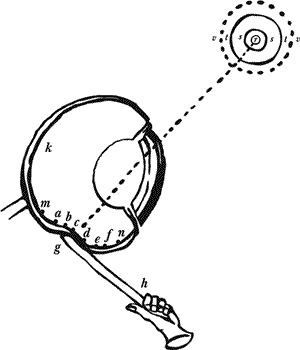
I work in the field of ophthalmic medical devices. I recently came across one of Sir Isaac Newton’s set of notes at the Newton project. In the notes, one particular experiment stood out to me. Newton pushed against his eye ball using a bodkin (a blunt needle) and recorded the optical sensations produced by the pressure on the eye. The schematic below drawn by Newton himself denotes the experiment. He noted:

Newton

I took a bodkin gh and put it between my eye & the bone as near to the backside of my eye as I could: and pressing my eye with the end of it (soe as to make the curvature a, bcdef in my eye) there appeared several white dark & colored circles r, s, t, &c. Which circles were plainest when I continued to rub my eye with the point of the bodkin, but if I held my eye & the bodkin still, though I continued to press my eye with it yet the circles would grow faint & often disappear until I renewed them by moving my eye or the bodkin.

He went on to note that there were different colors and types of sensations depending on if he was in a dark room or a well-lit room. I enjoyed reading through his notes because of my profession and also because it was an opportunity to peek inside a genius mind such as Newton. The experiment remined me of another great idea in Cybernetics called ‘the principle of undifferentiated coding’. This idea was proposed by another brilliant mind and one of my heroes, Heinz von Foerster. Von Foerster said:

The response of a nerve cell does not encode the physical nature of the agents that caused its response. Encoded is only ‘how much’ at this point in my body, but not what.

The brain does not perceive light, sound, heat, touch, taste or smell. It receives only neuronal impulses from sensory organs. Thus, the brain does not “see light,” “hear sounds,” etc.; it can perceive only “this much stimulation at this point on my body.” The practical consequence is that all perceptions, let alone “thoughts,” are deductions from sensory stimuli. They cannot be otherwise. All observations are therefore partly the function of the observer. This situation renders complete objectivity impossible in principle.

Ernst von Glasersfeld, the proponent of Radical Constructivism stated:

In other words, the phenomenological characteristics of our experiential world – color, texture, sounds, tastes and smells – are the result of our own computations based on co-occurrence patterns of signals that differ only with regard to their point of origin in the living system’s nervous network.

Cognition is an autonomous activity of the observer. The state of agitation of a nerve cell only codifies the intensity, not the nature of its cause. What is understood or constructed is unique to the observer. This goes against the idea that if we provide information to a person, he or she will understand what is being provided. Von Foerster would say that the hearer not the utterer determines what is being said. In Newton’s experiment, the sensations were not caused by the eye seeing lights, but due to the physical interaction on the eye. This idea is further explored by Humberto Maturana and Francisco Varela with the idea of autopoiesis. As an autopoietic being, we are all organizationally closed and any information generated is an autonomous activity of our cognitive apparatus.

Bernard Scott expands this idea further:

Von Foerster begins his epistemology, in traditional manner, by asking, “How do we know?” The answers he provides-and the further questions he raises-have consequences for the other great question of epistemology, “What may be known?”

there is no difference between the type of signal transmitted from eye to brain or from ear to brain. This raises the question of how it is we come to experience a world that is differentiated, that has “qualia”, sights, sounds, smells. The answer is that our experience is the product of a process of computation : encodings or “representations” are interpreted as being meaningful or conveying information in the context of the actions that give rise to them. What differentiates sight from hearing is the proprioceptive information that locates the source of the signal and places it in a particular action context.

Another key aspect to add to this is the idea of circularity, where the output is fedback into the cognitive apparatus.  We continue to learn based on what we already know. Thus, we can say that learning is a recursive activity. What we learn now helps further our learning tomorrow. There is no static nature when it comes to knowledge and learning. The great French philosopher Montesquieu said, “If triangles made a god, they would give him three sides.” The properties of the world (seen and unseen) are dependent on the constructor/observer. The construction/observation is ongoing and reflexive. Montesquieu also said, “You have to study a great deal to know a little.” In other words, the more you learn, the more you realize how less you know. Or simply put, “the more you know, the less you know.”

I will finish with a wonderful von Foerster story from Maturana.

Maturana tells of a time when Heinz von Foerster and the famous anthropologist, Margaret Mead went to visit Russia. While there, they went to visit a museum. Mead was using a walking stick at that time. At the entrance they learned that she could not carry her walking stick inside. Mead decided that she would not go in since she could not walk long without using the walking stick. Von Foerster convinced her to go with him. He suggested that he would hide the stick in his clothing, and once inside he would give the stick back to her. His thinking was as follows:

ln this country, whether by perfection or by design, people do not commit mistakes, therefore, any guard that sees us Inside with the walking stick will be forced to admit that we were granted a special permit because otherwise we would not be Inside with it.’

 As the story goes, they were able to visit the museum without any problems. Maturana concluded:

Heinz, by not asking beyond the entrance whether they could or not carry a walking stick, behaved as if he considered that through his interactions with the guards he could either interact with the protection system of the museum as a whole, or with its components as Independent entities, and as if he had chosen the latter. He, thus, revealed that he understood that the guards realized through their properties two non-intersecting phenomenal domains, and that they could do this without contradiction because they operated only on neighborhood relations. This allowed Heinz and Margaret Mead to move through the museum carrying what a meta- observer would have called an invisible forbidden walking stick.

Stay safe and Always keep on learning…

In case you missed it, my last post was The System in the Box: