Nature of Order for Conceptual Models:

251

I have recently been reading upon the renowned British-American architect and design theorist, Christopher Alexander.

Alexander is known for the idea of pattern languages. A pattern is a collection of a known problem discussed with a solution for the problem. As Alexander explains it:

Now, a pattern is an old idea. The new idea in the book was to organize implicit knowledge about how people solve recurring problems when they go about building things.

For example, if you are building a house you need to go from outside to inside and there are centuries of experiments on how to do this in a “just so” way. Sometimes the transition is marked not by just a door but by a change in elevation (steps, large, small, straight, or curved), or a shaded path, or through a court yard.

We wrote up this knowledge in the form of a pattern about entrance transitions.

I was very much inspired by what Alexander was pointing at. Alexander’s view is that a construction should always promote social interactions and thus life. He would ask the question, which building has more life? In a city or a village or even in your house, where do you see life? Is there a particular room that you really love in your house? Why do you like that room? Alexander was after this question. He and his team came up with 253 patterns that they observed by studying the world around them. They noticed that certain buildings and locations had more “life” than others. People were engaged in more interactions and they were enjoying being with one another. These buildings and locations add to the wholeness of the surrounding and also to the people themselves. They promote the nature of order.

For example, one of the patterns Alexander’s team came up with was “SMALL PUBLIC SQUARES” (Alexander’s team used capital letters to denote a pattern.) This pattern provides guidelines for the width of the public squares to less than 70 feet.

A town needs public squares; they are the largest, most public rooms, that the town has. But when they are too large, they look and feel deserted.

It is natural that every public street will swell out at those important nodes where there is the most activity. And it is only these widened, swollen, public squares which can accommodate the public gatherings, small crowds, festivities, bonfires, carnivals, speeches, dancing, shouting, mourning, which must have their place in the life of the town.

But for some reason there is a temptation to make these public squares too large. Time and again in modern cities, architects and planners build plazas that are too large. They look good on drawings; but in real life they end up desolate and dead.

Our observations suggest strongly that open places intended as public squares should be very small. As a general rule, we have found that they work best when they have a diameter of about 6o feet – -at this diameter people often go to them, they become favorite places, and people feel comfortable there. When the diameter gets above 70 feet, the squares begin to seem deserted and unpleasant.

They reasoned that a person’s face is still recognizable at 70 feet, and the voice can also be heard at this distance. In other words, any distance further than 70 feet reduces interactions, and thus does not promote “life”.

Conceptual Models:

I am not an architect by trade or by passion. However, I noticed that the ideas that Alexander was talking about has much wider use. His ideas were behind the wiki movement.

We generally construct conceptual models to explain how things work in our mind. For example, when we look at a car, we may construct a conceptual model in our mind to explain how the car works. It could be as simple as – put gasoline, and the engine runs making the car move. When we talk about problem solving and problem structuring, we are in many regards constructing a conceptual model in our mind.

Alexander stated:

One of the things we looked for was a profound impact on human life. We were able to judge patterns, and tried to judge them, according to the extent that when present in the environment we were confident that they really do make people more whole in themselves.

The allegory of “constructing a model” works well with Alexander’s ideas. Alexander would propose that one should not construct a building that does not add to the existing surroundings. Furthermore, it should add to the wholeness, and it should promote life via social interactions. I am sometimes guilty of coming to a problem with a preconceived bias and notion. When I am informed of a problem, I may construct the problem statement immediately. I come to the source with the problem model already constructed.  This hinders “life” and promotes “unwholeness”, as Alexander would say.

Similar to Marie Kondo’s question of “Does it spark joy?”, Alexander asks the question, “Does it promote life?” and “Does it add to the wholeness?”

Alexander defines wholeness as “the source of coherence in any part of the world.”

When you build a thing you cannot merely build that thing in isolation, but must also repair the world around it, and within it so that the larger world at that one place becomes more coherent and more whole; and the thing which you make take its place in the web of nature as you make it.

When we are constructing a problem model, we should not come with the box already prepared. Instead, we should construct the box around the problem as we find it at the source, the gemba. We often talk about lean problems and six sigma problems. This is not the correct approach. We should construct the box around the problem making sure to match the conceptual surroundings. The model should add to the wholeness. This in my mind is regarding correspondence and coherence. The problem model should correspond to the reality, and should promote coherence to other ideas and models that we have in our epistemological toolbox. In other words, the problem model should make sense.

Each pattern is connected to certain larger patterns which come above it in the language; and to certain smaller patterns which come below it in the language.

No pattern is an island… Each pattern can exist in the world, only to the extent that it is supported by other patterns.

A thing is whole according to how free it is of inner contradictions. When it is at war with itself, and gives rise to forces which act to tear it down, it is unwhole.

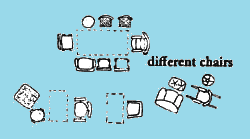
In this post, we will look at one additional pattern that Alexander’s team came up with called “DIFFERENT CHAIRS” to discuss this further. This patterns adds further clarity to the multidimensional and multireality nature of complex problems.

People are different sizes; they sit in different ways. And yet there is a tendency in modern times to make all chairs alike. Never furnish any place with chairs that are identically the same. Choose a variety of different chairs, some big, some small, some softer than others, some rockers, some very old, some new, with arms, without arms, some wicker, some wood, some cloth.

In my mind, this alludes to the multiple perspectives that we should consider. Problem structuring is extremely difficult (and sometimes not possible) for complex problems mainly because of the numerous connected parts, numerous perspectives and due to the fact that there are portions of a complex phenomenon that we are not able to completely grasp. We should always welcome multiple perspectives. The great American Systems Thinker, Russell Ackoff said:

Effective research is not disciplinary, interdisciplinary, or multidisciplinary; it is transdisciplinary.

In our case, we can paraphrase this and say that effective construction of a conceptual model is transdisciplinary.

The same idea of conceptual model is applicable in Systems Thinking. A “system” is also a conceptual model. This is very well articulated by Weber Ulrich:

‘Systems’ are essentially conceptual constructs rather than real-world entities. Systems concepts and other constructs help us describe and understand the complex realities of realworld situations, including natural, technical, social, psychological or any other aspects that might potentially or actually be relevant at any one time. 

Alexander proposed an 8-step approach for promoting “wholeness”. As we look at the steps, we can see that it requires deep questioning and thinking. How can we use this approach to promote constructing better conceptual models?

  1. At every step of the process—whether conceiving, designing, making, maintaining, or repairing—we must always be concerned with the whole within which we are making anything. We look at this wholeness, absorb it, try to feel its deep structure.
  2. We ask which kind of thing we can do next that will do the most to give this wholeness the most positive increase of life.
  3. As we ask this question, we necessarily direct ourselves to centers, the units of energy within the whole, and ask which one center could be created (or extended or intensified or even pruned) that will most increase the life of the whole.
  4. As we work to enhance this new living center, we do it in such a way as also to create or intensify (by the same action) the life of some larger center.
  5. Simultaneously we also make at least one center of the same size (next to the one we are concentrating on), and one or more smaller centers— increasing their life too.
  6. We check to see if what we have done has truly increased the life and feeling of the whole. If the feeling of the whole has not been deepened by the step we have just taken, we wipe it out. Otherwise we go on.
  7. We then repeat the entire process, starting at step 1 again, with the newly modified whole.
  8. We stop altogether when there is no further step we can take that intensifies the feeling of the whole.

Final Words:

The title of this post is adopted from the title of a Christopher Alexander book, “The Nature of Order”. I welcome the readers to take upon reading and learning his wonderful works. I will finish with the complete description of pattern 252, DIFFERENT CHAIRS:
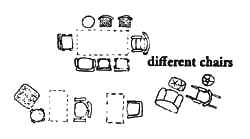
251 - Diff Chairs

People are different sizes; they sit in different ways. And yet there is a tendency in modern times to make all chairs alike.

Of course, this tendency to make all chairs alike is fueled by the demands of prefabrication and the supposed economies of scale. Designers have for years been creating “perfect chairs” – chairs that can be manufactured cheaply in mass. These chairs are made to be comfortable for the average person. And the institutions that buy chairs have been persuaded that buying these chairs in bulk meets all their needs.

But what it means is that some people are chronically uncomfortable; and the variety of moods among people sitting gets entirely stifled.

Obviously, the “average chair” is good for some, but not for everyone. Short and tall people are likely to be uncomfortable. And although situations are roughly uniform – in a restaurant everyone is eating, in an office everyone is working at a table – even so, there are important distinctions: people sitting for different lengths of time; people sitting back and musing; people sitting aggressively forward in a hot discussion; people sitting formally, waiting for a few minutes. If the chairs are all the same, these differences are repressed, and some people are uncomfortable.

What is less obvious, and yet perhaps most important of all, is this: we project our moods and personalities into the chairs we sit in. In one mood a big fat chair is just right; in another mood, a rocking chair; for another, a stiff upright; and yet again, a stool or sofa. And, of course, it isn’t only that we like to switch according to our mood; one of them is our favorite chair, the one that makes us most secure and comfortable; and that again is different for each person. A setting that is full of chairs, all slightly different, immediately creates an atmosphere which supports rich experience; a setting which contains chairs that are all alike puts a subtle straight jacket on experience.

Therefore:

Never furnish any place with chairs that are identically the same. Choose a variety of different chairs, some big, some small, some softer than others, some rockers, some very old, some new, with arms, without arms, some wicker, some wood, some cloth.

In case you missed it, my last post was UX at the Gemba:

My Recent Tweets (7/28/2019):

img_7584-1

I will be posting soon. Meanwhile, here are selected tweets (cybernetics, purpose of a system, complexity etc.):


Always keep on learning…

Solving a Lean Problem versus a Six Sigma Problem:

Model

I must confess upfront that the title of this post is misleading. Similar to the Spoon Boy in the movie, The Matrix, I will say – There is no Lean problem nor a Six Sigma problem. All these problems are our mental constructs of a perceived phenomenon. A problem statement is a model of the actual phenomenon that we believe is the problem. The problem statement is never the problem! It is a representation of the problem. We form the problem statement based on our vantage point, our mental models and biases. Such a constructed problem statement is thus incomplete and sometimes incorrect. We do not always ask for the problem statement to be reframed from the stakeholder’s viewpoint. A problem statement is an abstraction based on our understanding. Its usefulness lies in the abstraction. A good abstraction ignores and omits unwanted details, while a poor abstraction retains them or worse omits valid details. Our own cognitive background hinders our ability to frame the true nature of the problem. To give a good analogy, a problem statement is like choosing a cake slice. The cake slice represents the cake, however, you picked the slice you wanted, and you still left a large portion of the cake on the table, and nobody wants your slice once you have taken a bite out of it.

When we have to solve a problem, it puts tremendous cognitive stress on us. Our first instinct is to use what we know and what we feel comfortable with. Both Lean and Six Sigma use a structured framework that we feel might suit the purpose. However, depending upon what type of “problem” we are trying to solve, these frameworks may lack the variety they need to “solve” the problem. I have the used the quotation marks on purpose. For example, Six sigma relies on a strong cause-effect relationship, and are quite useful to address a simple or complicated problem. A simple problem is a problem where the cause-effect relationship is obvious, whereas a complicated problem may require an expert’s perspective and experience to analyze and understand the cause-effect relationship. However, when you are dealing with a complex problem, which is non-linear, the cause-effect relationship is not entirely evident, and the use of a hard-structured framework like Six sigma can actually cause more harm than benefit. All human-centered “systems” are complex systems. In fact, some might say that such systems do not even exist. To quote Peter Checkland, In a certain sense, human activity systems do not exist, only perceptions of them exist, perceptions which are associated with specific worldviews.

We all want and ask for simple solutions. However, simple solutions do not work for complex problems. The solutions must match the variety of the problem that is being resolved. This can sometimes be confusing since the complex problems may have some aspects that are ordered which give the illusion of simplicity. Complex problems do not stay static. They evolve with time, and thus we should not assume that the problem we are trying to address still has the same characteristics when they were identified.

How should one go from here to tackle complex problems?

  • Take time to understand the context. In the complex domain, context is the key. We need to take our time and have due diligence to understand the context. We should slow down to feel our way through the landscape in the complex domain. We should break our existing frameworks and create new ones.
  • Embrace diversity. Complex problems require multidisciplinary solutions. We need multiple perspectives and worldviews to improve our general comprehension of the problem. This also calls to challenge our assumptions. We should make our assumptions and agendas as explicit as possible. The different perspective allows for synthesizing a better understanding.
  • Similar to the second suggestion, learn from fields of study different from yours. Learn philosophy. Other fields give you additional variety that might come in handy.
  • Understand that our version of the problem statement is lacking, but still could be useful. It helps us to understand the problem better.
  • There is no one right answer to complex problems. Most solutions are good-enough for now. What worked yesterday may not work today since complex problems are dynamic.
  • Gain consensus and use scaffolding while working on the problem structure. Scaffolding are temporary structures that are removed once the actual construction is complete. Gaining consensus early on helps in aligning everybody.
  • Go to the source to gain a truer understanding. Genchi Genbutsu.
  • Have the stakeholders reframe the problem statement in their own words, and look for contradictions. Allow for further synthesis to resolve contradictions. The tension arising from the contradictions sometimes lead us to improving and refining our mental models.
  • Aim for common good and don’t pursue personal gains while tackling complex problems.
  • Establish communication lines and pay attention to feedback. Allow for local context while interpreting any new information.

Final Words:

I have written similar posts before. I invite the reader to check them out:

Lean, Six Sigma, Theory of Constraints and the Mountain

Herd Structures in ‘The Walking Dead’ – CAS Lessons

A successful framework relies on a mechanism of feedback-induced iteration and keenness to learn. The iteration function is imperative because the problem structure itself is often incomplete and inadequate. We should resist the urge to solve a Six Sigma or a Lean problem. I will finish with a great paraphrased quote from the Systems Thinker, Michael Jackson (not the famous singer):

To deal with a significant problem, you have to analyze and structure it. This means, analyzing and structuring the problem itself, not the system that will solve it. Too often we push the problem into the background because we are in a hurry to proceed to a solution. If you read most texts thoughtfully, you will see that almost everything is about the solution; almost nothing is about the problem.

Always keep on learning…

In case you missed it, my last post was Maurice Merleau-Ponty’s Lean Lessons:

Is Lean the Medium or the Message?

IMG_7255

In today’s post, I am looking at the profound phrase of Marshall McLuhan, “The medium is the message.” Marshall McLuhan was a Canadian philosopher and a media theorist. McLuhan noted that: [1]

Each medium, independent of the content it mediates, has its own intrinsic effects which are its unique message… The message of any medium or technology is the change of scale or pace or pattern that it introduces into human affairs… It is the medium that shapes and controls the scale and form of human association and action.

The simplest understanding of the phrase, “the medium is the message”, is that it does not matter what we say, it matters how we say it. However, this is a simplistic view. McLuhan’s insight was that any medium is an extension of ourselves. For example, the telephone is an environment, and it affects everybody. The smartphone, which is a further advancement of the telephone, has a much larger impact on us and what we do. McLuhan realized that as we shape the media, the media shapes us. It is a complex interactive phenomenon. McLuhan said that it does not matter what you print, as long as you keep going with that activity. Every medium helps us to do much more that what we can do physically. For example, McLuhan talked about language being an extension of our thoughts, and written language is a further extension of our speech. The ability to print replaced the need for us to be there physically to extend our thoughts via speech. The ability to print had a profound impact on us much more than all the printed media combined. The medium is the message simply because the impact the media has on our social life.

McLuhan realized that media has an impact on our environment, and sadly we are most of the time unaware of our changing environment. He noted that people in any environment are less privileged to observing themselves than those slightly outside. McLuhan explained this phenomenon with a catchy phrase – the fish did not discover water. He postulated that fish may not be aware of the water, the very thing their life depend on. Another way to look at this is by looking at tweets from a politician. The tweets themselves are beside the point. The medium of Twitter has a far reaching impact on our social media. McLuhan would ask us to look beyond the obvious content in a tweet and look at the social impact the medium is generating.

I wanted to view this idea with Lean. As Lean Leaders, we are trying to propagate the good messages of Lean – “Banish waste”, “respect for Humanity”, “kaizen” etc. We need to realize that the message is not the content, but the medium and the context of our actions. As the aphorism goes, our actions speak louder than our words. The medium, as extensions of us, reaches into our lives and shape ourselves. We should concentrate on the medium to make a larger favorable impact. A good example is kanban. Kanban is a simple mechanism for a pull system, a paper slip that triggers production in a quantity that is needed at the time it is needed. However, the use of kanban leads to an awareness of the problems at the gemba, which leads to a need for a kaizen culture.

The ideas of revealing waste as it occurs, challenging ourselves to continuously improve by elimination of waste and develop people as part of a value adding function are integral to any Lean implementation. This complex intermingled set of ideas cannot be made understood by an edict top down from the CEO – “implement Lean.” What is needed is an understanding of the medium and the environment. The medium of daily board meetings for example has an impact on the social aspects in an organization because of involvements at different levels. The medium of QC circles or daily or weekly kaizen groups are another example. The content of fixing problems is not as important as the medium itself and the long-lasting impact it has by developing people to see wastes and improving their own ability to fix problems.

Sometimes we focus more on the content of the message, as in implementing “Lean”, without trying to understand what is the need that we are trying to address. McLuhan explained this focus on the content as a juicy piece of meat carried by the burglar to distract the watchdog of the mind. We are focusing on the wrong thing. The top down push for lean, six sigma etc. without changing medium may not have a lasting effect. The medium itself has to be changed to change the meaning and impact. The medium is the message, which is context driven! If you want to make “change”, don’t just change the message, change the medium itself. Hence, the title of this post – Is Lean the Medium or the Message?

Final Words:

It is said that the typesetters mistakenly printed, “The medium is the massage” on the cover of his book [2]. McLuhan loved the changed phrasing because it had additional interpretations that he appreciated. He said, “Leave it alone! It’s great, and right on target!” [3]

I will finish with a great insight that McLuhan made in 1964 [1], that foreshadowed the medium of internet and social media:

Archimedes once said, “Give me a place to stand and I will move the world.” Today he would have pointed to our electric media and said, “I will stand on your eyes, your ears, your nerves, and your brain, and the world will move in any tempo or pattern I choose.” We have leased these “places to stand” to private corporations.

Always keep on learning…

In case you missed it, my last post was Purpose of a System in Light of VSM:

[1] Understanding Media, Marshall McLuhan

[2] The Medium is the Massage, Marshall McLuhan

[3] https://www.marshallmcluhan.com/common-questions/

Herd Structures in ‘The Walking Dead’ – CAS Lessons:

zombie_PNG64

The Walking Dead is one of the top-rated TV shows currently. The show is about survival in a post-apocalyptic zombie world. The zombies are referred to as “walkers” in the show. I have written previously about The Walking Dead here. In today’s post, I want to briefly look at Complex Adaptive Systems (CAS) in the show’s backdrop. A Complex Adaptive System is an open non-linear system with heterogenous and autonomous agents that have the ability to adapt to their environment through interactions between themselves and with their environment.

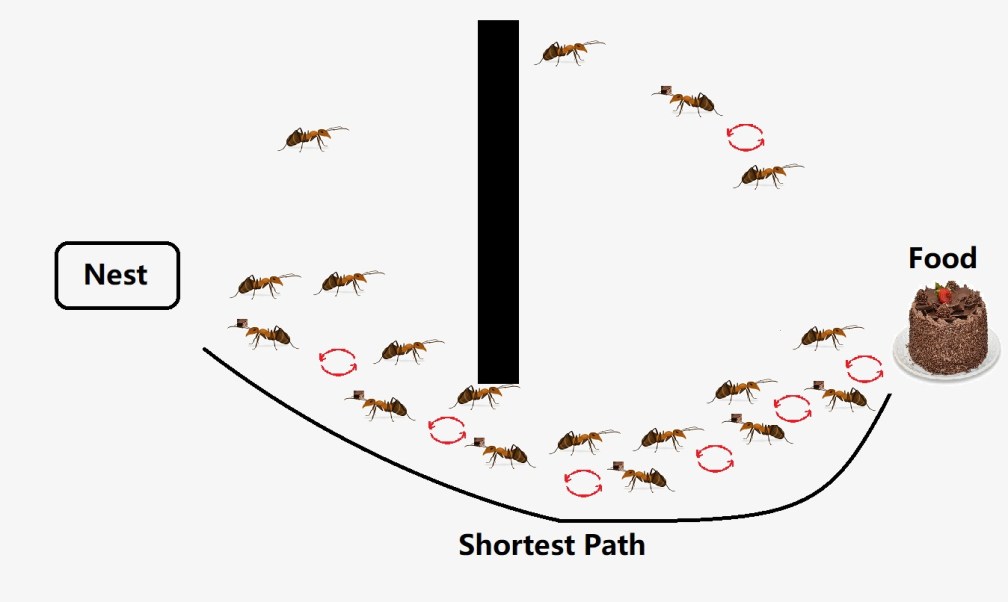
The simplest example to get a grasp of CAS is to look at an ant colony. Ants are simple creatures without a leader telling what each ant should do. Each ant’s behavior is constrained by a set of behavioral rules which determine how they will interact with each other and with their environment. The ant colony taken as a whole is a complex and intelligent system. Each ant works with local information, and interacts with other ants and the environment based on this information. The different tasks that the ants do are patrol, forage, maintain nest and perform midden work. The local information available to each ant is the pheromone scent from another ant. As a whole, their interactions result in a collective intelligence that sustains their colony. In presence of perturbations in their environment, the ants are able to switch to specific tasks to maintain their system. The ants decide the task based on the local information in the form of perturbation to their environment and their rate of interaction with other ants performing the specific tasks. The ants go up in the ranks eventually becoming a forager in the presence of need. A forager ant always stays a forager. The ant colony carries a large amount of “reserve ants” who do not perform any function. This reserve allows for specific task allocation as needed based on perturbations to their environment.

To further illustrate the “self-organizing” or pattern forming behavior of ants, let’s take for example, their foraging activity. The ants will set out from the colony in a random fashion looking for food. Once an ant finds food, it will bring it back to the nest leaving a pheromone trail on its way back. The other ants engaged in the foraging activity will follow the pheromone trail and bring back food while leaving their pheromone scent on the path. The pheromone scent will evaporate over a short amount of time. The ants that followed the shortest path would go back for more food and their pheromone trail will stay “fresh” while a longer path will not remain as “fresh” since the pheromone has more time to evaporate. This means that the path with the strongest pheromone trail is the shortest path to the food. The shortest path was a result of positive feedback loops from more and more ants leaving pheromone at a faster rate. Here the local information available to each ant is the rate of pheromone release from the other ants. The faster the rate, the stronger the trail. This generally corresponds to the shortest trail to the food source. Once the food source is consumed, another food source is identified and a new short path is established. This “algorithm” called as Ant Colony Optimization Algorithm is utilized by several transportation companies to find the shortest routes.

Foraging

In the show, The Walking Dead, a similar collective behavior is shown by the zombies. The zombies exhibit a herding behavior where a large number of zombies will move together as a herd in search for “food”. The zombies in The Walking Dead world are devoid of any intelligence and there is no one in charge similar to the ants. The zombies however do not have a nest. They just wander around. The zombies in the show are attracted by sound, movement and possibly absence of “zombie smell”. The zombies do not attack each other possibly due to the presence of “zombie smell”. In fact, in the show several characters were able to survive zombie attack by lathering themselves in the “zombie goo”.

The possible explanation for the formation of herd structures is the hardwired attribute that we all have – copying others. We tend to follow what others are doing when we are not sure what is happening. We go with the flow. A good example is the wave we do in a sports stadium. We could develop a model where a few zombies are attracted by a stimulus and they walk toward the stimulus. The other zombies simply follow them, and soon a large crowd forms due to the reinforced loops with more and more followers. This is similar to the positive reinforcing feedback of pheromone trail in the example of ants.

The show recently introduced an antagonist group called the “Whisperers”. The Whisperers worship the dead and adorn the zombie skins and walk amongst the zombies. They learned to control the herd and make them go where they want. The Whisperers themselves a CAS, adapted to survive by being with the walkers. Possibly, they are able to guide the walkers by first forming a small crowd themselves and then getting more walkers to join them as they move as a group. Since they have the “zombie smell” on them, the walkers do not attack them.

How Does Understanding CAS Help Us?

We are not ants and certainly not zombies (at least not yet). But there are several lessons we can get from understanding CAS. We all belong to a CAS at work, and in our community. The underlying principle of CAS is that we live in a complex world where we can understand the world only in the context of our environment and our local interactions with our neighbors and with the environment. Every project we are involved in is new and not identical to any previous project. This could be the nature of the project itself, or the team members or the deadlines or the client. Every part of the project can introduce a new variation that we did not know of. Given below are some lessons from CAS.

  1. Observe and understand patterns:

Complex Adaptive Systems present patterns due to the agents’ interactions. You have to observe and understand the different patterns around you. How do others interact with each other? Can you identify new patterns forming in the presence of new information or perturbations in your environment? Improve your observation skills to understand how patterns form around you. Look and see who the “influencers” are in your team.

  1. Understand the positive and negative feedback loops:

Observe and understand the positive and negative feedback loops that exist around. A pattern forms based on these loops. The awareness of the positive and negative loops will help us nurture the required loops.

  1. Be humble:

Complexity is all around us and this means that we lack understanding. We cannot foresee or predict how things will turn out every time. Complex systems are dispositional, to quote Dave Snowden. They may exhibit tendencies but we cannot completely understand how things work in a complex system. Edicts and rules do not always work and they can have unintended consequences. Every event is possibly a new event and this means that although you can have insights from your past experiences, you cannot control the outcomes. You cannot simply copy and paste because the context in the current system is different.

  1. Get multiple perspectives always (reality is multidimensional and constructed):

Get multiple perspectives. To quote the great American organizational theorist, Russell Ackoff, “Reality is multidimensional.” To add to this, it is also constructed. The multiple perspectives help us to understand things a little better and provide a new perspective that we were lacking. Systems are also constructed and can change how it appears depending on your perspective.

  1. Go inside and outside the system:

We cannot try to understand a system by staying outside it all of the time. Similarly, we cannot understand a system by staying inside it all of the time. Go to the Gemba (the actual workplace) to grasp the situation to better understand what is going on. Come away from it to reflect. We can understand a system only in the context of the environment and the interactions going on.

  1. Have variety:

Similar to #4, variety is your friend in a complex system. Variety leads to better interactions that will help us with developing new patterns. If everybody was the same then we would be reinforcing the same idea that would lack the requisite variety to counter the variety present in our environment. Our environment is not homogenous.

  1. Aim for Effectiveness and not Efficiency:

In complex systems, we should aim for effectiveness. Here, the famous Toyota heuristic, “Go slow to go fast” is applicable. Since each event is novel, we cannot aim for efficiency always.

  1. Use Heuristics and not Rules:

Heuristics are flexible and while rules are rigid. Rules are based on past experiences and lack the variety needed in the current context. Heuristics allow flexing allowing for the agents to change tactics as needed.

  1. Experiment frequently with safe to fail small experiments:

As part of prodding the environment, we should engage in frequent and small safe to fail experiments.  This helps us improve our understanding.

  1. Understand that complexity is always nonlinear, thus keep an eye out for emerging patterns:

Complexity is nonlinear and this means that a small change can have an unforeseen and large outcome. Thus, we should observe for any emerging patterns and determine our next steps. Move towards what we have identified as “good” and move away from what we have deemed as “bad”. Patterns always emerge bottom-up. We may not be able to design the patterns, but we may be able to recognize the patterns being developed and potentially influence them.

Final Words:

My post has been a very simple look at CAS. There are lot more attributes to CAS that are worth pursuing and learning. Complexity Explorer from Santa Fe institute is a great place to start. I will finish with a great quote from the retired United States Army four-star general Stanley McChrystal, from his book, Team of Teams:

“The temptation to lead as a chess master, controlling each move of the organization, must give way to an approach as a gardener, enabling rather than directing. A gardening approach to leadership is anything but passive. The leader acts as an “Eyes-On, Hands-Off” enabler who creates and maintains an ecosystem in which the organization operates.”

Always keep on learning…

In case you missed it, my last post was Conceptual Metaphors in Lean:

Know Your Edges:

jigsaw

In today’s post I will start with a question, “Do you know your edges?

Edges are boundaries where a system or a process (depending upon your construction) breaks down or changes structure. Our preference, as the manager or the owner, is to stay in our comfort zone, a place where we know how things work; a place where we can predict how things go; a place we have the most certainty. Let’s take for a simple example your daily commute to work – chances are high that you always take the same route to work. This is what you know and you have a high certainty about how long it will take you to get to your work. Counterintuitively, the more certainty you have of something, the less information you have to gain from it. Our natural tendency is to have more certainty about things, and we hate uncertainty. We think of uncertainty as a bad thing. If I can use a metaphor, uncertainty is like medicine – you need it to stay healthy!

To discuss this further, I will look at the concept of variety from Cybernetics. Variety is a concept that was put forth by William Ross Ashby, a giant in the world of Cybernetics. Simply speaking, variety is the number of states. If you look at a stop light, generally it has three states (Red, Yellow and Green). In other words, the stop light’s variety is three (ignoring flashing red and no light). With this, it is able to control traffic. When the stop light is able to match the ongoing traffic, everything is smooth. But when the volume of traffic increases, the stop light is not able to keep up. The system reacts by slowing down the traffic. This shows that the variety in the environment is always greater than the variety available internally. The external variety also equates with uncertainty. Scaling back, let’s look at a manufacturing plant. The uncertainty comes in the form of 6M (Man, Machine, Method, Material, Measurement and Mother Nature). The manager’s job is to reduce the uncertainty. This is done by filtering the variety imposed from the outside, magnifying the variety that is available internally or looking at ways to improve the requisite variety. Ashby’s Law of Requisite Variety can be stated as – “only variety can absorb variety.

All organizations are sociotechnical systems. This also means that in order to sustain, they need to be complex adaptive systems. In order to improve the adaptability, the system needs to keep learning. It may be counterintuitive, but uncertainty is required for a complex adaptive system to keep learning, and to maintain the requisite variety to sustain itself. Thus, the push to stay away from uncertainty or staying in the comfort zone could actually be detrimental. Metaphorically, staying the comfort zone is staying away from the edges, where there is more uncertainty. After a basic level of stability is achieved, there is not much information available in the center (away from the edges). Since the environment is always changing, the organization has to keep updating the information to adapt and survive. This means that the organization should engage in safe to fail experiments and move away from their comfort zone to keep updating their information. The organization has to know where the edges are, and where the structures break down. Safe to fail experiments increases the solution space of the organization making it better suited for challenges. These experiments are fast, small and reversible, and are meant to increase the experience of the organization without risks. The organization cannot remain static and has to change with time. The experimentation away from the comfort zone provides direction for growth. It also shows where things can get catastrophic, so that the organization can be better prepared and move away from that direction.

This leads me to the concept of “fundamental regulator paradox”. This was developed by Gerald Weinberg, an American Computer scientist. As a system gets really good at what it does, and nothing ever goes wrong, then it is impossible to tell how well it is working. When strict rules and regulations are put in place to maintain “perfect order”, they can actually result in the opposite of what they are originally meant for. The paradox is stated as:

The task of a regulator is to eliminate variation, but this variation is the ultimate source of information about the quality of its work. Therefore, the better job a regulator does, the less information it gets about how to improve.

This concept also tells us that trying to stay in the comfort zone is never good and that we should not shy away from uncertainty. Exploring away from the comfort zone is how we can develop the adaptability and experience needed to survive.

Final Words:

This post is a further expansion from my recent tweet. https://twitter.com/harish_josev/status/1055977583261769728?s=11

Information is most rich at the edges. Information is at its lowest in the center. Equilibrium also lies away from the edges.

The two questions, “How good are you at something?” and “How bad are you at something?” may be logically equivalent. However, there is more opportunity to gain information from the second question since it leads us away from the comfort zone.

I will finish with a lesson from one of my favorite TV Detectives, D.I Richard Poole from Death in Paradise.

Poole noted that solving murders were like solving jigsaw puzzles. One has to work from the corners, and then the edges and then move towards the middle. Then, everything will fall in line and start to make sense.

Always keep on learning…

In case you missed it, my last post was Bootstrap Kaizen: