
Observations on Observing, The Case Continues:

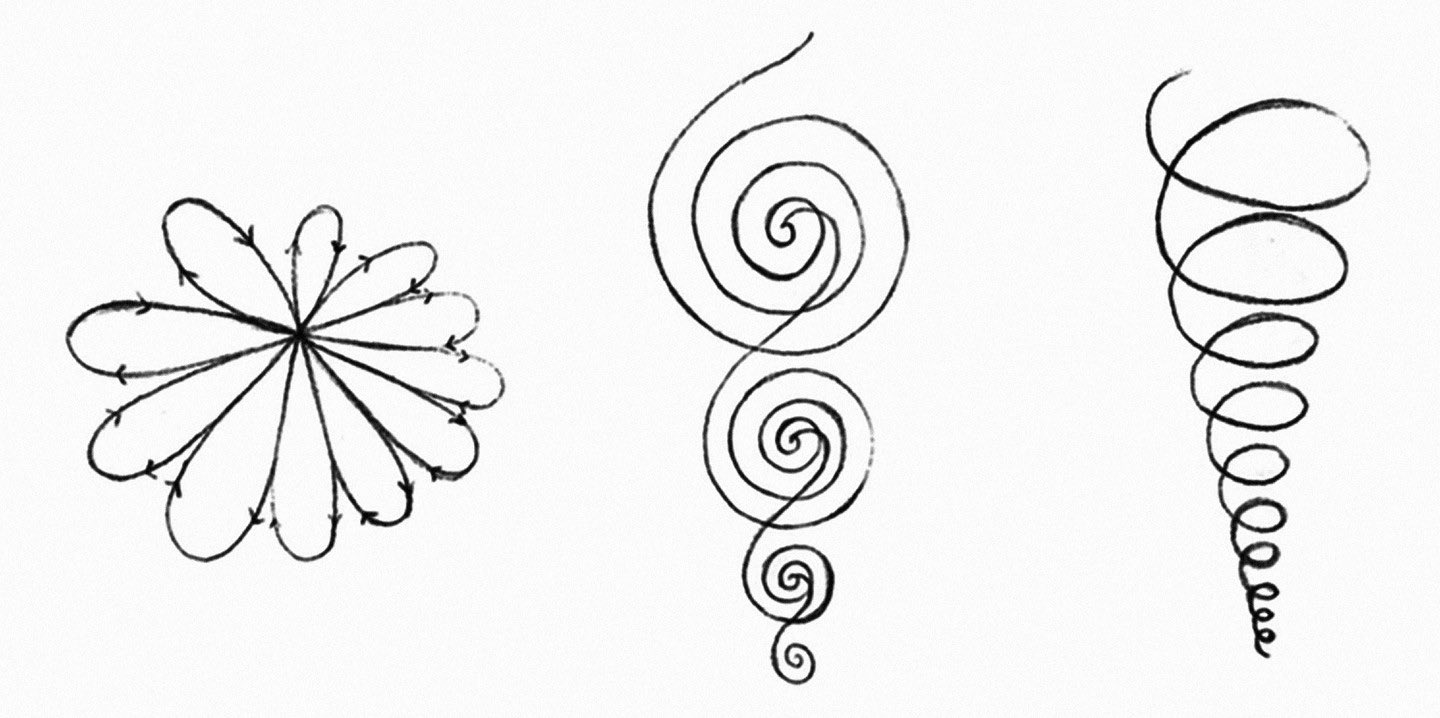
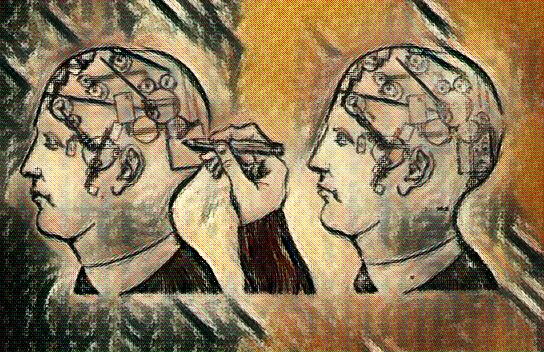
Art by Audrey Jose

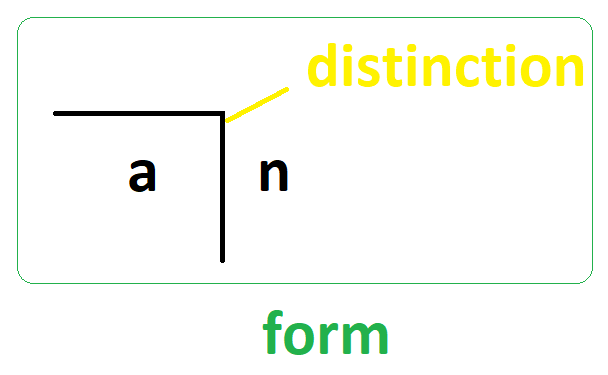
In today’s post, I am continuing from the last post, mainly using the ideas of Dirk Baecker. We noted that every observation is an operation of distinction, where an observer crosses a line, entering a marked state. This is shown in the schematic below. Here “a” refers to the marked state that the observer is interested in. The solid corner of a square is the distinction that was used by the observer, and “n” refers to the unmarked state. The entire schematic with the two sides and the three values (“a”, “n” and the distinction) are notated as a “form”. The first order observer is observing only the marked state “a”, and is not aware of or paying attention to the distinction(s) utilized. They are also not aware of the unmarked state “n”. When a second order observer enters the picture, they are able to see the entire form including the distinction employed by the first order observer.  
However, it is important to note that the observation made by the second order observer is also a first order observation. This means that they also have a distinction and an unmarked state, another “n” that they are not aware of. Baecker explains this:

We have to bring in second-order observers in order to introduce consciousness or self-observation. Yet to be able to operate at all, these second-order observers must also be first-order observers… Second-order observers intervene as first-order observers, thereby presenting their own distinction to further second-order observation.

We also discussed the idea of “reentry” in our last post. Reentry is a means to provide closure so that the first order and second order observations taken together leads to a stable meaning.

So, to recap, the first order observer is interested in “a”.
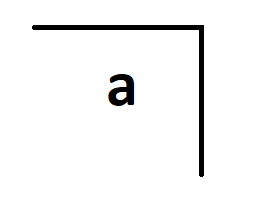
The second order observer observes the first order observer, and understands that the first order observer made a distinction. They see where the first order observer is coming from, and the context of their observation. Let’s call the context as “b”. This will be the unmarked state for the first observer.
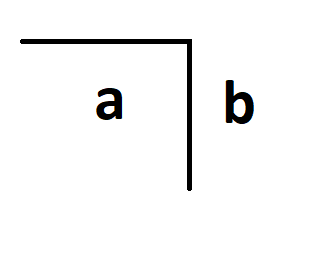
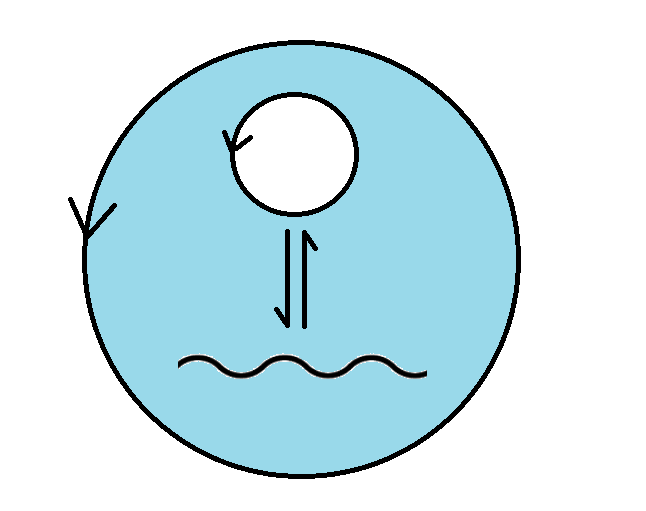
The second order observer engages with the first order observer in an ongoing back and forth discussion. The second order observer is able to combine both their “dealing with the world” approaches and come together to a nuanced understanding. This understanding is an effect of distinguishing “a” from “b”, and also combining “a” and “b” – an action of implication and negation taken together. This is an operation of sensemaking in the medium of meaning. This is depicted as the reentry in the schematic below.
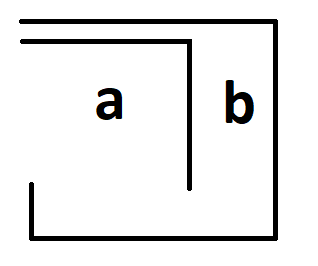
Baecker explains reentry further:

Any operation that is able to look at both sides of the distinction – that is, at its form – is defined by Spencer Brown as an operation of reentry. It consists of reentering the distinction into the distinction, thereby splitting the same distinction into one being crossed and the same one being marked by another distinction that is deferred. The general idea of the reentry is to note and use the fact that distinctions occur in two versions: the distinction actually used, and the distinction looked at or reflected on.

Let’s look further at the form by using a famous syllogism from philosophy to further enhance our understanding:

All Men are Mortals;

Socrates is a man;

Therefore, Socrates is a mortal.

 This can be depicted as a form as shown below:
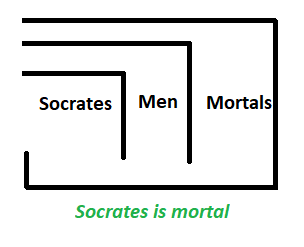
By distinguishing Socrates from Men, and Men from Mortals, and by putting it all together, we get to “Socrates is Mortal”. In this case, we did not have to do a lot of work to come to the final conclusion. However, as the complexity increases, we will need to perform reentry on an ongoing basis to bring forth a stable meaning. Reentry introduces temporality to the sensemaking operation. No matter how many distinctions we employ, we can only get to a second order observation. All observations are in all actuality first order observations. And what is being distinguished is also dependent entirely on the observer.

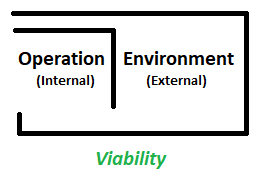
I will also look at another example. A manager is required to maintain the operations of a plant while at the same time they need to make modifications to the operations to ensure that the plant can stay viable in an everchanging environment. In other words, the operations are maintained as consistent as possible until it needs to be changed. This can be depicted as shown below:
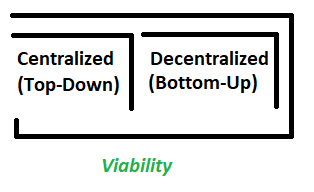
Another way to look at this is to view a plant as needing centralized structure as well as decentralized structure or top-down and bottom-up structure. This can be depicted as shown below. Here the two states are not shown as nested, but adjacent to each other.
Dirk Baecker saw a firm as follows:
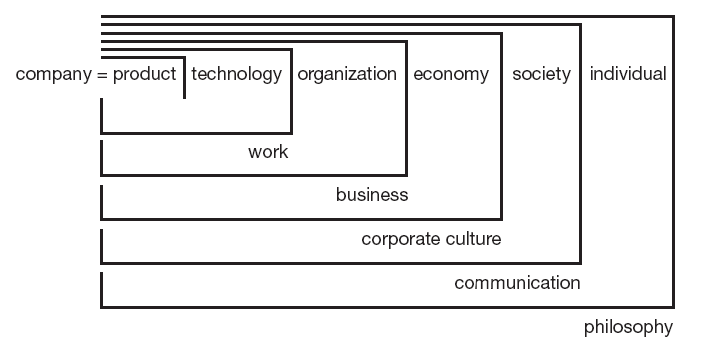
Baecker notes that the product is the first distinction that we have to make. Our first distinction is the distinction of the product. Whatever else the firm may be doing, it has to recursively draw the distinction of which product it is to produce. This may be a material or immaterial, a tangible or intangible, an easy or difficult to define product, but it has to be a product that tells employees, managers and clients alike just what the firm is about. He continues- The technology is part of the form of the first distinction. Indeed, it is the outside or the first context of the first distinction, as observed by a second-order observer who may be the first-order observer observing him/herself. This means that a firm distinguishes only those products for which it has, or hopes to acquire, the necessary technology. Technology here means all kinds of ways of making sure that we can do what we want to do. This includes material access to resources, knowledge of procedures, technologies, availability of people to do the job and ways to convince society that you are doing what you are doing in the proper way.

Baecker explains “work” as follows:

We add the assumption of communication between first-order observers who at the same time act as second-order observers. The firm observes itself. By working, it relates products to technology and technology back to products.

Additional information can be found on Dirk Baecker’s The Form of the Firm.

In all that we have seen so far, we have not yet talked about the unmarked state. The unmarked state “n” is always present in the form and is not accessible to the observer. The observation can have as many distinctions as needed, dependent on the observer. The “n” represents everything that can be further added to the distinctions to improve our “meaning” as needed. The more distinctions there are, the more complex the observations. The observers deal with the complexity of the phenomena to be understood by applying as many or as few distinctions as needed.

We are able to better help with someone else’s problems because we can engage in second order observations. As second order observers, we can see the distinctions they made which are not accessible to them in the first order observation. The second order observer is able to understand the distinctions that the first order observer was able to make. The distinctions lay in the blind spots for the first order observer. The second order observation can be completed by the first order observer themselves as an operation of self-reflection. As cognitive beings, we must reproduce existing patterns by continually engaging with the external world, our local environment. We have to keep evaluating and adjusting these patterns on an ongoing self-correcting basis.

The basic structure of what we have discussed so far can be depicted as the following form:
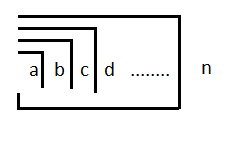
We need to be mindful that there is always “n” that is not part of our observation. We may gain a better understanding of our distinctions if we engage in second order observation, but we will still not be able to access the unmarked state. We will not be able to access the unmarked state unless we create a new distinction in the unmarked state cutting “n” to a marked state and an unmarked state, yielding a new “n”. Second-order observation, noting one’s own distinctions, can lay the groundwork for epistemic humility.

This brings into question – how many distinctions are really needed? We will answer this with going to the first distinction we made. The first cross that we started with leading to the first distinction is the most important thing that we care about. Every other distinction is based on this first one. To answer – how many distinctions are really needed? – we need as many distinctions as needed until we are fully satisfied with our understanding. This includes understanding our blind spots and the distinctions we have made.

I will finish with a Peter Drucker story from Baecker. Peter Drucker was working with a hospital to improve their Emergency Room. Baecker noted that it took the hospital staff two days to come up with the first distinction, their “a”. Their “a” was to bring immediate relief to the afflicted. The afflicted needing relief may not always be the patient. In Drucker’s words:

Many years ago, I sat down with the administrators of a major hospital to think through the mission statement of the emergency room. It took us a long time to come up with the very simple, and (most people thought) too obvious statement that the emergency room was there to give assurance to the afflicted.

To do that well, you have to know what really goes on. And, much to the surprise of the physicians and nurses, it turned out that in a good emergency room, the function is to tell eight out of ten people there is nothing wrong that a good night’s sleep won’t take care of. You’ve been shaken up. Or the baby has the flu. All right, it’s got convulsions, but there is nothing seriously wrong with the child. The doctors and nurses give assurance.

We worked it out, but it sounded awfully obvious. Yet translating that mission statement into action meant that everybody who comes in is now seen by a qualified person in less than a minute. That is the mission; that is the goal. The rest is implementation.

Some people are immediately rushed to intensive care, others get a lot of tests, and yet others are told: “Go back home, go to sleep, take an aspirin, and don’t worry. If these things persist, see a physician tomorrow.” But the first objective is to see everybody, almost immediately — because that is the only way to give assurance.

This post is also available as a podcast – https://anchor.fm/harish-jose/episodes/Observations-on-Observing–The-Case-Continues-e15kpc1

Please maintain social distance and wear masks. Please take vaccination, if able. Stay safe and Always keep on learning…

In case you missed it, my last post was The Case of the Distinguished Observer:
Complexity is in the Middle:

In today’s post, I am inspired by the idea of a rhizome by Félix Guattari and Gilles Deleuze. They spoke about it in their fascinating book, A Thousand Plateaus. A rhizome is defined in Oxford dictionary as a continuously growing horizontal underground stem which puts out lateral shoots and adventitious roots at intervals. Common examples of rhizomes include crab grass and ginger. Guattari and Delueze or G&D as often notated, used the idea of a rhizome as a metaphor. They put the idea of a rhizome against what they called as “arborescent” or tree-thinking. A tree has a very definite structure; one that is hierarchic with the branches, main stalk and the root system. G&D viewed tree-thinking as being focused on a central idea and building a world view upon that. They noted:

The tree is already the image of the world, or the root the image of the world-tree.

Tree-thinking believes in having a true image of the world. As G&D noted, the tree-thinkers’ law is the law of reflection. They believe that they can simply copy the rules and apply them to any situation. Any situation has a clear structure that is hierarchical and centralized. This can be understood by all if they just follow the logic presented. With this thinking, things can be separated out to distinct categories that do not overlap. Most times this leads to a dichotomy – either this or that, with no middle ground. As G&D noted – binary logic is the spiritual reality of the root-tree. Additionally, the arborescent thinking is also linear thinking, where things follow a linear pattern and rarely lead to paradoxes or confusion.

In a contrast to this, G&D presented rhizome. A rhizome does not have a central structure. It does not have a beginning or an end. Wherever you are, you can start from there. A rhizomic plant can grow from any point in the horizontal structure. If you cut a rhizome in half, each half can grow separately.

A pack of organisms can act as a rhizome. Structures such as a burrow or a city can be a rhizome. There is a collective identification that can be started at any point in the structure. You can start from any point in a city and walk around the city to absorb its culture. It is not specific to one point that we can pinpoint as the start or the end. Just like in a map, we can start anywhere and move around in a map. There is not start or an end. A torn map still remains a map. A rhizome includes the best and the worst.

G&D also calls a collection of elements that are connected together in an intricate relationship as a rhizome. One of the examples they give is that of a certain type of wasp and an orchid. The orchid flower resembles the female wasp, and this leads to a relationship where the wasp becomes part of the reproductive cycle of the orchid. There is a lot more going on in this relationship. This is explained in a very poetic language by G&D:

The orchid deterritorializes by forming an image, a tracing of a wasp; but the wasp reterritorializes on that image. The wasp is nevertheless deterritorialized, becoming a piece in the orchid’s reproductive apparatus. But it reterritorializes the orchid by transporting its pollen. Wasp and orchid, as heterogeneous elements, form a rhizome. It could be said that the orchid imitates the wasp, reproducing its image in a signifying fashion (mimesis, mimicry, lure, etc.). But this is true only on the level of the strata-a parallelism between two strata such that a plant organization on one imitates an animal organization on the other. At the same time, something else entirely is going on: not imitation at all but a capture of code, surplus value of code, an increase in valence, a veritable becoming, a becoming-wasp of the orchid and a becoming-orchid of the wasp. Each of these becomings brings about the deterritorialization of one term and the reterritorialization of the other; the two becomings interlink and form relays in a circulation of intensities pushing the deterritorialization ever further. There is neither imitation nor resemblance, only an exploding of two heterogeneous series on the line of flight composed by a common rhizome that can no longer be attributed to or subjugated by anything signifying.

A rhizome has a circular relationship amongst the elements of its assemblage. A book’s relationship with the world is one such example. A book is never a copy of the world. Its meaning changes with the world. The book changes how we view the world, and this in turn changes how we view the book. G&D noted:

contrary to a deeply rooted belief, the book is not an image of the world. It forms a rhizome with the world, there is an aparallel evolution of the book and the world; the book assures the deterritorialization of the world, but the world effects a reterritorialization of the book, which in turn deterritorializes itself in the world (if it is capable, if it can).

G&D noted that a rhizome is characterized by connections and heterogeneity – any point of a rhizome can be connected to anything other, and must be. Heterogeneity simply means the different or non-identical components in the rhizome. Coming back to the example of the pack of organisms, I am reminded of the idea of complexity. Often, complexity is denoted by the numerous connections within a collective that lead to unforeseen and nonlinear results. Things somewhat make sense when we look backwards. A very good example of a complex phenomenon is child rearing. No matter how many kids you raise, every experience is unique. There is nothing that you can do that will ensure a fixed outcome. There are however several heuristics that might help you along the way. Giving a loving and caring home is a great heuristic for example.

Understanding the idea of a rhizome helps me also understand complexity better. To me, complexity is about possibilities. It is about the numerous connections that are made. Every point is able to connect to any other point. There is no fixed outcome expected. There are mostly nonlinear relationships in a rhizome. The start and the end are boring parts; the excitement is always in the middle. Complexity is in the middle. G&D noted each chapter as a plateau in their book. From this standpoint, a rhizome is also a plateau – just the middle. G&D were French, and they used the term “milieu” to denote the middle. They used the term also because it stood for context. Complexity is all about context. There is no one way for a rhizome. A rhizome is what a rhizome does. You cannot copy what worked in one situation and expect the same outcome from a different situation. A rhizome changes with time. Complexity changes with time. This implies that along with asking what is complexity, we should also ask WHEN is complexity?

Stafford Beer, the eminent Management Cybernetician, viewed variety as the unit for complexity. In Cybernetics, variety is the number of possible states of a collective. For example, a light switch has two states, ON and OFF. The more connections an assemblage has, the more variety it possesses. The more variety something has, the more complex it becomes. A human being has more variety than a switch. A switch is somewhat predictable, while a human being is not. A collection of human beings is even more complex. A human is a rhizome. A collection of human beings is a rhizome. A collection of human beings in their environment is also a rhizome. As I noted before, I see complexity in terms of possibilities. A light switch does not have a lot of possibilities. A light switch, some wires, circuit boards, electronic components and a very curious child have a lot of possibilities. Wherever there are connections, there is a rhizomatic possibility. Wherever elements come together as an assemblage and interact, there is a rhizomatic possibility. The possibility comes from a decentralized space. Every word and every thought are part of a rhizome. This post is also a rhizome with you, the reader.

A rhizome has to remain only a metaphor for complexity or else it fails what G&D intended. It cannot be an exact image of complexity. It cannot be the only way to explain complexity.

G&D were inspired by the great cybernetician and anthropologist Gregory Bateson. They got the idea of a plateau from Bateson. I will finish with a great quote from Bateson:

What is the pattern that connects the crab to the lobster and the orchid to the primrose, and all four of them to me? And me to you?

This post is also available as a podcast here – https://anchor.fm/harish-jose/episodes/Complexity-is-in-the-Middle-e134o61

Please maintain social distance and wear masks. Please take vaccination, if able. Stay safe and Always keep on learning… In case you missed it, my last post was View from the Left Eye – Modes of Observing:

View from the Left Eye – Modes of Observing:

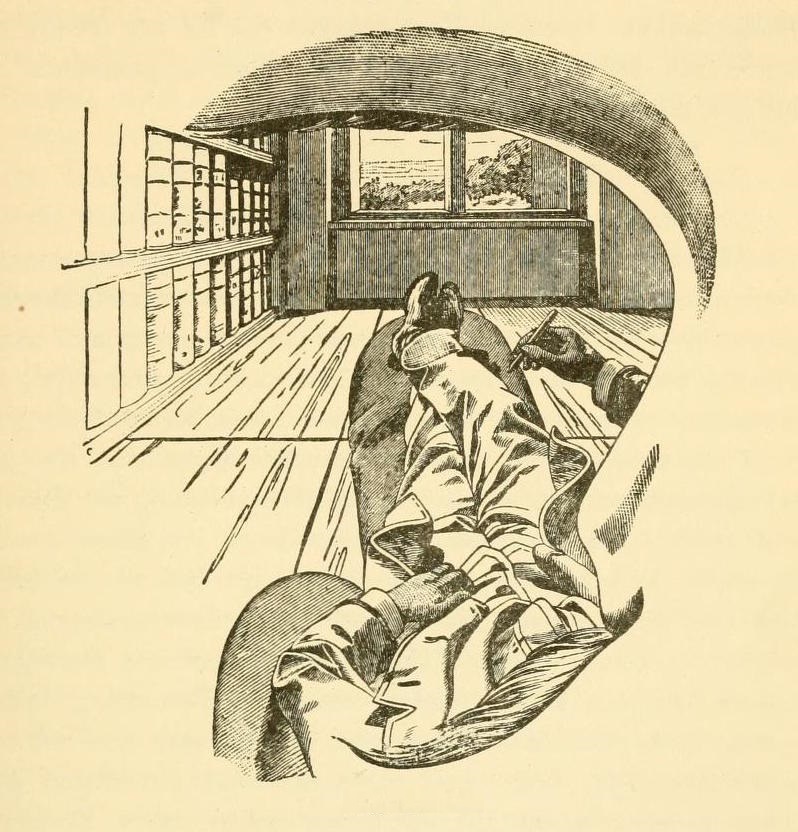
I was introduced to the drawing above through Douglas Harding who wrote the Zen book, “The Headless Way.” The drawing was drawn by Ernst Mach, the 19th Century Austrian physicist. He called the drawing, “the view from the left eye.” What is beautiful about the drawing is that it is sort of a self-portrait. This is the view we all see when we look around (without using a mirror or other reflective surfaces). If we could draw what we see of ourselves, this would be the most accurate picture. This brings me to the point about the different modes of observing.

Right now, you are most likely reading this on a screen of some sort or perhaps you are listening to this as a podcast. You were not paying attention to the phone or computer screen – until I pointed it out to you. You were not paying attention to how your shoes or socks or clothes feel on your body – until I pointed them out to you. This is mostly how we are in the world. We are just being in the world most of the time. Everything that we interact with is invisible to us. They just flow along the affordances we can afford. The keyboard clacks away when we hit on the keys, the door knobs turn when we turn them, etc. We do not see them until we have to see them. The 20th century German philosopher, Martin Heidegger called this ready-to-handedness. Everything is connected to everything else. We interact with the objects in order to achieve something. We open the door to go inside a building to do something else. We get in the car to get to a place. We use a hammer to hammer a nail in order to build something. Heidegger called these things equipment, and he called the interconnectedness, the totality of the equipment. The items are in the background to us. We do not pay attention to them. This is how we generally see the world by simply being in the world.

Now let’s say that the general flow of things breaks down for some reason. We picked up the hammer, and it is heavier than we thought and we pay attention to the hammer. We look at the hammer as a subject looking at an object. We start seeing that it has a red handle and a steel head. The hammer is not ready-to-hand anymore. The hammer has become an object and in the foreground. Heidegger called this as present-at-hand. When we really look at something, we realize that we, the subjects, are looking at something, the object. We no longer have the affordances to interact with it in a nonchalant manner. We have to pay attention in order to engage with the object, if needed.

With this background, I turn to observing again. In my view(no pun intended), there are three modes of observing:

  1. No self – similar to ready-to-hand, you just “are” in the world, enacting in the world. You just see things without any thought to self. There is no distinction of self in what you observe. Perhaps, we can refer to this as the zero person or zero order view.
  2. Seeing self – you make a distinction with this. You draw a line between you the subject, and the world out there. The world is out there and you are separate from the world. This is similar to present-at-hand. The world is out there. This is also the first order in First Order Cybernetics.
  3. Seeing self through self/others – Here you are able to see yourself through self or others. You are able to observe yourself observing. This is the second order in Second Order Cybernetics. In this case, the world is in here, within you, as a constructed stable reality.

In the first mode, you are being in the world. Heidegger would call this as “dasein.” In the second mode, you see the world as being outside. And in the third mode, you see the world as being inside. There are no hierarchies here. Each mode is simply just a mode of observing. In the second and third modes, you become aware of others who are like you in the world. In the third mode, you will also start to see how the others view the world since you are looking through others’ eyes. You realize that just as you construct a world, they too construct a world. Just like you have a perspective, they too have a perspective. The different modes of observing lead to a stable reality for us based on our interpretative framework. We cognize a reality by constructing it based on the stable correlations we infer from our being in the world. Sharing this with others lead to a stable societal realm through our communication with others. A community is formed when we share and something common emerges. It is no accident that the word “community” stems from the root word “common.”

When we observe a system, we also automatically stipulate a purpose for it. Systems are not real-world entities, but a means for the observer to make sense of something. We may call a collection of automobiles on the road as the transportation system just so that we can explain the congestion in the traffic. The same transportation system might be entirely different for the construction worker working on the pavement.

We have to go through the different modes of observation to help further our understanding. Seeing through the eyes of others is a practice for empathy. And this is something that we have to continuously practice to get better at. Empathy requires continuous practice.

I will finish with Ernst Mach’s explanation for his drawing:

Thus, I lie upon my sofa. If I close my right eye, the picture represented in the accompanying cut is presented to my left eye. In a frame formed by the ridge of my eyebrow, by my nose, and by my moustache, appears a part of my body, so far as visible, with its environment. My body differs from other human bodies beyond the fact that every intense motor idea is immediately expressed by a movement of it, and that, if it is touched, more striking changes are determined than if other bodies are touched by the circumstance, that it is only seen piecemeal, and, especially, is seen without a head

It was about 1870 that the idea of this drawing was suggested to me by an amusing chance. A certain Mr L., now long dead, whose many eccentricities were redeemed by his truly amiable character, compelled me to read one of C. F. Krause’s writings, in which the following occurs:

“Problem : To carry out the self-inspection of the Ego.

Solution : It is carried out immediately.”

In order to illustrate in a humorous manner this philosophical “much ado about nothing,” and at the same time to shew how the self-inspection of the Ego could be really “carried out,” I embarked on the above drawing. Mr L.’s society was most instructive and stimulating to me, owing to the naivety with which he gave utterance to philosophical notions that are apt to be carefully passed over in silence or involved in obscurity.

This post is also available as a podcast episode – https://anchor.fm/harish-jose/episodes/View-from-the-Left-Eye–Modes-of-Observing-e1297um

Please maintain social distance and wear masks. Please take vaccination, if able. Stay safe and Always keep on learning…

In case you missed it, my last post was The Stories We Live By:

The Being-Question in Systems Thinking:

In today’s post, I am looking at the Being-question from Martin Heidegger. Heidegger is a philosopher I put off studying mainly because he was a Nazi sympathizer. His ideas are said to be of utmost importance for the twentieth century and he influenced many of the post-modern philosophers such as Sartre, Foucault, Derrida, Rorty etc. Heidegger’s main philosophical work is “Being and Time”.

At that time, the prevalent view about how we view the world was based on the distinction between the subject and the object. The subject, let’s say an observer, is able to stand outside and observe the world. The world is independent of the observer. The observer is able to study the world and using their rational mind to come to meaningful conclusions. This view was made famous by the French philosopher, René Descartes. Descartes emphasized the difference between the subject and the object. The observer themselves are not part of the observation. What is observed (the object) is part of an objective reality that is readily accessible to everyone. From this standpoint, we come to see systems as physical entities of the world that is waiting there to be objectively observed and understood by everyone.

Heidegger wanted to turn this view upside down. He viewed the idea of trying to prove an objective reality as a scandalous activity. He did not deny the subject and the object. However, he viewed the subject as being a part of the world; an embedded being in the world. Heidegger thought that the question of “what exists?” is a useless activity. He realized that the question – “what does it mean to be existing?” was more meaningful.

Michael Gelven, who authored one of the most accessible books on Heidegger notes:

Descartes not only asks whether such a thing as material substance exists, he actually tells us what it means for such a thing to exist: if it takes up space it is a material thing that exists. Heidegger, however, argues there is an even more fundamental question that can be asked: What does it mean to exist at all?  The question is not whether something does exist or how to characterize the existence of particular kinds of things, like material things or mental things, but simply to ask about the very meaning of Being.

To ask what it means to exist or simply to be is to engage in the most fundamental kind of questioning possible. Heidegger calls this die Frage nach den Sinn von Sein, “to question what it means to be,” or simply, “the Being-question.”

Here the word “Being” is capitalized to reflect how it was written by Heidegger and it does not stand for a Supreme Being. The Being is basically us in the world interacting with the world.

Gelven gives a great example to further the idea of the “Being-question”:

Suppose I ask “What is a jail? ” You answer, “The jail is that red-brick building down the street with bars on the windows and locks on the cells. ” In this case, the question is about an entity, and the answer provides one with characteristics that describe or identify the entity. Suppose I ask, “What does it mean to be in jail? ” In response, you say, “To be in jail is to be guilty of a crime and to be punished for it by suffering the loss of liberty. To be in jail thus is to be punished, to feel reprimanded, to suffer, possibly to be afraid, to be lonely, to feel outcast, etc. ” The second question is answered by reference to what it means to exist in various ways, such as being guilty or being unfree. The question What is a jail? is answered by the description of other entities, bars in the windows, locks, unsavory patrons; but the question of the meaning of anything is answered by reference to other meanings. In this we simply recognize there must be a parallel between the kind of question asked and the kind of answers given.

But suppose I press this distinction and ask Which question is prior? A moment’s reflection will assure us that what it means to be in jail is the reason or the ground for the jail being built the way it is. In other words, what it means to be in jail is prior to what kind of thing a jail is, for the meaning determines the entity. If I understand what it means to be in jail, I will know what is required to make a jail. So, in the formal sense of what explains what, meaning precedes entity. The inquiry into what it means to be in jail is not only different from the question about what kind of thing is a jail, it is also prior to it, for the meaning ultimately explains the entity.

The problem with believing that there is an objective reality ready for everyone to access is that we take others for granted and also view them as part of the “objective” reality. We don’t realize that most of what we see and believe are contingent on our past experiences, biases, worldviews etc. These are not necessities. It would be a categorical error to assume that the conditions of contingencies are actually conditions of necessities. An easy way to explain the difference between contingency and necessity is to think of a red triangle. The color “red” is contingent on the direction I gave you. I could have said blue instead of red or any other color for that matter. However, it is necessary that you have three sides to the triangle. You cannot have two sides or four sides for the triangle since then it ceases to be a triangle.

When we assume that systems are physical entities of the world, we fall into the categorical error. We bring in our biases and worldviews and impose them on others. Similar to the jail example above, if we simply ask “what is a hospital and how can we improve the hospital?”, we get answers that go nowhere. If instead, we try to ask the question – “what is it like to be a patient in the hospital?”, and try to see this from another person’s viewpoint, we might be able to make some headway. The world as we see it, is our construction of our being in the world. We are in a social realm, and we cope with the world by being part of it, rather than being apart from it.

Gelven also gives another example:

I ask: What is the mind? This question is the traditional metaphysical one; it asks for classification and identification. I also ask: Do I have a mind that is anything more than the physical brain? Here the question is one of whether something exists. Let us now re-ask this all-important question in terms of Heidegger’s revolution. What kind of question could we ask? What does it mean to think? Notice what happens when we rephrase the question in this way. By asking What does it mean to think? I avoid completely the metaphysical questions of whether something exists or what kind of thing it is. Yet, at the same time, the question probes just as deeply into what I want to know.

How we are in the world depends on our affordances to be in this world. As the great Cybernetician/Enactivist Francesco Varela pointed out – Our cognition is directed toward the world in a certain way: it is directed toward the world as we experience it. For example, we perceive the world to be three/ dimensional, macroscopic, colored, etc.: we do not perceive it as composed of subatomic particles. To this, I will also add Cybernetician Bruce Clarke’s quote- We still have a hard time taking for real that all knowledge of the environment depends upon the specific realities of the systems that observe it. The systemic reality of the environment is to be both the precondition and the product of an observing system.

The next time when someone asks you to improve the system, remember to use the Being-question. I will finish with a quote from Heidegger:

In order to be who we are, we human beings remain committed to and within the being of language, and can never step out of it and look at it from somewhere else. Thus, we always see the nature of language only to the extent to which language itself has us in view, has appropriated us to itself. That we cannot know the nature of language—know it according to the traditional concept of knowledge defined in terms of cognition as representation—is not a defect, however, but rather an advantage by which we are favored with a special realm, that realm where we, who are needed and used to speak language, dwell as mortals.

Please maintain social distance and wear masks. Stay safe and Always keep on learning… In case you missed it, my last post was Round and Round We Go:

Round and Round We Go:

In today’s post, I am looking at a simple idea – Loops, and will follow it up with Heinz von Foerster’s ideas on second order Cybernetics. A famous example of a loop is “PDCA”. The PDCA loop is generally represented as a loop – Plan-Do-Check-Act-Plan-Do…, and the loop is represented as an iterative process where it goes on and on. To me, this is a misnomer and misrepresentation. These should be viewed as recursions. First, I will briefly explain the difference between iteration and recursion. I am using the definitions of Klaus Krippendorff:

Iteration – A process for computing something by repeating a cycle of operations.

Recursion – The attribute of a program or rule which can be applied on its results indefinitely often.

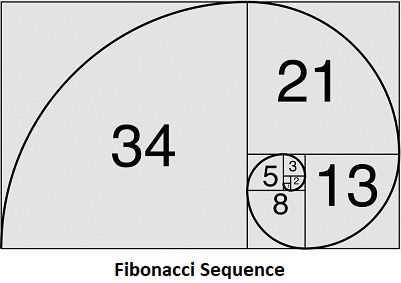
In other words, iteration is simply repetition. In a program, I can say to print the word “Iteration” 5 times. There is no feedback here, other than to keep count of the times the word was printed on screen. On the other hand, in recursion, the value of the first cycle is fed back into the second cycle, the output of which is fed into the third cycle and so on. Here circular feedback is going on. A great example of a recursive function is the Fibonnaci sequence. The Fibonacci sequence is expressed as follows:

Fn = Fn-1 + Fn-2, for n > 1

Fn = 1, for n = 0 or 1

Here, we can see that the previous value is fed into the equation to create a new value, and this is an example of recursion.

From the complexity science standpoint, recursions lead to interesting phenomenon. This is not an iterative non-feedback loop any longer, where you come back to the same point again and again. With recursion, you get to circular causality with each loop, and you enter a new state altogether. Each loop is directly impacted by the previous loop. Anything that leads back to its original starting point doesn’t lead to emergence and can actually lead to a paradox. A great example is the liar paradox. In a version of this, a card has a statement written on both sides of a card. They are as follows:

  1. The statement on the other side of this card is FALSE.
  2. The statement on the other side of this card is TRUE.  

This obviously leads to a paradox when you follow it along a loop. You do not get to a new state with each iteration. Douglas Hofstadter wonderfully explained this as a mirror mirroring itself. However, with recursion, a wonderful emergence can happen, as we see in complexity science. Circular causality and recursion are ideas that have strong footing in Second Order Cybernetics. A great example of this is to look at the question – how do we make sense of the world around us? Heinz von Foerster, the Socrates of Cybernetics, has a lot to say about this. As Bernard Scott notes:

For Heinz von Foerster, the goal of second-order cybernetics is to explain the observer to himself, that is, it is the cybernetics of the cybernetician. The Greek root of cybernetics, kubernetes, means governor or steersman. The questions asked are; who or what steers the steersman, how is the steersman steered and, ethically, how does it behoove the steersman to steer himself? Von Foerster begins his epistemology, in traditional manner, by asking, “How do we know?” The answers he provides-and the further questions he raises-have consequences for the other great question of epistemology, “What may be known?” He reveals the creative, open-ended nature of the observer’s knowledge of himself and his world.

Scott uses von Foerster’s idea of undifferentiated coding to explore this further. I have written about this before here.

Undifferentiated coding is explained as below:

The response of a nerve cell encodes only the magnitude of its perturbation and not the physical nature of the perturbing agent.

Scott continues:

Put more specifically, there is no difference between the type of signal transmitted from eye to brain or from ear to brain. This raises the question of how it is we come to experience a world that is differentiated, that has “qualia”, sights, sounds, smells. The answer is that our experience is the product of a process of computation: encodings or “representations” are interpreted as being meaningful or conveying information in the context of the actions that give rise to them. What differentiates sight from hearing is the proprioceptive information that locates the source of the signal and places it in a particular action context.

Von Foerster explained the circular relationship between sense data and experiences as below:

The motorium (M) provides the interpretation for the sensorium (S) and the sensorium provides the interpretation for the motorium.

How we make sense depends on how we experience, and how we experience depends upon how we make sense. As Scott notes, we can explain the above relationship as follows:

S = F(M). Sensorium, S, is a function of motorium, M.

M = G(S). Motorium, M, is a function of sensorium, S.

Von Foerster pointed out that this is an open recursive loop, since we can replace M with G(S).

S=F(G(S))

With more replacements for the “S”, this equation becomes an open recursive loop as follows:

S=F(G(F(G(F(G(…………G(S)))))……

Scott continues:

Fortunately, the circularity is not vicious, as in the statement “I am a liar”. Rather, it is virtuous or, as von Foerster calls it, it is a creative circle, which allows us to “transcend into another domain”. The indefinite series is a description of processes taking place in sequence, in “time”, with steps t, t+1, t+2 and so on. (I put “time” in quotes as a forward marker for discussion to come). In such indefinite recursive expressions, solutions are those values of the expression which, when entered into the expression as a base, produce themselves. These are known as Eigen values (self-values). Here we have the emergence of stabilities, invariances. The “objects” that we experience are “tokens” for the behaviors that give rise to those experiences. There is an “ultimate” base to these recursions: once upon a “time”, the observer came into being. As von Foerster neatly puts it, “an observer is his own ultimate object”.

The computations that give rise to the experience of a stable world of “objects” are adaptations to constraints on possible behaviors. Whatever else, the organism, qua system, must continue to compute itself, as a product. “Objects” are anything else it may compute (and recompute) as a unitary aspect of experience: things, events, all kinds of abstraction. The possible set of “objects” it may come to know are limited only by the organism’s current anatomy and the culture into which she is born.

I have written about this further here – Consistency over Completeness.

Heinz von Foerster said – The environment contains no information; it is as it is. We are informationally closed entities, which means that information cannot come from outside to inside. We make meanings out of the perturbations and we construct a reality that our interpretative framework can afford.

I will finish with a great observation from the Cybernetist philosopher Yuk Hui:

Recursivity is a general term for looping. This is not mere repetition, but rather more like a spiral, where every loop is different as the process moves generally towards an end, whether a closed one or an open one.

Please maintain social distance and wear masks. Stay safe and Always keep on learning…

In case you missed it, my last post was Observing with Your Hands:

References:

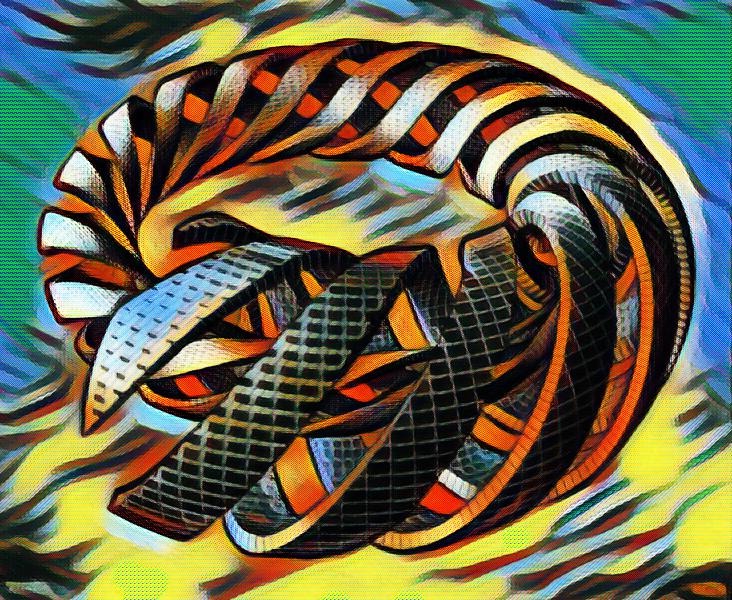
  1. M. C. Escher Spiral
  2. Second Order Cybernetics as Cognitive Methodology. Bernard Scott
  3. A Dictionary of Cybernetics. Klaus Krippendorff

The Extended Form of the Law of Requisite Variety:

This is a follow-up to my last week’s post – Notes on Regulation: In today’s post, I am looking at the Arvid Aulin-Ahmavaara’s extended form of the law of requisite variety (using Francis Heylighen’s version). As I have noted previously, Ross Ashby, the great mind and pioneer of Cybernetics came up with the law of requisite variety (LRV). The law can be stated as only variety can absorb variety. Here variety is the number of possible states available for a system. This is equivalent to statistical entropy. For example, a coin can be shown to have a variety of two – Heads and Tails. Thus, if a user wants a way to randomly choose one of two outcomes, the coin can be used. The user can toss the coin to randomly choose one of two options. However, if the user has 6 choices, they cannot use the coin to randomly choose one of six outcomes efficiently. In this case, a six-sided die can be used. A six-sided die has a variety of six. This is a simple explanation of variety absorbing variety.

The controller can find ways to amplify variety to still meet the external variety thrown upon the system. Let’s take the example of the coin and six choices again. It is possible for the user to toss the coin three times or use three coins, and use the three coin-toss results to make a choice (the variety for three coin-tosses is 8). This is a means to amplify variety in order to acquire requisite variety. From a cybernetics standpoint, the goal of regulation is to ensure that the external disturbances do not reach the essential variables. The essential variables are important for a system’s viability. If we take the example of an animal, some of the essential variables are the blood pressure, body temperature etc. The essential variables must be kept within a specific range to ensure that the animal continues to survive. The external disturbances are denoted by D, the essential variables by E and the actions available to the regulator as A. As noted, variety is expressed as statistical entropy for the variable. As Aulin-Ahmavaara notes – If A is a variable of any kind, the entropy H(A) is a measure of its variety.

With this background, we can note the extended form of the Law of Requisite Variety as:

H(E) ≥ H(D) – H(A) + H(A|D) – B

The H portions of the term represents the statistical entropy for the term. For example, H(E) is the statistical entropy for the essential variables. The larger the value for H, the more the uncertainty around the variable. The goal for the controller is to keep the H(E) as low as possible since a larger value for the entropy for the essential variables indicate a larger range of values for the essential variables. If the essential variables are not kept to a small range of values, the viability of the organism is compromised. We can now look at the other terms of the equation and see how the value for H(E) can be maintained at a lower value.

Heylighen notes:

This means that H(E) should preferably be kept as small as possible. In other words, any deviations from the ideal values must be efficiently suppressed by the control mechanism. The inequality expresses a lower bound for H(E): it cannot be smaller than the sum on the right-hand side. That means that if we want to make H(E) smaller, we must try to make the right-hand side of the inequality smaller. This side consists of four terms, expressing respectively the variety of disturbances H(D), the variety of compensatory actions H(A), the lack of requisite knowledge H(A|D) and the buffering capability B.

As noted, D represents the external disturbances, and H(D) is the variety of disturbances coming in. If H(D) is large, then it also increases the value generally for H(E). Thus, an organism in a complex environment is more likely to face some adversities that might drive the essential variables outside the safe range. For example, you are less likely to die while sitting in your armchair than while trekking through the Amazonian rain forest or wandering through the concrete jungle of a megacity. A good rule of thumb for survivability would be to avoid environments that have a larger variety for disturbances.

The term H(A) represents the variety of actions available to counter the disturbances. The more variety you have for your actions, the more likely you are able to counteract the disturbances. At least one of them will be able to solve the problem, escape the danger, or restore you to a safe, healthy state. Thus, the Amazonian jungle may not be so dangerous for an explorer having a gun to shoot dangerous animals, medicines to treat disease or snakebite, filters to purify water, and the physical condition to run fast or climb in trees if threatened. The term H(A) enters the inequality with a minus (–) sign, because a wider range of actions allows you to maintain a smaller range of deviations in the essential variables H(E).

The term H(A|D) represents a conditional state. It is also called the lack of requisite knowledge. It has a plus sign since it indicates a “lack”. It is not enough that you have a wide range of actions, you have to know which action will be effective. If you have minimal knowledge, then your best strategy is to try out each action at random, and this is highly inefficient and ineffective if time is not on your side. For example, there is little use in having a variety of antidotes for different types of snakebites if you do not know which snake bit you. H(A|D) expresses your uncertainty about performing an action A (e.g., taking a particular antidote) for a given disturbance D (e.g., being bitten by a particular snake). The larger your uncertainty, the larger the probability that you would choose a wrong action, and thus fail to reduce the deviation H(E). Therefore, this term has a “+” sign in the inequality: more uncertainty (= less knowledge) produces more potentially lethal variation in your essential variables.

The final term B stands for buffering (passive regulation). It expresses your amount of protective reserves or buffering capacity. Better even than applying the right antidote after a snake bite is to wear protective clothing thick enough to stop any snake poison from entering your blood stream. The term is negative because higher capacity means less deviation in the essential variables.

The law of requisite variety expresses in an abstract form what is needed for an organism to prevent or repair the damage caused by disturbances. If this regulation is insufficient, damage will accumulate, including damage to the regulation mechanisms themselves. This produces an acceleration in the accumulation of damage, because more damage implies less prevention or repair of further damage, and therefore a higher rate of additional damage.

The optimal formation for the Law of Requisite Variety occurs when the minimum value for H(E) is achieved, and when there is no lack of requisite knowledge. The essence of regulation is that disturbances happen all the time, but that their effects are neutralized before they have irreparably damaged the organism. This optimal result of regulation is represented as:

H(E)min = H(D) – H(A) – B

I encourage the reader to check out my previous posts on the LRV.

Getting Out of the Dark Room – Staying Curious:

Notes on Regulation:

Storytelling at the Gemba:

Exploring The Ashby Space:

Please maintain social distance and wear masks. Stay safe and Always keep on learning…

In case you missed it, my last post was Notes on Regulation:

References:

[1] Cybernetic Principles of Aging and Rejuvenation: the buffering-challenging strategy for life extension – Francis Heylighen

[2] The Law of Requisite Hierarchy – A. Y. Aulin-Ahmavaara

Getting Out of the Dark Room – Staying Curious:

In today’s post I am looking at the importance of staying curious in the light of Karl Friston’s “Free Energy Principle” (FEP) and Ross Ashby’s ideas on indirect regulation. I have discussed Free Energy Principle here. The FEP basically states that in order to resist the natural tendency to disorder, adaptive agents must minimize surprise.

Karl Friston, the brilliant mind behind FEP noted:

the whole point of the free-energy principle is to unify all adaptive autopoietic and self-organizing behavior under one simple imperative; avoid surprises and you will last longer.

Avoiding surprises means that one has to model and anticipate a changing and itinerant world. This implies that the models used to quantify surprise must themselves embody itinerant wandering through sensory states (because they have been selected by exposure to an inconstant world): Under the free-energy principle, the agent will become an optimal (if approximate) model of its environment. This is because, mathematically, surprise is also the negative log-evidence for the model entailed by the agent. This means minimizing surprise maximizes the evidence for the agent (model). Put simply, the agent becomes a model of the environment in which it is immersed. This is exactly consistent with the Good Regulator theorem of Conant and Ashby (1970). This theorem, which is central to cybernetics, states that “every Good Regulator of a system must be a model of that system.” .. Like adaptive fitness, the free-energy formulation is not a mechanism or magic recipe for life; it is just a characterization of biological systems that exist. In fact, adaptive fitness and (negative) free energy are considered by some to be the same thing.

This idea of the agent having a model of its environment is quite important in Cybernetics. In fact, the idea of FEP can be traced back to Ashby’s ideas on Cybernetics. For an organism to survive, it needs to keep certain internal variables such as blood pressure, internal temperature etc. in a certain range. Ashby called these as essential variables, depicted by “E”. Ashby noted that the goal of regulation is to keep these essential variables in range, in the light of disturbances coming from the environment. In other words, the goal of regulation is to minimize the effect of disturbances coming in. A perfect regulation will result in no disturbances reaching the essential variables. The organism will be completely ignorant of what is going on outside in this case. When the regulation succeeds, we say that the regulator has requisite variety. It is able to counter the variety coming in from the environment. Ashby called this “the law of Requisite Variety”, and explained it succinctly as “only variety can absorb variety.” Ashby explained the direct and indirect regulation as follows:

Direct and indirect regulation occur as follows. Suppose an essential variable X has to be kept between limits x’ and x”. Whatever acts directly on X to keep it within the limits is regulating directly. It may happen, however, that there is a mechanism M available that affects X, and that will act as a regulator to keep X within the limits x’ and x” provided that a certain parameter P (parameter to M) is kept within the limits p’ and p”. If, now, any selective agent acts on P so as to keep it between p’ and p”, the end result, after M has acted, will be that X is kept between x’ and x”.

Now, in general, the quantities of regulation required to keep P in p’ and p” and to keep X in x’ to x” are independent. The law of requisite variety does not link them. Thus, it may happen that a small amount of regulation supplied to P may result in a much larger amount of regulation being shown by X.

When the regulation is direct, the amount of regulation that can be shown by X is absolutely limited to what can be supplied to it (by the law of requisite variety); when it is indirect, however, more regulation may be shown by X than is supplied to P. Indirect regulation thus permits the possibility of amplifying the amount of regulation; hence its importance.

Ashby explained the direct and indirect regulation with the following example:

Living organisms came across this possibility eons ago, for the gene-pattern is a channel of communication from parent to offspring: ‘Grow a pair of eyes,’ it says, ‘ they’ll probably come in useful; and better put hemoglobin into your veins — carbon monoxide is rare and oxygen common.’ As a channel of communication, it has a definite, finite capacity, Q say. If this capacity is used directly, then, by the law of requisite variety, the amount of regulation that the organism can use as defense against the environment cannot exceed Q. To this limit, the non-learning organisms must conform. If, however, the regulation is done indirectly, then the quantity Q, used appropriately, may enable the organism to achieve, against its environment, an amount of regulation much greater than Q. Thus, the learning organisms are no longer restricted by the limit.

A lower cognitive capacity organism may be able to survive with just relying on its gene-pattern, while a higher cognitive capacity organism has to supplement the basic gene-patterns with a learning behavior. In order to do this, it has to learn from its environment. Ashby continued:

In the same way the gene-pattern, when it determines the growth of a learning animal, expends part of its resources in forming a brain that is adapted not only by details in the gene-pattern but also by details in the environment… dictionary. While the hunting wasp, as it attacks its prey, is guided in detail by its genetic inheritance, the kitten is taught how to catch mice by the mice themselves. Thus, in the learning organism the information that comes to it by the gene-pattern is much supplemented by information supplied by the environment; so, the total adaptation possible, after learning, can exceed the quantity transmitted directly through the gene-pattern.

It is important to note that the environment does not input information into the organism. Instead, the organism perceives the environment through its action on the environment. The environment also acts on the organism, just like the organism acts on the environment. Perception is possible only through this circular causal cycle. As Ashby noted, the gene pattern for learning allows for the organism to model its environment, and this allows for the indirect regulation. Ashby explains this point further:

This is the learning mechanism. Its peculiarity is that the gene-pattern delegates part of its control over the organism to the environment. Thus, it does not specify in detail how a kitten shall catch a mouse, but provides a learning mechanism and a tendency to play, so that it is the mouse which teaches the kitten the finer points of how to catch mice. This is regulation, or adaptation, by the indirect method. The gene-pattern does not, as it were, dictate, but puts the kitten into the way of being able to form its own adaptation, guided in detail by the environment.

The Dark Room:

At this point, we can look at the idea of the dark room. This is a thought experiment in FEP. We can try to explain this also using Ashby’s ideas. If the goal of the regulator is to minimize the impact of disturbances on the essential variables, one strategy is to then go to an environment with minimum disturbances. In FEP, this thought experiment is explained similarly as – if the goal of the agent is to minimize surprise, why wouldn’t the agent find a dark room and stay in it indefinitely?

A recurrent puzzle raised by critics of these models (FEP) is that biological systems do not seem to avoid surprises. We do not simply seek a dark, unchanging chamber, and stay there. This is the “Dark-Room Problem.” 

Karl Friston offers an answer to this question:

Technically, the resolution of the Dark-Room Problem rests on the fact that average surprise or entropy H(s|m) is a function of sensations and the agent (model) predicting them. Conversely, the entropy H(s) minimized in dark rooms is only a function of sensory information. The distinction is crucial and reflects the fact that surprise only exists in relation to model-based expectations. The free-energy principle says that we harvest sensory signals that we can predict (cf., emulation theory; Grush, 2004); ensuring we keep to well-trodden paths in the space of all the physical and physiological variables that underwrite our existence. In this sense, every organism (from viruses to vegans) can be regarded as a model of its econiche, which has been optimized to predict and sample from that econiche. Interestingly, free energy is used explicitly for model optimization in statistics (e.g., Yedidia et al., 2005) using exactly the same principles.

This means that a dark room will afford low levels of surprise if, and only if, the agent has been optimized by evolution (or neurodevelopment) to predict and inhabit it. Agents that predict rich stimulating environments will find the “dark room” surprising and will leave at the earliest opportunity. This would be a bit like arriving at the football match and finding the ground empty. Although the ambient sensory signals will have low entropy in the absence of any expectations (model), you will be surprised until you find a rational explanation or a new model (like turning up a day early). Notice that average surprise depends on, and only on, sensations and the model used to explain them. This means an agent can compare the surprise under different models and select the best model; thereby eluding any “circular explanation” for the sensations at hand.

We are born with a gene pattern that allows for learning. The basic pattern is to learn, and our survival mainly comes from this. We are able to get out of the dark room because of this. We are born curious and this allows us to keep on learning. We have an inner ability to keep looking for answers and not be satisfied with status quo.

I am sure there is an important lesson for us all here with the idea of the dark room and the indirect regulation. I could simply say – stay curious and keep on learning. Or I can have you come to that conclusion on your own. As famous Spanish philosopher, José Ortega y Gasset noted – He who wants to teach a truth should place us in the position to discover it ourselves.

I will finish with a great lesson from Ashby to explain the idea of the indirect regulation:

If a child wanted to discover the meanings of English words, and his father had only ten minutes available for instruction, the father would have two possible modes of action. One is to use the ten minutes in telling the child the meanings of as many words as can be described in that time. Clearly there is a limit to the number of words that can be so explained. This is the direct method. The indirect method is for the father to spend the ten minutes showing the child how to use a dictionary. At the end of the ten minutes the child is, in one sense, no better off; for not a single word has been added to his vocabulary. Nevertheless, the second method has a fundamental advantage; for in the future the number of words that the child can understand is no longer bounded by the limit imposed by the ten minutes. The reason is that if the information about meanings has to come through the father directly, it is limited to ten-minutes’ worth; in the indirect method the information comes partly through the father and partly through another channel (the dictionary) that the father’s ten-minute act has made available.

Please maintain social distance and wear masks. Stay safe and Always keep on learning…

In case you missed it, my last post was The Cybernetics of Ohno’s Production System:

The Cybernetics of a Society:

In today’s post, I will be following the thoughts from my previous post, Consistency over Completeness. We were looking at each one of us being informationally closed, and computing a stable reality. The stability comes from the recursive computations of what is being observed. I hope to expand the idea of stability from an individual to a society in today’s post.

Humberto Maturana, the cybernetician biologist (or biologist cybernetician) said – anything said is said by an observer. Heinz von Foerster, one of my heroes in cybernetics, expanded this and said – everything said is said to an observer. Von Foerster’s thinking was that language is not monologic but always dialogic. He noted:

The observer as a strange singularity in the universe does not attract me… I am fascinated by images of duality, by binary metaphors like dance and dialogue where only a duality creates a unity. Therefore, the statement.. – “Anything said is said by an observer” – is floating freely, in a sense. It exists in a vacuum as long as it Is not embedded in a social structure because speaking is meaningless, and dialogue is impossible, if no one is listening. So, I have added a corollary to that theorem, which I named with all due modesty Heinz von Foerster’s Corollary Nr. 1: “Everything said is said to an observer.” Language is not monologic but always dialogic. Whenever I say or describe something, I am after all not doing it for myself but to make someone else know and understand what I am thinking of intending to do.

Heinz von Foerster’s great insight was perhaps inspired by the works of his distant relative and the brilliant philosopher, Ludwig Wittgenstein. Wittgenstein proposed that language is a very public matter, and that a private language is not possible. The meaning of a word, such as “apple” does not inherently come from the word “apple”. The meaning of the word comes from how it is used. The meaning comes from repeat usage of the word in a public setting. Thus, even though the experience of an apple may be private to the individual, how we can describe it is by using a public language. Von Foerster continues:

When other observers are involved… we get a triad consisting of the observers, the languages, and the relations constituting a social unit. The addition produces the nucleus and the core structure of society, which consists of two people using language. Due to the recursive nature of their interactions, stabilities arise, they generate observers and their worlds, who recursively create other stable worlds through interacting in language. Therefore, we can call a funny experience apple because other people also call it apple. Nobody knows, however, whether the green color of the apple you perceive, is the same experience as the one I am referring to with the word green. In other words, observers, languages, and societies are constituted through recursive linguistic interaction, although it is impossible to say which of these components came first and which were last – remember the comparable case of hen, egg and cock – we need all three in order to have all three.

Klaus Krippendorff defined closure as follows – A system is closed if it provides its own explanation and no references to an input are required. With closures, recursions are a good and perhaps the only way to interact. As organizationally closed entities, we are able to stay viable only as part of a social realm. When we are part of a social realm, we have to construct reality with reference to an external reference. Understanding is still generated internally, but with an external point of reference. This adds to the reality of the social realm as a collective. If the society has to have an identity that is sustained over time, its viability must come from its members. Like a set of nested dolls, society’s structure comes from participating individuals who themselves are embedded recursively in the societal realm. The structure of the societal or social realm is not designed, but emergent from the interactions, desires, goals etc. of the individuals. The society is able to live on while the individuals come and go.

I am part of someone else’s environment, and I add to the variety of their environment with my decisions and actions (sometimes inactions). This is an important reminder for us to hold onto in light of recent world events including a devastating pandemic. I will finish with some wise words from Heinz von Foerster:

A human being is a human being together with another human being; this is what a human being is. I exist through another “I”, I see myself through the eyes of the Other, and I shall not tolerate that this relationship is destroyed by the idea of the objective knowledge of an independent reality, which tears us apart and makes the Other as object which is distinct from me. This world of ideas has nothing to do with proof, it is a world one must experience, see, or simply be. When one suddenly experiences this sort of communality, one begins to dance together, one senses the next common step and one’s movements fuse with those of the other into one and the same person, into a being that can see with four eyes. Reality becomes communality and community. When the partners are in harmony, twoness flows like oneness, and the distinction between leading and being led has become meaningless.

Please maintain social distance and wear masks. Stay safe and Always keep on learning…

In case you missed it, my last post was Consistency over Completeness:

Source – The Certainty of Uncertainty: Dialogues Introducing Constructivism By Bernhard Poerksen

Consistency over Completeness:

Today’s post is almost a follow-up to my earlier post – The Truth about True Models. In that post, I talked about Dr. Donald Hoffman’s idea of Fitness-Beats-Truth or FBT Theorem. Loosely put, the idea behind the FBT Theorem is that we have evolved to not have “true” perceptions of reality. We survived because we had “fitness” based models and because we did not have “true models”. In today’s post, I am continuing on this idea using the ideas from Heinz von Foerster, one of my Cybernetics heroes.

Heinz von Foerster came up with “the postulate of epistemic homeostasis”. This postulate states:

The nervous system as a whole is organized in such a way (organizes itself in such a way) that it computes a stable reality.

It is important to note here that, we are speaking about computing “a” reality and not “the” reality. Our nervous system is informationally closed (to follow up from the previous post). This means that we do not have direct access to the reality outside. All we have is what we can perceive through our perception framework. The famous philosopher, Immanuel Kant, referred to this as the noumena (the reality that we don’t have direct access to) and the phenomena (the perceived representation of the external reality). All we can do is to compute a reality based on our interpretive framework. This is just a version of the reality, and each one of us computes such a reality that is unique to each one of us.

The other concept to make note of is the “stable” part of the stable reality. In Godelian* speak, our nervous system cares more about consistency than completeness. When we encounter a phenomenon, our nervous system looks at stable correlations from the past and present, and computes a sensation that confirms the perceived representation of the phenomenon. Von Foerster gives the example of a table. We can see the table, and we can touch it, and maybe bang on it. With each of these confirmations and correlations between the different sensory inputs, the table becomes more and more a “table” to us.

*Kurt Godel, one of the famous logicians of last century came up with the idea that any formal system able to do elementary arithmetic cannot be both complete and consistent; it is either incomplete or inconsistent.

From the cybernetics standpoint, we are talking about an observer and the observed. The interaction between the observer and the observed is an act of computing a reality. The first step to computing a reality is making distinctions. If there are no distinctions, everything about the observed will be uniform, and no information can be processed by the observer. Thus, the first step is to make distinctions. The distinctions refer to the variety of the observed. The more distinctions there are, the more variety the observed has. From a second order cybernetics standpoint, the variety of the observed depends upon of the variety of the observer. This goes back to the unique stable reality computation point from earlier. Each one of us are unique in how we perceive things. This is our variety as the observer. The observed, that which is external to us, always has more potential variety than us. We cut down or attenuate this high variety by choosing certain attributes that interests us. Once the distinctions are made, we find relations between these distinctions to make sense of it all. This corresponds to the confirmations and correlations that we noted above in the example of a table.

We are able to survive in our environment because we are able to continuously compute a stable reality. The stability comes from the recursive computations of what is being observed. For example, lets go back to the example of the table. Our eyes receive the sensory input of the image of the table. This is a first set of computation. This sensory image then goes up the “neurochain”, where it is computed again. This happens again and again as the input gets “decoded” at each level, until it gets satisfactorily decoded by our nervous system. The final result is a computation of a computation of a computation of a computation and so on. The stability is achieved from this recursion.

The idea of a consistency over completeness is quite fascinating. This is mainly due to the limitation of our nervous system to have a true representation of the reality. There is a common belief that we live with uncertainty, but our nervous system strives to provide us a stable version of reality, one that is devoid of uncertainties. This is a fascinating idea. We are able to think about this only from a second order standpoint. We are able to ponder about our cognitive blind spots because we are able to do second order cybernetics. We are able to think about thinking. We are able to put ourselves into the observed. Second order cybernetics is the study of observing systems where the observer themselves are part of the observed system.

I will leave the reader with a final thoughtthe act of observing oneself is also a computation of “a” stable reality.

Please maintain social distance and wear masks. Stay safe and Always keep on learning…

In case you missed it, my last post was Wittgenstein and Autopoiesis:

When is a Model Not a Model?

Ross Ashby, one of the pioneers of Cybernetics, started an essay with the following question:

I would like to start not at: How can we make a model?, but at the even more primitive question: Why make a model at all?

He came up with the following answer:

I would like then to start from the basic fact that every model of a real system is in one sense second-rate. Nothing can exceed, or even equal, the truth and accuracy of the real system itself. Every model is inferior, a distortion, a lie. Why then do we bother with models? Ultimately, I propose. we make models for their convenience.

To go further on this idea, we make models to come up with a way to describe “how things work?” This is done for us to also answer the question – what happens when… If there is no predictive or explanatory power, there is no use for the model. From a cybernetics standpoint, we are not interested in the “What is this thing?”, but the “What does this thing do?” We never try to completely understand a “system”. We understand it in chunks, the chunks that we are interested in. We construct a model in our heads that we call a “system” to make sense of how we think things work out in the world. We only care about certain specific interactions and its outcomes.

One of the main ideas that Ashby proposed was the idea of variety. Loosely put, variety is the number of available states a system has. For example, a switch has a variety of two – ON or OFF. A stop light has a variety of three (generally) – Red, Yellow or Green. As we increase the complexity, the variety also increases. The variety is dependent on the ability of the observer to discern them. A keen-eyed observer can discern a higher number of states for a phenomenon than another observer. Take the example of the great fictional characters, Sherlock Holmes and John Watson. Holmes is able to discern more variety than Watson, when they come upon a stranger. Holmes is able to tell the most amazing details about the stranger that Watson cannot. When we construct a model, the model lacks the original variety of the phenomenon we are modeling. This is important to keep in mind. The external variety is always much larger than the internal variety of the observer. The observer simply lacks the ability to tackle the extremely high amount of variety. To address this, the observer removes or attenuates the unwanted variety of the phenomenon and constructs a simpler model. For example, when we talk about a healthcare system, the model in our mind is pretty simple. One hospital, some doctors and patients etc. It does not include the millions of patients, the computer system, the cafeteria, the janitorial service etc. We only look at the variables that we are interested in.

Ashby explained this very well:

Another common aim that will have to be given up is that of attempting to “understand” the complex system; for if “understanding” a system means having available a model that is isomorphic with it, perhaps in one’s head, then when the complexity of the system exceeds the finite capacity of the scientist, the scientist can no longer understand the system—not in the sense in which he understands, say, the plumbing of his house, or some of the simple models that used to be described in elementary economics.

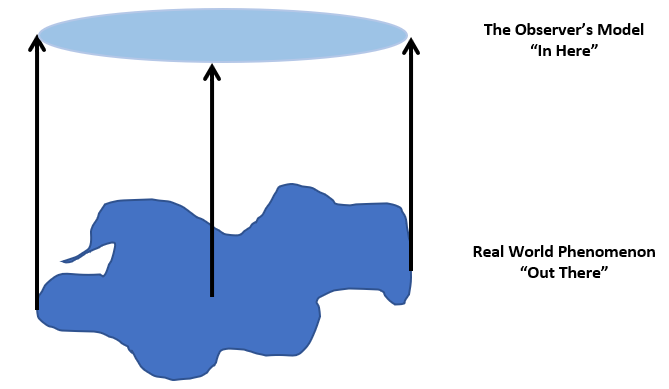
A crude depiction of model-making is shown below. The observer has chosen certain variables that are of interest, and created a similar “looking” version as the model.

Ashby elaborated on this idea as:

We transfer from system to model to lose information. When the quantity of information is small, we usually try to conserve it; but when faced with the excessively large quantities so readily offered by complex systems, we have to learn how to be skillful in shedding it. Here, of course, model-makes are only following in the footsteps of the statisticians, who developed their techniques precisely to make comprehensible the vast quantities of information that might be provided by, say, a national census. “The object of statistical methods, said R. A. Fisher, “is the reduction of data.”

There is an important saying from Alfred Korzybski – the map is not the territory. His point was that we should take the map to be the real thing. An important corollary to this, as a model-maker is:

If the model is the same as the phenomenon it models, it fails to serve its purpose. 

The usefulness of the model is in it being an abstraction. This is mainly due to the observer not being able to handle the excess variety thrown at them. This also answers one part of the question posed in the title of this post – A model ceases to be a model when it is the same as the phenomenon it models. The second part of the answer is that the model has to have some similarities to the phenomenon, and this is entirely dependent on the observer and what they want.

This brings me to the next important point – We can only manage models. We don’t manage the actual phenomenon; we only manage the models of the phenomenon in our heads. The reason being again that we lack the ability to manage the variety thrown at us.

The eminent management cybernetician, Stafford Beer, has the following words of wisdom for us:

Instead of trying to specify it in full detail, you specify it only somewhat. You then ride on the dynamics of the system in the direction you want to go.

To paraphrase Ashby, we need not collect more information than is necessary for the job. We do not need to attempt to trace the whole chain of causes and effects in all its richness, but attempt only to relate controllable causes with ultimate effects.

The final aspect of model-making is to take into consideration the temporary nature of the model. Again, paraphrasing Ashby – We should not assume the system to be absolutely unchanging. We should accept frankly that our models are valid merely until such time as they become obsolete.

Final Words:

We need a model of the phenomenon to manage the phenomenon. And how we model the phenomenon depends upon our ability as the observer to manage variety. We only need to choose certain specific variables that we want. Perhaps, I can explain this further with the deep philosophical question – If a tree falls in a forest and no one is around to hear it, does it make a sound? The answer to a cybernetician should be obvious at this point. Whether there is sound or not depends on the model you have, and if you have any value in the tree falling having a sound.

Please maintain social distance and wear masks. Stay safe and Always keep on learning…

In case you missed it, my last post was The Maximum Entropy Principle: