The Ghost in the System:

In today’s post, I am looking at the idea of ‘category mistake’ by the eminent British philosopher Gilbert Ryle. Ryle was an ardent opponent of Rene Descartes’ view of mind-body dualism. Ryle also came up with the phrase ‘the ghost in the machine’ to mock the idea of dualism. Cartesian dualism is the idea that mind and body are two separate entities. Descartes was perhaps influenced by his religious beliefs. Our bodies are physical entities that will wither away when we die. But our minds, Descartes concluded are immaterial and can “live on” after we die. Descartes noted:

There is a great difference between mind and body, inasmuch as body is by nature always divisible, and the mind is entirely indivisible… the mind or soul of man is entirely different from the body.

Ryle called this idea the official doctrine:

The official doctrine, which hails chiefly from Descartes, is something like this. With the doubtful exceptions of idiots and infants in arms every human being has both a body and a mind. Some would prefer to say that every human being is both a body and a mind. His body and his mind are ordinarily harnessed together, but after the death of the body his mind may continue to exist and function.

Ryle referred to the idea of Cartesian dualism as the dogma of the ghost in the machine – the physical body being the machine, and the mind being the ghost. Ryle pointed out that Descartes was engaging in a category mistake by saying that mind and body are separate things. A category mistake happens when we operate with an idea as if it belongs to a particular category. Loosely put, it is like comparing apples to oranges, or even better, comparing apples to hammers. The two items do not belong to the same category and hence, a comparison between the two is a futile and incorrect attempt. The mind is not separate from the body. In fact, the two are interconnected and influence each other in a profound manner. Ryle talked about the idea of dualism as the absurdity of the official doctrine:

I shall often speak of it, with deliberate abusiveness, as ‘the dogma of the Ghost in the Machine’. I hope to prove that it is entirely false, and false not in detail but in principle. It is not merely an assemblage of particular mistakes. It is one big mistake and a mistake of a special kind. It is, namely, a category-mistake. It represents the facts of mental life as if they belonged to one logical type or category (or range of types or categories), when they actually belong to another. The dogma is therefore a philosopher’s myth.

Ryle explained the category mistake with some examples. One of the examples was that of a foreigner visiting Oxford or Cambridge:

A foreigner visiting Oxford or Cambridge for the first time is shown a number of colleges, libraries, playing fields, museums, scientific departments and administrative offices. He then asks ‘But where is the University? I have seen where the members of the Colleges live, where the Registrar works, where the scientists experiment and the rest. But I have not yet seen the University in which reside and work the members of your ‘University’. It has then to be explained to him that the University is not another collateral institution, some ulterior counterpart to the colleges, laboratories and offices which he has seen. The University is just the way in which all that he has already seen is organized. When they are seen and when their co-ordination is understood, the University has been seen. His mistake lay in his innocent assumption that it was correct to speak of Christ Church, the Bodleian Library, the Ashmolean Museum and the University, to speak, that is, as if ‘the University’ stood for an extra member of the class of which these other units are members. He was mistakenly allocating the University to the same category as that to which the other institutions belong.

The foreigner committed the category mistake by assuming that the university is a material entity just like different buildings he saw. He could not understand that the university is a collective whole made up of the different buildings, the students, the staff etc. I will discuss one more example that Ryle gave:

The same mistake would be made by a child witnessing the march-past of a division, who, having had pointed out to him such and such battalions, batteries, squadrons, etc., asked when the division was going to appear. He would be supposing that a division was a counterpart to the units already seen, partly similar to them and partly unlike them. He would be shown his mistake by being told that in watching the battalions, batteries and squadrons marching past he had been watching the division marching past. The march-past was not a parade of battalions, batteries, squadrons and a division; it was a parade of the battalions, batteries and squadrons of a division.

Similar to the foreigner, the child was looking for a separate entity called “the division”. He could not understand that the division is what he is seeing. It was not a parade of battalions, batteries, squadrons and a division; it was a parade of the battalions, batteries and squadrons of a division.

Ryle also gave another example of a visitor who was getting an explanation of the game of Cricket. He saw and understood the different players in the field such as the batsman, the bowler, the fielder etc. After he looked at each one of the players, he asked who is in charge of the team spirit. “But there is no one left on the field to contribute the famous element of team-spirit. I see who does the bowling, the batting and the wicket-keeping; but I do not see whose role it is to exercise esprit de corps.” Ryles explained:

Once more, it would have to be explained that he was looking for the wrong type of thing. Team-spirit is not another cricketing-operation supplementary to all of the other special tasks. It is, roughly, the keenness with which each of the special tasks is performed, and performing a task keenly is not performing two tasks. Certainly exhibiting team-spirit is not the same thing as bowling or catching, but nor is it a third thing such that we can say that the bowler first bowls and then exhibits team-spirit or that a fielder is at a given moment either catching or displaying esprit de corps.

The reader would have noticed that I titled the post – The Ghost in the System. I am alluding to the category mistakes we make in systems thinking. Most often we commit the category mistake of assuming that the system is a standalone objective entity. This is an ontological error. We talk of a hospital system or a transportation system as if it is a physical entity that is visible for everyone to see and understand. We talk about optimizing the system or changing the system as if it is a machine that we can repair by changing out a faulty part with another. In actuality, the system we refer to is a mental construct of how we imagine the different chosen components interact with each other producing specific outcomes we are interested. When we talk of the issues haunting the hospital system, we might be meaning the long waits we have to endure, or the expensive tests that we had to go through. Each one of us construct a version of a “system” and yet we use the same term “system” to talk about different aspects. It is a category mistake to assume that we know what the others are saying. Coming back to the example of the hospital system, when we speak of a hospital system, we point to the hospital buildings, the equipment in the hospitals, the waiting rooms, the doctors, the staff, or the patients. But that is not a hospital system, not really because a system is mental construct that is entirely dependent on who is doing the observing. The observer has a specific thing in mind when they use that word. It is a category mistake to assume that you know what was said. The artifacts are not the system. 

Ryle viewed category mistakes occurring due to problems in vocabulary. He wrote:

These illustrations of category-mistakes have a common feature which must be noticed. The mistakes were made by people who did not know how to wield the concepts University, division and team-spirit. Their puzzles arose from inability to use certain items in the English vocabulary.

Wittgenstein famously wrote – The limits of language are the limits of my world. Our use of language limits what we can know or tell about the world. To go further with this idea, I am looking at the idea of systems from West Churchman’s viewpoint. Churchman advised us that a systems approach begins when first you see the world through the eyes of another. We live in a social realm and by social realm, I mean that we live in a world where “reality” is co-constructed with the other inhabitants of the realm. We define and redefine reality on an ongoing basis through continual interactions with the other cocreators. We should have a model or an image of what we are trying to manage. But if social realm is cocreated, we need to be aware of others in the realm and treat it as a cocreation rather than an objective reality that we have access to. Systems do not have an objective existence. Each one of us view and construct systems from our viewpoint. Thus, how we define a system is entirely dependent on us, the observers. What we have to do is to seek understanding before we rush in to change or optimize a system. The first step is to be aware of the others in the realm. The next step is to seek understanding and see how each one of them views the world. We have to better our vocabulary so that we can speak their language.

There is no ghost in the machine. There is only the machine.

I will finish with a wonderful reflexive nugget from Ryle:

In searching for the self, one cannot be the hunter and the hunted.

Please maintain social distance and wear masks. Please take vaccination, if able. Stay safe and Always keep on learning…

In case you missed it, my last post was The Cybernetics of Complexity:

This post is also available as a podcast – https://anchor.fm/harish-jose/episodes/The-Ghost-in-the-System-e169men

Observations on Observing, The Case Continues:

Art by Audrey Jose

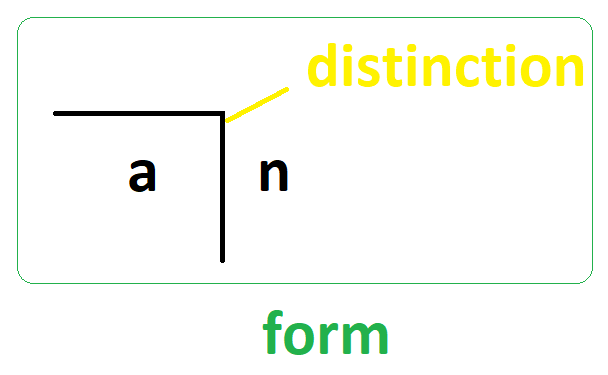
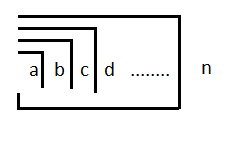
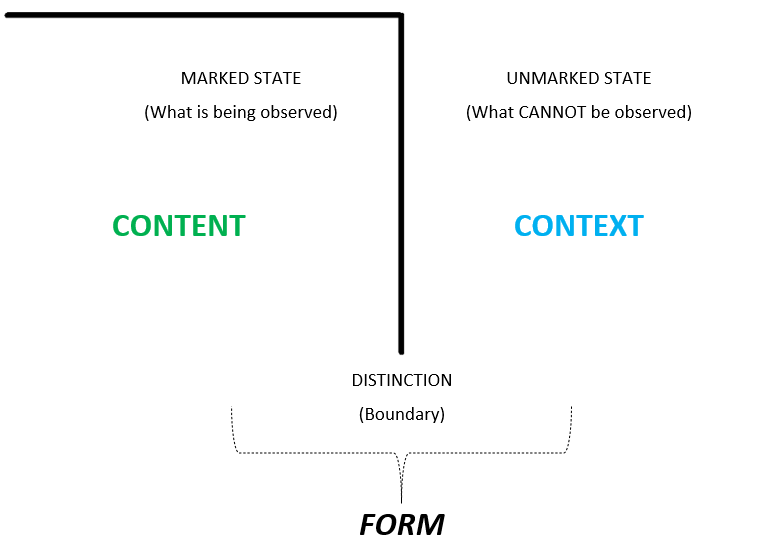
In today’s post, I am continuing from the last post, mainly using the ideas of Dirk Baecker. We noted that every observation is an operation of distinction, where an observer crosses a line, entering a marked state. This is shown in the schematic below. Here “a” refers to the marked state that the observer is interested in. The solid corner of a square is the distinction that was used by the observer, and “n” refers to the unmarked state. The entire schematic with the two sides and the three values (“a”, “n” and the distinction) are notated as a “form”. The first order observer is observing only the marked state “a”, and is not aware of or paying attention to the distinction(s) utilized. They are also not aware of the unmarked state “n”. When a second order observer enters the picture, they are able to see the entire form including the distinction employed by the first order observer.  

However, it is important to note that the observation made by the second order observer is also a first order observation. This means that they also have a distinction and an unmarked state, another “n” that they are not aware of. Baecker explains this:

We have to bring in second-order observers in order to introduce consciousness or self-observation. Yet to be able to operate at all, these second-order observers must also be first-order observers… Second-order observers intervene as first-order observers, thereby presenting their own distinction to further second-order observation.

We also discussed the idea of “reentry” in our last post. Reentry is a means to provide closure so that the first order and second order observations taken together leads to a stable meaning.

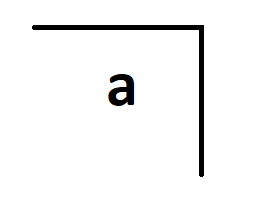
So, to recap, the first order observer is interested in “a”.

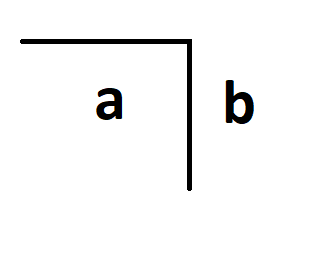
The second order observer observes the first order observer, and understands that the first order observer made a distinction. They see where the first order observer is coming from, and the context of their observation. Let’s call the context as “b”. This will be the unmarked state for the first observer.

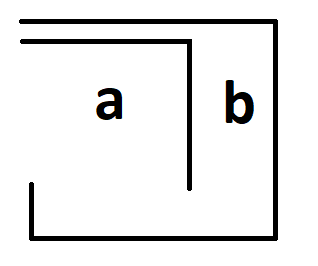
The second order observer engages with the first order observer in an ongoing back and forth discussion. The second order observer is able to combine both their “dealing with the world” approaches and come together to a nuanced understanding. This understanding is an effect of distinguishing “a” from “b”, and also combining “a” and “b” – an action of implication and negation taken together. This is an operation of sensemaking in the medium of meaning. This is depicted as the reentry in the schematic below.

Baecker explains reentry further:

Any operation that is able to look at both sides of the distinction – that is, at its form – is defined by Spencer Brown as an operation of reentry. It consists of reentering the distinction into the distinction, thereby splitting the same distinction into one being crossed and the same one being marked by another distinction that is deferred. The general idea of the reentry is to note and use the fact that distinctions occur in two versions: the distinction actually used, and the distinction looked at or reflected on.

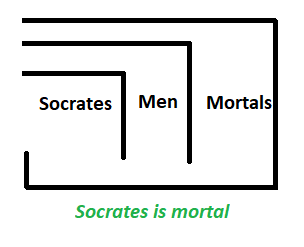
Let’s look further at the form by using a famous syllogism from philosophy to further enhance our understanding:

All Men are Mortals;

Socrates is a man;

Therefore, Socrates is a mortal.

 This can be depicted as a form as shown below:

By distinguishing Socrates from Men, and Men from Mortals, and by putting it all together, we get to “Socrates is Mortal”. In this case, we did not have to do a lot of work to come to the final conclusion. However, as the complexity increases, we will need to perform reentry on an ongoing basis to bring forth a stable meaning. Reentry introduces temporality to the sensemaking operation. No matter how many distinctions we employ, we can only get to a second order observation. All observations are in all actuality first order observations. And what is being distinguished is also dependent entirely on the observer.

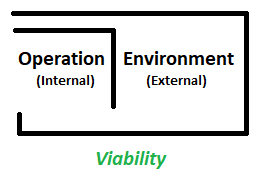
I will also look at another example. A manager is required to maintain the operations of a plant while at the same time they need to make modifications to the operations to ensure that the plant can stay viable in an everchanging environment. In other words, the operations are maintained as consistent as possible until it needs to be changed. This can be depicted as shown below:

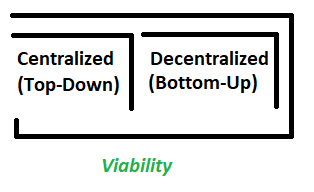
Another way to look at this is to view a plant as needing centralized structure as well as decentralized structure or top-down and bottom-up structure. This can be depicted as shown below. Here the two states are not shown as nested, but adjacent to each other.

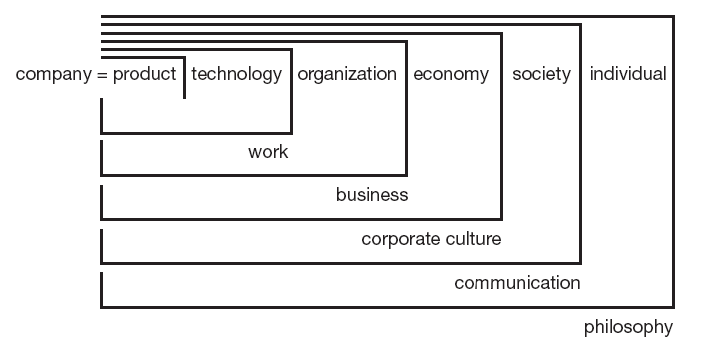
Dirk Baecker saw a firm as follows:

Baecker notes that the product is the first distinction that we have to make. Our first distinction is the distinction of the product. Whatever else the firm may be doing, it has to recursively draw the distinction of which product it is to produce. This may be a material or immaterial, a tangible or intangible, an easy or difficult to define product, but it has to be a product that tells employees, managers and clients alike just what the firm is about. He continues- The technology is part of the form of the first distinction. Indeed, it is the outside or the first context of the first distinction, as observed by a second-order observer who may be the first-order observer observing him/herself. This means that a firm distinguishes only those products for which it has, or hopes to acquire, the necessary technology. Technology here means all kinds of ways of making sure that we can do what we want to do. This includes material access to resources, knowledge of procedures, technologies, availability of people to do the job and ways to convince society that you are doing what you are doing in the proper way.

Baecker explains “work” as follows:

We add the assumption of communication between first-order observers who at the same time act as second-order observers. The firm observes itself. By working, it relates products to technology and technology back to products.

Additional information can be found on Dirk Baecker’s The Form of the Firm.

In all that we have seen so far, we have not yet talked about the unmarked state. The unmarked state “n” is always present in the form and is not accessible to the observer. The observation can have as many distinctions as needed, dependent on the observer. The “n” represents everything that can be further added to the distinctions to improve our “meaning” as needed. The more distinctions there are, the more complex the observations. The observers deal with the complexity of the phenomena to be understood by applying as many or as few distinctions as needed.

We are able to better help with someone else’s problems because we can engage in second order observations. As second order observers, we can see the distinctions they made which are not accessible to them in the first order observation. The second order observer is able to understand the distinctions that the first order observer was able to make. The distinctions lay in the blind spots for the first order observer. The second order observation can be completed by the first order observer themselves as an operation of self-reflection. As cognitive beings, we must reproduce existing patterns by continually engaging with the external world, our local environment. We have to keep evaluating and adjusting these patterns on an ongoing self-correcting basis.

The basic structure of what we have discussed so far can be depicted as the following form:

We need to be mindful that there is always “n” that is not part of our observation. We may gain a better understanding of our distinctions if we engage in second order observation, but we will still not be able to access the unmarked state. We will not be able to access the unmarked state unless we create a new distinction in the unmarked state cutting “n” to a marked state and an unmarked state, yielding a new “n”. Second-order observation, noting one’s own distinctions, can lay the groundwork for epistemic humility.

This brings into question – how many distinctions are really needed? We will answer this with going to the first distinction we made. The first cross that we started with leading to the first distinction is the most important thing that we care about. Every other distinction is based on this first one. To answer – how many distinctions are really needed? – we need as many distinctions as needed until we are fully satisfied with our understanding. This includes understanding our blind spots and the distinctions we have made.

I will finish with a Peter Drucker story from Baecker. Peter Drucker was working with a hospital to improve their Emergency Room. Baecker noted that it took the hospital staff two days to come up with the first distinction, their “a”. Their “a” was to bring immediate relief to the afflicted. The afflicted needing relief may not always be the patient. In Drucker’s words:

Many years ago, I sat down with the administrators of a major hospital to think through the mission statement of the emergency room. It took us a long time to come up with the very simple, and (most people thought) too obvious statement that the emergency room was there to give assurance to the afflicted.

To do that well, you have to know what really goes on. And, much to the surprise of the physicians and nurses, it turned out that in a good emergency room, the function is to tell eight out of ten people there is nothing wrong that a good night’s sleep won’t take care of. You’ve been shaken up. Or the baby has the flu. All right, it’s got convulsions, but there is nothing seriously wrong with the child. The doctors and nurses give assurance.

We worked it out, but it sounded awfully obvious. Yet translating that mission statement into action meant that everybody who comes in is now seen by a qualified person in less than a minute. That is the mission; that is the goal. The rest is implementation.

Some people are immediately rushed to intensive care, others get a lot of tests, and yet others are told: “Go back home, go to sleep, take an aspirin, and don’t worry. If these things persist, see a physician tomorrow.” But the first objective is to see everybody, almost immediately — because that is the only way to give assurance.

This post is also available as a podcast – https://anchor.fm/harish-jose/episodes/Observations-on-Observing–The-Case-Continues-e15kpc1

Please maintain social distance and wear masks. Please take vaccination, if able. Stay safe and Always keep on learning…

In case you missed it, my last post was The Case of the Distinguished Observer:

The Case of the Distinguished Observer:

In today’s post, I am looking at observation. This will be a general overview and I will follow up with more posts in the future. I am inspired by the ideas of George Spencer-Brown (GSB), Niklas Luhman, Dirk Baecker and Heinz von Foerster. In Cybernetics, observation does not mean just to utilize your eyes and look at something. It has a deeper “sensemaking” type meaning. Observation in Cybernetics does not follow the rigid subject-object relationship. Toth Benedek explains this:

Heinz von Foerster tried to develop a point of view that replaces the linear and rigid structure of the object-subject (observer-observed) distinction. According to von Foerster, the observer is really constructed by the observed and vice versa: ‘observation’ is nothing else but the circular relation between them. Observation as a relation defines the observer and the observed, so the observer refers not only to the observed, but also to himself by the act of observation.

Observation is an operation of distinction. The role of an observer is to generate information. If no information is being generated, then no observation has been made. An observation is an act of cognition. GSB in his seminal work, Laws of Form noted:

A universe comes into being when a space is severed or taken apart. The skin of a living organism cuts off an outside from an inside. So does the circumference of a circle in the plane. By tracing the way we represent such a severance, we can begin to reconstruct, with an accuracy and coverage that appear almost uncanny, the basic forms underlying linguistic, mathematical, physical, and biological science, and can begin to see how the familiar laws of our own experience follow inexorably from the original act of severance.

GSB advises us to draw a distinction. He proposed a notation called as “mark” to do this. A basic explanation of a mark is shown below. It separates a space into two sections; one part that is observed and the other that is not observed. We can look at a space, and identify a difference, a distinction that allows us to identify a part of the space as something and the remaining of that space as NOT that something. For example, we can distinguish a part of a house as kitchen and everything else is “not kitchen”. At that point in time, we are looking only at the kitchen, and ignoring or not paying attention to anything else. What is being observed is in relation to what is not being observed. A kitchen is identified as “kitchen” only in the context of the remaining of the house.

Dirk Baecker explains this:

Spencer-Brown’s first propositions about his calculus is the distinction being drawn itself, considered to be “perfect continence”, that is to contain everything. A distinction can only contain everything when one assumes that it indeed contains (a) its two sides, that is the marked state and the unmarked state, (b) the operation of the distinction, that is the separation of the two sides by marking one of them, and (c) the space in which all this occurs and which is brought forth by this occurrence.

From the context of GSB, we can view a distinction as a first order observation. We can only see what is inside the box, and not what is outside the box. What is outside the box is our “blind spot.”

Hans-Georg Moeller explains this very well:

A first-order observation can simply observe something and, on the basis of this, establish that thing’s factuality: I see that this book is black—thus the book is black. Second-order observation observes how the eye of an observer constructs the color of this book as black. Thus, the simple “is” of the expression “the book is black” becomes more complex—it is not black in itself but as seen by the eyes of its observer. The ontological simplicity is lost and the notion of “being” becomes more complex. What is lost is the certainty about the “essential” color of this book.

The first order observer is confident about the observation he makes. He may view his observation as necessary and not contingent. However, a second order observer is able to also see what the first order observer is not. The second order observer is able to understand to an extent how the first order observer is making his distinctions. The second order observer thus comes to the conclusion that the distinction made by the first order observer is in fact contingent and somewhat arbitrary.

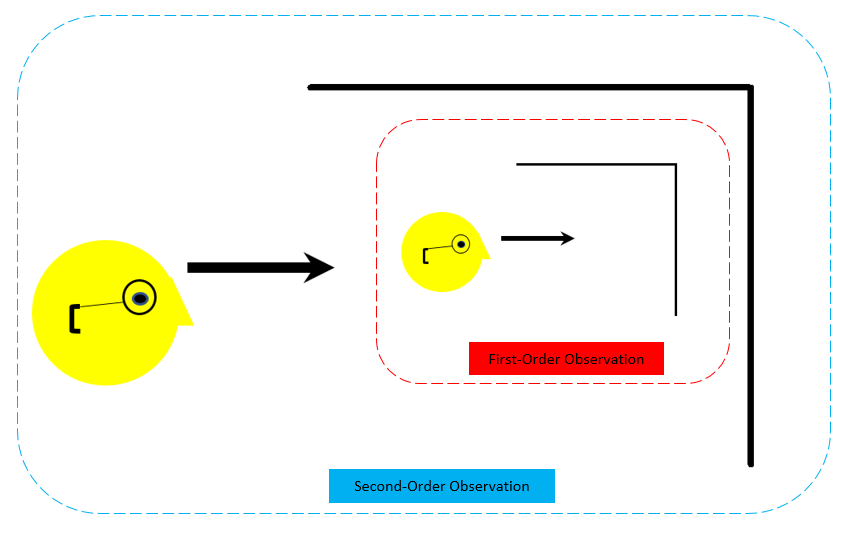
The most important point about the first order observation is that the first order observer cannot see that he does not see what he does not see. In other words, the first order observer is unaware that he has a blind spot. A second order observer observing a first order observer is able to see what the first order observer is not able to see, and he is also able to see that the first order observer has a blind spot. This is depicted in the schematic below:

As the schematic depicts, the second order observer is also making a distinction. In other words, what he is doing is also a first order observation! This means that the second order observer also has a blind spot, and he not aware that he has a blind spot! As Benedek further notes:

the first order of observation (our eye’s direct observation) is unable to get a coherent and complete image about the world out there. What we can see is something we learnt to see: the image we “see” is a result of computing processes.

The second order observation can also be carried out as a self-observation, where the observer doing the first order observation is also the observer doing the second order observation. This may appear paradoxical. GSB talked about an idea called “reentry” in Laws of Form. Reentry is the idea of reentering the form again. In other words, we are re-introducing the distinction we used onto the form again. The reentry is depicted in the schematic below:

Dirk Baecker explains:

Spencer-Brown’s calculus of form consists in developing arithmetic with distinctions from a first instruction—”draw a distinction”—to the re-introduction (“re-entry”) of the distinction into the form of distinction, in order to be able to show in this way that the apparently simple, but actually already complex beginning involved in making a distinction can only take place in a space in which the distinction is for its part introduced again. The observer who makes this distinction through it becomes aware of the distinction, to which he is himself indebted.

Self-observation requires a reentry. In order to become aware that we have cognitive blind spots, we have to perform reentry. The re-entry includes what was not part of the original distinction. This allows us to understand (to a point) how we make and utilize distinctions. To paraphrase Heinz von Foerster, we come to see when we realize that we cannot see.

The reentry is a continuous operation that is self-correcting in nature. There is no end point to this per-se and it oscillates between the inside and the outside. This leads to an emergent stability as an eigenform. As noted before, the second order observation is still a form of first order observation even with reentry. There are still cognitive blind spots and we are still subject our biases and limitations of our interpretative framework. We are affected by what we observe and we can only observe what our interpretative framework can afford. As noted at the start of the post, the role of the observer is to generate information. If the observer is not able to make a distinction, then no information can be generated. This has the same effect as us being in a closed system where the entropy keeps on increasing. Borrowing a phrase from Stafford Beer, this means that observers are negentropic pumps. We engage in making dynamic distinctions which allows us to gather the requisite information/knowledge to remain viable in an everchanging environment.

The discussion about first order and second order observations may bring up the question – is it possible to have a third order observation? Heinz von Foerster pointed out that there is no need for a third order observation. He noted that a reflection of a reflection is still a reflection. Hans-Georg Moeller explains this further:

While second-order observation arrives at more complex notions of reality or being, it still only observes—it is a second-order observation, because it observes as a first-order observation another first-order observation. It is, so to speak, the result of two simultaneous first-order observations. A third-order observation cannot transcend this pattern—for it is still the first-order observation of a first-order observation of a first-order observation… No higher-order observation—not even a third-order observation—can observe more “essentially” than a lower-order observation. A third-order observation is still an observation of an observation and thus nothing more than a second-order observation. There is no Platonic climb towards higher and higher realities—no observation brings us closer to the single light of truth.

I will finish with some wise words from Dirk Baecker:

Draw a distinction.

Watch its form.

Work its unrest.

Know your ignorance.

Please maintain social distance and wear masks. Please take vaccination, if able. Stay safe and Always keep on learning… In case you missed it, my last post was The Cybernetics of Magic and the Magic of Cybernetics:

The Cybernetics of Magic and the Magic of Cybernetics:

In today’s post, I am looking at magic and cybernetics. From a young age, I have been a fan of magic. I have talked about magic here before. I see magic as the art of paradoxes.  The word paradox stems from the Greek words – “para” and “dokein”, and taken together it means contrary to expectation.

Take for example a simple magic trick where the magician shows you an open empty hand. The magician closes the hand, and does a gentle wiggle and then opens his hand to reveal a coin. He again closes his hands, and does another gentle wiggle and then opens the hand to show that his hand is empty. The magic happens from a self-referential operation. The spectator (or the observer) sees an empty hand and describes it to themselves as an empty hand. Later, when the magician shows their hand again, the hand now contains a coin. The spectator has to reference back to the previous state of empty hand, and face the moment of paradox. The hand that was empty now has a coin. The moment of magic comes only when the spectator can reference back to the empty hand. If we denote the empty hand as A, the value of the hand now is !A or in other words, not an empty hand. If the spectator cannot reference back to their original observation, they will not see the magic. From the magician’s standpoint, he should take care to make sure that this experience is as strong as possible. For example, he should take care to maintain the image of the hand with and without the coin, the same. This means that the position of the fingers, the gap between them, the gesture etc. are all maintained the same for the two states – one where the hand has no coin, and the second where the hand has a coin. This reinforces the “magic” for the spectator.

The idea of self-reference is of great importance in cybernetics. In logic, the idea of self-reference is shunned because it normally leads to paradoxes. A great example for a paradox is the liar paradox. One of the oldest forms of liar paradox is the statement that Epimenides, the Cretan made. He said that, “all Cretans are liars.” Since he himself was a Cretan, that would mean that he is also a liar, but that would mean that what he is saying is true, which means that he must be a liar… and so on. This goes into a paradox from the self-reference. There have been many solutions suggested for this conundrum. One of the ways to resolve any apparent paradox is to introduce temporality into this sentence. We can do this by making the statement slightly ambiguous and add the word “sometimes”. So, the sentence becomes, “all Cretans are liars sometimes.” The temporality suggests that the value for the statement and the person uttering the statement changes with time and this dissolves the paradox.

Paradoxes don’t exist in the “real world.” The reasonable conclusion is that they have something to do with our stubborn and rigid thinking. When we are unwilling to add temporality or ambiguity, we get stuck with our thinking. Another way to look at this is from a programmer’s standpoint. The statement a = a + 1, is valid from a computer program standpoint. Here the variable, “a” does not stand for a constant value. It is a placeholder for a value at a given point in time. Thus, although the equation a = a +1 is self-referential, it does not crash the computer because we introduce temporality to it, and we do not see “a” having one unique value at all times.

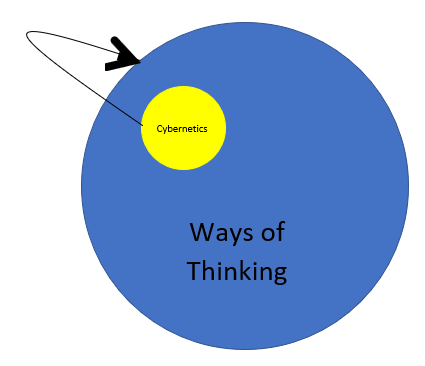
In Cybernetics, self-reference is accepted as a normal operation. Cyberneticians talk about second order concepts such as “understanding understanding” and “observing observing”. One of my favorite description of Cybernetics comes from Larry Richards. He describes cybernetics as a way of thinking about ways of thinking (of which it – cybernetics – is one). This is form of self-reference.

In Cybernetics, self-reference does not lead to paradox. Instead, it leads to a stable outcome. As cognizing agents, we build a stable reality based on self-reference. We can do activities such as thinking about thinking or learning about learning from this approach. Louis Kauffman talks about this:

Heinz von Foerster in his essays has suggested the enticing notion that “objects are tokens for eigen behaviors.” … The short form of this meaning is that there is a behavior between the perceiver and the object perceived and a stability or repetition that “arises between them.” It is this stability that constitutes the object (and the perceiver). In this view, one does not really have any separate objects, objects are always “objects perceived,” and the perceiver and the perceived arise together in the condition of observation.

We identify the world in terms of how we shape it. We shape the world in response to how it changes us. We change the world and the world changes us. Objects arise as tokens of behavior that leads to seemingly unchanging forms. Forms are seen to be unchanging through their invariance under our attempts to change, to shape them.

My post was inspired by the ideas of Spencer-Brown, Francisco Varela and Heinz von Foerster. I will finish with another gem from Heinz von Foerster:

I am the observed relation between myself and observing myself.

This post is also available as a podcast here – https://anchor.fm/harish-jose/episodes/The-Cybernetics-of-Magic-and-the-Magic-of-Cybernetics-e14a257

Please maintain social distance and wear masks. Please take vaccination, if able. Stay safe and Always keep on learning… In case you missed it, my last post was TPS’s Operation Paradox:

Note: The point of a = a+ 1, was made also by Elena Esposito (Kalkul der Form).

View from the Left Eye – Modes of Observing:

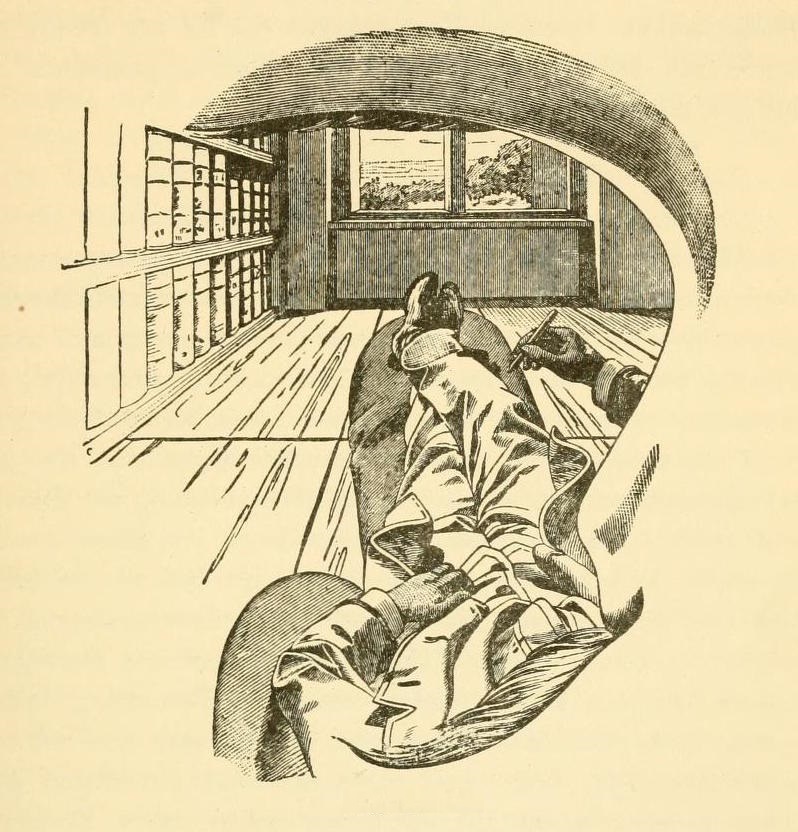
I was introduced to the drawing above through Douglas Harding who wrote the Zen book, “The Headless Way.” The drawing was drawn by Ernst Mach, the 19th Century Austrian physicist. He called the drawing, “the view from the left eye.” What is beautiful about the drawing is that it is sort of a self-portrait. This is the view we all see when we look around (without using a mirror or other reflective surfaces). If we could draw what we see of ourselves, this would be the most accurate picture. This brings me to the point about the different modes of observing.

Right now, you are most likely reading this on a screen of some sort or perhaps you are listening to this as a podcast. You were not paying attention to the phone or computer screen – until I pointed it out to you. You were not paying attention to how your shoes or socks or clothes feel on your body – until I pointed them out to you. This is mostly how we are in the world. We are just being in the world most of the time. Everything that we interact with is invisible to us. They just flow along the affordances we can afford. The keyboard clacks away when we hit on the keys, the door knobs turn when we turn them, etc. We do not see them until we have to see them. The 20th century German philosopher, Martin Heidegger called this ready-to-handedness. Everything is connected to everything else. We interact with the objects in order to achieve something. We open the door to go inside a building to do something else. We get in the car to get to a place. We use a hammer to hammer a nail in order to build something. Heidegger called these things equipment, and he called the interconnectedness, the totality of the equipment. The items are in the background to us. We do not pay attention to them. This is how we generally see the world by simply being in the world.

Now let’s say that the general flow of things breaks down for some reason. We picked up the hammer, and it is heavier than we thought and we pay attention to the hammer. We look at the hammer as a subject looking at an object. We start seeing that it has a red handle and a steel head. The hammer is not ready-to-hand anymore. The hammer has become an object and in the foreground. Heidegger called this as present-at-hand. When we really look at something, we realize that we, the subjects, are looking at something, the object. We no longer have the affordances to interact with it in a nonchalant manner. We have to pay attention in order to engage with the object, if needed.

With this background, I turn to observing again. In my view(no pun intended), there are three modes of observing:

  1. No self – similar to ready-to-hand, you just “are” in the world, enacting in the world. You just see things without any thought to self. There is no distinction of self in what you observe. Perhaps, we can refer to this as the zero person or zero order view.
  2. Seeing self – you make a distinction with this. You draw a line between you the subject, and the world out there. The world is out there and you are separate from the world. This is similar to present-at-hand. The world is out there. This is also the first order in First Order Cybernetics.
  3. Seeing self through self/others – Here you are able to see yourself through self or others. You are able to observe yourself observing. This is the second order in Second Order Cybernetics. In this case, the world is in here, within you, as a constructed stable reality.

In the first mode, you are being in the world. Heidegger would call this as “dasein.” In the second mode, you see the world as being outside. And in the third mode, you see the world as being inside. There are no hierarchies here. Each mode is simply just a mode of observing. In the second and third modes, you become aware of others who are like you in the world. In the third mode, you will also start to see how the others view the world since you are looking through others’ eyes. You realize that just as you construct a world, they too construct a world. Just like you have a perspective, they too have a perspective. The different modes of observing lead to a stable reality for us based on our interpretative framework. We cognize a reality by constructing it based on the stable correlations we infer from our being in the world. Sharing this with others lead to a stable societal realm through our communication with others. A community is formed when we share and something common emerges. It is no accident that the word “community” stems from the root word “common.”

When we observe a system, we also automatically stipulate a purpose for it. Systems are not real-world entities, but a means for the observer to make sense of something. We may call a collection of automobiles on the road as the transportation system just so that we can explain the congestion in the traffic. The same transportation system might be entirely different for the construction worker working on the pavement.

We have to go through the different modes of observation to help further our understanding. Seeing through the eyes of others is a practice for empathy. And this is something that we have to continuously practice to get better at. Empathy requires continuous practice.

I will finish with Ernst Mach’s explanation for his drawing:

Thus, I lie upon my sofa. If I close my right eye, the picture represented in the accompanying cut is presented to my left eye. In a frame formed by the ridge of my eyebrow, by my nose, and by my moustache, appears a part of my body, so far as visible, with its environment. My body differs from other human bodies beyond the fact that every intense motor idea is immediately expressed by a movement of it, and that, if it is touched, more striking changes are determined than if other bodies are touched by the circumstance, that it is only seen piecemeal, and, especially, is seen without a head

It was about 1870 that the idea of this drawing was suggested to me by an amusing chance. A certain Mr L., now long dead, whose many eccentricities were redeemed by his truly amiable character, compelled me to read one of C. F. Krause’s writings, in which the following occurs:

“Problem : To carry out the self-inspection of the Ego.

Solution : It is carried out immediately.”

In order to illustrate in a humorous manner this philosophical “much ado about nothing,” and at the same time to shew how the self-inspection of the Ego could be really “carried out,” I embarked on the above drawing. Mr L.’s society was most instructive and stimulating to me, owing to the naivety with which he gave utterance to philosophical notions that are apt to be carefully passed over in silence or involved in obscurity.

This post is also available as a podcast episode – https://anchor.fm/harish-jose/episodes/View-from-the-Left-Eye–Modes-of-Observing-e1297um

Please maintain social distance and wear masks. Please take vaccination, if able. Stay safe and Always keep on learning…

In case you missed it, my last post was The Stories We Live By:

Hermeneutics in Systems Thinking:

In today’s post, I am carrying on some of the ideas from Heidegger. See the last post for more details. I have written about Hermeneutics before here.  Heidegger was a student of the great German philosopher, Edmund Husserl. Husserl pioneered the school of phenomenology. Phenomenology is the study of how things appear to us experientially. The objects we experience are the phenomena. As Susan Laverty notes:

Phenomenology is essentially the study of lived experience or the life world (van Manen, 1997). Its emphasis is on the world as lived by a person, not the world or reality as something separate from the person (Valle et al., 1989). This inquiry asks “What is this experience like?” as it attempts to unfold meanings as they are lived in everyday existence. Polkinghorne (1983) identified this focus as trying to understand or comprehend meanings of human experience as it is lived. The ‘life world’ is understood as what we experience pre-reflectively, without resorting to categorization or conceptualization, and quite often includes what is taken for granted or those things that are common sense (Husserl, 1970). The study of these phenomena intends to return and re-examine these taken for granted experiences and perhaps uncover new and/or forgotten meanings.

Husserl taught that to understand things around us, we have to go back to the things themselves. He gave a detailed methodology to make phenomenology happen. He wanted a structured approach just like in science or mathematics. Husserl believed that how we experience things can be affected by our biases about things. So, he proposed that we “bracket” our presuppositions, biases etc. and approach the thing at hand. This suspension of our presuppositions is a phenomenological reduction. It is said that Husserl would spend days with his class analyzing a trivial object such as a mailbox. His version of phenomenology was free of social, cultural and historical “grasps” on the object. The object was a standalone entity waiting to be experienced, and through this experience an understanding of the entity was possible. He suggested with his method, we are able to come to a descriptive presentation of the phenomena.

Heidegger, as Husserl’s student was very taken by the idea of phenomenology. However, Heidegger realized that we cannot be separated from our presuppositions. We can understand existence only through our existing; the way we are. Heidegger realized that the experience of a phenomenon is a personal activity, and therefore we may come up with multiple descriptions of the phenomenon. Most importantly, the process of coming up with a description is an interpretive process. We make sense of the phenomenon as an interpretive process. Heidegger’s version of phenomenology is thus termed as “hermeneutic phenomenology”, whereas Husserl’s version is termed as “transcendental phenomenology”. Heidegger realized that the knowledge we achieve at any point in time is incomplete, and is contingent on our existence at that point in time. Our relationship to the phenomenon is affected by who we are, where we are, when we are and how we are experiencing the phenomenon.

A key point in hermeneutics is the hermeneutic circle. This circle is actually a recursion. Hermeneutics is generally associated with interpreting a text. Generally, when we start to read a part of the text, we get an idea of what the whole of the text stands for. As we get more into the text, we get a better understanding of the part, which helps with a better understanding of the whole text, and so on. This can be viewed as a recursive function. The uniqueness of our worldview comes from the recursive nature of our experiential living. We keep updating our worldview based on the current worldview which is impacted by our past worldview. And round and round we go.

Heidegger’s view that we cannot assume freedom from our presuppositions is an important thing to keep in mind in Systems Thinking. This reaffirms the idea that we are not able to experience a singularly objective reality. Reality is multidimensional, and have many variations contingent on many social factors. The circularity of hermeneutics is explained well by M. N. Babu:

The most important consequence of the circularity of understanding for hermeneutics that there is no pure starting point for understanding because every act of understanding takes place within a finite historically conditioned horizon, within an already understood frame of reference. It is no longer a question of how we are to enter the hermeneutical circle, because human consciousness is always already in it. We understand only by constant reference to what we have already understood, namely, our past and anticipated experience. The experiencing and reflecting subject is never a tabula rasa upon which the understanding of raw experience inscribes its objective character, rather, all experience and reflection are the result of a confrontation between one’s pre-understanding or even prejudice and new or perhaps strange objects. The inevitable presence of pre-understanding or prejudice is not necessarily the distortion of the meaning of an object by an arbitrary subject, rather, it is the very condition for any understanding of all. Heidegger, however, contends that presuppositions are the very condition for any reception of the object whatsoever. His notions of the ontological character of understanding and the primordial connection of subject and object in their pre- understanding and the primordial connection of subject and object in their pre-reflective relational whole provides the foundation for this contention. For him, all interpretation is a derivative form of a prior understanding, in which the prior relationship between subject and object is brought to explication.

How does one proceed when we realize that we cannot be free of our presuppositions? Heidegger advises that we need to get into the circle in the right way. Hans-Georg Gadamer provides clarity on this. As Jean Grondin notes:

Gadamer takes up Heidegger’s suggestion that the important thing is to get into the circle in the right way, but for him this mainly means that the “prejudiced” nature of our understanding should be recognized as that which makes understanding possible in the first place. This is what he calls the “ontological” and positive aspect of the hermeneutical circle. He emphasizes the ontological nature of the circle to fight against the false ideal of a presupposition‐less type of knowledge which would have been imposed upon the humanities by the objectivity requirement of exact science. His aim in highlighting the hermeneutical circle is to liberate the humanities from this alienating model. But does this mean that all presuppositions, prejudices, and anticipations are valid? Obviously not, since this would call into question the very idea of truth, which a book entitled Truth and Method surely wants to defend. Gadamer does maintain the distinction between adequate and inadequate anticipations. According to his best account of this key critical difference, it is through temporal distance and the work of history that we are able to make this distinction.

The most important thing in the process of making sense of a phenomenon is to understand the context. If the context is not understood, we fall into the trap of relativism. Relativism is the idea that all views are equally valid. A better nuanced version of this is pluralism. Pluralism is the idea that there are multiple views of a phenomenon that are different but equally valid. The difference between pluralism and relativism is in understanding the context. As we have been discussing, this understanding requires hermeneutical phenomenology. When we are aware that our understanding is always incomplete and imperfect, we are more open to going through the self-correcting hermeneutic cycle. We are open to challenge what we think we know, and we welcome scrutiny of our ideas. We put our assumptions open for all to see. Rather than being stuck with the realization that our views are imperfect and incomplete, we learn to cope with the world.

The great Systems Thinker, C. West Churchman said that the systems approach begins when first you see the world through the eyes of another.

We can only know things in terms of things we already know. From this standpoint, when we are looking at a new phenomenon, we have to look at it in terms of things we already know. If we are looking at a social “system”, then we have to always start from things that are common. The basis of all that is common in a social realm is the humanity in us all, and that is a good place to start. This is my takeaway from Churchman’s advice.

Please maintain social distance and wear masks. Please take vaccination, if able. Stay safe and Always keep on learning…

In case you missed it, my last post was The Being-Question in Systems Thinking:

The Being-Question in Systems Thinking:

In today’s post, I am looking at the Being-question from Martin Heidegger. Heidegger is a philosopher I put off studying mainly because he was a Nazi sympathizer. His ideas are said to be of utmost importance for the twentieth century and he influenced many of the post-modern philosophers such as Sartre, Foucault, Derrida, Rorty etc. Heidegger’s main philosophical work is “Being and Time”.

At that time, the prevalent view about how we view the world was based on the distinction between the subject and the object. The subject, let’s say an observer, is able to stand outside and observe the world. The world is independent of the observer. The observer is able to study the world and using their rational mind to come to meaningful conclusions. This view was made famous by the French philosopher, René Descartes. Descartes emphasized the difference between the subject and the object. The observer themselves are not part of the observation. What is observed (the object) is part of an objective reality that is readily accessible to everyone. From this standpoint, we come to see systems as physical entities of the world that is waiting there to be objectively observed and understood by everyone.

Heidegger wanted to turn this view upside down. He viewed the idea of trying to prove an objective reality as a scandalous activity. He did not deny the subject and the object. However, he viewed the subject as being a part of the world; an embedded being in the world. Heidegger thought that the question of “what exists?” is a useless activity. He realized that the question – “what does it mean to be existing?” was more meaningful.

Michael Gelven, who authored one of the most accessible books on Heidegger notes:

Descartes not only asks whether such a thing as material substance exists, he actually tells us what it means for such a thing to exist: if it takes up space it is a material thing that exists. Heidegger, however, argues there is an even more fundamental question that can be asked: What does it mean to exist at all?  The question is not whether something does exist or how to characterize the existence of particular kinds of things, like material things or mental things, but simply to ask about the very meaning of Being.

To ask what it means to exist or simply to be is to engage in the most fundamental kind of questioning possible. Heidegger calls this die Frage nach den Sinn von Sein, “to question what it means to be,” or simply, “the Being-question.”

Here the word “Being” is capitalized to reflect how it was written by Heidegger and it does not stand for a Supreme Being. The Being is basically us in the world interacting with the world.

Gelven gives a great example to further the idea of the “Being-question”:

Suppose I ask “What is a jail? ” You answer, “The jail is that red-brick building down the street with bars on the windows and locks on the cells. ” In this case, the question is about an entity, and the answer provides one with characteristics that describe or identify the entity. Suppose I ask, “What does it mean to be in jail? ” In response, you say, “To be in jail is to be guilty of a crime and to be punished for it by suffering the loss of liberty. To be in jail thus is to be punished, to feel reprimanded, to suffer, possibly to be afraid, to be lonely, to feel outcast, etc. ” The second question is answered by reference to what it means to exist in various ways, such as being guilty or being unfree. The question What is a jail? is answered by the description of other entities, bars in the windows, locks, unsavory patrons; but the question of the meaning of anything is answered by reference to other meanings. In this we simply recognize there must be a parallel between the kind of question asked and the kind of answers given.

But suppose I press this distinction and ask Which question is prior? A moment’s reflection will assure us that what it means to be in jail is the reason or the ground for the jail being built the way it is. In other words, what it means to be in jail is prior to what kind of thing a jail is, for the meaning determines the entity. If I understand what it means to be in jail, I will know what is required to make a jail. So, in the formal sense of what explains what, meaning precedes entity. The inquiry into what it means to be in jail is not only different from the question about what kind of thing is a jail, it is also prior to it, for the meaning ultimately explains the entity.

The problem with believing that there is an objective reality ready for everyone to access is that we take others for granted and also view them as part of the “objective” reality. We don’t realize that most of what we see and believe are contingent on our past experiences, biases, worldviews etc. These are not necessities. It would be a categorical error to assume that the conditions of contingencies are actually conditions of necessities. An easy way to explain the difference between contingency and necessity is to think of a red triangle. The color “red” is contingent on the direction I gave you. I could have said blue instead of red or any other color for that matter. However, it is necessary that you have three sides to the triangle. You cannot have two sides or four sides for the triangle since then it ceases to be a triangle.

When we assume that systems are physical entities of the world, we fall into the categorical error. We bring in our biases and worldviews and impose them on others. Similar to the jail example above, if we simply ask “what is a hospital and how can we improve the hospital?”, we get answers that go nowhere. If instead, we try to ask the question – “what is it like to be a patient in the hospital?”, and try to see this from another person’s viewpoint, we might be able to make some headway. The world as we see it, is our construction of our being in the world. We are in a social realm, and we cope with the world by being part of it, rather than being apart from it.

Gelven also gives another example:

I ask: What is the mind? This question is the traditional metaphysical one; it asks for classification and identification. I also ask: Do I have a mind that is anything more than the physical brain? Here the question is one of whether something exists. Let us now re-ask this all-important question in terms of Heidegger’s revolution. What kind of question could we ask? What does it mean to think? Notice what happens when we rephrase the question in this way. By asking What does it mean to think? I avoid completely the metaphysical questions of whether something exists or what kind of thing it is. Yet, at the same time, the question probes just as deeply into what I want to know.

How we are in the world depends on our affordances to be in this world. As the great Cybernetician/Enactivist Francesco Varela pointed out – Our cognition is directed toward the world in a certain way: it is directed toward the world as we experience it. For example, we perceive the world to be three/ dimensional, macroscopic, colored, etc.: we do not perceive it as composed of subatomic particles. To this, I will also add Cybernetician Bruce Clarke’s quote- We still have a hard time taking for real that all knowledge of the environment depends upon the specific realities of the systems that observe it. The systemic reality of the environment is to be both the precondition and the product of an observing system.

The next time when someone asks you to improve the system, remember to use the Being-question. I will finish with a quote from Heidegger:

In order to be who we are, we human beings remain committed to and within the being of language, and can never step out of it and look at it from somewhere else. Thus, we always see the nature of language only to the extent to which language itself has us in view, has appropriated us to itself. That we cannot know the nature of language—know it according to the traditional concept of knowledge defined in terms of cognition as representation—is not a defect, however, but rather an advantage by which we are favored with a special realm, that realm where we, who are needed and used to speak language, dwell as mortals.

Please maintain social distance and wear masks. Stay safe and Always keep on learning… In case you missed it, my last post was Round and Round We Go:

Round and Round We Go:

In today’s post, I am looking at a simple idea – Loops, and will follow it up with Heinz von Foerster’s ideas on second order Cybernetics. A famous example of a loop is “PDCA”. The PDCA loop is generally represented as a loop – Plan-Do-Check-Act-Plan-Do…, and the loop is represented as an iterative process where it goes on and on. To me, this is a misnomer and misrepresentation. These should be viewed as recursions. First, I will briefly explain the difference between iteration and recursion. I am using the definitions of Klaus Krippendorff:

Iteration – A process for computing something by repeating a cycle of operations.

Recursion – The attribute of a program or rule which can be applied on its results indefinitely often.

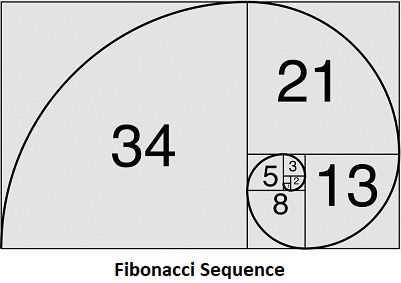
In other words, iteration is simply repetition. In a program, I can say to print the word “Iteration” 5 times. There is no feedback here, other than to keep count of the times the word was printed on screen. On the other hand, in recursion, the value of the first cycle is fed back into the second cycle, the output of which is fed into the third cycle and so on. Here circular feedback is going on. A great example of a recursive function is the Fibonnaci sequence. The Fibonacci sequence is expressed as follows:

Fn = Fn-1 + Fn-2, for n > 1

Fn = 1, for n = 0 or 1

Here, we can see that the previous value is fed into the equation to create a new value, and this is an example of recursion.

From the complexity science standpoint, recursions lead to interesting phenomenon. This is not an iterative non-feedback loop any longer, where you come back to the same point again and again. With recursion, you get to circular causality with each loop, and you enter a new state altogether. Each loop is directly impacted by the previous loop. Anything that leads back to its original starting point doesn’t lead to emergence and can actually lead to a paradox. A great example is the liar paradox. In a version of this, a card has a statement written on both sides of a card. They are as follows:

  1. The statement on the other side of this card is FALSE.
  2. The statement on the other side of this card is TRUE.  

This obviously leads to a paradox when you follow it along a loop. You do not get to a new state with each iteration. Douglas Hofstadter wonderfully explained this as a mirror mirroring itself. However, with recursion, a wonderful emergence can happen, as we see in complexity science. Circular causality and recursion are ideas that have strong footing in Second Order Cybernetics. A great example of this is to look at the question – how do we make sense of the world around us? Heinz von Foerster, the Socrates of Cybernetics, has a lot to say about this. As Bernard Scott notes:

For Heinz von Foerster, the goal of second-order cybernetics is to explain the observer to himself, that is, it is the cybernetics of the cybernetician. The Greek root of cybernetics, kubernetes, means governor or steersman. The questions asked are; who or what steers the steersman, how is the steersman steered and, ethically, how does it behoove the steersman to steer himself? Von Foerster begins his epistemology, in traditional manner, by asking, “How do we know?” The answers he provides-and the further questions he raises-have consequences for the other great question of epistemology, “What may be known?” He reveals the creative, open-ended nature of the observer’s knowledge of himself and his world.

Scott uses von Foerster’s idea of undifferentiated coding to explore this further. I have written about this before here.

Undifferentiated coding is explained as below:

The response of a nerve cell encodes only the magnitude of its perturbation and not the physical nature of the perturbing agent.

Scott continues:

Put more specifically, there is no difference between the type of signal transmitted from eye to brain or from ear to brain. This raises the question of how it is we come to experience a world that is differentiated, that has “qualia”, sights, sounds, smells. The answer is that our experience is the product of a process of computation: encodings or “representations” are interpreted as being meaningful or conveying information in the context of the actions that give rise to them. What differentiates sight from hearing is the proprioceptive information that locates the source of the signal and places it in a particular action context.

Von Foerster explained the circular relationship between sense data and experiences as below:

The motorium (M) provides the interpretation for the sensorium (S) and the sensorium provides the interpretation for the motorium.

How we make sense depends on how we experience, and how we experience depends upon how we make sense. As Scott notes, we can explain the above relationship as follows:

S = F(M). Sensorium, S, is a function of motorium, M.

M = G(S). Motorium, M, is a function of sensorium, S.

Von Foerster pointed out that this is an open recursive loop, since we can replace M with G(S).

S=F(G(S))

With more replacements for the “S”, this equation becomes an open recursive loop as follows:

S=F(G(F(G(F(G(…………G(S)))))……

Scott continues:

Fortunately, the circularity is not vicious, as in the statement “I am a liar”. Rather, it is virtuous or, as von Foerster calls it, it is a creative circle, which allows us to “transcend into another domain”. The indefinite series is a description of processes taking place in sequence, in “time”, with steps t, t+1, t+2 and so on. (I put “time” in quotes as a forward marker for discussion to come). In such indefinite recursive expressions, solutions are those values of the expression which, when entered into the expression as a base, produce themselves. These are known as Eigen values (self-values). Here we have the emergence of stabilities, invariances. The “objects” that we experience are “tokens” for the behaviors that give rise to those experiences. There is an “ultimate” base to these recursions: once upon a “time”, the observer came into being. As von Foerster neatly puts it, “an observer is his own ultimate object”.

The computations that give rise to the experience of a stable world of “objects” are adaptations to constraints on possible behaviors. Whatever else, the organism, qua system, must continue to compute itself, as a product. “Objects” are anything else it may compute (and recompute) as a unitary aspect of experience: things, events, all kinds of abstraction. The possible set of “objects” it may come to know are limited only by the organism’s current anatomy and the culture into which she is born.

I have written about this further here – Consistency over Completeness.

Heinz von Foerster said – The environment contains no information; it is as it is. We are informationally closed entities, which means that information cannot come from outside to inside. We make meanings out of the perturbations and we construct a reality that our interpretative framework can afford.

I will finish with a great observation from the Cybernetist philosopher Yuk Hui:

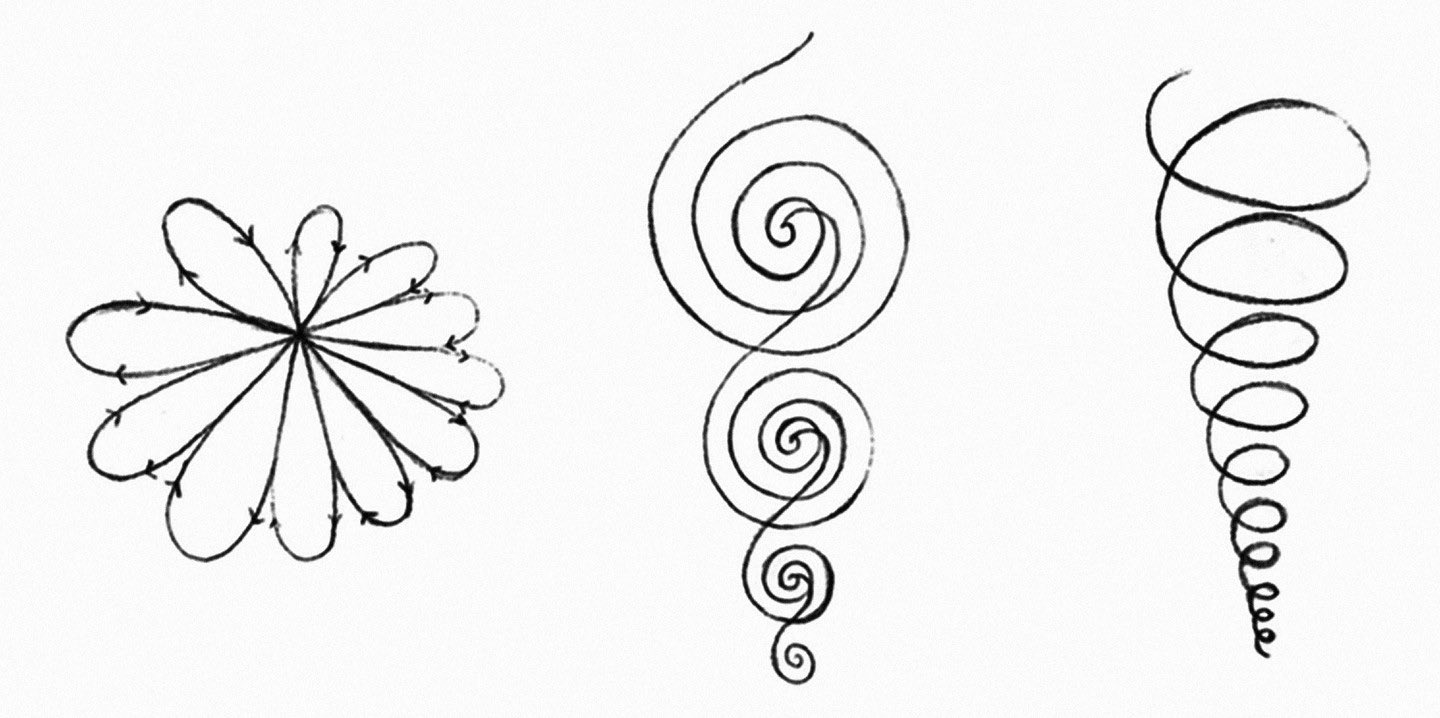
Recursivity is a general term for looping. This is not mere repetition, but rather more like a spiral, where every loop is different as the process moves generally towards an end, whether a closed one or an open one.

Please maintain social distance and wear masks. Stay safe and Always keep on learning…

In case you missed it, my last post was Observing with Your Hands:

References:

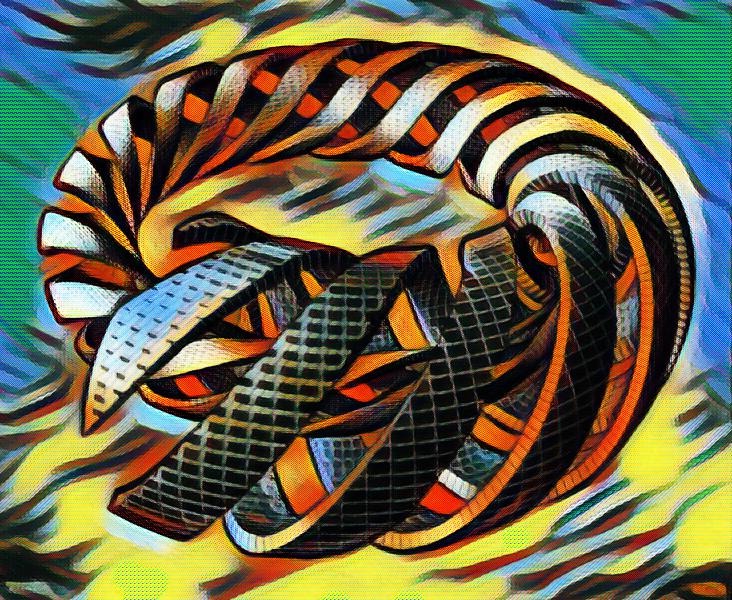
  1. M. C. Escher Spiral
  2. Second Order Cybernetics as Cognitive Methodology. Bernard Scott
  3. A Dictionary of Cybernetics. Klaus Krippendorff

Observing with Your Hands:

In today’s post, I am looking at the ideas inspired by mirror neurons. Mirror neurons are a class of neurons that activate when someone engages in an activity or when they observe the same activity being performed by someone else. It was first identified by a group of Italian neurophysiologists led by Giacomo Rizzolatti in the 1980s. They were studying macaque monkeys. As part of their research, they placed electrodes in the monkeys’ brains to study hand and mouth motions. The story goes that the electrodes sent signals when the monkeys observed the scientists eating peanuts. The same neurons that fired when the monkeys were eating peanuts fired when they merely observed the same action. Several additional studies indicate that the mirror neurons are activated to respond to goal-oriented actions. For example, when the scientist covered the peanut bowl, and performed the action of picking a peanut and eating, the mirror neurons still fired even though the monkeys could not see the peanut bowl. However, when the scientist simply mimicked the action of taking a peanut without a peanut bowl, the neurons did not fire. There have been several hypotheses regarding the mirror neurons such as they facilitate learning by copying, and that they are the source for empathy.

The most profound idea about mirror neurons is that action execution and action observation are tightly coupled. Our ability to interpret or comprehend other’s actions involve our own motor system. For example, when we observe someone doing an action, depending upon whether we have performed the action adds depth to how we can observe the action being performed. If I am watching a ballet and the ballerina performs a difficult move, I may not fully grasp what I have seen since I do not know ballet and because I have never performed it. However, if I watch a spin bowler in Cricket throwing an off-spin, I will be able to grasp it better and possibly tell how the ball is going to spin. This is because I have played a lot of Cricket as a youth. The same with a magician performing a sleight of hand.

The idea of mirror neurons brings an extra depth to the meaning of going to the gemba. Going to gemba is a key tenet of Toyota Production System. We go to the gemba, where the action is, to grasp the current situation. We go there to observe. Gemba, it is said, is our best teacher. When we go there to observe the work being performed, we may get a different experience depending upon whether we ourselves have performed the work or not. Heinz von Foerster, the Socrates of Cybernetics, said – if you want to see, learn how to act. He was talking about the circular loop of sensorium and motorium. In order to see, there has to be interaction between the sensorium and motorium.

In a similar way, Kiichiro Toyoda, the founder of Toyota Motor Corporation is said to have remarked that engineers would never amount to anything unless they had to wash their hands at least three times a day; the evidence they were getting their hands dirty from real work.

I will finish with a great advice from Taiichi Ohno:

Don’t look with your eyes, look with your feet. Don’t think with your head, think with your hands.

Please maintain social distance and wear masks. Stay safe and Always keep on learning…

In case you missed it, my last post was The Extended Form of the Law of Requisite Variety:

Image Reference – Now You See It. Now You Don’t (Bill Tarr)