Sakui – A story about abnormalities not listed on the inspection form:

sakui

In this post, I would like to discuss a story I read in the book “Total Quality Control for Management” by Masao Nemoto, a Toyota veteran.

The story was under the section “Discovery of Abnormalities and Quick Reporting”. The incident took place at Toyota Gosei’s Inazawa plant. There is a component called “fan shroud” made of plastic. This component is needed to adjust air flow and is situated near the engine fan. The operator, who was an older woman, was going to process the component as part of her routine work. She stopped and exclaimed “Sakui”, which means “soft to touch” in Japanese. She immediately called her squad leader who in turn stopped the production of the component to examine the component. Everything was checked, and everything was found to be working as expected except for the material. Another lot was used as the interim corrective action, and the components were determined to be as before. The suspect lot was sent back to the supplier and it was later found that the material was at fault. The resin was produced by “mixing of different size grains”. Since the discovery was early, the loss was minimal. As Nemoto notes, this was made possible by the older woman’s action, by reporting what felt “different” to her. She was not trained to look for this issue. The section chief wrote a letter of commendation to her and utilized this example as an opportunity for training.

A while back, I discussed the importance of fast feedback to increase the value of inspection. This story demonstrates an interesting point. If the abnormality or non-conformance is not listed on the inspection form, what should the worker do?

I liked this story since it points out many aspects of Toyota Production System. This also reminds me of Canon Production System, which is quite similar to Toyota Production System. Their mantra was TSS (Tomete – stop, Sugu – right away, and Shochi o toru – take measures to correct). Stopping the line is shunned in the traditional Taylor style production system. In the example above, the squad leader stopped the production to grasp the current condition, and took the right steps to continue production. Stopping the line when problems occur eliminates the need to stop the line for a longer time in the future. The operator has the right and responsibility to stop the line when there is a problem. This is also an opportunity for training. Stopping the line is one of the many counter-intuitive principles in Toyota Production System. The time spent stopping the line is tremendously decreased as days go by. This also encourages the operators to bring the problems to the surface. This encourages the operator to look for ways to improve the process as well.

Next time when your operator says “sakui”, heed to him/her.

Always keep on learning…

OpenFDA API, with Excel:

openFDA_720x825

FDA has made their databases more open to developers and businesses alike through open.FDA.gov. From their website, “The goal of the project is to create easy access to public data, to create a new level of openness and accountability, to ensure the privacy and security of public FDA data, and ultimately to educate the public and save lives.

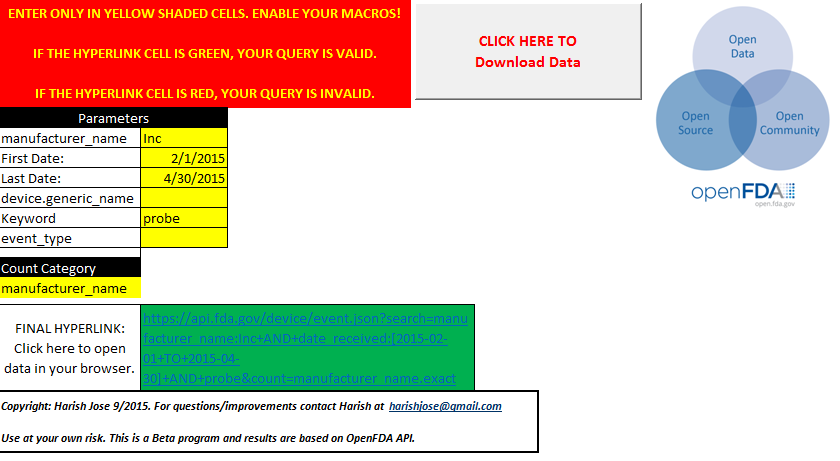
I have created an Excel interface that does not use a JSON library, and allows the user to perform searches based on multiple criteria. This interface will also allow the user to download the data for further manipulation.

A basic screenshot is shown below. Please note that, currently this is applicable only for Medical Devices Adverse Events.

main

The user has to enter the required information into the yellow cells. The query is based on a “count” criterion. It is also important to note the “Keyword” search as well. I have found this to be quite useful, when I was playing around.

If the query criteria will yield results, the “FINAL HYPERLINK” cell will turn green. If the query results produce a null, the cell will turn red. The user can also click on the hyperlink to view the results in a browser.

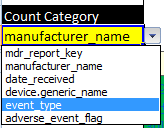
The count criteria are shown below.

count

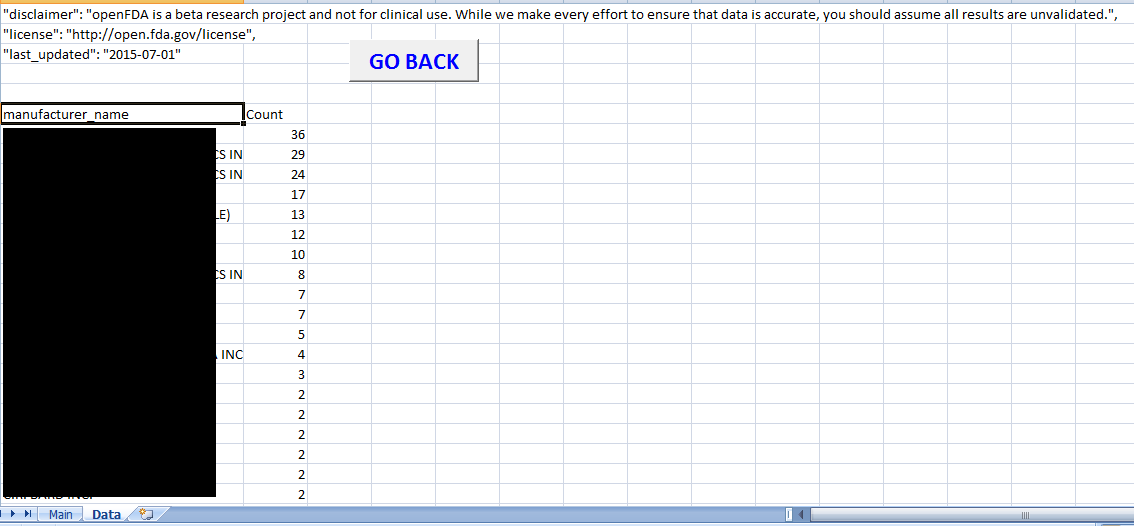
Based on the data input, the user clicks on the “CLICK HERE” button, and it will perform the query, and download the dataset to another sheet. This is shown below. I have used the FDA disclaimer section from the results, for my data page.

The speed of the query has been pretty impressive.

data

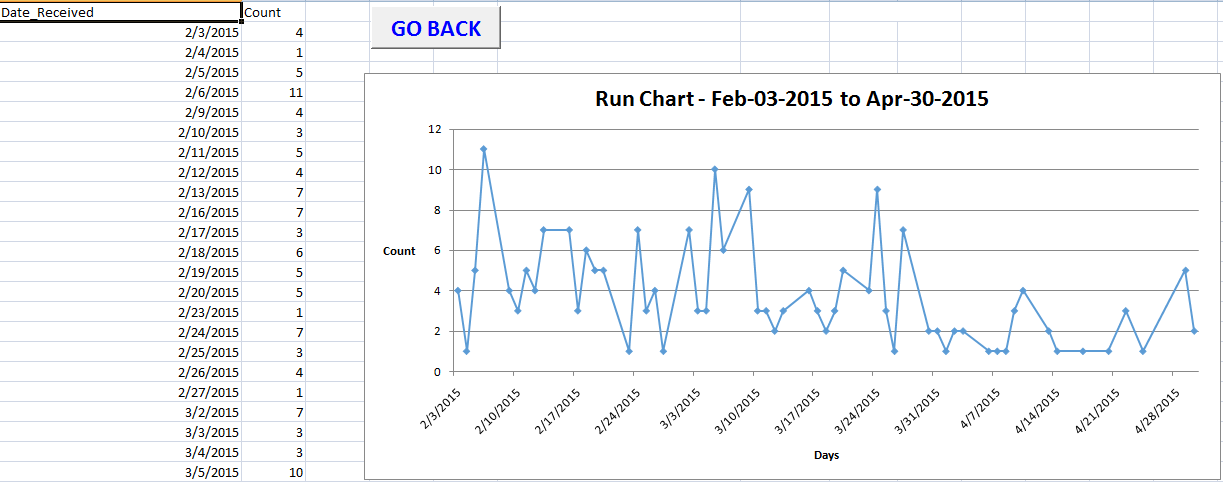
If the count selected is “date received”, the program will automatically parse the data and create a run chart along with the data sheet. This is shown below. The user can further manipulate the dates to weeks or months run chart.

runchart

Interested in R functions?

I have also created several functions in R to query and download the data to a .csv file. If there is an interest for this, I can certainly share them.

Feedback request:

I am interested in getting feedback from the users. If there are ideas to improve this further, please provide me feedback. You can reach me at harishjose@gmail.com

Disclaimer:

This program must be used at your own risk. I do not guarantee accuracy of the data. All the data is acquired through OpenFDA’s API. The data is updated frequently. The “update” information is shown as part of the dataset.

Download:

You can download the spreadsheet here (.xls format).

Always keep on learning…

Confirmation Bias – Colbert and Sagan Edition:

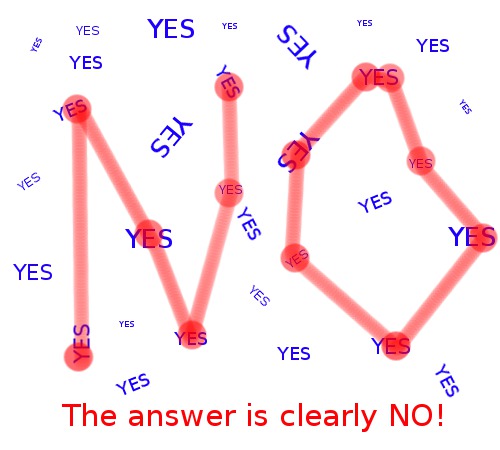
Yes-No

I discussed confirmation bias in an earlier post here. In this post, I hope to bring Astrophysicist Carl Sagan and Comedian Stephen Colbert together and end with a Zen story.

Wikipedia defines Confirmation Bias as “Confirmation bias, also called myside bias, is the tendency to search for, interpret, favor, and recall information in a way that confirms one’s beliefs or hypotheses while giving disproportionately less attention to information that contradicts it.”

Confirmation bias can put brakes on your scientific thinking, and it is a daily struggle to avoid your biases.

The Colbert Report Edition:

I recently came across a study performed by LaMarre, Landreville and Beam from Ohio State University. In this study the authors investigated the biased message processing of political satire in the famous “The Colbert Report” TV show. For those who do not know this show, “The Colbert Report” show was a political satire show hosted by Stephen Colbert. Colbert refered to his fictional character as a “well-intentioned, poorly informed, high-status idiot”, and was a caricature of televised political pundits.

In the study, the researchers investigated the biased message processing of political satire in the show and the influence of political ideology on perceptions of Stephen Colbert. The researchers called his style of comedy as “ambiguous deadpan satire”. The following facts were revealed from the study.

  • No significant difference existed between conservatives and liberals regarding Stephen Colbert being funny.
  • Conservatives reported that Colbert only pretends to be funny, and genuinely meant what he said; supporting their conservative ideology. Liberals on the other hand reported that Colbert used satire and was not serious; supporting their liberal ideology.

In other words, both liberals and conservatives with extreme viewpoints watched the exact same show and came away with exactly opposite opinions. This is a classical case of confirmation bias!

Carl Sagan and the Fine Art of Baloney Detection:

Carl Sagan was a very famous American Astrophysicist and great scientific thinker. In his book, The Demon-Haunted World, Science as a Candle in the Dark, Carl Sagan provides us a thinking tool kit that will assist us in detecting baloney, as he puts it. Sagan refers to this as a means to construct and to understand, a reasoned argument and – especially important – to recognize a fallacious or fraudulent argument. The tools are as follows;

  • Wherever possible there must be independent confirmation of the “facts.”
  • Encourage substantive debate on the evidence by knowledgeable proponents of all points of view.
  • Arguments from authority carry little weight — “authorities” have made mistakes in the past. They will do so again in the future. Perhaps a better way to say it is that in science there are no authorities; at most, there are experts.
  • Spin more than one hypothesis. If there’s something to be explained, think of all the different ways in which it could be explained. Then think of tests by which you might systematically disprove each of the alternatives. What survives, the hypothesis that resists disproof in this Darwinian selection among “multiple working hypotheses,” has a much better chance of being the right answer than if you had simply run with the first idea that caught your fancy.
  • Try not to get overly attached to a hypothesis just because it’s yours. It’s only a way station in the pursuit of knowledge. Ask yourself why you like the idea. Compare it fairly with the alternatives. See if you can find reasons for rejecting it. If you don’t, others will.
  • If whatever it is you’re explaining has some measure, some numerical quantity attached to it, you’ll be much better able to discriminate among competing hypotheses. What is vague and qualitative is open to many explanations. Of course there are truths to be sought in the many qualitative issues we are obliged to confront, but finding them is more challenging.
  • If there’s a chain of argument, every link in the chain must work (including the premise) — not just most of them.
  • Occam’s Razor. This convenient rule-of-thumb urges us when faced with two hypotheses that explain the data equally well to choose the simpler.
  • Always ask whether the hypothesis can be, at least in principle, falsified. Propositions that are untestable, unfalsifiable are not worth much. Consider the grand idea that our Universe and everything in it is just an elementary particle — an electron, say — in a much bigger Cosmos. But if we can never acquire information from outside our Universe, is not the idea incapable of disproof? You must be able to check assertions out. Inveterate skeptics must be given the chance to follow your reasoning, to duplicate your experiments and see if they get the same result.

Surprisingly, the list above is also applicable to detecting, and reducing confirmation bias.

A cup of Tea – a Zen story:

There once lived a great Zen master, Nan-in. Reputation of his wisdom spread, and a university professor decided to visit Nan-in to inquire about Zen.

The professor was welcomed into Nan-in’s room. Nan-in served the professor tea.

The professor’s cup was soon full and yet Nan-in kept on pouring tea causing the professor’s cup to overflow. Nan-in still kept on pouring.

“Master, please stop. The cup is full. There is no more room for more tea.”

“Like this cup,” Nan-in said, “your brain is full of your opinions and biases. There is no more room for Zen unless you first empty it”

Final Words:

I will finish off with a great piece of wisdom, I heard on Quora. Unfortunately, I do not know the source.

“My opinions are not me.  My opinions are just pieces of data that I carry in a box with me.  I can and should change them based on the information available.  If I marry myself to my opinions, I will cling to them regardless of what the information says.  If I want to be right, I need to be prepared to change my mind.” 

Always keep on learning…

Photo credit – Paul H. Byerly

It’s Complicated

Cynefin final

It’s Complicated:

PDCA, the four letter acronym made famous by Dr. Deming stands for Plan – Do – Check – Act. It is a continuous cycle.

PDCA is said to be the framework for scientific thinking and continuous improvement. I have always thought of PDCA to have something missing in it. It looked so simplistic. Can it really be that simple?

I have come to realize that what was missing was context; the context behind PDCA. It cannot be that everything you see is a nail, if you only have a hammer. What happens before PDCA? The moment before you decided, “Hey, let’s do PDCA.” What makes you decide the “scope” for PDCA? How do you know if PDCA is even appropriate?

This post is an ode to the Cynefin framework. For those who do not know the Cynefin framework, it is a brainchild of Dave Snowden, and it is a sense making framework. Dave Snowden has stated that in the Cynefin framework, data precedes framework and it is valid to understand. The Cynefin framework is not a categorization framework, where framework precedes data.

The idea behind the Cynefin framework is that when you encounter a problem or a new project, your first step is to understand what domain you are in. This provides us a framework to proceed. As a learning organization, it is essential that our efforts and our methodologies match the type of change that we are planning. The Cynefin framework lays the groundwork for this exact intent.

The Cynefin framework has 5 domains and is dynamic. No problem with high complexity or chaos ever stays in the same domain at all times. The problem we had last year may have appeared to be complex, but now it may be in the complicated domain, or even the simple domain. Even a situation from the Simple domain can collapse into the Chaotic domain if there is complacency.
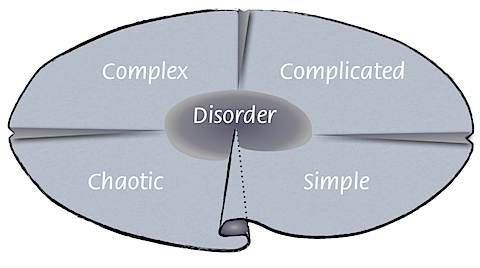
Screen shot 2010-07-07 at 23.33.02

The following definitions are taken from Cognitive Edge website;

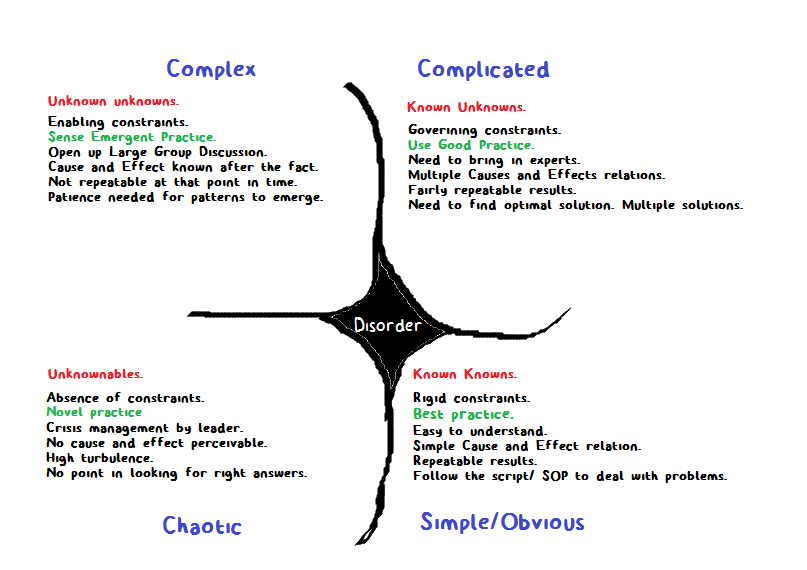
The Cynefin framework has five domains. The first four domains are:

Simple (also called as Obvious), in which the relationship between cause and effect is obvious to all. The approach is to Sense – Categorize – Respond and we can apply best practice.


Complicated, in which the relationship between cause and effect requires analysis or some other form of investigation and/or the application of expert knowledge. The approach is to Sense – Analyze – Respond and we can apply good practice.


Complex, in which the relationship between cause and effect can only be perceived in retrospect, but not in advance. The approach is to Probe – Sense – Respond and we can sense emergent practice.


Chaotic, in which there is no relationship between cause and effect at systems level. The approach is to Act – Sense – Respond and we can discover novel practice.


The fifth domain is Disorder, which is the state of not knowing what type of causality exists, in which state people will revert to their own comfort zone in making a decision. In full use, the Cynefin framework has sub-domains, and the boundary between simple and chaotic is seen as a catastrophic one: complacency leads to failure. In conclusion, chaos is always transitionary and dynamics are a key aspect.

This is summarized in the following figure.

Cynefin final

The need for the Cynefin Framework:

Most of the methodologies, including PDCA, assume some form of order. Sometimes this leads to the misapplication of methodology that leads to failures. Only Simple and Complicated domains assume some form of order. The Cynefin framework helps us in being efficient and at the same time effective.

There are minimal resources needed for a situation in the Simple domain. The answer is fairly obvious, and best practice is already known in the form of SOPs (Standard Operating Procedures) or work instructions. For example, the light bulb burned out – replace the light bulb. Project management is certainly not needed for this domain. There is no true need for a PDCA methodology in this domain. The Cynefin framework recommends sense-categorize-respond for this domain. The assumption is that there is a known best practice available or that the best practice is fairly straightforward.

The Complicated domain needs guidance from experts. Multiple solutions can exist, and we need experts’ help to identify the optimal solution. For example, if the light bulb keeps going out, it may not be as easy as replacing a light bulb. This is a domain that works well with PDCA. One should not imitate and apply the best-practice in this domain. Dave Snowden refers to a phenomenon called “premature convergence” where we stop exploring how to make ideas better, thinking that we have found the answer. Cynefin framework recommends sense-analyze-respond. This is similar to a PDCA approach.

The Complex domain does not have order. It is an unordered domain. We need patience for patterns to emerge in this domain. Cause and effect relations are not directly visible in this domain. The recommended practice is probe-sense-respond. Multiple and different PDCA loops might be required for this domain to let the patterns emerge. Think of any root cause projects that you completed, where you did not see the solution in the beginning, but on hindsight it made sense. Dave Snowden gives the example of “Houston, we have a problem” scene from the movie “Apollo 13”.

As the name suggests, the chaos domain is indeed full of turbulence and chaos. This is not a domain where you search for answers. This is a domain for rapid decisions to regain control and stabilize the turbulence. The recommended approach is act-sense-respond. The act phase can be an attempt to stabilize the turbulence. As you can see, this is not an ideal candidate for the PDCA approach. If PDCA is used, the Plan phase will need to be quite short. The goal of this domain is to quickly move to the complex domain as soon as possible. Dave Snowden’s example for this domain is the unfortunate 9/11 incident.

Final words:

In the business world, there is no solution that is one-size-fits-all. Context is everything! Each domain of the Cynefin framework comes with its own burden. Being too complacent in the Simple domain can push you into the Chaotic domain. Trying to imitate what worked for one company can cause you to fail (the Complicated domain). Not waiting for patterns to emerge in the Complex domain, and trying to push for best practices can push you over to the Chaotic domain. The Cynefin framework provides you a thinking framework to understand the scope of your situation and helps you in being efficient and effective with your PDCA approach. This post was written based on my thoughts on my learning with the Cynefin framework. I encourage the reader to read upon the Cynefin framework more at Cognitive-Edge.com. The HBR article “A Leader’s Framework for Decision Making” is also an excellent place to start.

Always keep on learning…

Is Inspection Value Added?

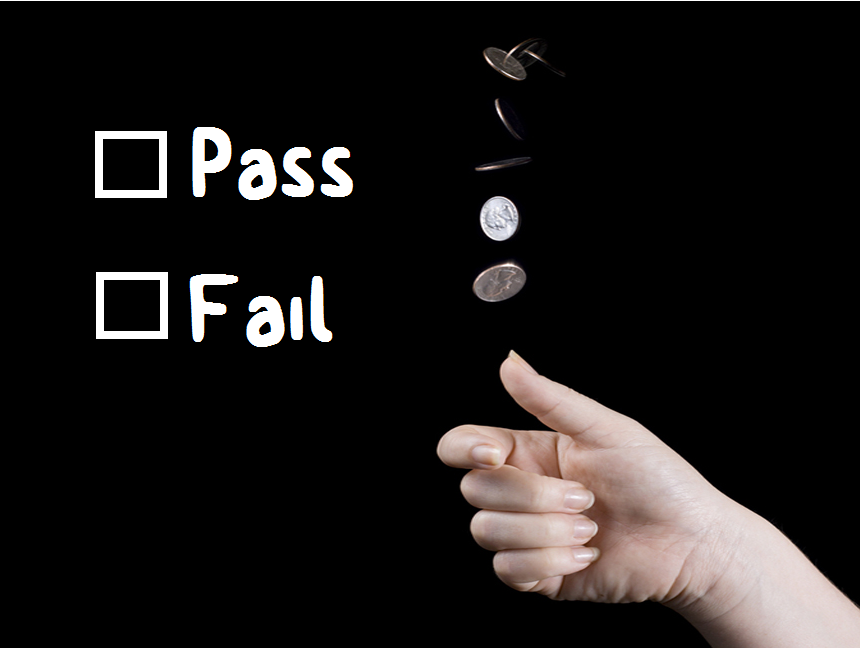
pass fail

In popular Lean circles, the idea of value-added is represented by the following two criteria;

  • Is your customer willing to pay for the activity?
  • Is the activity physically changing the shape or character of the product so that it increases the product’s value in the eyes of the customer?

In lieu of these criteria, is inspection value added? Before answering, please be aware that this is a loaded question. Also understand that the question is not “should we inspect product?”

Inspection generally does not alter the physical attributes of a product. Inspection in the traditional sense accepts or rejects the product. In this aspect, inspection should prevent a bad product from reaching the hands of the customer. Does this mean that then the inspection activity is value added?

As a customer, I would love it if the product is inspected, and reinspected ten times. But I would not want to pay for such an activity. Are we as a society of consumers wrongfully trained to think that inspection somehow increases the quality of the product?

Deming’s view:

Dr. Deming’s view of inspection is as follows;

Cease dependence on inspection to achieve quality. Eliminate the need for inspection on a mass basis by building quality into the product in the first place.

In fact, this is the third principle of his 14 key principles for management to follow for significantly improving the effectiveness of a business or organization. Deming’s view is clearly stated in his “Out of Crisis” book. “Inspection does not improve the quality, nor guarantee quality. Inspection is too late. The quality, good or bad, is already in the product.”

Shigeo Shingo’s View:

Shigeo Shingo is considered by many a powerful force behind Toyota Production System. He trained Toyota employees with his “P-courses”. Shingo was the person behind Poka-yoke (Error proof) and SMED (Single Minute Exchange of Dies). In his views, there were three types of inspection:

  • Judgment Inspection – inspections that discover defects
  • Informative Inspection – inspections that reduce defects
  • Source Inspection – inspections that eliminate defects

Judgment inspection is an inspection that is performed after the fact. The lot is produced, and then inspection is performed to determine if the lot is acceptable or not. In Shingo’s words “It (Judgment Inspection) remains inherently a kind of postmortem inspection, however, for no matter how accurately and thoroughly it is performed, it can in no way contribute to lowering the defect rate in the plant itself.” Shingo continues to state that the Judgment Inspection method is consequently of no value, if one wants to bring down defect rates within plants.

Informative Inspection is an inspection that helps in reducing defects. This method feedbacks information to the work process involved, thus allowing actions to take place to correct the process. Shingo describes three types of Informative Inspections.

  1. Statistical Quality Control Systems – This is the system with control charts where one can identify trends or out of control processes, aiding in getting the process back to stability.
  2. Successive Check Systems – This is the system where the component gets inspected by the next operator in the line. Any defect is identified and corrected almost immediately by letting the previous operator know. Please note that ideally this system uses 100% inspection.
  3. Self-check systems – This is the system where the operator can inspect the work that he/she did, and fix the problem immediately. Please note that ideally this system uses 100% inspection.

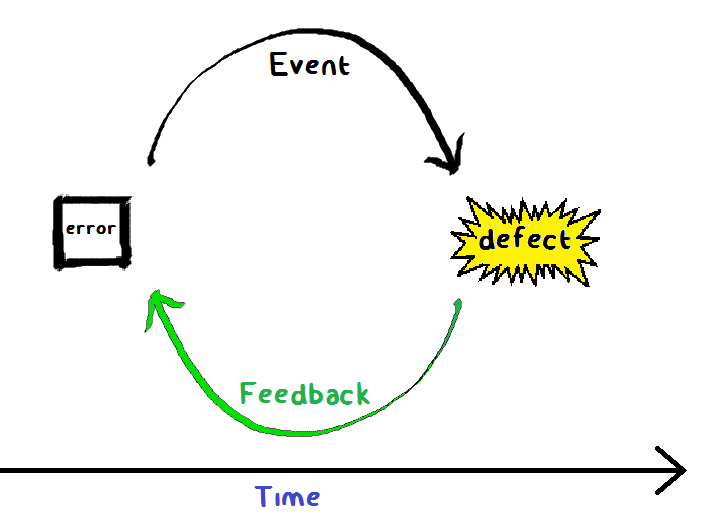
The final category is Source Inspection. In this category, the feedback loop is so short that as soon as the error occurs, the feedback kicks in preventing the error from becoming a defect.

Feedback Loop – The Key:

The key in determining value in the inspection process is the length of the feedback loop. Judgmental Inspection is the least value adding in this regards because the product lot is already built and completed. Informative Inspection is value adding, since the feedback loop is considerably shorter. Finally, the source inspection is the most value adding since the feedback loop is the shortest.

The feedback loop is shown below.

feedback loop

Thus, the shorter the feedback loop, the higher the inspection method’s value.

Final Words:

This post started with a question, Is inspection value added? Errors are inevitable. Drifts in processes are inevitable. Learning from errors is also becoming inevitable. Inspection activities that increase the system’s value are definitely value added. I used to wonder, whether kaizen is value added. Is a customer willing to pay for an organization to be a learning organization? I came to the realization that kaizen is based on a long term principle. The real value is in cultivating the long term trustful relationship with the customer.

Inspection activities that allow the organization to grow and learn are definitely value added. The table below summarizes this post.

table

Always keep on learning…

How do I do Kaizen?

kaizen

Kaizen is most likely one of the most misused words in lean. There is a strong precedence in the lean community to call a “Kaizen Event” or “Kaizen Blitz” as “Kaizen”.

Kaizen just means incremental and continuous improvement towards the ideal state.

A Kaizen Event on the other hand, means generally a week long team-based rapid improvement activity. Thus, there is a definite start and a stop to Kaizen Events, making this almost an oxymoron since Kaizen implies a continuous and never stopping state. This post is about Kaizen and not Kaizen events.

A lot of people talk about the need for doing Kaizen. This post hopefully provides nuts and bolts on how to perform improvement activities. Please note that the first step for Kaizen is to nurture your employees so that they become aware of problems. This is a post for another day.

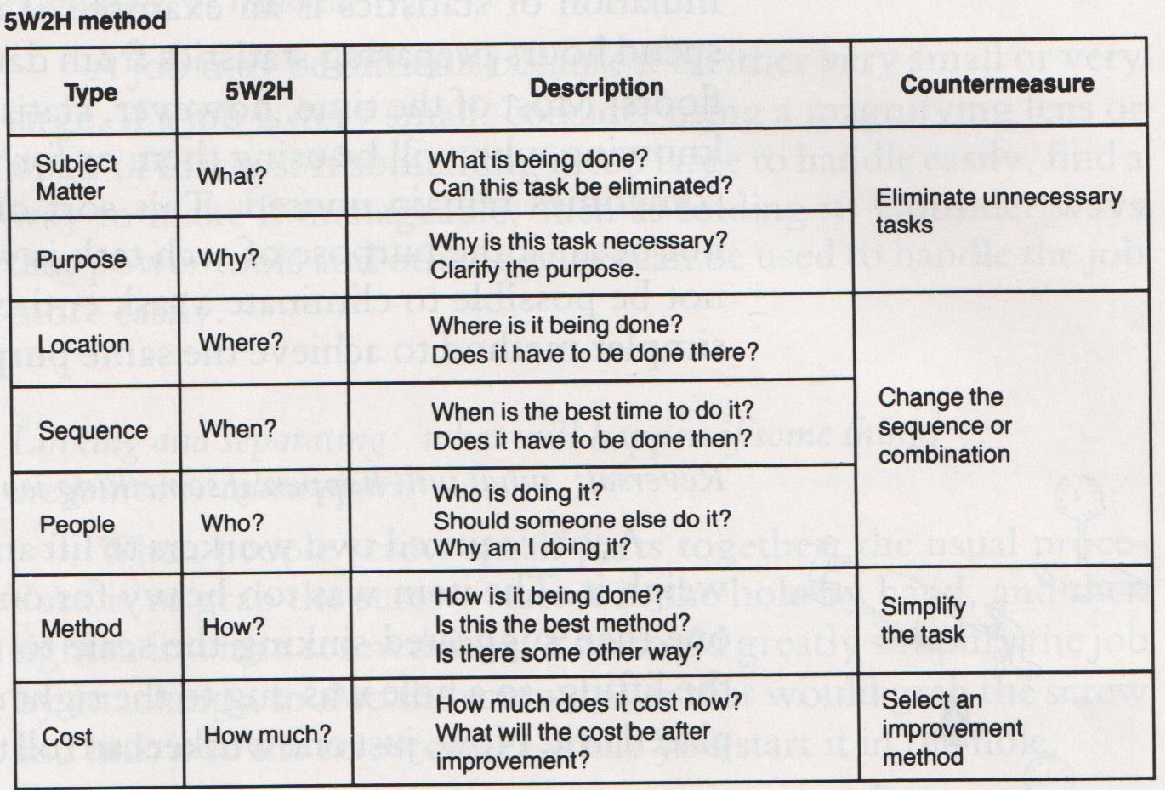
The following figure is taken from The Idea Book, edited by the Japan Human Relations Association (1980). The original title was “Kaizen Teian Handobukku” which roughly translates to “Kaizen through (Employee) Suggestions Handbook”. This figure shows how to approach improving your process. The right column is also known as the ECRS method. Going through these questions under the Description column and then following through the steps in the Countermeasure column is how one can improve a process.

tei

Figure 1 : How to Improve a process?

  • Eliminate Unnecessary Tasks: The ultimate improvement is eliminating a task altogether. The What and Why questions help us with this.
  • Combine the Steps: What are the steps that need to be done in series? Are there any steps that can be done in parallel? The Where, When and Who questions help us with combining steps to eliminate waste. Additionally, combining also reduces the number of discrete steps in the process.
  • Rearrange the Steps: Sometimes changing the sequence also allows us to take away waste from the process. The Where, When and Who questions help us with this. Can we do the current step# 3 before Step# 1? Is there any logic to the current sequence of steps? Can we rearrange to create a better sequence.
  • Simplify: Is there any task that can be simplified to make the whole process faster and better? Does the operator spend a lot of time trying to sort things or fumble with things? Can we ultimately simplify all the steps?

Please note that the steps are carried out in the order described above.

The reader should also be aware that the ECRS process and the questions have roots in USA’s Training Within Industry (TWI) movement that got started near the era that led to World War II. TWI was an emergency service by US to help nation’s war contractors and essential production. There was a need to produce a lot in a short amount of time, and this required training operators to be better within a short amount of time. C R Dooley, the Director of TWI, stated the following; “TWI’s objectives were to help contractors to get out better war production faster, so that the war might be shortened, and to help industry to lower the cost of war materials.

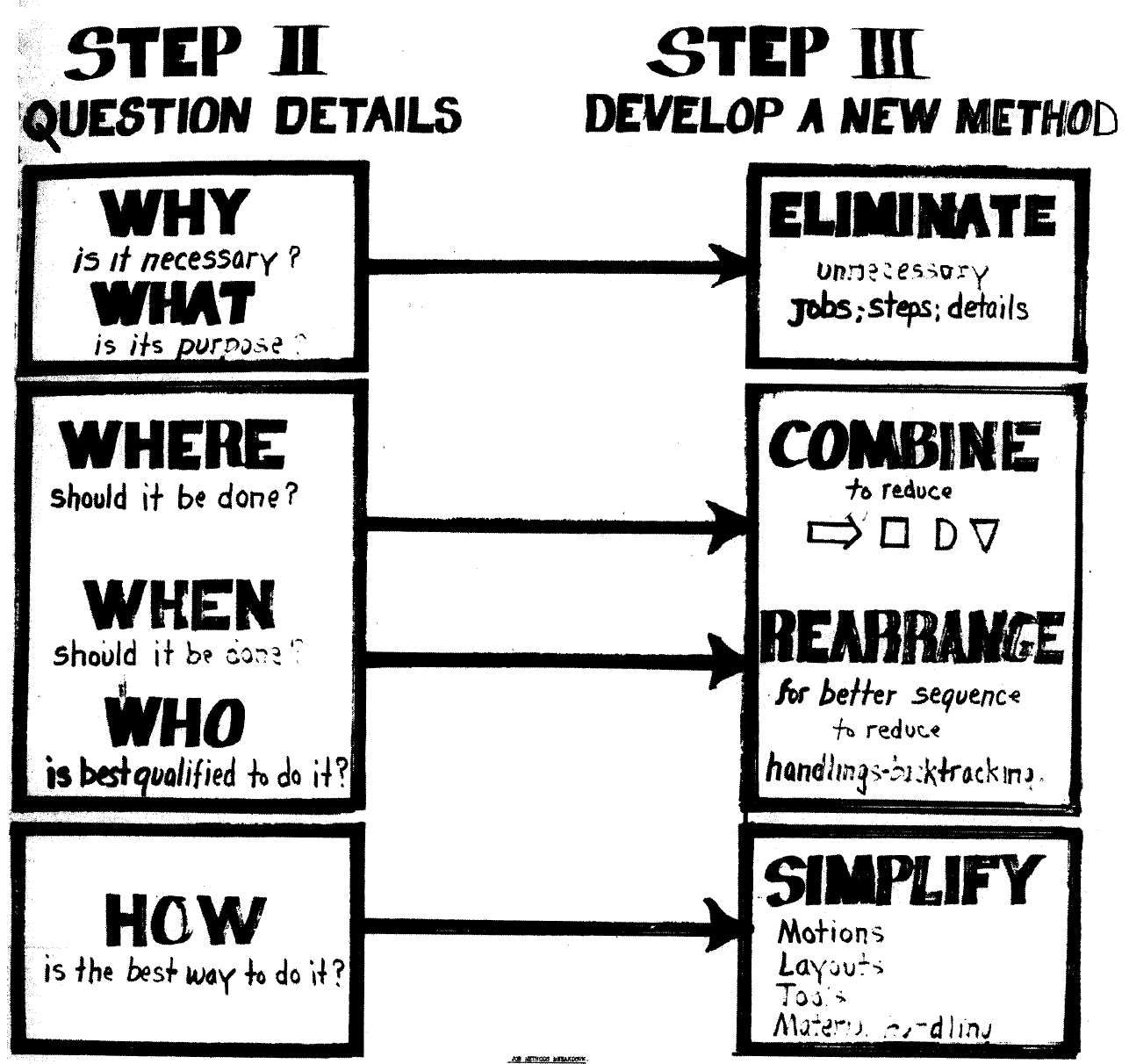
The following figure is taken from the Problem Solving Manual from TWI. The following is also part of Job Methods program.

psmanual

Figure 2: Steps 2 and 3 of Job Methods (TWI)

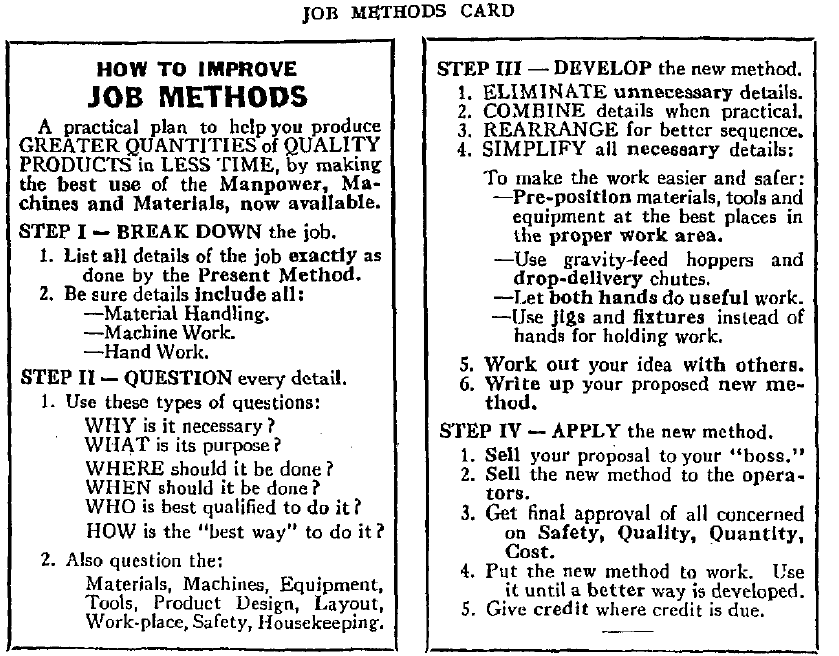
The following is a pocket card that was supplied as part of Job Methods program.

JMcard

Figure 3: Job Methods Card

A keen observer of the Job Methods can find the scientific approach of PDCA (Plan-Do-Check-Act) in it. Additionally, I would also like to bring attention to “Use the new method until a better way is developed” statement. This clearly shows that this is a continuous process.

I encourage the reader to study the Job Methods manual to get a better grasp. You can find a lot more about TWI here. http://chapters.sme.org/204/TWI_Materials/TWIPage.htm

As a side note, Toyota implemented the TWI programs in the early 1950’s. Surprisingly the first of the TWI programs that was dropped was the Job Methods program. This was replaced by Shigeo Shingo’s P-courses that added the Industrial Engineering elements to process improvement activities. Taiichi Ohno wanted to add the importance of takt time, Standard WIP, flow, and pull style production to the idea of Kaizen. (Source: Art Smalley, Isao Kato)

Nugget from the Problem Solving Manual:

The Problem Solving Manual from TWI also identified “Make Ready” and “Put Away” as “movements of material without definite work accomplishment”.

The manual also identified these as the “greatest opportunities for improvement”. It is also noteworthy that “Less than 50% of the total time is usually consumed by the ‘DO’ part of the job.” Current thinking is that the true value added activities equate to less than 5% of a general process that is untouched by any improvement activities.

value

Figure 4: Value (Problem Solving Manual)

Final Words:

Maybe it is ironic that I am going to use the introductory words of C R Dooley, the then Director of TWI, from the Job Methods manual as my final words for this post. You can clearly see the undercurrents of Respect for People and Kaizen in his words.

Most of the men with whom you will work have had years of experience. They have latent ideas which, if properly developed, will increase production, reduce lost time, prevent waste of material, and increase the use of machinery and equipment. These men command your respect because of their knowledge.

Always keep on learning…
What do you mean by “No problem is a problem”:

giphy

When I first heard of “No problem is a problem”, I thought that it was a pretty deep philosophical statement. I could understand what it meant, but I realized at that time that there is something more to that statement, some deeper layers that still need to be understood.

Taiichi Ohno, the father of Toyota Production System is behind this quote. His original version is “Having no problems is the biggest problem of all.” This idea was engrained in the TPS senseis by their senseis.

Three interpretations come to surface when you look at the quote “Having no problems is the biggest problem of all.”

  • We are always surrounded by problems.
  • We are not looking hard enough.
  • By saying “there is no problem”, we are trying to hide problems.

Actually there is more to this basic idea. How would you define the concept of “problem”? Merriam-Webster defines problem as;

  • something that is difficult to deal with : something that is a source of trouble, worry, etc.
  • difficulty in understanding something
  • a feeling of not liking or wanting to do something

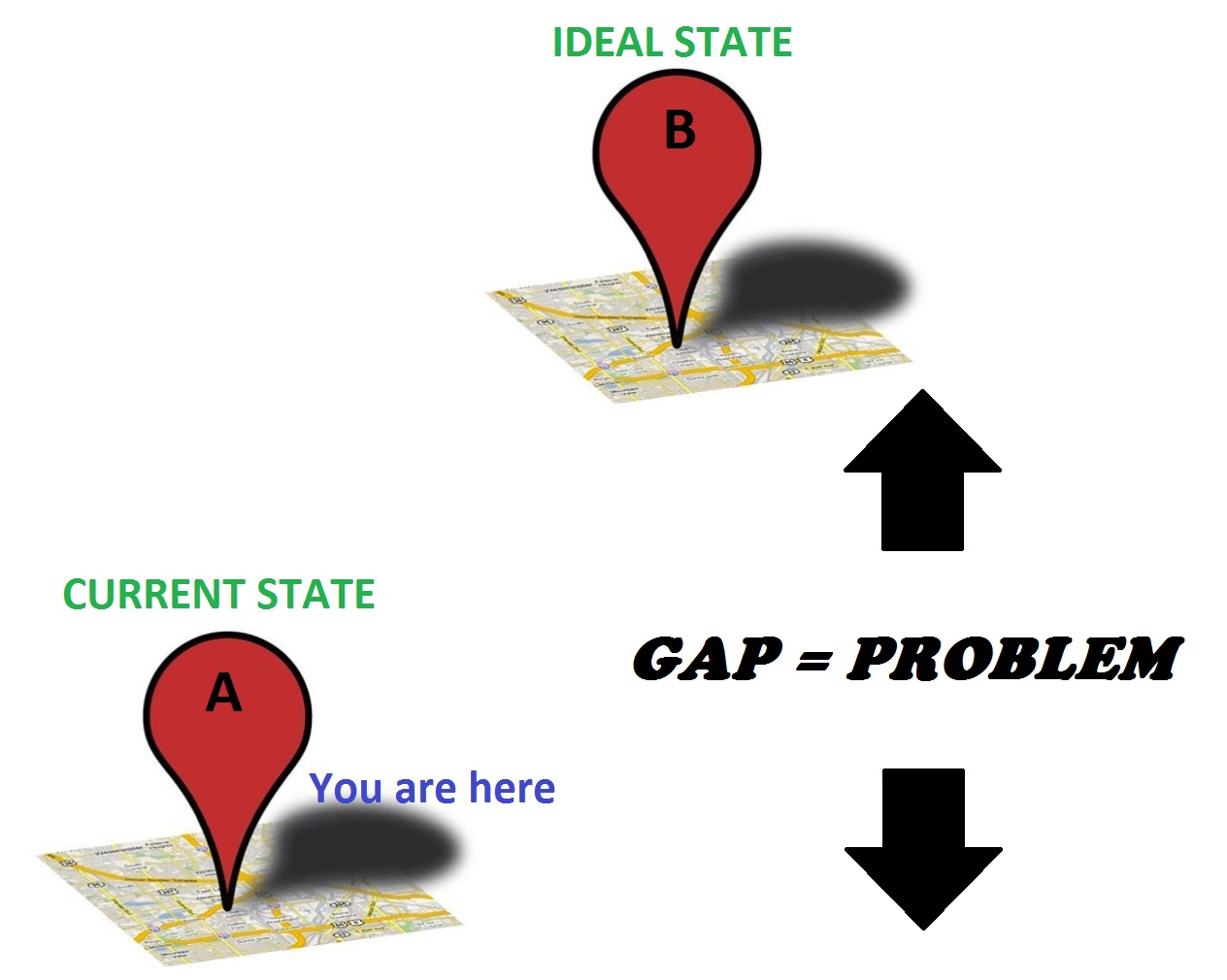
The book Kaizen Teian 2 defines “problem” as the gap between Ideal State and Current State. This is the gold nugget that will provide the deeper meaning to the statement “no problem is a problem”.

problem

At Toyota, you are trained to think of a problem as the gap between the current state and the ideal state. This way, you can start proposing countermeasures to reach the ideal state and thus address the problem. The thought process can be summarized as below.

  • What is your ideal state (goal)?
  • What is your current state?
  • Define the problem as the gap.
  • Suggest countermeasures with an understanding of the cause.
  • Implement and study the new current state.
  • If you have not reached your ideal state go back to step 4.

As you can see, this is the scientific thinking of PDCA (Plan – Do – Check – Act). With this light, and with the new definition of a problem as the gap, if you say there is no problem, it would mean that you have reached your ideal state, which is never the case.

One can thus see Kaizen (continuous improvement) as a problem solving methodology. Kaizen is the engine that chugs along towards the ideal state. This represents slow and incremental progress towards the ideal state. The reader should be aware that Kaizen does not equate fixing things. Fixing things is firefighting. Firefighting is associated with maintaining the status quo. This does not let you move towards your ideal state.

The traditional thinking is viewing problems as the fires that need to be put out. There is no continuous improvement thinking here. Putting out fires just mean that we are back where we started. This is the essence of “no problem is a problem”. By saying “I have no problems”, one is giving up on continuous improvement. By viewing “problem” as the gap, it gives motivation for continuous improvement. Think of this as Pull and putting out fires as Push. Thus, you have a better flow towards your ideal state.

The scientific method detailed above is also taught as genchi genbutsu at Toyota. This roughly translates to “go to the actual place of activity, and grasp the facts”. Interestingly, Honda uses a similar theme under san genshugi. This roughly translates to the three actualities. Honda requires their employees to go to the actual place of activity to gain firsthand information, look at the actual situation, and decide on countermeasures based on actual facts. The “gen” component of the Japanese word means real or actual. Sometimes this is spoken as “gem” as well. For example, gemba means actual place of action.

Final words:

I am at fault for not always using this thinking process. Looking at problems as what should be versus what is right now, helps us understand the problem better. Being at the actual location where the problem happened, and talking to the operator, looking at the equipment or the raw materials, and understanding the facts helps us in moving towards addressing the problem. View problems as the gap between ideal state and current state, and understand that your purpose is to move towards the ideal state. Under this idea of “problem”, you will always have opportunities to move towards the ideal state.

Always keep on learning…
Respect for People – Kin Test:

respect

I work in the field of medical devices. We use a thought experiment in our field that I like to call “the kin test”. It goes something like this. Would you let your kin, your mother, your child or your father, use this medical device we manufacture? Is the quality of this device good enough that it can be used on your dearest kin?

After writing the post about Respect for People last week, I pondered about this kin test and wondered if it is applicable for Respect for People as well.

How would you answer the question, “Would you let your kin, your mother, your child or your father, work at where you are working?” If there is a hesitation in answering this, maybe the Respect for People is something that your company needs to look at.

Everything depreciates with time or so we learn from our accounting counterparts. The equipment you just bought, the building you are in, all these have lost value since day 1. There is something that actually gains value with time – people. People actually gain value with time, their experience and knowledge increases their value with time. This is all the more reason why you should invest in your people.

Not a lot is out there about this subject. The following interpretations are based on my research and thinking. Respect for People is not about being nice. It is not about saying “hello”. Respect for people is about nurturing accountability and ownership. Peter Senge, in his book The Fifth Discipline, talks about creative tension.

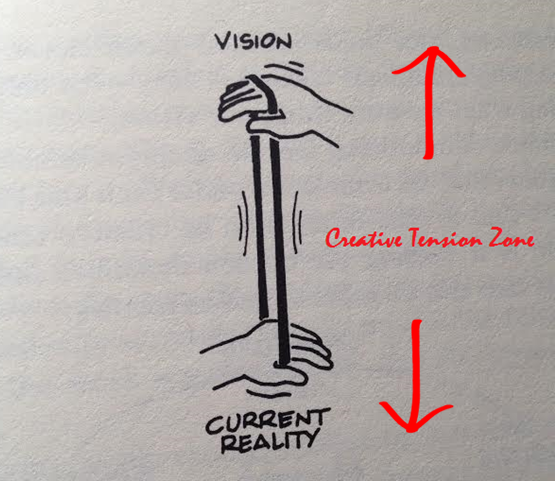
Creative tension exists when there are two opposing realities,

1) vision – where we should be, and

2) current reality – the status quo, where we are right now.

Creative tension resides in the zone between these two opposing forces. My thinking is that Respect for People also resides in this zone. This is one that nurtures accountability and ownership.

respect - creative tension

This Creative Tension idea actually aligns really well with Toyota Production System (TPS). In TPS, one is asked to understand the current state, the ideal state and the gap. This allows creation of countermeasures to reach the ideal state.

The current reality represents the struggle from middle management and lower management to maintain the status quo. The vision represents the struggle from the upper management and some portion of the middle management to recreate the status quo. This zone is ideal for Kaizen or continuous improvement. The continuous improvement is an everlasting march towards betterment and is incremental in nature.

A key point that I want to shed light on is that, in this zone, answers are never provided. The manager provides coaching and training, and nudges in the right direction such that the employee is able to reach the goal on his own. Giving the answer takes away the accountability; instead the manager mentors the employee to find the ideal solution by giving him thinking tools. This can happen only in the Creative Tension zone. Providing suggestions or answers and not getting involved is not the answer either. The manager is required to mentor the employee and advise him of things to consider to reach the vision state.

The first step for this is to coach the employee to start noticing problems. Taiichi Ohno, the creator of TPS is said to have drawn chalk circles on the factory floor and made his subordinates stand inside it and watch the process to identify problems. They were made to stand inside the circle until their list of problems matched Ohno’s.

Once the problems are identified, the employee is coached to find causes and propose countermeasures. The final step is empowering the employees to make decisions and implement the countermeasures.

These steps are very well described in the book Kaizen Teian 1, as four levels of employee involvement in continuous improvement.

  • Level 0 – Zero energy, zero interest and zero responsibility
  • Level 1 – Noticing and pointing out problems
  • Level 2 – Finding causes of problems, raising ideas and proposing countermeasures
  • Level 3 – Making decisions, implementation and effects

Final Thoughts:

Creating a culture of Respect for People is everybody’s job. What level would you say you are in at your current job?

ct2

As indicated in the figure above, the Respect for People increases as the number of levels goes up. Level 3 clearly results in a culture of Respect for People, and a path well aligned to reach the Vision State. This does not represent a workplace where the employee is asked to leave his brains outside. Nor does it represent a workplace where the employee does not feel empowered. You are creating the most value in a level 3 workplace. This in turn will make the employees feel valued. The level 3 workplace is a workplace that will pass the kin test with flying colors.

Always keep on learning…
Continuous Improvement Inhibitors and ‘Respect for People’:

respect

I recently reread Deming’s Out of Crisis book. I came across a list that caught my eye – perhaps I overread it last time, or did not pay enough attention to it. This list is based on a conversation with 45 production workers. According to them, these inhibitors stood in their way to improvement of quality and productivity. Bear in mind that this book came out first in 1982. After more than thirty years, how many of the items in the list are still valid today? How many of these inhibitors do you have at your workplace?

  • Inadequate training
  • Delays and shortages of components
  • Inadequate documentation on how to do the job
  • Rush jobs (bad planning)
  • Outdated drawings
  • Inadequate design
  • Foremen do not have sufficient knowledge to give leadership
  • Inadequate and wrong tools and instruments
  • No lines of communication between production and management
  • Poor working environment
  • Poor performance measurements
  • Defective components at incoming
  • Struggle to get technical help from Engineers

It is said that Deming helped complete Toyota Production System with the introduction of the PDCA cycle as part of Kaizen. If I look at the list above, I realize that majority of the items are to do with Respect for People.

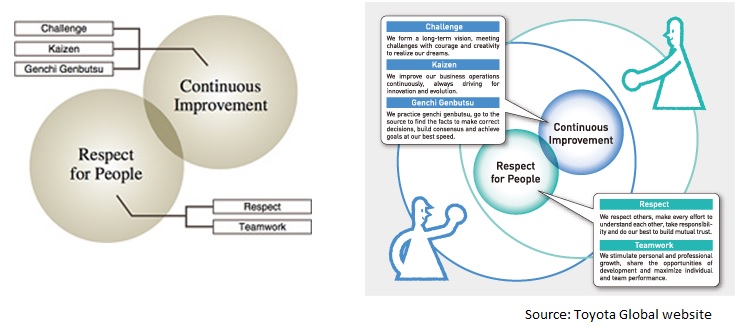
Maybe it is not by accident that the Toyota Way consists of ‘Continuous Improvement’ and ‘Respect for People’.

respect2

The Toyota Global website states the following;

The Toyota Way is supported by two main pillars: ‘Continuous Improvement’ and ‘Respect for People’. We are never satisfied with where we are and always work to improve our business by putting forward new ideas and working to the best of our abilities. We respect all Toyota stakeholders, and believe the success of our business is created by individual effort and good teamwork.

http://www.toyota-global.com/company/history_of_toyota/75years/data/conditions/philosophy/toyotaway2001.html

There is a saying from Toyota “Monozukuri wa hitozukuri,” which roughly translates to “making things is about making people.”

Deming did not talk specifically about ‘Respect for People’. However, his fourteen key principles to managers for transforming business effectiveness were very much about ‘Respect for People’. I have highlighted the sections that I believe applies to ‘Respect for People’.

  1. Create constancy of purpose toward improvement of product and service.
  2. Adopt the new philosophy. We are in a new economic age.
  3. Cease dependence on mass inspection.
  4. End the practice of awarding business on the basis of a price tag alone(This is about long-term relationship of loyalty and trust with your supplier base).
  5. Improve constantly and forever the system of production and service.
  6. Institute training.
  7. Adopt and institute leadership.
  8. Drive out fear.
  9. Break down barriers between staff areas
  10. Eliminate slogans, exhortations, and targets for the work force.
  11. Eliminate numerical quotas for the work force. Eliminate numerical goals for people in management.
  12. Remove barriers that rob people of pride of workmanship.
  13. Encourage education and self-improvement for everyone.
  14. Take action to accomplish the transformation. The transformation is everybody’s job.

Final Thoughts:

A lot of people before me have tried to define what ‘Respect for People’ mean to them. Jon Miller at GembaPantarei has further clarified that a better translation is Respect for Humanness or Humanity.

http://gembapantarei.com/2008/02/exploring_the_respect_for_people_principle_of_the/

To me, ‘Respect for People’ determines why I come to work today and tomorrow. My view is that by creating the equation making things is making people, Toyota has placed people development as a value added activity.

My view is that by creating the equation making things is making people, Toyota has placed people development as a value added activity.

If you agreed with the list of continuous improvement inhibitors, and if you believe that all, if not some, of the inhibitors are applicable to your organization, you may need to look at ‘Respect for People’.

Always keep on learning…
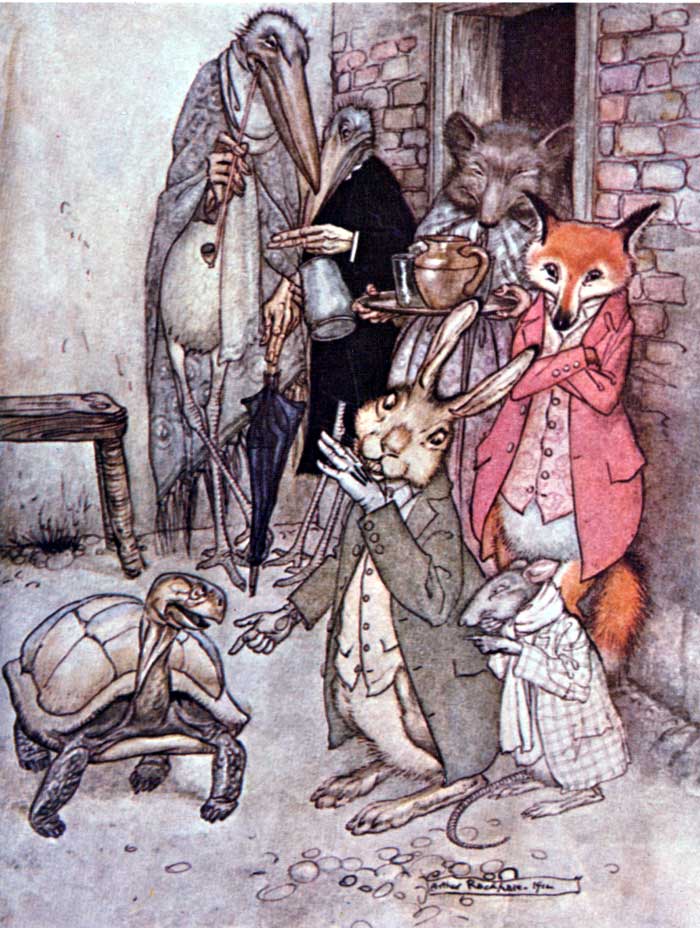
Rethinking Tortoise and Hare fable:

01hare

Taiichi Ohno, creator of the Toyota Production System wrote in his book “Toyota Production System – Beyond Large-Scale Production” that “The Toyota Production System can be realized only when all the workers become tortoises”. He was referencing the Tortoise and the Hare fable.

There are more references to this in Toyota Production System. Some of them are given below:

  • Heijunka – Leveling the load. The heijunka system uses the theme of “steady”. The production schedule is rearranged where daily production matches daily demand. This allows flexibility in your plant and reduces your inventory. Most importantly, it reduces Muri (overburdening) on your people.
  • Go slow to go fast” – unknown. Taiichi Ohno has stated “The slower but consistent tortoise causes less waste and is much more desirable than the speedy hare that races ahead and then stops occasionally to doze” in his book “Toyota Production System – Beyond Large-Scale Production.” The idea is that slowing down helps to see the big picture, and eliminates making mistakes and reworks. Thus in the long run, going slow and steady makes you fast. A corollary to this quote is “Haste makes waste.”

I remember reading the Aesop’s fable about the Tortoise and the Hare, and trying to understand the moral “Slow and steady wins the race”. I did not get the moral from the story. In my eyes, the hare lost simply because he slept during the race. The tortoise did not do anything special. As an adult, I feel that a better moral would be “Do not sleep at your job” or “Keep your eye on the goal”.

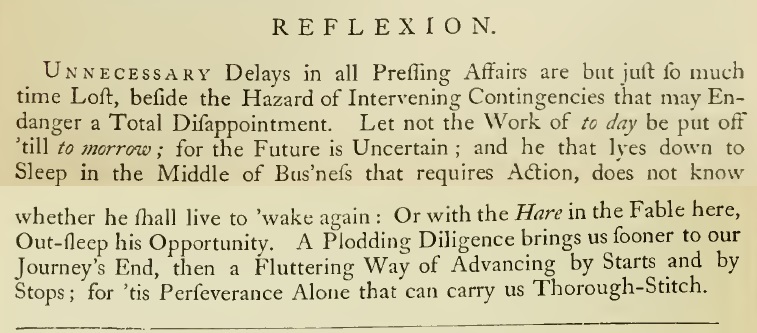
I did some research on the origins of the fable, and came across “Fables of Aesop and other Eminent Mythologists: With Morals and Reflections” written by Sir Roger L’Estrange (1669). Interestingly, the moral of the fable was a little different.

moral

Up and be doing, is an edifying text; for action is the business of life, and there’s no thought of ever coming to the end of our journey in time, if we sleep by the way.

The last section of “Reflection” is indeed a little more familiar.

reflection

A plodding diligence brings us sooner to our journey’s end than a fluttering way of advancing by starts and stops; for it is perseverance alone that can carry us through stitch.”

My take:

My take on the fable is that the race was actually a “long” race and the persistent tortoise had a long term plan (get to the end of the race at any cost), while the hare only was looking at short term gains (food, sleep etc.). Curiously, this aligns with the first principle in Jeff Liker’s Toyota Way.

“Base your management decisions on a long-term philosophy, even at the expense of short-term financial goals.”

Thus, in my view, the moral of the Tortoise and the Hare fable is to operate from a long term philosophy to win the race, without looking at short term gains.

Always keep on learning…