Maurice Merleau-Ponty’s Lean Lessons:

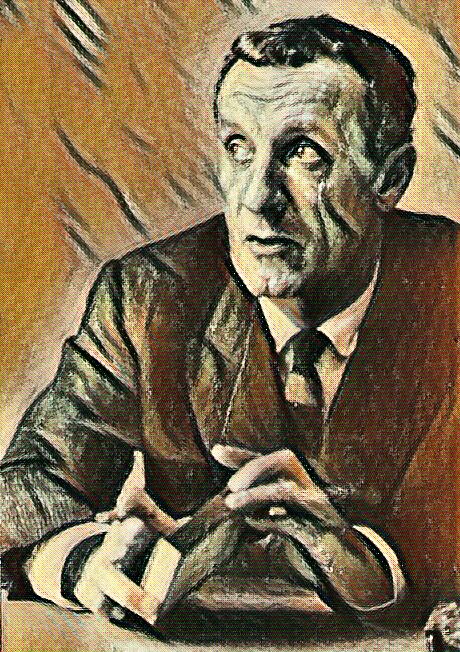
Merleau-Ponty

In today’s post, I am writing about three great Lean lessons inspired by the late French philosopher, Maurice Merleau-Ponty. Merleau-Ponty was a phenomenologist who believed that our conceptual framework is inherently flawed. He wanted to develop a framework that accurately reflected the nature of things it described. His insight was that we perceive things by interacting with them. The more we interact, the deeper our perception becomes, and the more we can enjoy the richness of the object we are interacting with. Merleau-Ponty believed that being in the world is the embodied experience of perception. The world does not present itself “all at once” to the perceiver. The perceiver has to go through an ongoing process of exploration and discovery and a deeper understanding emerges gradually through this ongoing process.

The three lessons I have chosen are interrelated and are about perception. Lean teaches us the importance of Genchi Genbutsu or Go to See and Grasp the Situation. The following three ideas align really well with the idea of Genchi Genbutsu.

  • The philosopher is a perpetual beginner…

Merleau-Ponty’s point here is that a true philosopher does not take things for granted. I will replace the word “philosopher” with “Lean leader”. Thus, the Lean leader is a perpetual beginner. As Lean leaders, we are ready to learn everyday from the gemba. We are continually improving our perception from the gemba. We must resist the urge to feel that we have completed our learning and that there is nothing left to learn. To paraphrase Merleau-Ponty, we need to learn to see the world (and gemba) as something new every single day. We must start to “see” with a beginner’s mind to learn.


  • In order to see the world, we must break with our familiar acceptance of it:

Our ability to observe depends on our preconceived notions and biases. Understanding of a phenomenon lies under the surface in the nuances and the contradictions. Our familiarity based on our prior biases cloud our ability to “see”, and Merleau-Ponty advises us to break our familiar acceptance in order to see the world. We must put aside our assumptions and relearn to see the world with fresh eyes.


  • Nothing is more difficult than to know precisely what we see:

This idea to me is simply wonderful. When we are at the Gemba to see or observe, we jump to conclusions. We believe that we “see” the problem and know how to fix it. The act of observing and perceiving requires a vantage point. This vantage point comes with prejudices. We believe that what we see is quite simple and straightforward, and that we have a clear perspective. This actually hinders our ability to know and understand the phenomenon we are perceiving. From a philosophy standpoint, we believe that what we perceive is reality. This of course is incomplete and most of the time a faulty notion.

Final Words:

The three ideas of Merleau-Ponty advises us to go to the Gemba more and interact with it to improve our understanding. We should look at the real workplace with the eyes of a beginner, and keep interacting with an open mind without preconceived notions to learn. We should resist the urge to believe that we know precisely what we see.

Taiichi Ohno was famous for his Ohno circles. Taiichi Ohno drew chalk circles and made the supervisor or the engineer stand in the circle to observe an operation until he was able to “see” the waste that Ohno saw. Similar to Merleau-Ponty, Ohno also advises us to go and see without preconceived notions. Go and see a lot. This helps us to improve our perception. The more we do it, the better we get at it. And yet, we should strive to remain a perpetual beginner.

Always keep on learning…

In case you missed it, my last post was Toyota Physics:

Toyota Physics:

newton

In today’s post, I am looking at Factory Physics and Toyota Production System. My main references for the post are the 1977 paper coauthored by ex-Toyota president Fujio Cho [1] and key ideas from Factory Physics [2].

One of my favorite definitions of “Lean” comes from Wallace J. Hopp and Mark L. Spearman (Factory Physics). They defined Lean as:

Lean is fundamentally about minimizing the cost of buffering variability… Production of goods or services is lean if it is accomplished with minimal buffering costs.

Variability is the norm of life. Variability is all around us. Variability impacts the 6Ms of production – Man, Method, Machine, Material, Mother Nature (Environment) and Measurement. Variability degrades the performance of a system. Variability is anything that causes the system to depart from regular, predictable behavior. Variability can be internal in the form of quality issues, operator unavailability, material shortage, skill levels, equipment issues etc. Variability can also be external in the form of irregular flow of customer orders, requests for diverse products, supplier issues, new regulations etc.

Factory Physics teaches us that any system has three buffers to deal with variability – Inventory, Capacity and Time.

Regardless of its source, all variability in a production system will be buffered. A fundamental principle of factory physics is that there are three types of variability buffer: inventory, capacity, and time.

For example, safety stocks represent inventory buffers against variability in demand and/or production. Excess capacity can also provide protection (i.e., a capacity buffer) against fluctuations in demand and/or production. Finally, safety lead times provide a time buffer against production variability. While the exact mix of buffers is a management decision, the decision of whether or not to buffer variability is not. If variability exists, it will be buffered somehow.

A Capacity buffer in the form of overtime is quite familiar to any organization. If there is excess demand, use overtime to get out of the backorder situation. The Inventory buffer in the form of just-in-case or safety stocks is also easy to understand. The last form, time buffer, is unfortunately suffered by the customer. When an organization cannot produce products on time, the lead time goes up and the customer has to wait. The time buffer is automatically enforced by the system when the other two buffers are not used wisely.

Another way to look at these buffers is to see what is waiting to know what buffer is available to use:

                Inventory buffer – parts are waiting

                Capacity buffer – resources (labor, equipment etc.) are waiting

                Time buffer – customers are waiting.

A successful organization is able to swap the right buffer at the right time in the right amount. The success of Taiichi Ohno and Toyota was in developing a production system framework through decades of trial and error that excelled in minimizing the cost of buffering variability.

Toyota could not match Ford or any other competitor in carrying the inventory required by the mass production system. Toyota focused first on the capacity buffer. They modified equipment to match what they needed. They created the Just-in-Time system so that required product is made at the right time and in the right quantity. They also had operators manage more than one piece of equipment at a time. Toyota was also able to bring down the set-up times for their equipment which allowed them to run a variety of parts in smaller lots. They focused on the flow of parts and redid the factory layout to match the process flow. With the development of the kanban system, Ohno was able to create a full-fledged pull system to support the Just-in-Time concept. As Hopp and Spearman point out, Toyota utilized the capacity buffer wisely. [3]

At a time when automotive plants generally ran three shifts a day, Toyota went to a two-shift schedule, with 10-hour shifts separated by 2-hour preventive maintenance (PM) periods. These PM periods served as capacity buffers to allow shifts to make up any shortfalls on their production quotas. With these capacity buffers as backup, Toyota could afford to run much leaner with respect to inventory.

A key part of increasing capacity was also where Toyota shined, with the concept of Respect for Humanity. This is very well described in the 1977 paper – Toyota production system and Kanban system Materialization of just-in-time and respect-for-human system (Y. Sugimori, K. Kusunoki, F. Cho & S. Uchikawa). The authors document that Toyota recognized the need for producing better quality goods having higher added value and at an even lower production cost than those of the other countries. Toyota focused on a system that would allow the workers to display their full capabilities by themselves. The authors detailed the “requirements” that existed at the time for the automotive industry – the need to carry large inventory of many different components.

The ordinary production control system in such an industry consists of fulfilling the production schedules by holding work-in-process inventory over all processes as a means of absorbing troubles in the processes and changes in demand. However, such a system in practice often creates excessive unbalance of stock between the processes, which often leads to dead stock. On the other hand, it can easily fall into the condition of having excessive equipment and surplus of workers, which is not conformable to Toyota’s recognition.

This section in the paper identifies the inventory buffer and capacity buffer quite well. Toyota was not keen on carrying inventory and having extra equipment and surplus of labor since that would increase the cost of production. Ohno realized that focusing on value added work would allow them to utilize the capacity buffer efficiently.

In order to improve their capacity buffer, Toyota focused on Respect for Humanity. The paper states:

The just-in-time production is a method whereby the production lead time is greatly shortened by maintaining the conformity to changes by having ” all processes produce the necessary parts at the necessary time and have on hand only the minimum stock necessary to hold the processes together”. In addition, by checking the degree of inventory quantity and production lead time as policy variables, this production method discloses existence of surplus equipment and workers. This is the starting point to the second characteristic of Toyota Production System (the first being Just-In-Time production), that is, to make full use of the workers’ capability.

Toyota clearly identified that they were not going to utilize the inventory buffer or the time buffer in the form of production lead time.

Toyota has succeeded in reducing the lot size through greatly shortening the· setup time, improving production methods including the elimination of in-process inventory within the process resulting from ordering of multipurpose machining equipment in accordance with the processing requirements for a product line, and improving conveyance resulting from repetitive mixed loading.

In fact, Toyota specifically called out not using the inventory buffer.

In the conventional production control system, existence of inventory is appreciated as a means to absorb troubles and fluctuations in demand and to smooth fluctuations in load of processes. In contrast to this, Toyota sees the stock on hand as being only a collection of troubles and bad causes.

Toyota went on to clearly state that carrying an inventory buffer goes against their need for respect for humanity.

Such latency of waste makes it difficult for workers to display their capability and it even becomes obstructive of an ever-lasting evolution of a company.

The paper also goes into detail on the formulation of number of the kanbans needed. They identify that the capacity buffer in the form of overtime and inventory buffer can be used initially while the plant focuses on making improvements.

Toyota defined themselves as an organization where conditions are enforced to make the necessity for improvement immediately visible. This is in a sense a pull system for improvements.

Any employee at Toyota has a right to make an improvement on the waste he has found. In the just-in-time production, all processes and all shops are kept in the state where they have no surplus so that if trouble is left, unattended, the line will immediately stop running and will affect the entire plant. The necessity for improvement can be easily understood by anyone. Therefore, Toyota is endeavouring to make up a working place where not only the managers and foremen but also all workers can detect trouble. This is called ‘ visible control ‘. Through visible control, all workers are taking positive steps to improve a lot of waste they have found. And the authority and responsibility for running and improving the workshop have been delegated to the workers themselves, which is the most distinctive feature of Toyota’s respect for human system.

Always keep on learning…

In case you missed it, my last post was My recent tweets…

[1] Y. SUGIMORI , K. KUSUNOKI , F. CHO & S. UCHIKAWA (1977) Toyota production system and Kanban system Materialization of just-in-time and respect-for-human system, THE INTERNATIONAL JOURNAL OF PRODUCTION RESEARCH, 15:6, 553-564, DOI:10.1080/00207547708943149

[2] Factory Physics, 3rd edition

[3] Wallace J. Hopp, Mark L. Spearman, (2004) To Pull or Not to Pull: What Is the Question? Manufacturing & Service Operations Management 6(2):133-148.

My recent tweets…

I will be posting soon… Meanwhile, here are some of my recent tweets that may be of interest to you.

Always keep on learning…

Is Lean the Medium or the Message?

IMG_7255

In today’s post, I am looking at the profound phrase of Marshall McLuhan, “The medium is the message.” Marshall McLuhan was a Canadian philosopher and a media theorist. McLuhan noted that: [1]

Each medium, independent of the content it mediates, has its own intrinsic effects which are its unique message… The message of any medium or technology is the change of scale or pace or pattern that it introduces into human affairs… It is the medium that shapes and controls the scale and form of human association and action.

The simplest understanding of the phrase, “the medium is the message”, is that it does not matter what we say, it matters how we say it. However, this is a simplistic view. McLuhan’s insight was that any medium is an extension of ourselves. For example, the telephone is an environment, and it affects everybody. The smartphone, which is a further advancement of the telephone, has a much larger impact on us and what we do. McLuhan realized that as we shape the media, the media shapes us. It is a complex interactive phenomenon. McLuhan said that it does not matter what you print, as long as you keep going with that activity. Every medium helps us to do much more that what we can do physically. For example, McLuhan talked about language being an extension of our thoughts, and written language is a further extension of our speech. The ability to print replaced the need for us to be there physically to extend our thoughts via speech. The ability to print had a profound impact on us much more than all the printed media combined. The medium is the message simply because the impact the media has on our social life.

McLuhan realized that media has an impact on our environment, and sadly we are most of the time unaware of our changing environment. He noted that people in any environment are less privileged to observing themselves than those slightly outside. McLuhan explained this phenomenon with a catchy phrase – the fish did not discover water. He postulated that fish may not be aware of the water, the very thing their life depend on. Another way to look at this is by looking at tweets from a politician. The tweets themselves are beside the point. The medium of Twitter has a far reaching impact on our social media. McLuhan would ask us to look beyond the obvious content in a tweet and look at the social impact the medium is generating.

I wanted to view this idea with Lean. As Lean Leaders, we are trying to propagate the good messages of Lean – “Banish waste”, “respect for Humanity”, “kaizen” etc. We need to realize that the message is not the content, but the medium and the context of our actions. As the aphorism goes, our actions speak louder than our words. The medium, as extensions of us, reaches into our lives and shape ourselves. We should concentrate on the medium to make a larger favorable impact. A good example is kanban. Kanban is a simple mechanism for a pull system, a paper slip that triggers production in a quantity that is needed at the time it is needed. However, the use of kanban leads to an awareness of the problems at the gemba, which leads to a need for a kaizen culture.

The ideas of revealing waste as it occurs, challenging ourselves to continuously improve by elimination of waste and develop people as part of a value adding function are integral to any Lean implementation. This complex intermingled set of ideas cannot be made understood by an edict top down from the CEO – “implement Lean.” What is needed is an understanding of the medium and the environment. The medium of daily board meetings for example has an impact on the social aspects in an organization because of involvements at different levels. The medium of QC circles or daily or weekly kaizen groups are another example. The content of fixing problems is not as important as the medium itself and the long-lasting impact it has by developing people to see wastes and improving their own ability to fix problems.

Sometimes we focus more on the content of the message, as in implementing “Lean”, without trying to understand what is the need that we are trying to address. McLuhan explained this focus on the content as a juicy piece of meat carried by the burglar to distract the watchdog of the mind. We are focusing on the wrong thing. The top down push for lean, six sigma etc. without changing medium may not have a lasting effect. The medium itself has to be changed to change the meaning and impact. The medium is the message, which is context driven! If you want to make “change”, don’t just change the message, change the medium itself. Hence, the title of this post – Is Lean the Medium or the Message?

Final Words:

It is said that the typesetters mistakenly printed, “The medium is the massage” on the cover of his book [2]. McLuhan loved the changed phrasing because it had additional interpretations that he appreciated. He said, “Leave it alone! It’s great, and right on target!” [3]

I will finish with a great insight that McLuhan made in 1964 [1], that foreshadowed the medium of internet and social media:

Archimedes once said, “Give me a place to stand and I will move the world.” Today he would have pointed to our electric media and said, “I will stand on your eyes, your ears, your nerves, and your brain, and the world will move in any tempo or pattern I choose.” We have leased these “places to stand” to private corporations.

Always keep on learning…

In case you missed it, my last post was Purpose of a System in Light of VSM:

[1] Understanding Media, Marshall McLuhan

[2] The Medium is the Massage, Marshall McLuhan

[3] https://www.marshallmcluhan.com/common-questions/

Cultural Transmission at Toyota:

Ohno_Eiiji_paint

One of my favorite stories related to statistics is of Abraham Wald. During World War II, American military sought the help of the Statistical Research Group (SRG) for their bomber planes. The problem was how to reinforce the planes to improve the chances of survival in an attack. The story goes that the military had done an analysis of the damages on all the planes returned from attacks. The different parts of the planes were the fuselage, the wings, the tail and the engine. The question was where should the reinforcement be done on the plane, because more reinforcement meant more weight, which impacted the performance of the plane. The data showed that the most damage was found on the fuselage. The military wanted to start working on reinforcing the fuselage. Wald, however, cautioned against it, and advised on reinforcing the least hit part that was most vulnerable part of the plane. It turned out that this part was the engine. Wald’s logic was that the military was looking at the planes that got hit and yet managed to come back safe. The data that was most important was on the planes that did not make it back home safe. This story is often used to explain the survivorship bias – the logical error of using the cherrypicked data of the very few that made the cut while ignoring the very high numbers of those who did not make the cut.

My main takeaway from the Wald story is about looking at what is not there. Sometimes this information is the most important and yet it is not readily visible. I will try to use this concept with Lean. Lean is often perceived as a set of tools. When Toyota opened the doors for the rest of the world, many like the Military in the Wald story saw only what was in front of them – 5S, Kanban, andon cords etc. The unseen part, the culture of Toyota, the Toyota Way, was missed. One of the words that sticks out when one reads the first books on Toyota Production System is “rationality.” Rationality is coming up with innovative ideas to meet the required challenge primarily with what you got – with your wit and what you have on hand already. Rationality is doing just what is right. Rationality is the root of kaizen.

I am interested in looking at how Taiichi Ohno was able to develop the Toyota Production System and most importantly make “it” stick, over the generations. Taiichi Ohno was inspired by the challenge issued by Kiichiro Toyoda, the founder of Toyota Motor Corporation. The challenge was to catch up with America in 3 years in order to survive.  Ohno built his ideas with inspirations from Sakichi Toyoda, Kiichiro Toyoda, Henry Ford and the supermarket system. The two pillars of the Toyota Production System are Just-in-Time and Jidoka. Just-in-time or “Exactly-in-time”, as Ohno calls it [1], is the idea of producing just what is needed at the right time in the right quantity. The concept of Just-in-Time was the brainchild of Kiichiro Toyoda. Kiichiro Toyoda had written a 4” thick pamphlet that detailed his ideas of a system to produce every day exactly what was needed in the quantity needed. Piror to Ohno’s kanban concept, Toyota was already using tickets as part of Just-in-Time system. The concept of Jidoka was based on the automatic loom developed by Sakichi Toyoda (father of Kiichiro Toyoda). The automatic loom that Sakichi built also had a weft-breakage automatic stopping device, which ensured that the loom stopped when a thread breakage occurred. This allowed one operator to handle multiple looms at a time. Thus, we can see that the two pillars of Toyota Product System were based on the concepts of two parental figures in the Toyoda family.

Toyota Global’s website details the roots of Toyota Production System: [2]

The Toyota Production System (TPS), which is steeped in the philosophy of “the complete elimination of all waste” imbues all aspects of production in pursuit of the most efficient methods, tracing back its roots to Sakichi Toyoda’s automatic loom. The TPS has evolved through many years of trial and error to improve efficiency based on the Just-in-Time concept developed by Kiichiro Toyoda, the founder (and second president) of Toyota Motor Corporation.

Taiichi Ohno rose to the occasion of increasing the productivity of Toyota by developing a production system to improve productivity. The concept of Jidoka he learned from the Toyota Automatic Loom Works company, allowed him to have one operator man multiple machines at a time. He rearranged the facility in order to allow the process to flow better. By expanding on the Just-in-Time idea and the American Supermarket system, he developed a kanban system that ensured a pull system to make product only in the right quantity at the right time. There was a lot of resistance against his ideas. It was initially termed as the “Ohno system” instead of “Toyota Production System.” Ohno however had the full support of his superiors, Eiji Toyoda and Naiichi Saito [1]. They absorbed all the discontent and grumbling directed at Mr. Ohno from the factory and never mentioned to him. They only wanted him to continue finding ways to reduce manufacturing costs.

Implementing a production system like Toyota’s, can be viewed as a cultural transmission phenomenon in the organization. As the great population geneticist Luca Cavalli-Sforza puts it [3]Cultural transmission is the process of acquisition of behaviors, attitudes, or technologies through imprinting, conditioning, imitation, active teaching and learning, or combinations of these. Cavalli-Sforza expands on this idea [4]: the ability to accumulate knowledge by cultural means, that is by exchange of information between individuals within and across generations, is a powerful mechanism for adapting to new situations… Culture allows the spread of targeted solutions to problems affecting a population.

Cavalli-Sforza’s research indicates that the essence of cultural transmission is learning from other individuals. Ohno taught his methods to the production team most of the time by directly going to the required personnel. Ohno was famous for drawing a circle on the production floor and making the engineer or the supervisor stand in it to observe an operation so that he can “see” the wastes. Ohno’s methods were based on the “reality” present only at the gemba. He sometimes used trial and error methods. As he stated [1]: To confirm hypotheses through experimentation is not confined to the academic world. In industry as well, ideas are tested through continuous trial and error.

As I was reading Cavalli-Sforza’s works, one particular concept stayed with me. He noted that transmission through a social leader or teacher results in greater homogeneity in a population than transmission through a parental figure. The social leader has great influence over others in an organization. At the same time, the parental figure can have a long-lasting effect. [5]The culture created by the organization’s initial leaders forms a “genetic imprint” for the organization’s ontogeny; it will be clung to until it becomes unworkable or the group fails and breaks up. The two aspects of the cultural transmission from a social leader (Taiichi Ohno) and parental figures (Sakichi Toyoda and Kiichiro Toyoda) resonates well with any student of the Toyota Production System.  The cultural transmission over time allows for better ideas and practices to replace the less effective ones while at the same time maintaining the core concepts of the system.

Always keep on learning…

In case you missed it, my last post was Herd Structures in ‘The Walking Dead’ – CAS Lessons:

[1] Just-In-Time For Today and Tomorrow, Taiichi Ohno and Setsuo Mito

[2] Toyota Global Website

[3] Theory and Observation in Cultural Transmission, L. L. Cavalli-Sforza, M. W. Feldman et al.

[4] Cultural Transmission and Adaptation, L. Luca Cavalli-Sforza

[5] A Complex Adaptive Systems Model of Organization Change, Kevin J. Dooley

Herd Structures in ‘The Walking Dead’ – CAS Lessons:

zombie_PNG64

The Walking Dead is one of the top-rated TV shows currently. The show is about survival in a post-apocalyptic zombie world. The zombies are referred to as “walkers” in the show. I have written previously about The Walking Dead here. In today’s post, I want to briefly look at Complex Adaptive Systems (CAS) in the show’s backdrop. A Complex Adaptive System is an open non-linear system with heterogenous and autonomous agents that have the ability to adapt to their environment through interactions between themselves and with their environment.

The simplest example to get a grasp of CAS is to look at an ant colony. Ants are simple creatures without a leader telling what each ant should do. Each ant’s behavior is constrained by a set of behavioral rules which determine how they will interact with each other and with their environment. The ant colony taken as a whole is a complex and intelligent system. Each ant works with local information, and interacts with other ants and the environment based on this information. The different tasks that the ants do are patrol, forage, maintain nest and perform midden work. The local information available to each ant is the pheromone scent from another ant. As a whole, their interactions result in a collective intelligence that sustains their colony. In presence of perturbations in their environment, the ants are able to switch to specific tasks to maintain their system. The ants decide the task based on the local information in the form of perturbation to their environment and their rate of interaction with other ants performing the specific tasks. The ants go up in the ranks eventually becoming a forager in the presence of need. A forager ant always stays a forager. The ant colony carries a large amount of “reserve ants” who do not perform any function. This reserve allows for specific task allocation as needed based on perturbations to their environment.

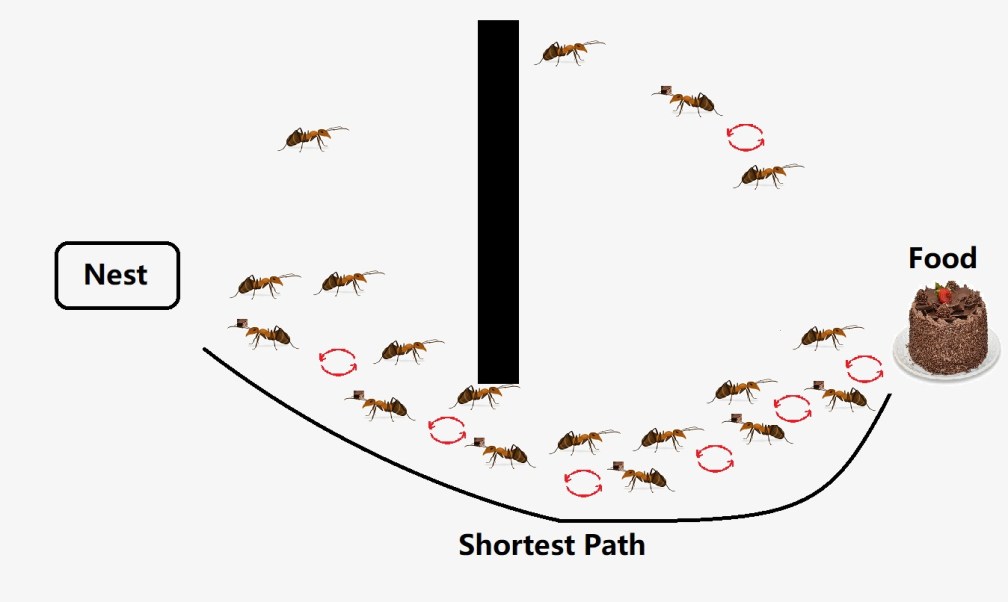
To further illustrate the “self-organizing” or pattern forming behavior of ants, let’s take for example, their foraging activity. The ants will set out from the colony in a random fashion looking for food. Once an ant finds food, it will bring it back to the nest leaving a pheromone trail on its way back. The other ants engaged in the foraging activity will follow the pheromone trail and bring back food while leaving their pheromone scent on the path. The pheromone scent will evaporate over a short amount of time. The ants that followed the shortest path would go back for more food and their pheromone trail will stay “fresh” while a longer path will not remain as “fresh” since the pheromone has more time to evaporate. This means that the path with the strongest pheromone trail is the shortest path to the food. The shortest path was a result of positive feedback loops from more and more ants leaving pheromone at a faster rate. Here the local information available to each ant is the rate of pheromone release from the other ants. The faster the rate, the stronger the trail. This generally corresponds to the shortest trail to the food source. Once the food source is consumed, another food source is identified and a new short path is established. This “algorithm” called as Ant Colony Optimization Algorithm is utilized by several transportation companies to find the shortest routes.

Foraging

In the show, The Walking Dead, a similar collective behavior is shown by the zombies. The zombies exhibit a herding behavior where a large number of zombies will move together as a herd in search for “food”. The zombies in The Walking Dead world are devoid of any intelligence and there is no one in charge similar to the ants. The zombies however do not have a nest. They just wander around. The zombies in the show are attracted by sound, movement and possibly absence of “zombie smell”. The zombies do not attack each other possibly due to the presence of “zombie smell”. In fact, in the show several characters were able to survive zombie attack by lathering themselves in the “zombie goo”.

The possible explanation for the formation of herd structures is the hardwired attribute that we all have – copying others. We tend to follow what others are doing when we are not sure what is happening. We go with the flow. A good example is the wave we do in a sports stadium. We could develop a model where a few zombies are attracted by a stimulus and they walk toward the stimulus. The other zombies simply follow them, and soon a large crowd forms due to the reinforced loops with more and more followers. This is similar to the positive reinforcing feedback of pheromone trail in the example of ants.

The show recently introduced an antagonist group called the “Whisperers”. The Whisperers worship the dead and adorn the zombie skins and walk amongst the zombies. They learned to control the herd and make them go where they want. The Whisperers themselves a CAS, adapted to survive by being with the walkers. Possibly, they are able to guide the walkers by first forming a small crowd themselves and then getting more walkers to join them as they move as a group. Since they have the “zombie smell” on them, the walkers do not attack them.

How Does Understanding CAS Help Us?

We are not ants and certainly not zombies (at least not yet). But there are several lessons we can get from understanding CAS. We all belong to a CAS at work, and in our community. The underlying principle of CAS is that we live in a complex world where we can understand the world only in the context of our environment and our local interactions with our neighbors and with the environment. Every project we are involved in is new and not identical to any previous project. This could be the nature of the project itself, or the team members or the deadlines or the client. Every part of the project can introduce a new variation that we did not know of. Given below are some lessons from CAS.

  1. Observe and understand patterns:

Complex Adaptive Systems present patterns due to the agents’ interactions. You have to observe and understand the different patterns around you. How do others interact with each other? Can you identify new patterns forming in the presence of new information or perturbations in your environment? Improve your observation skills to understand how patterns form around you. Look and see who the “influencers” are in your team.

  1. Understand the positive and negative feedback loops:

Observe and understand the positive and negative feedback loops that exist around. A pattern forms based on these loops. The awareness of the positive and negative loops will help us nurture the required loops.

  1. Be humble:

Complexity is all around us and this means that we lack understanding. We cannot foresee or predict how things will turn out every time. Complex systems are dispositional, to quote Dave Snowden. They may exhibit tendencies but we cannot completely understand how things work in a complex system. Edicts and rules do not always work and they can have unintended consequences. Every event is possibly a new event and this means that although you can have insights from your past experiences, you cannot control the outcomes. You cannot simply copy and paste because the context in the current system is different.

  1. Get multiple perspectives always (reality is multidimensional and constructed):

Get multiple perspectives. To quote the great American organizational theorist, Russell Ackoff, “Reality is multidimensional.” To add to this, it is also constructed. The multiple perspectives help us to understand things a little better and provide a new perspective that we were lacking. Systems are also constructed and can change how it appears depending on your perspective.

  1. Go inside and outside the system:

We cannot try to understand a system by staying outside it all of the time. Similarly, we cannot understand a system by staying inside it all of the time. Go to the Gemba (the actual workplace) to grasp the situation to better understand what is going on. Come away from it to reflect. We can understand a system only in the context of the environment and the interactions going on.

  1. Have variety:

Similar to #4, variety is your friend in a complex system. Variety leads to better interactions that will help us with developing new patterns. If everybody was the same then we would be reinforcing the same idea that would lack the requisite variety to counter the variety present in our environment. Our environment is not homogenous.

  1. Aim for Effectiveness and not Efficiency:

In complex systems, we should aim for effectiveness. Here, the famous Toyota heuristic, “Go slow to go fast” is applicable. Since each event is novel, we cannot aim for efficiency always.

  1. Use Heuristics and not Rules:

Heuristics are flexible and while rules are rigid. Rules are based on past experiences and lack the variety needed in the current context. Heuristics allow flexing allowing for the agents to change tactics as needed.

  1. Experiment frequently with safe to fail small experiments:

As part of prodding the environment, we should engage in frequent and small safe to fail experiments.  This helps us improve our understanding.

  1. Understand that complexity is always nonlinear, thus keep an eye out for emerging patterns:

Complexity is nonlinear and this means that a small change can have an unforeseen and large outcome. Thus, we should observe for any emerging patterns and determine our next steps. Move towards what we have identified as “good” and move away from what we have deemed as “bad”. Patterns always emerge bottom-up. We may not be able to design the patterns, but we may be able to recognize the patterns being developed and potentially influence them.

Final Words:

My post has been a very simple look at CAS. There are lot more attributes to CAS that are worth pursuing and learning. Complexity Explorer from Santa Fe institute is a great place to start. I will finish with a great quote from the retired United States Army four-star general Stanley McChrystal, from his book, Team of Teams:

“The temptation to lead as a chess master, controlling each move of the organization, must give way to an approach as a gardener, enabling rather than directing. A gardening approach to leadership is anything but passive. The leader acts as an “Eyes-On, Hands-Off” enabler who creates and maintains an ecosystem in which the organization operates.”

Always keep on learning…

In case you missed it, my last post was Conceptual Metaphors in Lean:

Conceptual Metaphors in Lean:

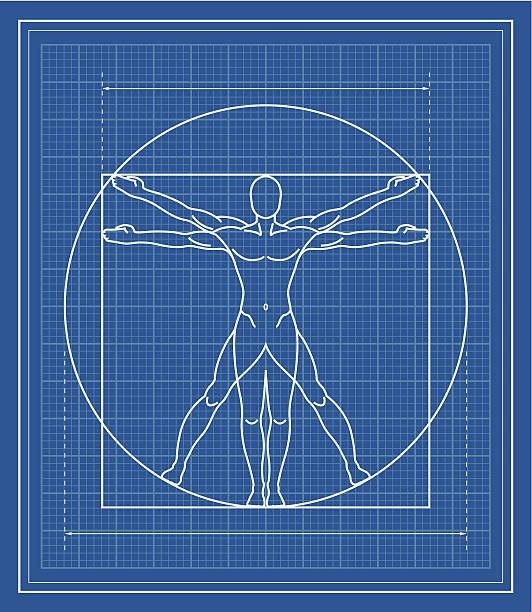
Vitruvian Man blueprint.

In today’s post, I am looking at conceptual metaphors in Lean. A Conceptual metaphor is a concept in conceptual linguistics, first introduced by George Lakoff and Mark Johnson in their 1980 book, Metaphors We Live By. They noted that:

Human beings structure their understanding of their experiences in the world via “conceptual metaphors” derived from basic sensorimotor and spatial concepts (spatial primitives and image schemata) learned during infancy and early childhood. 

Metaphors are normally thought of as a way to explain something further. Aristotle noted that metaphors made learning pleasant. “To learn easily is naturally pleasant to all people, and words signify something, so whatever words create knowledge in us are most pleasant.” However, the conceptual metaphor theory goes beyond the metaphor being just a linguistic/artistic phenomenon. The conceptual metaphor theory notes that metaphors are primarily used to understand abstract concepts, and that these are used subconsciously on an everyday basis. The conceptual metaphors are treated as an inevitable part of our thinking and reasoning. Lakoff and Johnson note that:

The essence of metaphor is understanding and experiencing one kind of thing in terms of another… Metaphors are fundamentally conceptual in nature; metaphorical language is secondary. Conceptual metaphors are grounded in everyday experience. Abstract thought is largely, though not entirely, metaphorical. Metaphorical thought is unavoidable, ubiquitous, and mostly unconscious. Abstract concepts have a literal core but are extended by metaphors, often by many mutually inconsistent metaphors. Abstract concepts are not complete without metaphors. For example, love is not love without metaphors of magic, attraction, madness, union, nurturance, and so on.

One form of conceptual metaphor is an “Ontological Metaphor” – a metaphor in which an abstraction, such as an activity, emotion, or idea, is represented as something concrete, such as an object, substance, container, or person. A good example of an ontological metaphor in lean is waste. We are taught that we should seek total elimination of waste in lean. We are giving a physical representation to the abstract concept of “waste”. Waste is an adversary that can hurt us, steal from us, and destroy us. To paraphrase Lakoff: (I have inserted Waste in his example)

The ontological metaphor of waste allows us to make sense of phenomena in the world in human terms—terms that we can understand on the basis of our own motivations, goals, actions, and characteristics. Viewing something as abstract as waste in human terms has an explanatory power of the only sort that makes sense to most people. When we are suffering substantial economic losses, WASTE IS AN ADVERSARY metaphor at least gives us a coherent account of why we’re suffering these losses.

It is also interesting to see how the concept of waste got translated as it was transplanted from Toyota to the West. Taiichi Ohno, the father of TPS, saw waste in terms of man-hours and labor density. Outside Toyota, elimination of waste was seen as a means to increase capacity, a pursuit of efficiency alone.

Labor density is the ratio of work and motion.

Work/Motion = Labor Density

In the equation, work indicates the action carried out to forward a process or enhance the added value. Ohno realized that the correct way to improve labor density is to keep the numerator (work) the same, while decreasing the non-value added portion of motion. The denominator is an impersonal motion and the numerator is work with a human touch. The act of intensifying labor density or of raising the labor utility factor means to make the denominator smaller (by eliminating waste) without making the numerator larger.

Kiichiro Toyoda, Toyota’s president in 1949, issued the challenge to catch up with the United States within three years. America’s productivity was thought to be eight or nine times better than Japan’s. Ohno realized that this was not because the Americans were physically exerting ten times more than the Japanese. “It was probably that the Japanese are wasteful in their production system”, Ohno thought. Ohno’s view was that the total elimination of waste should result in man-hour reduction. Toyota’s man-hour reduction movement is aimed at reducing the overall number of man-hours by eliminating wasted motions and transforming them into work. Toyota succeeded because they realized that elimination of waste was an expression of their respect for humanity. The respect of humanity portion may have gotten lost in translation when the ontological metaphor of “waste” was spread outside Toyota.

Employees give their valuable energy and time to the company. If they are not given the opportunity to serve the company by working effectively, there can be no joy. For the company to deny that opportunity is against the principle of respect for humanity. People’s sense of value cannot be satisfied unless they know they are doing something worthwhile.

Ohno’s first go-to training tool was to ask the supervisor to try doing the same work with less operators. The elimination of waste becomes easier when the operators have a visual control system for seeing waste as either time on hand or stock on hand, and when they avoid overproduction via Kanban. Ohno’s view of elimination of waste was to be effective and efficient by producing only what is needed. The idea of elimination of waste in the West may have become pursuing just efficiency and dropping effectiveness. The waste elimination can be viewed as a means to increase capacity, and this leads to the question – why should we stop at the daily required quantity of 100 units now that the improvement activities have yielded us more capacity to produce up to 125 units a day? Lean has become “doing more with less”, while Ohno’s goal was “doing just what is needed with less.” Ohno’s goal was being efficient and effective, even if it meant machines remained idle.

Final Words:

The term “Lean” itself is a conceptual metaphor. “Lean” refers to being fit, as opposed to being obese. In “Lean”, elimination of waste is about “trimming the fat”. The metaphor of “lean” represents the aesthetics of being beautiful and healthy – perhaps a notion of being in charge and knowing what needs to be done. This could be viewed as the Western philosophy of outwardly focus on external beauty, whereas the Eastern philosophy is more inwardly focused. In Japanese culture, the concept of harmony is imperative. This is part of the ‘respect for humanity’ side of the Toyota Production System.

I welcome the reader to explore the concept of conceptual metaphor. You may also like one of my older posts – Would Ohno Change the Term “Lean”?

Always keep on learning…

In case you missed it, my last post was Chekhov’s Gun at the Gemba:

Chekhov’s Gun at the Gemba:

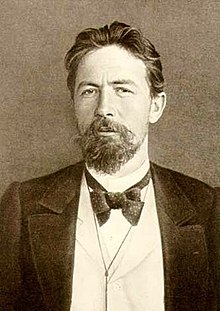
chekhov

One of my favorite things to do when I learn a new and interesting information is to apply it into a different area to see if I can gain further insight. In today’s post, I am looking at Chekhov’s gun, named after the famous Russian author, Anton Chekhov (1860-1904), and how it relates to gemba. Anton Chekhov is regarded as a master short story writer. In the short story genre, there is a limited amount of resources to tell your story. Chekhov’s gun is a principle that states that everything should have a purpose. Checkhov said:

Remove everything that has no relevance to the story. If you say in the first chapter that there is a rifle hanging on the wall, in the second or third chapter it absolutely must go off. If it’s not going to be fired, it shouldn’t be hanging there.

Chekhov also stated:

“One must never place a loaded rifle on the stage if it isn’t going to go off. It’s wrong to make promises you don’t mean to keep.” [From Chekhov’s letter to Aleksandr Semenovich Lazarev in 1889]. Here the “gun” is a monologue that Chekhov deemed superfluous and unrelated to the rest of the play.

“If in the first act you have hung a pistol on the wall, then in the following one it should be fired. Otherwise don’t put it there.” [From Gurlyand’s Reminiscences of A. P. Chekhov, in Teatr i iskusstvo 1904, No. 28, 11 July, p. 521]. Source: Wikipedia.

How does this relate to Gemba? Gemba is the actual place where you do your work. When you design the work station with the operator, you need to make sure that everything has a place and everything has a purpose. Do not introduce an item to the station that has no need to be there. Do not introduce a step or an action that does not add value. This idea also applies to the Motion Economy. Let’s look at some of the Industrial Engineering maxims from the Principles of Motion Economy that are akin to Chekhov’s gun:

  • There should be a definite and fixed place for all tools and materials.
  • Tools, materials, and controls should be located closely in and directly in front of the operator.
  • Materials and tools should be located to permit the best sequence of motions.
  • Two or more jobs should be worked upon at the same time or two or more operations should be carried out on a job simultaneously if possible.
  • Number of motions involved in completing a job should be minimized.

Chekhov’s gun is not necessarily talking about foreshadowing in a movie or a book. A gun should not be shown on the wall as a decoration. It needs to come into the story at some point to be value adding. The author should make use of every piece introduced into the story. Everything else can be removed. I loved this aspect of Chekhov’s gun. In many ways, as a lean practitioner, we are also doing the same. We are looking at an operation or a process, and we are trying to eliminate the unwanted steps/items/motions. When you work in a strictly regulated industry such as medical devices, the point about line clearance also comes up when you ponder about Chekhov’s gun. Line clearance refers to removal of materials, documentation, equipment etc. from the previous shop order/work order to prevent any inadvertent mix-ups that can be quite detrimental to the end user. Only keep things that are necessary at the station.

I will finish with a great lesson from Anton Chekhov that is very pertinent to improvement activities.

Instructing in cures, therapists always recommend that “each case be individualized.” If this advice is followed, one becomes persuaded that those means recommended in textbooks as the best, means perfectly appropriate for the template case, turn out to be completely unsuitable in individual cases.

Always keep on learning…

In case you missed it, my last post was The Confirmation Paradox:

The Confirmation Paradox:

albino raven

In today’s post I will be looking at Confirmation Paradox or Black Raven Paradox by Carl Hempel. Let’s suppose that you have never seen a raven in your life. You came across a raven one fine morning, and observe that it is black in color. Now that you have seen one, you suddenly start paying more attention and you start seeing ravens everywhere. Each time you see a raven, you observe that its color is black. Being the good scientist that you are, you come to a hypothesis – All ravens are black. This is also called induction, coming to a generalization from many specific observations.

Now you would like to confirm your hypothesis. You ask your good friend, Carl Hempel, to help. Carl suggests that you start looking at things around his house that are not black and not raven, like his red couch, the yellow tennis ball etc. He suggests that each of those observations support your hypothesis that all ravens are black. You are rightfully puzzled by this. This is the confirmation paradox. Carl Hempel was a German born philosopher who later immigrated to America.

Carl Hempel is correct with this claim. Let’s look at this further. All ravens are black can be restated as “Whatever is not black is not a raven”. This is a logical equivalence of your hypothesis. This would mean that if you observe something that is not black and is not a raven, it would support your hypothesis. Thus, if you observe a red couch, it is not black and it is also not a raven, therefore it supports your hypothesis that all ravens are black.

How do we come in terms with this? Surely, it does not make sense that a red couch supports the hypothesis that all ravens are black. The first point to note here is that one can never prove a hypothesis via induction. Induction requires the statement to be provided with a level of confidence or certainty. This would mean that the level of “support” that each observation makes depends upon the type of information gained from that observation.

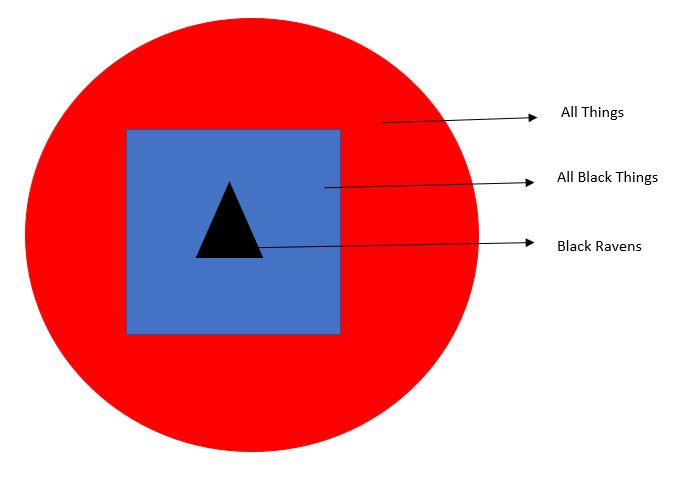
I will explain this further with the concept of information from Claude Shannon’s viewpoint. Information is all around us. Where ever you look, you can get information. Claude Shannon quantified this in terms of entropy with the unit as a bit. He described this as the amount of surprise or reduction of uncertainty. Information is inversely proportional to probability of an event. The less probable an event is, the more information it contains. Let’s look at the schematic below:

ravens

The black triangle represents all the black ravens in our observable universe. The blue square represents all of the black things in our observable universe. The red circle represents all the things in the observable universe. Thus, the set of black ravens is a subset of all black things, which in turn is a subset of all things. From a probability standpoint, the probability of observing a black raven is much smaller than the probability of observing a black thing since there are proportionally a lot more black things in existence. Similarly, the probability of observing a non-black thing is much higher since there are lot more non-black things in existence. Thus, from an information standpoint, the information you get from observing a non-black thing that is not a raven is very very small. Logically, this observation does provide additional support, however, the information content is miniscule. Please note that, on the other hand, observing a black raven is also supporting the statement that all non-raven things are non-black.

When you first saw a black raven, you had no idea about such a thing existing. The information content of that observation was high. After you started observing more ravens, the information you got from each observation started diminishing. Even if you made 10,000 observations of black ravens, you cannot prove (100% confirm) that all ravens are black. This is the curse of induction. This is where Karl Popper comes in. Karl Popper, an Austrian-British philosopher, had the brilliant insight that good hypotheses should be falsifiable. We should try to look for observations that would fail our hypothesis. His insight was in the asymmetry of falsifiability. You may have 100,000 observations supporting your hypothesis. All you need is a single observation to fail it. The most popular example for this is the case of the black swan. The belief that all swans are white was discredited when black swans were discovered in Australia. To come back to the information analogy, the observation of a white raven has lot more information content that is powerful enough to break down your hypothesis since the occurrence of a white raven(albino) is very low in nature. Finding a white raven is quite rare and thus have the most information or surprise.

This also brings up the concept of Total Evidence. The concept of Total Evidence was put forth by Rudolf Carnap, a German born philosopher. He stated that in the application of inductive logic to a given knowledge situation, the total evidence available must be taken as basis for determining the degree of confirmation. Let’s say that as we learned more about ravens and other birds, we came across the concept of albinism in other animals and birds. This should make us challenge our hypothesis since we know that albinism can occur in nature, and thus it is not farfetched that it can occur in ravens as well. The concept of Total Evidence is interesting because even though it has the term “Total” in it, it is beckoning us to realize that we cannot ever have total information. It is a reminder for us to consider all possibilities and to understand where our mental models break down. In theory, one could also make whimsical statements such as “All unicorns are rainbow colored”, and say that the observation of a white shoe supports it based on the confirmation paradox. Total evidence in this case would require us to have made at least one observation of a rainbow colored unicorn.

I will finish with another paradox that is similar to the confirmation paradox – the 99-foot (feet) man paradox by Paul Berent. Up to this point, we have been looking at qualitative data (black versus not black, or raven versus not raven). Let’s say that you have a hypothesis that says all men are less than 100 feet. You surveyed over 100,000 men and found all of them to be less than 100 feet. One day you heard about a new circus company coming to town. Their main attraction is a 99-foot man. You go to see him in person and sure enough, he is 99 feet tall. Now, your hypothesis is still intact since the 99-foot man is technically less than 100 feet. However, this adds doubt to your mind. You realize that if there is a 99-foot man, then the occurrence of a 100-foot man is not farfetched. The paradox occurs since the observation of a 99-foot man strengthens your hypothesis, but at the same time it also weakens it.

Always keep on learning…

In case you missed it, my last post was Know Your Edges: