Real Lean:

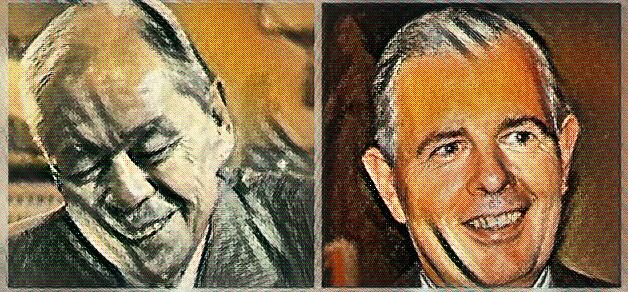
Ohno

In today’s post, I am looking at Lean through “realism”. Realism in philosophy has the view that things exist in the real world, independent of us, and that we can mirror reality in our mind. Through perception and our senses, we can gain knowledge about reality, albeit incomplete and imperfect. This stands in direct contrast against idealism in philosophy. Idealism has the view that the ultimate foundation of reality is completely inside the mind.

Taiichi Ohno, the father of Toyota Production System, put a lot of emphasis on what is real. His viewpoints were influenced by the Eastern philosophies of Zen and Confucianism, as well as by the scientific realism approaches proposed by Taylor, Ford, Lillian and Frank Gilbreths etc. Zen teaches to observe and grasp reality as-is; being here and now. Confucianism emphasizes virtue, benevolence and humanness. Taylor’s scientific management pursued the best way to make the operation more efficient. Ford’s ideas put emphasis on assembly lines and mass production. The Gilbreths focused on time and motion studies, and adapted teaching techniques so that the operators were able to learn better and understand the “why” and the “how”. Lilian Gilbreth championed for the “human element” in the production system.

Ohno’s thinking was based on reality – what is happening on the production floor. Ohno’s favorite word, in my opinion, would had been “genba”. The “gen” part in “genba” stands for actual or real. Genba is thus, the actual or real place where the action is. This would be the production floor for Ohno. Ohno viewed genba as the greatest teacher to learn from. His main line of thinking was to identify problem and take action; and by doing this again and again, get better at it. Additionally, he mentored and trained others to do the same. Ohno proposed that the basis of Toyota Production System was complete elimination of waste. Ohno even came up with seven types of wastes to help others. Ohno’s message was always kaizen – improve continuously. He taught at the genba, and had his team stand on the production floor in a chalk-drawn circle to see the waste. Ohno said that unless we actually try, we will never learn.

…Just try it. Try it, and if there are two opinions, let them each try it for one day. [1]

Ohno also said that even if your idea worked out, you should not just be satisfied with a verbal report. You should go to the genba and see for yourself. Go see with your own eyes, and you will understand very well what things were tried and what things were not included in your calculations.

Ohno was not a believer in simply copying and pasting. He said:

Even if we could see and copy what another company was doing, if we did not change it further we would only be as good as the company we had seen.

Ohno put a lot of emphasis on facts, and the source for the facts had to be genba, nowhere else. This is realism in action. It is said that Ohno hated written reports, and it is also said that he did not keep a lot of paperwork at his desk. [2] Ohno trusted only the things that he could see with his own eyes. Ohno advised that waiting till you got data from the genba is not good. It would be late by then. The horse is out of the barn by then. You have to take action on the spot at the genba. You have to go to the source to gather the data.

The andon lamps [which light up when employees pull the line-stop cord to indicate trouble] tell you where the problems are happening. You need to go to those places and examine the processes carefully. If you watch carefully, you’ll see what’s causing the problems. Then, you can do your kaizen improvements. Doing that again and again is how you raise productivity.[2]

Ohno was by no means an idealist and he was not a big fan of conjectures unless they could be put into action. Ohno believed that unless you felt the “squeeze”, your wits wont work. He kept challenging the supervisors and operators to do more with less. This was not always about cost savings, it was about developing them so that they become autonomous – see the problem, fix the problem. They were given the authority to stop the line, if there was any problem so that appropriate counteractions could be taken. If everything was running fine, Ohno would purposefully create conditions for learning by asking to remove an operator. Ohno also said that in order to make others feel the squeeze, you have to feel the squeeze yourself.

It may be easy to view Lean as a set of tools which can be copied into your organization. And it may even be possible to achieve a production system where everything flows and the production goals are met. Ohno would still not be happy with this scenario. Ohno would look at the well-run operations, and then look at the operators. If the operators are not able to continuously improve, Ohno would not be happy.

Anyone can gain knowledge through study. But wisdom is something else again. And what we need in the workplace is wisdom. We need to foster people who possess wisdom. The only way to do that is to set our goals high and force people to accomplish more than they might have thought possible. Once people really resolve to do something, the necessary wisdom arises. The people grow, and they assert new capabilities.

The most important thing for people in manufacturing is to keep one foot in the production workplace and take a good look at things there before making decisions. People who excel at anything tend to be people who insist on seeing things for themselves. That’s because the facts are in the things that we can actually see, and we can only get at the truth through the facts. Just thinking about things in your own head won’t [lead you to the truth].

All that I have written so far can be condensed into – Genchi Genbutsu. “Genchi” means actual place, and “Genbutsu” means actual parts. Genchi Genbutsu is often explained as “Go and see for yourself”, “Grasp the current condition” etc. In addition, there is also a third “gen” word – “Genjitsu”, which means actual data or facts. Collectively, the three “gens” are referred to as Sangen shugi or Three Reals Philosophy.

I will finish with an Ohno quote that might put an additional twist on what I have been saying so far. I had indicated that Ohno came up with seven wastes earlier and this is documented in his book, “Toyota Production System.”

I don’t know who came up with it but people often talk about “the seven types of waste.” This might have started when the book came out, but waste is not limited to seven types. There’s an old expression: “He without bad habits has seven,” meaning even if you think there’s no waste you will find at lease seven types. So I came up with overproduction, waiting, etc., but that doesn’t mean there are only seven types. So don’t bother thinking about “what type of waste is this?” Just get on with it and do kaizen.

Perhaps Ohno is saying that you should not just read his book and gain knowledge for the sake of it. We should start from need and practice. We should not be bound by what now is conventional wisdom. Ohno is challenging us to go to genba and solve our own problems, and in the process develop ourselves and others.

I should also note that there is a wonderful and insightful series of books written by Bob Emiliani called “Real Lean.” I encourage the reader to check them out.

Please also note that genba and gemba are used interchangeably. I have chosen to use genba to emphasize the “gen” part.

Always keep on learning…

In case you missed it, my last post was Ohno and VUT:

[1] Workplace Management, Taiichi Ohno

[2] Birth of Lean, The Lean Enterprise Institute
Ohno and VUT:

Ohno and Kingsman

One of my favorite “Factory Physics [1] equations” is Kingman’s equation, usually represented as “VUT”. The VUT equation is named after Sir John Kingman, a British mathematician.

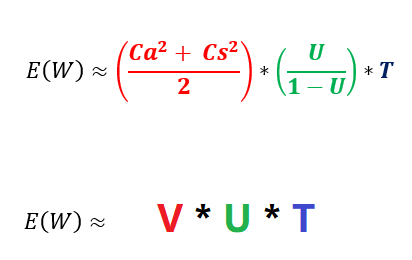
The equation is as follows:

VUT

The first factor represents variability and is a combination of variability factors representing arrival and service times (flow variability and process variability). The second factor represents utilization of the work station or the assembly line. The third factor represents the average processing time in the work station or the assembly line. The VUT equation shows that the average cycle time or wait time is proportional to the product of variability, utilization and process time.

The most important lesson from VUT is:

If a station increase utilization without making any other change, average WIP (work in process) and cycle time will increase in a highly nonlinear fashion.

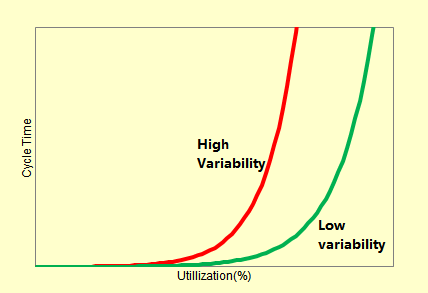
The influence of variability on cycle time is shown below. The red line shows that with high variability, any increase in utilization will results in an exponentially higher cycle time. If the variability is low (indicated by the green line), then the increase in the cycle time happens at a slower rate. If there was no variability, then the cycle time will be a constant. In other words, an increase in variability always degrades the performance of a production system.

VUT chart

Some of the lessons that we can learn from VUT equation are:

  1. To maintain a steady cycle time, reduce utilization if variability cannot be reduced. Reducing utilization means increasing capacity. As demand goes up, do not try to run the line at 100% utilization.
  2. The VUT equation can be used in conjunction with Little’s Law. Little’s Law states that WIP is proportional to the product of Throughput rate and Cycle Time. In other words, WIP is proportional to the product of Throughput and VUT. If you try to reduce WIP without trying to reduce variability, the throughput will go down. Thus, implementing one-piece flow without trying to reduce variability will result in a reduction in throughput.
  3. Reducing process variability will reduce cycle time variability.
  4. Adding buffer space at bottlenecks will improve throughput. Adding buffers at non-bottlenecks will not have a positive impact on throughput.
  5. Variability shall always be buffered either in the form of inventory, capacity or time. If variability is not reduced, you pay in terms of high WIP, underutilized capacity and reduced customer service. This is further explained here.
  6. Utilization effects are not linear but are highly nonlinear. Thus, the effect of variability at 40% utilization is not half of the effect of variability at 80% utilization.
  7. Reducing variability reduces uncertainty regarding cycle time or project lead times.
  8. First reduce variability and then go for increasing throughput.
  9. The rule of thumb is to run a line at or near 80% utilization. You should experiment yourself to learn more about your production system.
  10. In Lean, the variability factor can viewed as Mura (unevenness) and the burden from pushing for 100% utilization can be viewed as Muri (overburdening). Both result in Muda (waste).

VUT and TPS(Lean):

Taiichi Ohno, the father of Toyota Production System (TPS), learned by trial and error and by actively learning from the gemba. Ohno realized early on that the first step in increasing throughput is by achieving stability. The idea of variability is closely tied to the idea of Mura (unevenness) in TPS. Ohno pushed for the idea of standard work for kaizen. He taught that kaizen is not possible without standard work. Standard work is aimed at reduction of variability in the process. In addition, Ohno came up with kanban to minimize variability in the process flow. He further pushed for reduction in WIP once process stability was achieved. Ohno constantly pushed to remove “waste” from the production system through kaizen. This continuous improvement cycle helped to maintain process stability. As Art Smalley puts it, What Toyota (Ohno) learned the hard way is that in the beginning of a transformation you need lots of basic stability before you can succeed with the more sophisticated elements of lean… Veterans of Toyota comment that certain pre-conditions are needed for a lean implementation to proceed smoothly.  These include relatively few problems in equipment uptime, available materials with few defects, and strong supervision at the production line level.[2]

Art Smalley further gives four questions to evaluate stability:

  1. Do you have enough machine uptime to produce customer demand?
  2. Do you have enough material on hand every day to meet your production needs?
  3. Do you have enough trained employees available to handle the current processes?
  4. Do you have work methods, such as basic work instructions, defined or standards in place?

If the answer is emphatically “no” to any of these questions, stop and fix the problem before proceeding. Attempting to flow product exactly to customer demand with untrained employees, poor supervision, or little inventory in place is a recipe for disaster.

It is said that Ohno first go-to method to train the production team to start thinking in terms of improvement is to ask the line to maintain current throughput with one less operator. In many regards, this can be viewed as reducing capacity or increasing utilization. As we learned from VUT, increasing utilization is a bad thing. Why would Ohno do that?

Ohno firmly believed that doing is the main way to learn something. Ohno advises that – “Knowledge is something you buy with the money. Wisdom is something you acquire by doing it.” Ohno was able to “see” wastes in the process that hindered the flow. Ohno had to train others to see the wastes like he did. It is likely that Ohno was able to the see the wastes in the current process that the leads or the operators are not able to see. This could be because they are able to meet the demand with their current process. The only way that Ohno could make them improve further was by asking them to do the same with one less operator. The removal of one operator challenged the team to look at their standard work, and the process to see where excess waste was. This idea of challenge is part of the “respect for people” pillar of the Toyota Way. It is said that TPS also stands for “Thinking Production System”, a system that makes people think! Toyota develops their people to think and be autonomous to see problems and fix them. Fujio Cho, ex-President of Toyota Motor Corporation and a student of Ohno, has said that the Toyota Production System pioneered by Ohno is not just a method of production; it is a different way of looking and thinking about things. Ohno developed the management team by giving genchi genbutsu-based practical tasks through which the team members were matched in a “competition of wits” against him [3]. Cho called it the hands-on human resources “nurturing” that Ohno promoted. Ohno believed that if he was in a position to give orders, he could not do that unless he has had a lot of confidence about what he was asking. Ohno saw that the current condition can be improved, and he challenged the team to do that by knowingly pushing the utilization up.

I welcome to reader to learn more about VUT here and here.

Always keep on learning…

In case you missed it, my last post was The Cybernetic View of Quality Control:

[1] Factory Physics by Wallace Hopp and Mark Spearman

[2] Basic Stability is Basic to Lean Manufacturing Success by Art Smalley

[3] Workplace Management by Taiichi Ohno

The Cybernetic View of Quality Control:

Shewhart cycle1

My last post was a review of Mark Graban’s wonderful book, Measures of Success. After reading Graban’s book, I started rereading Walter Shewhart’s books, Statistical Method from the Viewpoint of Quality Control (edited by Dr. Deming) and Economic Control of Quality of Manufactured Product. Both are excellent books for any Quality professional. One of the themes that stood out for me while reading the two books was the concept of Cybernetics. Today’s post is a result from studying Shewhart’s books and articles on cybernetics by Paul Pangaro.

The term “cybernetics” has its origins from the Greek word, κυβερνήτης, which means “navigation”. Cybernetics is generally translated as “the art of steering”. Norbert Wiener, the great American mathematician, wrote the 1948 book, Cybernetics: Or Control and Communication in the Animal and the Machine. Wiener made the term “cybernetics” famous. Wiener adapted the Greek word to evoke the rich interaction of goals, predictions, actions, feedback, and response in systems of all kinds.

Loosely put, cybernetics is about having a goal and a self-correcting system that adjusts to the perturbations in the environment so that the system can keep moving towards the goal. This is referred to as the “First Order Cybernetics”. An example (remaining true to the Greek origin of the word), we can use is a ship sailing towards a destination. When there are perturbations in the form of wind, the steersman adjusts the path accordingly and maintains the course. Another common example is a thermostat. The thermostat is able to maintain the required temperature inside the house by adjusting according to the external temperature. The thermostat “kicks on” when a specified temperature limit is tripped and cools or heats the house. An important concept that is used for cybernetics is the “law of requisite variety” by Ross Ashby. The law of requisite variety states that only variety can absorb variety. If the wind is extreme, the steersman may not be able to steer the ship properly. In other words, the steersman lacks the requisite variety to handle or absorb the external variety. The main mechanism of cybernetics is the closed feedback loop that helps the steersman adjust accordingly to maintain the course. This is also the art of a regulation loop –compare, act and sense.

Warren McCulloch, the American cybernetician, explained cybernetics as follows:

Narrowly defined it (cybernetics) is but the art of the helmsman, to hold a course by swinging the rudder so as to offset any deviation from that course. For this the helmsman must be so informed of the consequences of his previous acts that he corrects them – communication engineers call this ‘negative feedback’ – for the output of the helmsman decreases the input to the helmsman. The intrinsic governance of nervous activity, our reflexes, and our appetites exemplify this process. In all of them, as in the steering of the ship, what must return is not energy but information. Hence, in an extended sense, cybernetics may be said to include the timeliest applications of the quantitative theory of information.

Walter Shewhart’s ideas of statistical control works well with the cybernetic ideas. Shewhart purposefully used the term “control” for his field. The term control is a key concept in cybernetics, as explained above. Shewhart defined control as:

A phenomenon is said to be controlled when, through the use of past experience, we can predict at least within limits, how the phenomenon may be expected to vary in the future. Here it is understood that prediction within limits means that we can state, at least approximately, the probability that the observed phenomenon will fall within the given limits.

Shewhart expanded further:

The idea of control involves action for the purpose of achieving a desired end. Control in this sense involves both action and a specified end.

..We should keep in mind that the state of statistical control is something presumable to be desired, something to which one may hope to attain; in other words it is an ideal goal.

Shewhart’s view of control aligns very well with the teleological aspects of cybernetics. From here, Shewhart develops his famous Shewhart cycle as a means to maintain statistical control. Shewhart wrote:

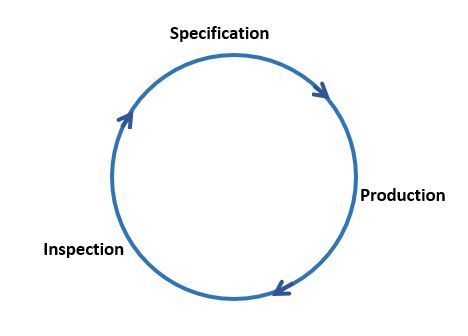
Three steps in quality control. Three senses of statistical control. Broadly speaking, there are three steps in a quality control process: the specification of what is wanted, the production of things to satisfy the specification, and the inspection of things produced to see if they satisfy the specification.

The three steps (making a hypothesis, carrying out an experiment, and testing the hypothesis) constitute a dynamic scientific process of acquiring knowledge. From this viewpoint, it is better to show them as a forming a sort of spiral gradually approach a circular path to which would represent the idealized case, where no evidence is found in the testing of hypothesis indicates a need for changing the hypothesis. Mass production viewed in this way constitutes a continuing and self-corrective method for making the most efficient use of raw and fabricated materials.

The Shewhart cycle as he proposed is shown below:

Shewhart cycle1

One of the criterions Shewhart developed for his model was that the model should be as simple as possible and adaptable in a continuing and self-corrective operation of control. The idea of self-correction is a key point of cybernetics as part of maintaining the course.

The brilliance of Shewhart was in providing guidance on when we should react and when we should not react to the variations in the data. He stated that a necessary and sufficient condition for statistical control is to have a constant system of chance causes… It is necessary that differences in the qualities of a number of pieces of a product appear to be consistent with the assumption that they arose from a constant system of chance causes… If a cause system is not constant, we shall say that an assignable cause is present.

Shewhart continued:

My own experience has been that in the early stages of any attempt at control of a quality characteristic, assignable causes are always present even though the production operation has been repeated under presumably the same essential conditions. As these assignable causes are found and eliminated, the variation in quality gradually approaches a state of statistical control as indicated by the statistics of successive samples falling within their control limits, except in rare instances.

We are engaging in a continuing, self-corrective operation designed for the purpose of attaining a state of statistical control.

The successful quality control engineer, like the successful research worker, is not a pure reason machine but instead is a biological unit reacting to and acting upon an everchanging environment.

James Wilk defined cybernetics as:

Cybernetics is the study of justified intervention.”

This is an apt definition when we look at quality control, as viewed by Shewhart. We have three options when it comes to quality control:

  1. If we have an unpredictable system, then we work to eliminate the causes of signals, with the aim of creating a predictable system.
  2. If we have a predictable system that is not always capable of meeting the target, then we work to improve the system in a systematic way, aiming to create a new a system whose results now fluctuate around a better average.
  3. When the range of predictable performance is always better than the target, then there’s less of a need for improvement. We could, however, choose to change the target and then continue improving in a systematic way.

Source: Measures of Success (Mark Graban, 2019)

Final Words:

Shewhart wrote “Statistical Method from the Viewpoint of Quality Control” in 1939, nine years before Wiener’s Cybernetics book. The use of statistical control allows us to have a conversation with a process. The process tells us what the limits are, and as long as the data points are plotted randomly within the two limits, we can assume that whatever we are seeing is due to chance or natural variation. The data should be random and without any order. When we see some manner of order in the likes of a trend or an outside data point, then we should look for an assignable cause. The data points are not necessarily due to chance anymore. As we keep plotting, we should improve our process, and recalculate the limits.

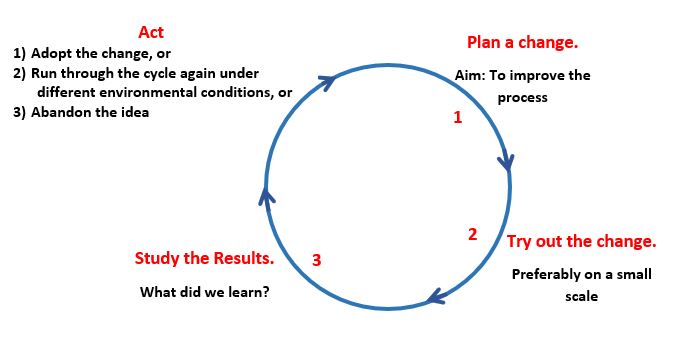
I will finish off with Dr. Deming’s enhancement of Shewhart’s cycle. This is taken from a presentation by Clifford L. Norman. This was part of the evolution of the PDSA (Plan-Do-Study-Act) cycle which later became famous as PDCA cycle (Plan-Do-Check-Act). This showed only 3 steps with a decision point after step 3.

Shewhart cycle2

The updated cycle has lots of nuggets in it such as experimenting on a small scale, reflecting on what we learned etc.

Always keep on learning…

In case you missed it, my last entry was My Recent Tweets:

Note: The updated Shewhart cycle was added to the post after a discussion with Benjamin Taylor (Syscoi.com).

My Recent Tweets:

tweets

I will be posting soon… Meanwhile, here are some of my recent tweets that may be of interest to you.

#cybernetics #Lean #SystemsThinking #philosophy

Always keep on learning…

Book Review – Measures of Success:

Measures-of-Success-Cover-Dark-Green-Final-copy-1

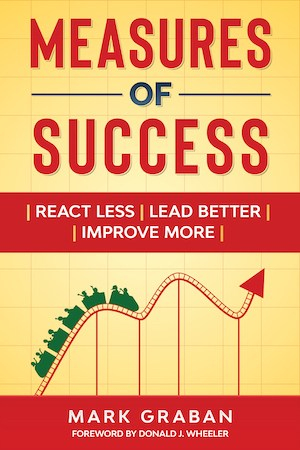
In today’s post, I am reviewing the book, “Measures of Success”, written by Mark Graban. Graban is a Lean thinker and practitioner. Graban has written several books on Lean including Lean Hospitals and Healthcare Kaizen. Graban was kind enough to send me a preview copy of his latest book, Measures of Success. As Graban writes in the Preface, his goal is to help managers, executives, business owners, and improvement specialists in any industry use limited time available more effectively.

The book is about Process Behavior Charts or PBC (Statistical Process Control or SPC). Graban teaches in an easy way how to use Process Behavior Charts to understand a process, and truly see and listen to the process. The use of PBC is a strategy of prevention, and not a strategy of detection alone. PBCs help us see when a process is in control and whether what we see is indicative of normal noise present in a process in control or not. Walter Shewhart, who created and pioneered SPC, defined control as:

A phenomenon is said to be controlled when, through the use of past experience, we can predict at least within limits, how the phenomenon may be expected to vary in the future. Here it is understood that prediction within limits means that we can state, at least approximately, the probability that the observed phenomenon will fall within the given limits.

 Shewhart proceeded to state that a necessary and sufficient condition for statistical control is to have a constant system of chance causes… It is necessary that differences in the qualities of a number of pieces of a product appear to be consistent with the assumption that they arose from a constant system of chance causes… If a cause system is not constant, we shall say that an assignable cause is present.

Graban has written a great book to help us decide what is noise and what is meaningful data. By understanding how the process is speaking to us, we can stop overreacting and use the saved time to actually make meaningful improvements to the process. Graban has a great style of writing which makes a somewhat hard statistical subject easy to read. I enjoyed the narrative he gave of the CEO looking at the Bowling Chart and reacting to it in the third chapter. The CEO was following the red and green datapoints, and reacting by either pontificating as a means of encouragement or yelling “just do things right” at her team. And worse of all, she thinks that she is making a difference by doing it. Just try harder and get to the green datapoint! Graban also goes into detail on Deming’s Red Bean experiment that is a fun way of demonstrating the minimal impact a worker has on normal variation of the process through a fun exercise.

Similar to Deming’s line of questions regarding process improvementHow are you going to improve? By what method? And How will you know?, Graban also provides three insightful core questions:

  1. Are we achieving our target or goal?
  2. Are we improving?
  3. How do we improve?

We should be asking these questions when we are looking at a Process Behavior Chart. These questions will guide in our continual improvement initiatives. Graban has identified 10 key points that help us reflect on our learning of PBCs. They are available at his website. They help us focus on truly understanding what the process is saying – where are we and should we make a change?

Graban provides numerous examples of current events depicted as PBCs. Some of the examples include San Antonio homicide rates and Oscar Ratings. Did the homicide rate significantly go down recently? Did the Oscar ratings significantly go down in the recent years? These are refreshing because they help solidify our understanding. This also provides a framework for us to do our own analysis of current events we see in the news. Graban also provides an in-depth analysis of his blog data. In addition, there are several workplace cases and examples included.

The list of Chapters are as follows:

  • Chapter 1: Improving the Way We Improve
  • Chapter 2: Using Process Behavior Charts for Metrics
  • Chapter 3: Action Metrics, not Overreaction Metrics
  • Chapter 4: Linking Charts to Improvement
  • Chapter 5: Learning From “The Red Bead Game”
  • Chapter 6: Looking Beyond the Headlines
  • Chapter 7: Linear Trend Lines and Other Cautionary Tales
  • Chapter 8: Workplace Cases and Examples
  • Chapter 9: Getting Started With Process Behavior Charts

The process of improvement can be summarized by the following points identified in the book:

  • If we have an unpredictable system, then we work to eliminate the causes of signals, with the aim of creating a predictable system.
  • If we have a predictable system that is not always capable of meeting the target, then we work to improve the system in a systematic way, aiming to create a new a system whose results now fluctuate around a better average.
  • When the range of predictable performance is always better than the target, then there’s less of a need for improvement. We could, however, choose to change the target and then continue improving in a systematic way.

It is clear that Graban has written this book with the reader in mind. There are lots of examples and additional resources provided by Graban to start digging into PBCs and make it interesting. The book is not at all dry and has managed to retain the main technical concepts in SPC.

The next time you see a Metric dashboard either at the Gemba or in the news, you will definitely know to ask the right questions. Graban also provides a list of resources to further improve our learning of PBCs. I encourage the readers to check out Mark Graban’s Blog at LeanBlog.org and also buy the book, Measures of Success.

Always keep on learning…

In case you missed it, my last post was Ubuntu At the Gemba:

Ubuntu At the Gemba:

Ubuntu

“My humanity is tied to yours. I am because you are.” 

In today’s post I will be looking at the African philosophical concept of Ubuntu. The word “Ubuntu” is best explained by the Nguni aphorism – Umuntu Ngumuntu Ngabantu, which means “a person is a person because of or through others.” Ubuntu is a key African philosophy and can be translated as humanity. It emphasizes the group solidarity, sharing, caring and the idea of working together for the betterment of everybody. Ubuntu has many derivatives in Bantu languages and this concept is spread across the many nations in Africa.

Ubuntu is the humanness in us. It is said that a solitary human being is a contradiction. We remain human as part of a community. We get better through the betterment of our community. Our strength comes from being part of a community. To quote Archbishop Desmond Tutu:

One of the sayings in our country is Ubuntu – the essence of being human. Ubuntu speaks particularly about the fact that you can’t exist as a human being in isolation. It speaks about our interconnectedness. You can’t be human all by yourself, and when you have this quality – Ubuntu – you are known for your generosity. 

We think of ourselves far too frequently as just individuals, separated from one another, whereas you are connected and what you do affects the whole world. When you do well, it spreads out; it is for the whole of humanity. 

An interesting part about African philosophy is that most of it was not written down. The ideas were transmitted through oral traditions, which depended upon having strong communal roots. Some of the key ideas that are part of the Ubuntu philosophy are:

  • Always aim for the betterment of the community over self.
  • When we treat others with dignity, all of us are able to perform and contribute better.
  • The strength of the community lies in the interconnectedness of the members.
  • The survival of one person is dependent upon the survival of the community.
  • Ubuntu philosophy aims for harmony and consensus in decision making.
  • Ubuntu requires us to be open and make ourselves available to others.
  • Ubuntu requires us to coach and mentor those younger than us. This also helps us become better at what we do.
  • Respect and dignity, as part of ubuntu, ensure that we provide an environment where everybody is able to contribute and bring value.
  • Ubuntu is a philosophy focused on people, and promotes working together as a team towards the common goal. At the same time, it promotes healthy competition and challenges people to keep growing.
  • Ubuntu points out that aiming for individual goals over common goals is not good. System optimization is the end goal.
  • Ubuntu facilitates a need to have a strong communication system.
  • As a management system, Ubuntu puts the focus on local conditions and context. How does what we do impact those around us? How does what we do impact our environment? How does what we do impact our society?
  • Another key concept is the Ubuntu philosophy is forgiveness or short memory of hate!

As I was researching and learning about Ubuntu, I could not help but compare it against the concept of “Respect for Humanity” in Toyota Production System.  I see many parallels between the two concepts. Respect for Humanity (People) is one of the two pillars of the Toyota Way. The other pillar being Continuous Improvement. Japan is an island with limited resources, and the concept of harmony is valued in the Japanese culture. Toyota Production System and Lean are famous for its many tools. Tools are easy to identify since they have physical attributes like kanban, Visual work place, standard work etc. However, respect for people was not understood or looked at by the Toyota outsiders. Most of the Japanese literature about Toyota Production System mentioned Respect for Humanity (people) while it took a while for the western authors to start discussing Respect for Humanity.

Toyota’s view of Respect for People is to ensure that its employees feel that they are bringing value and worth to the organization. Fujio Cho, the pioneer of the Toyota Way 2001, expressed Respect for People as:

Creating a labor environment “to make full use of the workers’ capabilities.” In short, treat the workers as human beings and with consideration. Build up a system that will allow the workers to display their full capabilities by themselves.

Toyota has built up a system of respect for human, putting emphasis on the points as follows: (1) elimination of waste movements by workers; (2) consideration for workers’ safety; and (3) self-display of workers’ capabilities by entrusting them with greater responsibility and authority.

Final Words:

Paul Bate, Emeritus Professor of Health Services Management in University College London, said:

Nothing exists, and therefore can be understood, in isolation from its context, for it is context that gives meaning to what we think and we do.

Our context is in the interconnectedness that we share with our fellow beings. It is what gives meaning to us. In this regard, Ubuntu sheds light on us as humans. Respect for people begins by developing them and providing them an opportunity to grow so that they can help with the common goal and causes.

I will finish with the great Nelson Mandela’s explanation of Ubuntu:

A traveler through a country would stop at a village and he didn’t have to ask for food or for water. Once he stops, the people give him food and attend him. That is one aspect of Ubuntu, but it will have various aspects. Ubuntu does not mean that people should not enrich themselves. The question therefore is:

Are you going to do so in order to enable the community around you to be able to improve?

Always keep on learning…

In case you missed it, my last post was Clausewitz at the Gemba:

Clausewitz at the Gemba:

vonClausewitz

In today’s post, I will be looking at Clausewitz’s concept of “friction”. Carl von Clausewitz (1780-1831) was a Prussian general and military philosopher. Clausewitz is considered to be one of the best classical strategy thinkers and is well known for his unfinished work, “On War.” The book was published posthumously by his wife Marie von Brühl in 1832.

War is never a pleasant business and it takes a terrible toll on people. The accumulated effect of factors, such as danger, physical exertion, intelligence or lack thereof, and influence of environment and weather, all depending on chance and probability, are the factors that distinguish real war from war on paper. Friction, Clausewitz noted, was what separated war in reality from war on paper. Friction, as the name implies, hindered proper and smooth execution of strategy and clouded the rational thinking of agents. He wrote:

War is the realm of uncertainty; three quarters of the factors on which action in war is based are wrapped in a fog of greater or lesser uncertainty.

Everything in war is very simple, but the simplest thing is difficult. The difficulties accumulate and end by producing a kind of friction that is inconceivable unless one has experienced war.

Friction is the only conception which, in a general way, corresponds to that which distinguishes real war from war on paper. The military machine, the army and all belonging to it, is in fact simple; and appears, on this account, easy to manage. But let us reflect that no part of it is in one piece, that it is composed entirely of individuals, each of which keeps up its own friction in all directions.

Clausewitz viewed friction as impeding our rational abilities to make decisions. He cleverly stated, “the light of reason is refracted in a manner quite different from that which is normal in academic speculation… the ordinary man can never achieve a state of perfect unconcern in which his mind can work with normal flexibility.” In a tense situation, as most often the case is in combat, the “freshness” or usefulness of the available information is quickly decaying and reliability of the information is also in question.

Friction is what happens when reality differs from your model. Although Clausewitz’s concept of friction contains other elements, I am interested in is the friction coming from ambiguous information. Uncertainty and information are related to each other. In fact, one is the absence of the other. The only way to reduce uncertainty (be certain) is to have the required information that counters the uncertainty. To quote Wikipedia, Uncertainty refers to epistemic situations involving imperfect or unknown information. If we have full information then we don’t have uncertainty. It’s a zero-sum game.

We have two options to deal with the uncertainty due to informational friction:

  1. Reduce uncertainty by making useful information readily available to required agents when needed and where needed
  2. Come up with ways to tolerate uncertainty when we are not able to reduce it further.

As Moshe Rubinstein points out in his wonderful book, Tools for Thinking and Problem Solving, uncertainty is reduced only by acquisition of information and you need to ask three questions, in the order specified, when acquiring information.

  1. Is the information relevant? (is it current, and is the context applicable?)
  2. Is the information credible? (is it accurate?)
  3. Is the information worth the cost?

How should we proceed to minimize the friction?

  1. We should try to get the total picture, an understanding of the forest before we get lost in the trees. This helps us in realizing where our epistemic boundaries might be, and where we need to improve our learning.
  2. We should have the courage to ask questions and cast doubts on our world views. Even with our belief system, we can ask whether it is relevant and credible. We should try to ask – what is wrong with this picture? What am I missing?
  3. We should always keep on learning. We should not shy away from “hard projects.” We should see the challenges as learning experiences.
  4. We should know and be ready to have our plan fail. We should understand what the “levers” are in our plan. What happens when we push on one lever versus pulling on another? We should have models with the understanding that they are not perfect but they help us understand things better. We should rely on heuristics and flexible rules of thumbs. They are more flexible when things go wrong.
  5. We should reframe our understanding from a different perspective. We can try to draw things out or write about it or even talk about it to your spouse or family. Different viewpoints should be welcomed. We should generate multiple analogies and stories to help tell our side of the story. These will only help in further our understanding.
  6. When we make decisions under uncertainty and risk, each action can result in multiple outcomes, and most of the times, these are unpredictable and can have large-scale consequences. We should engage in fast and safe-to-fail experiments and have strong feedback loops to change course and adapt as needed.
  7. We should have stable substructures when things fail. This allows us to go back to a previous “safe point” rather than go back all the way to the start.
  8. We should go to gemba to grasp the actual conditions and understand the context. Our ability to solve a problem is inversely proportional to the distance from the gemba.
  9. We should take time, as permissible, to detail out our plan, but we should be ready to implement it fast. Plan like a tortoise and run like a hare.
  10. We should go to the top to take a wide perspective, and then come down to have boots on ground. We should take time to reflect on what went wrong and what went right, and what our impact was on ourselves and others. This is the spirit of Hansei in Toyota Production System.

Final Words:

Although not all of us are engaged in a war at the gemba, we can learn from Clausewitz about the friction from uncertainty, which impedes us on a daily basis. Clausewitz first used the term “friction” in a letter he wrote to his future wife, Marie von Brühl, in 1806. He described friction as the effect that reality has on ideas and intentions in war. Clausewitz was a man ahead of his time, and from his works we can see elements of systems thinking and complexity science.

We propose to consider first the single elements of our subject, then each branch or part, and, last of all, the whole, in all its relations—therefore to advance from the simple to the complex. But it is necessary for us to commence with a glance at the nature of the whole, because it is particularly necessary that in the consideration of any of the parts the whole should be kept constantly in view. The parts can only be studied in the context of the whole, as a “gestalt.

Clausewitz realized that each war is unique and thus what may have worked in the past may not work this time. He said:

Further, every war is rich in particular facts; while, at the same time, each is an unexplored sea, full of rocks, which the general may have a suspicion of, but which he has never seen with his eye, and round which, moreover, he must steer in the night. If a contrary wind also springs up, that is, if any great accidental event declares itself adverse to him, then the most consummate skill, presence of mind and energy, are required; whilst to those who only look on from a distance, all seems to proceed with the utmost ease.

Clausewitz encourages us to get out of our comfort zone, and gain as much variety of experience as we can. The variety of states in the environment always is larger than the variety of states we can hold. He continues to advise the following to reduce the impact of friction:

The knowledge of this friction is a chief part of that so often talked of, experience in war, which is required in a good general. Certainly, he is not the best general in whose mind it assumes the greatest dimensions, who is the most overawed by it (this includes that class of over-anxious generals, of whom there are so many amongst the experienced); but a general must be aware of it that he may overcome it, where that is possible; and that he may not expect a degree of precision in results which is impossible on account of this very friction. Besides, it can never be learnt theoretically; and if it could, there would still be wanting that experience of judgment which is called tact, and which is always more necessary in a field full of innumerable small and diversified objects, than in great and decisive cases, when one’s own judgment may be aided by consultation with others. Just as the man of the world, through tact of judgment which has become habit, speaks, acts, and moves only as suits the occasion, so the officer, experienced in war, will always, in great and small matters, at every pulsation of war as we may say, decide and determine suitably to the occasion. Through this experience and practice, the idea comes to his mind of itself, that so and so will not suit. And thus, he will not easily place himself in a position by which he is compromised, which, if it often occurs in war, shakes all the foundations of confidence, and becomes extremely dangerous.

US President Dwight Eisenhower said, “In preparing for battle I have always found that plans are useless, but planning is indispensable.” The act of planning helps us to conceptualize our future state. We should strive to minimize the internal friction, and we should be open to keep learning, experimenting, and adapting as needed to reach our future state. We should keep on keeping on:

“Perseverance in the chosen course is the essential counter-weight, provided that no compelling reasons intervene to the contrary. Moreover, there is hardly a worthwhile enterprise in war whose execution does not call for infinite effort, trouble, and privation; and as man under pressure tends to give in to physical and intellectual weakness, only great strength of will can lead to the objective. It is steadfastness that will earn the admiration of the world and of posterity.”

Always keep on learning…

In case you missed it, my last post was Exploring The Ashby Space:

Exploring The Ashby Space:

Ashby4

Today’s post is a follow-up to an earlier post, Solving a Lean Problem versus a Six Sigma Problem:

In today’s post, I am looking at “The Ashby Space.” The post is based on the works of Ross Ashby, Max Boisot, Bill McKelvey and Karl Weick. Ross Ashby was a prominent cybernetician who is famous for his “Law of Requisite Variety.” The Law of Requisite Variety can be stated as “Only variety can destroy/absorb variety.” Ashby defined variety as the number of distinguishable states of a system. Stafford Beer used variety as a measure of complexity. The more variety a system has the more complex it is. An important concept to grasp with this idea is that the number of distinguishable states (and thus variety) depends upon the ability of the observer. In this regard, variety of a system may be viewed as dependent on the observer.

Max Boisot and Bill McKelvey expanded upon the Law of Requisite Variety and stated that only complexity can destroy complexity. In other words, only internal complexity can destroy external complexity. If the regulatory agency of a system does not have the requisite variety to match the variety of its environment, it will not be able to adapt and survive. Ashby explained this using the example of a fencer:

If a fencer faces an opponent who has various modes of attack available, the fencer must be provided with at least an equal number of modes of defense if the outcome is to have the single value: attacked parried.

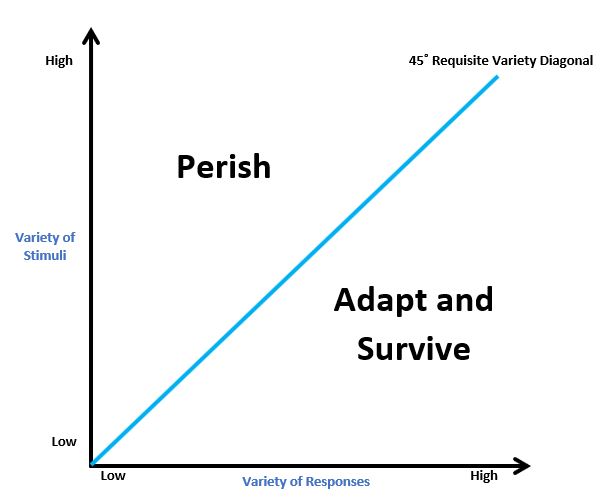
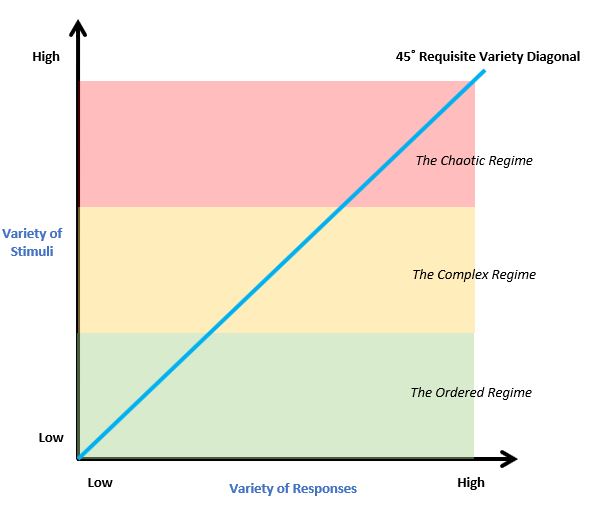
Boisot and McKelvey restated Ashby’s law as – the range of responses that a living system must be able to marshal in its attempt to adapt to the world must match the range of situations—threats and opportunities—that it confronts. They explained this further using the graphical depiction they termed as “the Ashby Space.” The Ashby Space has two axes, the horizontal axis represents the Variety of Responses, and the vertical axis represents the Variety of Stimuli. Ashby’s law can be represented by the 45˚ diagonal line. The diagonal line represents the requisite variety where the stimuli variety matches the response variety. To adapt and survive we should be in on the diagonal line or below. If we are above the diagonal line, the external variety surpasses the internal variety needed and we perish. Using Ashby’s fencer example, the fencer is able to defend against the opponent only if his defense variety matches or exceeds that of the opponent’s offense variety. This is shown below.

Ashby1

Boisot and McKelvey also depicted the Ordered, Complex and Chaotic regimes in the Ashby space. In the ordered regime, the cause-effect relationships are distinguishable and generally has low variety. The complex regime has a higher variety of stimuli present and requires a higher variety of responses. The cause-effect relationships are non-linear and may make sense only in hindsight. The chaotic regime has the most variety of stimuli. This is depicted in the schematic below. Although the three regimes may appear equally sized in the schematic, this is just for representational purposes.

Ashby2

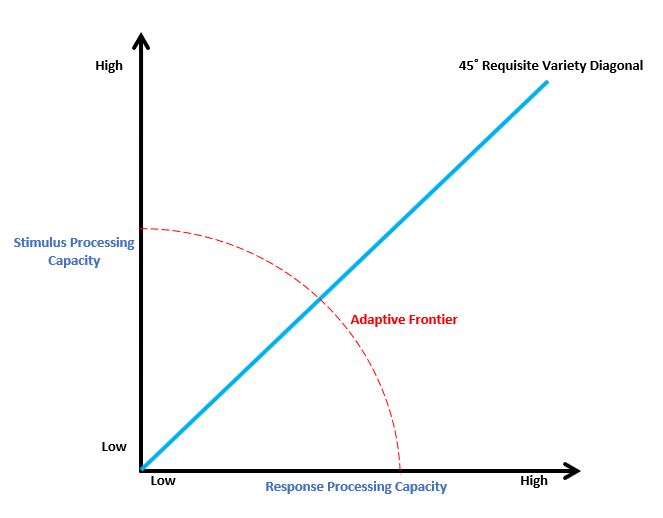
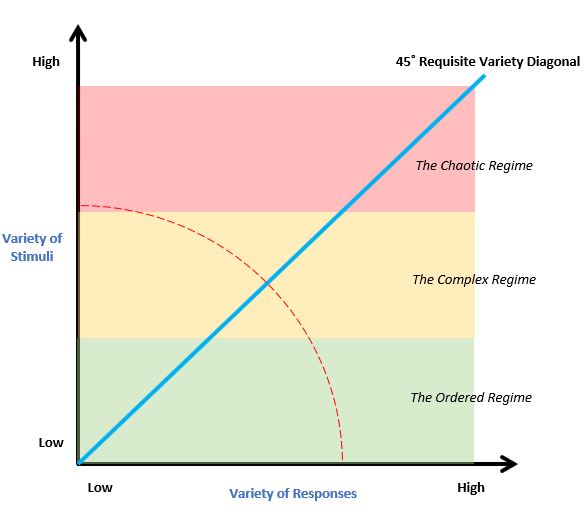
The next idea that we will explore on the Ashby Space is the idea of the Adaptive Frontier. Ashby proposed a strong need for reducing the amount of variety from the external environment. He viewed this as the role of regulation. Ashby pointed out that the amount of regulation that can be achieved is limited by the amount of information that can be transmitted and processed by the system. This idea is depicted by the Adaptive Frontier curve. Any variety that lies outside this curve is outside the “adaptation budget” of the system. The system does not have the resources nor capacity to process all the variety that is coming in, and does not have the capacity to allocate resources to choose appropriate responses. The adaptive frontier is shown in the schematic below as the red dotted curve.

Ashby3

Combining all the ideas above, the Ashby Space can be depicted as below.

Ashby Space

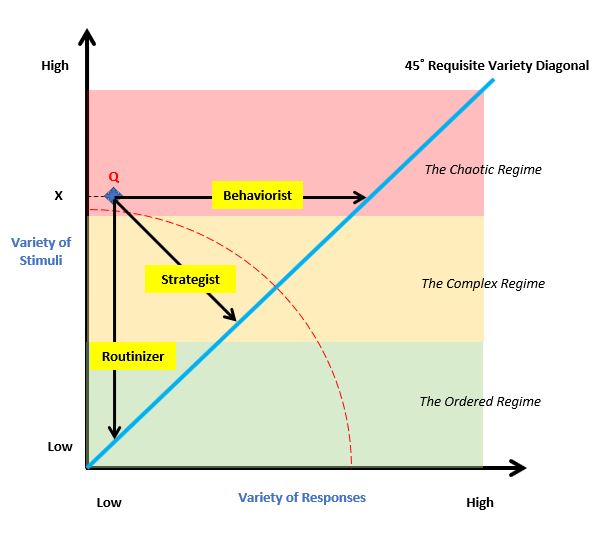
Boisot and McKelvey detail three types of responses that a living system might follow in the presence of external stimuli. Consider the schematic below, where the agent is located at “Q” in the Ashby Space, which refers to the stimuli variety, X.

  1. The Behaviorist – This is also referred to as the “headless chicken response”. When presented with the stimuli variety, X, the agent will pursue the headless chicken response of trying to match the high variety in a haphazard fashion and soon finds himself outside the adaptive frontier and perishes. The agent fails to filter out any unwanted stimuli and fails to process meaningful information out of the incoming data.
  2. The Routinizer – The routinizer interprets the incoming stimuli as “seen it all before.” They will filter out too much of the incoming data and fail to recognize patterns or mis-categorize them. The routinizer is using the schema which they already have, and their success lies in how well their schema matches the real-world variety-reducing regularities confronting the agent.
  3. The Strategist – An intelligent agent has to correctly interpret the data first, and extract valid information about relevant regularities from the incoming stimuli. The agent then has to use existing schema and match against existing patterns. If the patterns do not match, the agent will have to develop new patterns. As you go up in the Ashby space, the complexity increases, and as you go down, the complexity decreases. The schemas should have the required complexity to match the incoming stimuli. The agent should also be aware of the adaptive frontier and stay within the resource budget constraints. The strategist will try to filter out noise, use/develop appropriate schemas and generate effectively complex responses.

Ashby4

Final Words:

The Ashby Space is a great representation to keep in mind while coping with complexity. The ability of a system to discern what is meaningful and what is noise depends on the system’s past experiences, world views, biases and what its construes as morals and values. Boisot and McKelvey note that:

Not everything in a living system’s environment is relevant or meaningful for it, however. If it is not to waste its energy responding to every will-o-the wisp, a system must distinguish schema based on meaningful information (signals about real-world regularities judged important) from noise (meaningless signals). Note that what constitutes information or noise for a system is partly a function of the organism’s own expectations, judgments, and sensory abilities about what is important —as well as of its motivations— and hence, of its models of the world. Valid and timely representations (schema) economize on the organism’s scarce energy resources.

This also points to the role of sensemaking. As Karl Weick notes, “an increase in complexity can increase perceived uncertainty… Complexity affects what people notice and ignore… The variety in a firm’s repertory of beliefs should affect the amount of time it spends consciously struggling to make sense. The greater the variety of beliefs in a repertoire, the more fully should any situation be seen, the more solutions identified, and the more likely it should be that someone knows a great deal about what is happening.”

The models or representations we construct to represent a phenomenon do not have to be as complex as the phenomenon itself, just like the usefulness of a map is in its abstraction. If the map was as complex as the city it represented, it would become identical to city, with the roads, buildings etc., an exact replica. The system however should have the requisite variety. The system should be able to filter out unwanted variety and amplify its meaningful variety to achieve this. The agent must wait for “meaningful” patterns to emerge, and keep learning.

The agent must also be aware to not claim victory or “Mission Accomplished” when dealing with complexity. Some portion of the stimuli variety may be met with the existing schema as part of routinizing. However, this does not mean that the requisite variety has been achieved. A broken clock is able to tell time correctly twice a day, but it does not mean that you should assume that the clock is functional.

I will finish off with a great insight from Max Boisot:

Note that we do not necessarily require an exact match between the complexity of the environment and the complexity of the system. Afterall, the complexity of the environment might turn out to be either irrelevant to the survival of the system or amenable to important simplifications. Here, the distinction between complexity as subjectively experienced and complexity as objectively given is useful. For it is only where complexity is in fact refractory to cognitive efforts at interpretation and structuring that it will resist simplification and have to be dealt with on its own terms. In short, only where complexity and variety cannot be meaningfully reduced do they have to be absorbed. So an interesting way of reformulating the issue that we shall be dealing with in this article is to ask whether the increase in complexity that confronts firms today has not, in effect, become irreducible or “algorithmically incompressible”? And if it has, what are the implications for the way that firms strategize?

Always keep on learning…

In case you missed it, my last post was Nietzsche’s Overman at the Gemba:

I welcome the reader to read further upon the ideas of Ross Ashby. Some of the references I used are:

  1. An Introduction to Cybernetics, Ross Ashby (1957)
  2. Requisite variety and its implications for the control of complex systems, Cybernetica 1:2, p. 83-99, Ross Ashby (1958)
  3. Complexity and Organization–Environment Relations: Revisiting Ashby’s Law of Requisite Variety, Max Boisot and Bill McKelvey (2011)
  4. Knowledge, Organization, and Management. Building on the Work of Max Boisot, Edited by John Child and Martin Ihrig (2013)
  5. Connectivity, Extremes, and Adaptation: A Power-Law Perspective of Organizational Effectiveness, Max Boisot and Bill McKelvey (2011)
  6. Counter-Terrorism as Neighborhood Watch: A Socio/Computational Approach for Getting Patterns from Dots, Max Boisot and Bill McKelvey (2004)
  7. Sensemaking in Organizations (Foundations for Organizational Science), Karl Weick (1995)

Nietzsche’s Overman at the Gemba:

Overman

In today’s post, I am looking at Nietzsche’s philosophy of Übermensch. Friedrich Wilhelm Nietzsche is probably one of the most misunderstood and misquoted philosophers. The idea of Übermensch is sometimes mistranslated as Superman. A better translation is “Overman”. The German term “mensch” means “human being” and is gender neutral. Nietzsche spoke about overman first in his book, “Thus Spoke Zarathustra.” In the prologue of this book, Nietzsche through Zarathustra asks:

I teach you the overman. Man is something that shall be overcome. What have you done to overcome him?

Nietzsche provides further clarification that, “Man is a rope, fastened between animal and Übermensch – a rope over an abyss.Übermensch is an idea that represents a being who has overcome himself and his human nature – one who can break away from the bondage of ideals and create new ones in place of the old stale ones.

Nietzsche came to the conclusion that humanity was getting stale by maintaining status quo through adhering to ideals based in the past. He also realized that the developments in science and technology, and the increase in collective intelligence was disrupting the “old” dogmatic ideals and the end result was going to be nihilism – a post-modern view that life is without meaning or purpose. Nietzsche famously exclaimed that; God is dead! He was not rejoicing in that epiphany. Nietzsche proposed the idea of Übermensch as a solution to this nihilistic crisis. Übermensch is not based on a divine realm. Instead Übermensch is a higher form on Earth. Overcoming the status quo and internal struggles with the ideals is how we can live our full potential in this earth and be Übermensch.

Nietzsche contrasted Übermensch with “Last Man”. The last man embraces status quo and lives in his/her comfort zone. The last man stays away from any struggle, internal or external. The last man goes with the flow as part of a herd. The last man never progresses, but stays where he is, clutching to the past.

Nietzsche used the metaphors of the camel, the lion and the child to detail the progress towards becoming an Übermensch. As the camel, we should seek out struggle, to gain knowledge and wisdom through experience. We should practice self-discipline and accept more duties to improve ourselves. As the lion, we should seek our independence from the ideals and dogmas. Nietzsche spoke of tackling the “Thou Shalt” dragon as the lion. The dragon has a thousand scales with the notation, “thou shalt”. Each scale represents a command, telling us to do something or not do something. As the lion, we should strongly say, “No.” Finally, as the child, we are free. Free to create a new reality and new values.

At the Gemba:

Several thoughts related to Übermensch  and Lean came to my mind. Toyota teaches us that we should always strive toward True North, our ideal state. We are never there, but we should always continue to improve and move towards True North. Complacency/the push to maintain status quo is the opposite of kaizen, as I noted in an earlier post.

I am reminded of a press article about Fujio Cho. In 2002, when Fujio Cho was the President of Toyota Motor Corporation, Toyota became the third largest automaker in the world and had 10.2% of share of world market. Cho unveiled a plan to be world’s largest automaker with 15% global market share. Akio Matsubara, Toyota’s managing director in charge of the corporate planning division, stated:

“The figure of 15 percent is a vision, not a target,” he said. “Now that we’ve achieved 10 percent, we want to bring 15 percent into view as our next dream. We don’t see any significance in becoming No. 1.”

The point of the 15 percent figure, he said, is to motivate Toyota employees to embrace changes to improve so they would not become complacent with the company’s success.

My favorite part of the article was Morgan Stanley Japan Ltd. auto analyst Noriaki Hirakata’s remarks about Fujio Cho. Toyota’s executives, he said, believe Toyota is “the best in the world, but they don’t want to be satisfied.”

It’s as if Cho’s motto has become “Beat Toyota,” Hirakata said.

I am also reminded of a story that the famous American Systems Thinker, Russel Ackoff shared. In 1951, he went to Bell Labs in Murray Hill, New Jersey, as a consultant. While he was there, all the managers were summoned to an impromptu urgent meeting by the Vice President of Bell Labs. Nobody was sure what was going on. Everyone gathered in a room anxious to hear what the meeting was about. The Vice President walked in about 10 minutes late and looked very upset. He walked up to the podium and everyone became silent. The Vice President announced:

“Gentlemen, the telephone system of the United States was destroyed last night.”

He waited as everyone started talking and whispering that it was not true. The Vice President continued:

“The telephone system was destroyed last night and you had better believe it. If you don’t by noon, you are fired.”

The room was silent again. The Vice President then started out laughing, and everyone relaxed.

“What was that all about? Well, in the last issue of the Scientific American,” he said, “there was an article that said that these laboratories are the best industrially based scientific laboratories in the world. I agreed, but it got me thinking.”

The Vice President went to on to state that all of the notable inventions that Bell Lab had were invented prior to 1900. This included the dial, multiplexing, and coaxial cable. All these inventions were made prior to when any of the attendees were born. The Vice President pointed out that they were being complacent. They were treating the parts separately and not improving the system as a whole. His solution to the complacency? He challenged the team to assume that the telephone system was destroyed last night, and that they were going to reinvent and rebuilt it from scratch! One of the results of this was the push button style phones that reduced the time needed to dial a number by 12 seconds. This story reminds me of breaking down the existing ideals and challenging the currently held assumptions.

Nietzsche challenges us to overcome the routine monotonous ideas and beliefs. Instead of simply existing, going from one day to the next, we should challenge ourselves to be courageous and overcome our current selves. This includes destruction and construction of ideals and beliefs. We should be courageous to accept the internal struggle, when we go outside our comfort zone. The path to our better selves is not inside the comfort zone.

Similar to what Toyota did by challenging the prevalent mass production system and inventing a new style of production system, we should also challenge the currently held belief system. We should continue evolving toward our better selves. As Nietzsche said:

What is great in man is that he is a bridge and not an end.

I say unto you: One must still have chaos in oneself to be able to give birth to a dancing star.

Always keep on learning…

In case you missed it, my last post was Solving a Lean Problem versus a Six Sigma Problem:

Solving a Lean Problem versus a Six Sigma Problem:

Model

I must confess upfront that the title of this post is misleading. Similar to the Spoon Boy in the movie, The Matrix, I will say – There is no Lean problem nor a Six Sigma problem. All these problems are our mental constructs of a perceived phenomenon. A problem statement is a model of the actual phenomenon that we believe is the problem. The problem statement is never the problem! It is a representation of the problem. We form the problem statement based on our vantage point, our mental models and biases. Such a constructed problem statement is thus incomplete and sometimes incorrect. We do not always ask for the problem statement to be reframed from the stakeholder’s viewpoint. A problem statement is an abstraction based on our understanding. Its usefulness lies in the abstraction. A good abstraction ignores and omits unwanted details, while a poor abstraction retains them or worse omits valid details. Our own cognitive background hinders our ability to frame the true nature of the problem. To give a good analogy, a problem statement is like choosing a cake slice. The cake slice represents the cake, however, you picked the slice you wanted, and you still left a large portion of the cake on the table, and nobody wants your slice once you have taken a bite out of it.

When we have to solve a problem, it puts tremendous cognitive stress on us. Our first instinct is to use what we know and what we feel comfortable with. Both Lean and Six Sigma use a structured framework that we feel might suit the purpose. However, depending upon what type of “problem” we are trying to solve, these frameworks may lack the variety they need to “solve” the problem. I have the used the quotation marks on purpose. For example, Six sigma relies on a strong cause-effect relationship, and are quite useful to address a simple or complicated problem. A simple problem is a problem where the cause-effect relationship is obvious, whereas a complicated problem may require an expert’s perspective and experience to analyze and understand the cause-effect relationship. However, when you are dealing with a complex problem, which is non-linear, the cause-effect relationship is not entirely evident, and the use of a hard-structured framework like Six sigma can actually cause more harm than benefit. All human-centered “systems” are complex systems. In fact, some might say that such systems do not even exist. To quote Peter Checkland, In a certain sense, human activity systems do not exist, only perceptions of them exist, perceptions which are associated with specific worldviews.

We all want and ask for simple solutions. However, simple solutions do not work for complex problems. The solutions must match the variety of the problem that is being resolved. This can sometimes be confusing since the complex problems may have some aspects that are ordered which give the illusion of simplicity. Complex problems do not stay static. They evolve with time, and thus we should not assume that the problem we are trying to address still has the same characteristics when they were identified.

How should one go from here to tackle complex problems?

  • Take time to understand the context. In the complex domain, context is the key. We need to take our time and have due diligence to understand the context. We should slow down to feel our way through the landscape in the complex domain. We should break our existing frameworks and create new ones.
  • Embrace diversity. Complex problems require multidisciplinary solutions. We need multiple perspectives and worldviews to improve our general comprehension of the problem. This also calls to challenge our assumptions. We should make our assumptions and agendas as explicit as possible. The different perspective allows for synthesizing a better understanding.
  • Similar to the second suggestion, learn from fields of study different from yours. Learn philosophy. Other fields give you additional variety that might come in handy.
  • Understand that our version of the problem statement is lacking, but still could be useful. It helps us to understand the problem better.
  • There is no one right answer to complex problems. Most solutions are good-enough for now. What worked yesterday may not work today since complex problems are dynamic.
  • Gain consensus and use scaffolding while working on the problem structure. Scaffolding are temporary structures that are removed once the actual construction is complete. Gaining consensus early on helps in aligning everybody.
  • Go to the source to gain a truer understanding. Genchi Genbutsu.
  • Have the stakeholders reframe the problem statement in their own words, and look for contradictions. Allow for further synthesis to resolve contradictions. The tension arising from the contradictions sometimes lead us to improving and refining our mental models.
  • Aim for common good and don’t pursue personal gains while tackling complex problems.
  • Establish communication lines and pay attention to feedback. Allow for local context while interpreting any new information.

Final Words:

I have written similar posts before. I invite the reader to check them out:

Lean, Six Sigma, Theory of Constraints and the Mountain

Herd Structures in ‘The Walking Dead’ – CAS Lessons

A successful framework relies on a mechanism of feedback-induced iteration and keenness to learn. The iteration function is imperative because the problem structure itself is often incomplete and inadequate. We should resist the urge to solve a Six Sigma or a Lean problem. I will finish with a great paraphrased quote from the Systems Thinker, Michael Jackson (not the famous singer):

To deal with a significant problem, you have to analyze and structure it. This means, analyzing and structuring the problem itself, not the system that will solve it. Too often we push the problem into the background because we are in a hurry to proceed to a solution. If you read most texts thoughtfully, you will see that almost everything is about the solution; almost nothing is about the problem.

Always keep on learning…

In case you missed it, my last post was Maurice Merleau-Ponty’s Lean Lessons: