The Free Energy Principle at the Gemba:

FEP

In today’s post, I am looking at the Free Energy Principle (FEP) by the British neuroscientist, Karl Friston. The FEP basically states that in order to resist the natural tendency to disorder, adaptive agents must minimize surprise. A good example to explain this is to say successful fish typically find themselves surrounded by water, and very atypically find themselves out of water, since being out of water for an extended time will lead to a breakdown of homoeostatic (autopoietic) relations.[1]

Here the free energy refers to an information-theoretic construct:

Because the distribution of ‘surprising’ events is in general unknown and unknowable, organisms must instead minimize a tractable proxy, which according to the FEP turns out to be ‘free energy’. Free energy in this context is an information-theoretic construct that (i) provides an upper bound on the extent to which sensory data is atypical (‘surprising’) and (ii) can be evaluated by an organism, because it depends eventually only on sensory input and an internal model of the environmental causes of sensory input.[1]

In FEP, our brains are viewed as predictive engines, or also Bayesian Inference engines. This idea is built on predictive coding/processing that goes back to the German physician and physicist Hermann von Helmholtz from the 1800s. The main idea is that we have a hierarchical structure in our brain that tries to predict what is going to happen based on the previous sensory data received. As philosopher Andy Clarke explains, our brain is not a cognitive couch potato waiting for sensory input to make sense of what is going on. It is actively predicting what is going to happen next. This is why minimizing the surprise is important. For example, when we lift a closed container, we predict that it is going to have a certain weight based on our previous experiences and the visual signal of the container. We are surprised if the container is light in weight and can be lifted easily. We have similar experiences when we miss a step on the staircase. From a mathematical standpoint, we can say that when our internal model matches the sensory input, we are not surprised. This refers to the KL divergence in information theory. The lower the divergence, the better the fit between the model and the sensory input, and lower the surprise. The hierarchical model is top down. The prediction flows top down, while the sensory data flows bottom up. If the model matches the sensory data, then nothing goes up the chain. However, when there is a significant difference between the top down prediction and the bottom up incoming sensory date, the difference is raised up the chain. One of my favorite examples to explain this further is to imagine that you are in the shower with your radio playing. You can faintly hear the radio in the shower. When your favorite song plays on the radio, you feel like you can hear it better than when an unfamiliar song is played. This is because your brain is able to better predict what is going to happen and the prediction helps smooth out the incoming auditory signals. British neuroscientist Anil Seth has a great quote regarding the predictive processing idea, “perception is controlled hallucination.”

Andy Clarke explains this further:

Perception itself is a kind of controlled hallucination… [T]he sensory information here acts as feedback on your expectations. It allows you to often correct them and to refine them.

(T)o perceive the world is to successfully predict our own sensory states. The brain uses stored knowledge about the structure of the world and the probabilities of one state or event following another to generate a prediction of what the current state is likely to be, given the previous one and this body of knowledge. Mismatches between the prediction and the received signal generate error signals that nuance the prediction or (in more extreme cases) drive learning and plasticity.

Predictive coding models suggest that what emerges first is the general gist (including the general affective feel) of the scene, with the details becoming progressively filled in as the brain uses that larger context — time and task allowing — to generate finer and finer predictions of detail. There is a very real sense in which we properly perceive the forest before the trees.

What we perceive (or think we perceive) is heavily determined by what we know, and what we know (or think we know) is constantly conditioned on what we perceive (or think we perceive).

(T)he task of the perceiving brain is to account for (to accommodate or ‘explain away’) the incoming or ‘driving’ sensory signal by means of a matching top-down prediction. The better the match, the less prediction error then propagates up the hierarchy. The higher level guesses are thus acting as priors for the lower level processing, in the fashion (as remarked earlier) of so-called ‘empirical Bayes’.

The question on what happens when the prediction does not match is best explained by Friston:

“The free-energy considered here represents a bound on the surprise inherent in any exchange with the environment, under expectations encoded by its state or configuration. A system can minimize free energy by changing its configuration to change the way it samples the environment, or to change its expectations. These changes correspond to action and perception, respectively, and lead to an adaptive exchange with the environment that is characteristic of biological systems. This treatment implies that the system’s state and structure encode an implicit and probabilistic model of the environment.”

Our brains are continuously sampling the data coming in and making predictions. When there is a mismatch between the prediction and the data, we have three options.

  • Update our model to match the incoming data.
  • Attempt to change the environment so that the model matches the environment. Try resampling the data coming in.
  • Ignore and do nothing.

Option 3 is not always something that will yield positive results. Option 1 is a learning process where we are updating our internal models based on the new evidence. Option 2 show ours strong confidence in our internal model, and that we are able to change the environment. Or perhaps there is something wrong with the incoming data and we have to get more data to proceed.

The ideas from FEP can also further our understanding on our ability to balance between maintaining status quo (exploit) and going outside our comfort zones (explore). To paraphrase the English polymath Spencer Brown, the first act of cognition is to differentiate (act of distinction). We start with differentiating – Me/everything else. We experience and “bring forth” the world around us by constructing it inside our mind. This construction has to be a simpler version due to the very high complexity of the world around us. We only care about correlations that matter to us in our local environment. This matters the most for our survival and sustenance. This leads to a tension. We want to look for things that confirm our hypotheses and maintain status quo. This is a short-term vision. However, this doesn’t help in the long run with our sustenance. We also need to explore to look for things that we don’t know about. This is the long-term vision. This helps us prepare to adapt with the everchanging environment. There is a balance between the two.

The idea of FEP can go from “I model the world” to “we model the world” to “we model ourselves modelling the world.” As part of a larger human system, we can cocreate a shared model of our environment and collaborate to minimize the free energy leading to our sustenance as a society.

Final Words:

FEP is a fascinating field and I welcome the readers to check out the works of Karl Friston, Andy Clarke and others. I will finish with the insight from Friston that the idea of minimizing free energy is also a way to recognize one’s existence.

Avoiding surprises means that one has to model and anticipate a changing and itinerant world. This implies that the models used to quantify surprise must themselves embody itinerant wandering through sensory states (because they have been selected by exposure to an inconstant world): Under the free-energy principle, the agent will become an optimal (if approximate) model of its environment. This is because, mathematically, surprise is also the negative log-evidence for the model entailed by the agent. This means minimizing surprise maximizes the evidence for the agent (model). Put simply, the agent becomes a model of the environment in which it is immersed. This is exactly consistent with the Good Regulator theorem of Conant and Ashby (1970). This theorem, which is central to cybernetics, states that “every Good Regulator of a system must be a model of that system.” .. Like adaptive fitness, the free-energy formulation is not a mechanism or magic recipe for life; it is just a characterization of biological systems that exist. In fact, adaptive fitness and (negative) free energy are considered by some to be the same thing.

Always keep on learning…

In case you missed it, my last post was The Whole is ________ than the sum of its parts:

[1] The free energy principle for action and perception: A mathematical review. Christopher L. Buckley, Chang Sub Kim, Simon McGregor, Anil K. Seth (2017)
The Whole is ________ than the sum of its parts:

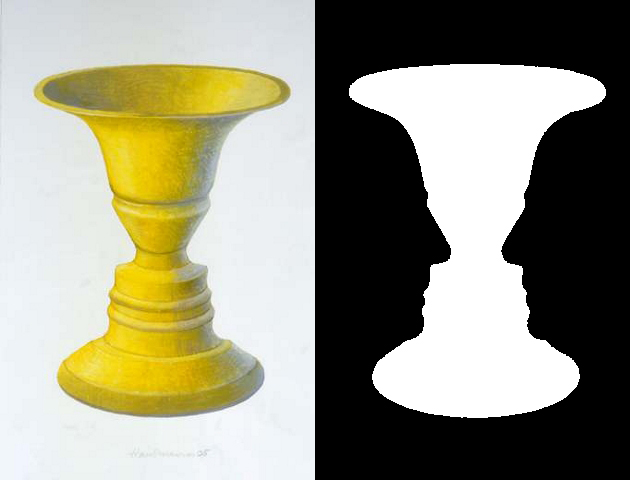
Rubin2

One of the common expressions depicting holistic thinking is – “the whole is larger/greater than the sum of its parts.” In today’s post I would like to look at this expression from a few different perspectives.

Kurt Koffka:

Kurt Koffka (1886 – 1941), the brilliant Gestalt psychologist said, “the whole is other than the sum of its parts.” Koffka was adamant to not misstate him as the whole being larger than the sum of its parts. He was pointing out that the whole is not merely an addition of parts, and that the whole has a separate existence. We humans tend to organize our percepts into wholes. Our mental shortcuts first make us see the whole, rather than the parts. The term “gestalt” itself refers to form or pattern. We are prone to identifying larger patterns from partial data.

Andras Angyal:

Andras Angyal (1902 – 1960) was an American psychiatrist and a Systems Theorist. He emphasized the importance of positional values of parts within a system. He did not view the whole being more than the sum of its parts.

Summation, however, is not organization, but it is of little help simply to say that a system is more than the sum of its parts…“A system is a distribution of constituents with positional values in a dimensional domain.” Functional relationship is the key concept of the reductive approach. For a systems approach a different concept, such as that of positional value, is required which expresses arrangement and compels reference of the parts back to the whole. The value of parts is what they do for the whole. Their function is its maintenance. Only a whole maintained in this way can relate to an environment. To make possible relations with an environment is the function of the whole.

An easy example is to put together three sticks of different lengths. The order of the sticks does not matter for the total length of the three sticks put together. For contrast, let’s look at a car. For a car, the positional value or the order of the parts are of utmost importance. They have to go together in a specific manner for the car to be a car.

Edgar Morin:

Edgar Morin, the brilliant French philosopher says that “the whole is less than the sum of its parts.” This is a powerful statement. The parts lose its freedom when it is constrained to be in a specific form of organization. The whole is more constrained, or has less freedom than the sum of freedoms of the parts put together. The parts give up some of its properties when it organizes to be a whole. At the same time, the whole is also more than the sum of its parts. Morin says:

In order to understand the apparent contradiction of a whole that is simultaneously more and less than the sum of its parts, I claim the heritage of the Greek philosopher Heraclitus, from the 6th century BC: when you reach a contradiction, it doesn’t necessarily mean an error, but rather that you have touched on a fundamental problem. Therefore, I believe that these contradictions should be recognized and upheld, rather than circumvented.

Additionally, Morin stated:

The whole is greater than the sum of the parts (a principle which is widely acknowledged and intuitively recognized at all macroscopic levels), since a macro-unity arises at the level of the whole, along with emergent phenomena, i.e., new qualities or properties.

The whole is less than the sum of the parts, since some of the qualities or properties of the parts are inhibited or suppressed altogether under the influence of the constraints resulting from the organization of the whole.

The whole is greater than the whole, since the whole as a whole affects the parts retroactively, while the parts in turn retroactively affect the whole (in other words, the whole is more than a global entity-it has a dynamic organization).

Morin had strong words about just using holism:

Holism is a partial, one-dimensional, and simplifying vision of the whole. It reduces all other system-related ideas to the idea of totality, whereas it should be a question of confluence. Holism thus arises from the paradigm of simplification (or reduction of the complex to a master-concept or master-category).

Final Words:

The idea that the whole is different or other than the sum of its parts is a different way of thinking. Holism can be as limiting as reductionism. One might say that thinking in terms of wholes is very much thinking in terms of parts since the whole can be construed to be a part of a larger system. The emphasis is on the observer and the purpose that the observer has with the specific perspective that he or she is taking. All humans are purposeful creatures. What one observes, depends upon the properties of the observer. This also means that the other observers, the cocreators or the participants in the system, have their own purposes. We cannot stipulate the purpose(s) for a fellow being. To paraphrase West Churchman, systems thinking begins when one sees through the eyes of another.

The idea that the whole is more important than the part should be challenged, especially when it comes to human systems. All human systems are in a delicate balance with each other, which can tip one way or the other based on emerging attractors. The individual strives for autonomy, while the larger human systems the individual is part of, strive for homonomy. One should not ignore the other.

I will finish with another lesson from Morin:

The parts are at once less and greater than the parts. The most remarkable emergent phenomena within a highly complex system, such as human society, occur not only at the level of the whole (society), but also at the level of the individuals (even especially at that level-witness the fact that self-consciousness only emerges in individuals). In this sense: The parts are sometimes greater than the whole. As Stafford Beer has noted: “[T]he most profitable control system for the parts does not exclude the bankruptcy of the whole.” “Progress” does not necessarily consist in the construction of larger and larger wholes; on the contrary, it may lie in the freedom and independence of small components. The richness of the universe is not found in its dissipative totality, but in the small reflexive entities-the deviant and peripheral units-which have self-assembled within it…

Always keep on learning…

In case you missed it, my last post was Constructivism at the Gemba:

My Recent Tweets on Cybernetics / Systems Thinking:

cybernetics tweets

Do Systems Exist?

Heinz von Foerster, Master Storyteller!

My humble take on von Foerster’s Aesthetic Imperative:

Wittgenstein’s Ruler and Models:

The Whole is NOT greater than the sum of its parts:

Autonomy, what’s the big deal?

Teaching from a Cybernetics standpoint:

My favorite translation of von Foerster’s Ethical Imperative:

The map IS the territory! Another von Foerster Gem:

Carlo Rovelli, the Systems Thinker!

Another von Foerster gem:

Heinz von Foerster’s Therapeutic Imperative:

Umpleby on Ashby’s Epistemology:

There are no such things as self-organizing systems!

What are systems again?

Systems thinking is fundamentally based on a spatial metaphor:

If you enjoyed these, please follow me on Twitter. https://twitter.com/harish_josev

In case you missed it, my last post was Wu Wei at the Gemba:

Karakuri Kaizen:

karakuri doll tea

As the readers of my blog know, I am an ardent student of Toyota Production System (TPS). One of the core philosophies of TPS is kaizen, often translated from Japanese as continuous improvement. It is the idea that one should continuously find ways to eliminate non-value adding activities, and in the process develop oneself and others to get better at kaizen. The idea of kaizen begetting more kaizen. Kaizen is a human capital enrichment philosophy. As Eiji Toyoda, Toyota Motor Corporation President from 1967 to 1982, said – “It is people that make things, and so people must be developed before work can start.

One of the ways Toyota inspire their employees to nurture their creativity is Karakuri Kaizen. It is said that in the early seventeenth century, during the Edo period, European clocks were introduced in Japan. This sparked a wide curiosity amongst the Japanese craftsmen. The idea of developing motion mechanisms with elaborate sets of springs and gears was new to them. This led to the development of karakuri ningyō, or mechanized dolls. These were dolls that moved around and did several tasks such as bring tea to a guest and then bring it back to the owner, or climb a set of stairs. There was even a magician doll that performed a cups and balls routine.

What set the karakuri dolls of Japan separate from the European clockwork mechanism was the humanization of the dolls. The dolls were created with high importance to its physical features such as face, movement of head and limbs; in an effort to the make the doll life-like. Aesthetics was of utmost importance. All the mechanisms were cleverly hidden beneath clothing such that no mechanism was visible from outside. The doll moved around as if it is alive. The karakuri dolls brought fascinated delight to its spectators.

All the motion was achieved using simple springs, gravity and gears. No external power source was used. How does this all relate to the manufacturing floor? One of the challenges that is often posed to an organization is to increase its production. This is often tackled by either hiring more employees or by using automation. Automation is highly attractive even though it is sometimes cost prohibitive. It might make sense that the nonvalue added activities such as transportation and repeated motions could be replaced with a robot. Most modern manufacturing operations are riddled with automation. However, this comes with its own problems. The main one is that the automation becomes the focus of manufacturing rather than the employees. The high cost, large equipment becomes a monument that everything has to work around the monument. It is an expensive way to ensure that the status quo is maintained. To get the most out of the high expense, the new machine is run around the clock increasing the unwanted inventory and it raises the cost of the operation.

This is where karakuri kaizen comes in. Karakuri, as explained before, is a low-cost automation that does not utilize external power resources. It is comparatively small and works solely based on gravity, counterweights, springs, gears etc. The key point of karakuri kaizen is that it should inspire more kaizen. Generally, a challenge is posed to the operators to come up with a means to remove unwanted strain and motion, and to eliminate waste. Normally, this would be task where a heavy part(s) is lifted and moved to another location or where a part is turned around and operated on. The first impulse is to automate the process. This would require an expensive piece of equipment. Karakuri kaizen focuses on solving the problem on hand with what is readily available and using minimal resources. This might be construed as pushing to minimize capital expenditure. However, the most important part is that the operators are being challenge to use their wit and brains. As Fujio Cho, Toyota Motor Corporation President from 1999 to 2005, said – “Human ingenuity has no bounds.” The karakuri mechanism does not become the center of focus. Instead, the operator does. The mechanism generally is such that it can easily be modified if needed, and even replaced with another karakuri. Unlike, a heavy piece of machinery, a karakuri does not become a monument. It is built specifically to achieve a purpose, and thus it is highly customized. It is also designed in-house. The “challenge” portion is a core ingredient for kaizen.

When Toyota started car manufacturing, it did not have a lot of capital or resources. They modified existing machinery to achieve its needs. They first used what they had in-house before going outside for solutions. They relied on their employees to come up with ingenious solutions to their problems. This meant that the solutions were made specifically for their problems. Generally, when an equipment or a software is purchased, it is not always made specific to the need of the customer. The customer often has to work with what was offered. Toyota had to come up with ingenious solutions to solve their problems without spending much capital. The only capital they would come up with was human capital. Even after Toyota became successful, this mindset was maintained.

As Toyota veteran Kazuhiko Furui explained:

Toyota has tried to use as little external power as possible in its car manufacturing since its foundation. Karakuri kaizen is one of the Toyota Way values. Karakuri is a mechanism that uses gravity, springs and gears instead of external power sources to manipulate objects. A karakuri does not always work well on the first try. If something breaks, we rebuild it, trying continuously to make it better, always reforming the mechanism. For us, when we succeed, there is a great sense of achievement: “we did it!” And that brings a drive to try making yet another mechanism. Developing karakuri is also about developing people. 

Final Words:

What is the point of kaizen? The simple answer is often to make things better. If kaizen does not beget more kaizen and if it does not improve the thinking of the persons involved, then it is missing the meaning of kaizen. Kaizen should lead the employees to develop their abilities to see and identify waste, and come up with ways to eliminate waste. It should lead them to second order thinking where they don’t just what is my goal, but also ask what is the purpose of my goal. This means that the employee becomes part of the meta-system rather than just doing what they are told.

I will finish with some fine words from the great philosopher, Immanuel Kant:

The human being can either be merely trained, broken in, mechanically instructed, or really enlightened. One trains dogs and horses, and one can also train human beings. Training, however, does little; what matters above all is that they learn to think. The aim should be the principles from which all actions spring.

In case you missed it, my last post was Weber’s Law at the Gemba:


Weber’s Law at the Gemba:

Ernst_Heinrich_Weber

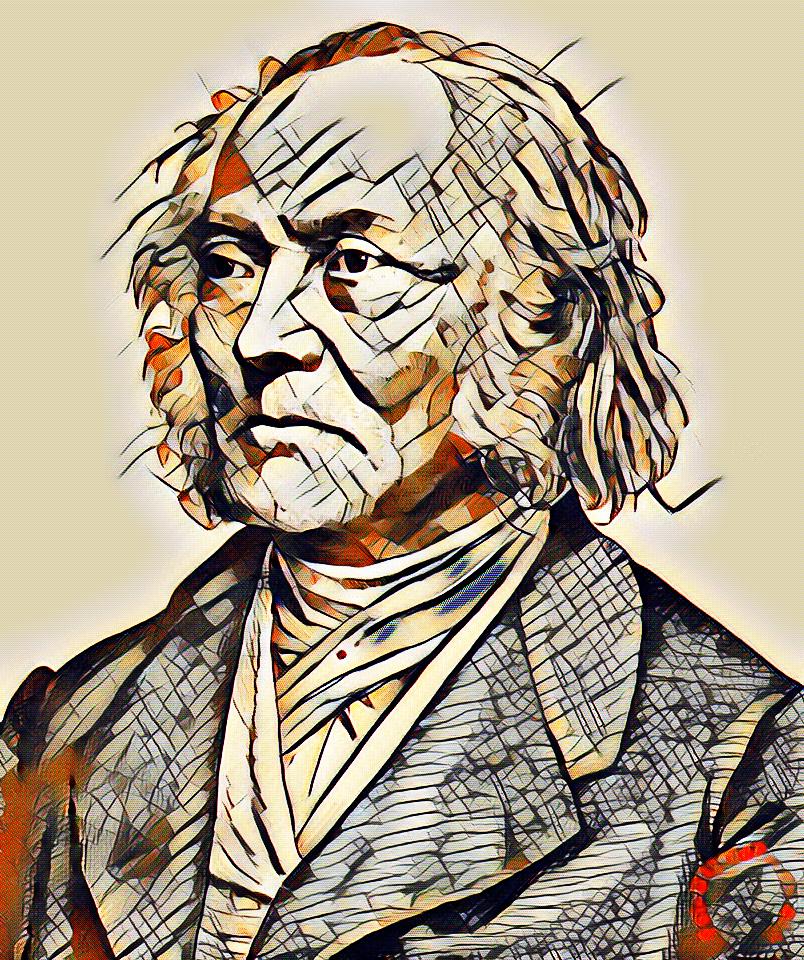
In today’s post, I am looking at Weber’s Law. Weber’s Law is named after Ernst Heinrich Weber (24 June 1795 – 26 January 1878), a German physician who was one of the pioneers of experimental psychology. I highly recommend the Numberphile YouTube video that explains this in detail.

A simple explanation of Weber’s Law is that we notice things more at a lower intensity than at a higher intensity. For example, the light from your phone in a dark room may appear very bright to you. At the same time, the light from your phone in a bright room may seem insignificant. This type of perception is logarithmic in nature. This means that a change from 1 to 2 feels about the same as a change from 2 to 4, or 4 to 8. The perception of change for an increment of one unit, depends on whether you are experiencing it at a low intensity or a high intensity. At low intensity, a slight change feels stronger.

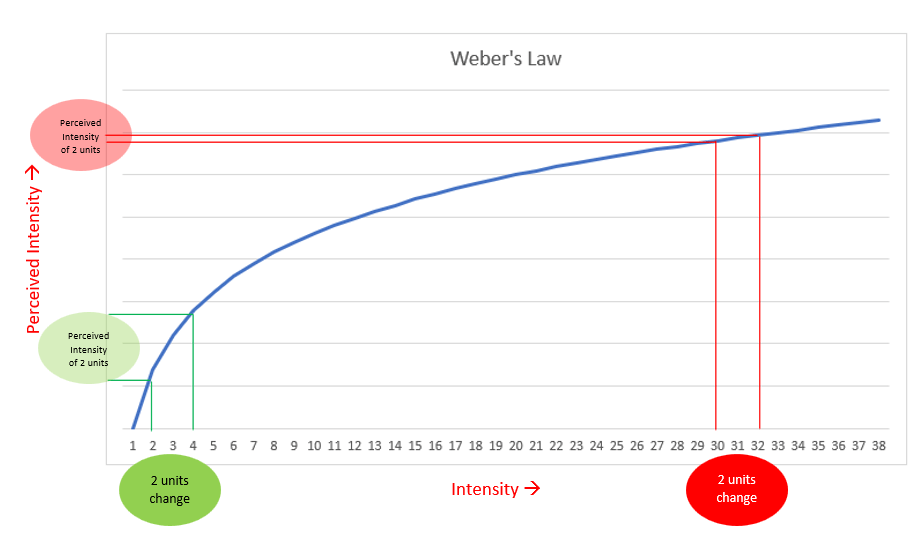
This is explained in the graph below. The green ovals represent the change of 2 units (2 to 4) and the red ovals represent the same change of 2 units (30 to 32). It can be seen that the perceived intensity is much less for the change from 30 to 32 than for the change from 2 to 4. These are represented by the oval shapes on the Y-axis. To achieve the same level of perceived intensity (change from 2 to 4), we need to create a large amount of intensity (~ change from 30 to 60, a difference of 30 units).

Weber

All of this fall under Psychophysics. Per Wikipedia; Psychophysics quantitatively investigates the relationship between physical stimuli and the sensations and perceptions they produce. What does all this have to do with Gemba and Lean?

How often were you able to see problems differently when you came to the production floor as an outsider? Perhaps, you were asked by a friend or colleague for help. You were able to see the problem in a different perspective and you saw something that others missed or you had a better perception of the situation. Most often, we get used to the problems on the floor that we miss seeing things. We do not notice problems until things get almost out of hand or the problems become larger. Small changes in situations do not alert us to problems. This to me is very similar to what Weber’s law teaches us. Small changes in intensity do not appear in our radar unless we are at the low intensity area.

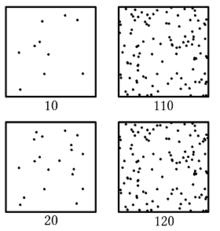
A good example is to imagine a white sheet of paper. If there is one black spot on the paper, it jumps out to us. But if there are many spots on the paper, an additional dot does not jump out to us. It takes a lot of dots before we realize things have changed. One of the experiments that is used to demonstrate Weber’s law is to do with dots. It is easier to see the change from 10 to 20 dots, rather than the change from 110 to 120 dots.

Weber-Fechner_law_demo_-_dots

Ohno and Weber’s Law:

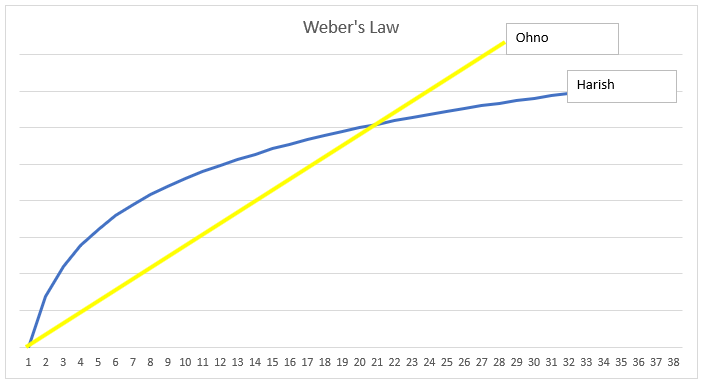
Taiichi Ohno was the father of Toyota Production System. I wonder how Taiichi Ohno’s perceptive skills were and whether his skillset followed Weber’s Law. I would like to imagine that his perceptive skillset was linear rather than logarithmic. He trained his perceptive muscles to see a small change no matter what the intensity was. Even if he was used to his gemba, he was able to see waste no matter if it was small, medium or large. Ohno is famous for his Ohno circle, which was a chalk circle he drew on the production floor for his supervisors, engineers etc. He would have them stand in the circle to observe an operation, trying to see waste in the operation. Waste is anything that has no value. Ohno was an expert who could differentiate a little amount of waste. Ohno’s Weber’s Law plot might appear to be linear instead of being logarithmic, when compared to a student like me.

Weber Ohno

What we can learn from Weber’s Law is that we need to improve our perception skills to perceive waste as it happens. We should not get used to “waste”. When there is already so much waste, the ability to perceive it is further diminished. It would take a larger event to make us notice of problems on the floor. We lack the ability to perceive waste accurately. We can only understand it based on what has been perceived already. This would mean that we should go to gemba more often, and each time try to see things with a fresh set of eyes. As the Toyota saying goes, we should think with our hands and see with our feet. Change spots from where you are observing a process. Understand that gemba not only means the actual place, but it also includes people, equipment, parts and the environment. We should avoid going with preconceived notions and biases. As we construct our understanding try to include input from the actual users/operators as much as possible. Learn to see differently.

Final Words:

One of the examples I came up with for this post is about cleaning rooms. Have you noticed that cleaner rooms get messy fast? Actually, we perceive a slight increase in messiness when the room is clean versus when it is not. The already messy room requires a larger amount of mess to have a noticeable difference. What Weber’s law shows us is that our natural instinct is not to think linearly.

Humans evolved to notice and minimize relative error. As noted on an article on the Science20 website:

One of the researchers’ assumptions is that if you were designing a nervous system for humans living in the ancestral environment, with the aim that it accurately represents the world around them, the right type of error to minimize would be relative error, not absolute error. After all, being off by four matters much more if the question is whether there are one or five hungry lions in the tall grass around you than if the question is whether there are 96 or 100 antelope in the herd you’ve just spotted.

The STIR researchers demonstrated that if you’re trying to minimize relative error, using a logarithmic scale is the best approach under two different conditions: One is if you’re trying to store your representations of the outside world in memory; the other is if sensory stimuli in the outside world happen to fall into particular statistical patterns.

Perhaps, all this means that we learn to see waste and solve problems on a logarithmic scale. And as we get better, we should train to see and solve problems on a linear scale. Any small amount of waste is waste that can be eliminated and the operation to be improved. It does not matter where you are on the X-axis of the Weber’s law plot. I will finish with an excellent anecdote from one of my heroes, Heinz von Foerster, who was also a nephew of Ludwig Wittgenstein. I have slightly paraphrased the anecdote.

Let me illustrate this point. I don’t know whether you remember Castaneda and his teacher, Don Juan. Castaneda wants to learn about things that go on in the immense expanses of the Mexican chaparral. Don Juan says, “You see this … ?” and Castaneda says “What? I don’t see anything.” Next time, Don Juan says, “Look here!” Castaneda looks, and says, “I don’t see a thing.” Don Juan gets desperate, because he wants really to teach him how to see. Finally, Don Juan has a solution. “I see now what your problem is. You can only see things that you can explain. Forget about explanations, and you will see.”

You become surprised because you abandoned your preoccupation with explanations. Therefore, you are able to see. I hope you will continue to be surprised.

In case you missed it, my last post was OODA Loop at the Gemba:

I also encourage the readers to check out my other similar posts:

Drawing at the Gemba

The Colors of Waste

Maurice Merleau-Ponty’s Lean Lessons

The Cybernetic Aspects of OODA Loop:

Boyd2

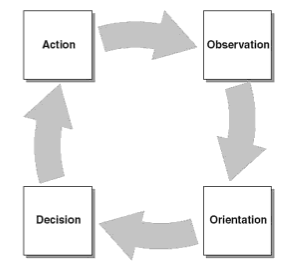
I had briefly discussed OODA loop in my previous post. In today’s post, I will continue looking at OODA loop and discuss the cybernetic aspects of OODA loop. OODA loop was created by the great American military strategist, John Boyd. OODA stands for Observe-Orient-Decide-Act. The simplest form of OODA loop, taken from Francis Osinga, is shown below.

Simple OODA

The OODA loop is a framework that can be used to describe how a rational being acts in a changing environment. The first step is to take in the available information as part of Observation. With the newly gathered information, the rational being has to gage the analyzed and synthesized information against the previous sets of information, relevant schema and mental models. The relevant schema and mental models are updated as needed based on the new set of information. This allows the rational being to better Orient themselves for the next step – Decide. The rational being has to decide what needs to be done based on their orientation, and at this point, the rational being Acts. The loop is repeated as the action triggers some reaction, which demands additional observation, orientation, decision and action. The loop has to be repeated until, a stable equilibrium is reached. Boyd was a fighter pilot and was often called as “40 second Boyd” because of his ability to get the better of his opponents in 40 seconds or less. The OODA loop was a formalization of his thoughts. See my previous post for additional information.

The key points of Boyd’s teachings are:

  • A rational being has to have a link with the external world to keep updating their orientation.
  • The absence of this live link will trigger an inward spiral that leads to disorientation and entropy.
  • Based on this, a rational being has to ensure that they maintain their internal harmony, and stay in touch with the external environment.

Osinga summarized this beautifully as:

The abstract aim of Boyd’s method is to render the enemy powerless by denying him the time to mentally cope with the rapidly unfolding, and naturally uncertain, circumstances of war, and only in the most simplified way, or at the tactical level, can this be equated with the narrow, rapid OODA loop idea… This points to the major overarching theme throughout Boyd’s work: the capability to evolve, to adapt, to learn, and deny such capability to the enemy.

In “John Boyd and John Warden – Air Power’s Quest for Strategic Paralysis”, David S. Fadok explained Boyd’s ideas as:

Boyd’s theory of conflict advocates a form of maneuver warfare that is more psychological and temporal in its orientation than physical and spatial.  Its military object is “to break the spirit and will of the enemy command by creating surprising and dangerous operational or strategic situations.” To achieve this end, one must operate at a faster tempo or rhythm than one’s adversaries. Put differently, the aim of Boyd’s maneuver warfare is to render the enemy powerless by denying him the time to mentally cope with the rapidly unfolding, and naturally uncertain, circumstances of war.  One’s military operations aim to: (1) create and perpetuate a highly fluid and menacing state of affairs for the enemy, and (2) disrupt or incapacitate his ability to adapt to such an environment.

Cybernetic Aspects:

The simplest explanation of Cybernetics is (from Paul Pangaro):

Cybernetics is about having a goal and taking action to achieve that goal. Knowing whether you have reached your goal (or at least are getting closer to it) requires “feedback”, a concept that was made rigorous by cybernetics.

The term cybernetics comes from a Greek word than means “steering”. Cybernetics is the art of steering towards the goal. The feedback loop allows for the regulatory component of the system to adjust itself and steer the system towards the goal. An example is a thermostat where a set temperature is inputted as the goal, and the thermostat kicks on when the temperature goes below the set point. It stops once it reaches the set temperature. This is achieved due to the feedback loop in the system. Pangaro continues:

The idea is this: You have goals and I have goals. If we’re in conversation, the way we find a shared goal is through probing, experimentation, alignment on means, revision of the goals, mistakes…and recursion. The recursive process of seeing a goal, aiming for it, seeing the “error” or gap and then moving to close the gap…that’s cybernetics. And the principles of cybernetics really are a way to think about everything. Or, rather…anything that has a purpose, goals, intention. So, orgs that need to shift business models, teams that need to tighten timelines…getting your friends to pick a restaurant for next week…So, everything that really matters!

Any closed loop is capable of feedback and thus has cybernetic functionality. One can see that the OODA loop has cybernetic aspects to it. You, the rational being, are trying to get inside the opponent’s OODA loop. This essentially means that you are working at a tempo faster than your opponent, and that you are able to go through your OODA loop more efficiently and effectively than your opponent. In order to do this, you should have a better equipped orientation which can also adapt as needed to the changing needs of the environment.

A key idea in Cybernetics is Ross Ashby’s Law of requisite variety (LRV). Variety in cybernetics means the number of available states of a system. In order for a system to control and regulate another system, the regulating system should have more variety than the one that is being regulated. For example, a light switch has two varieties (on or off). Depending upon the two states, the switch can control the light bulb to be either lit or not lit. If the demand is to have the brightness dimmed by the switch, the switch lacks the requisite variety. If we can add an adjustable resistor to the switch, then we are increasing the variety of the switch, and the switch now has the requisite variety to have the light’s brightness adjusted in more varieties (on, dim, bright, off).

One of the ways the regulator can handle the excess variety from the environment is to attenuate it or in other words filter out the excess variety. Our brains are very good at this. For example, if you are driving your car, most of the information coming at you gets filtered out by your brain. Your brain does not want you focusing on the color of the shirt of the driver of the car coming in the opposite direction.

Another way the regulator can attempt controlling a system is to amplify its variety so that it has a better capability to control certain factors. An example of this is the use of sabermetric approach to assemble a baseball team as narrated in the book and movie, Moneyball.

Ultimately, in order to regulate a system, the regulating system must attenuate unwanted variety, and amplify its variety so that the requisite variety is achieved.

John Boyd was aware of the power of cutting off the variety of the opponent.

Fadok explains:

Boyd proposes that success in conflict stems from getting inside an adversary’s OODA loop and staying there. The military commander can do so in two supplementary ways.

First, he must minimize his own friction through initiative and harmony of response. This decrease in friendly friction acts to “tighten” his own loop (i.e., to speed up his own decision-action cycle time).

Second, he must maximize his opponent’s friction through variety and rapidity of response. This increase in enemy friction acts to “loosen” the adversary’s loop (i.e., to slow down his decision-action cycle time). Together, these “friction manipulations” assure one’s continual operation within the enemy’s OODA loop in menacing and unpredictable ways. Initially, this produces confusion and disorder within the enemy camp. Ultimately, it produces panic and fear which manifest themselves in a simultaneous paralysis of ability to cope and willingness to resist.

Fadok’s thesis details that Boyd is actually looking at variety attenuation and amplification, referred to as “variety engineering” in Management Cybernetics.

In Cybernetics, information is of paramount importance. Information in many regards can be seen as the fuel in the “feedback engine”. Stale or wrong information can steer the system in the wrong direction sometimes at its own peril. The most important phase of OODA loop is the Orientation phase. This refers to the phase where the internal schema and mental models are reviewed and updated as needed based on incoming information. Boyd identified this really well. From Fadok:

The operational aim should be to ensure the opponent cannot rid himself of these menacing anomalies by hampering his ability to process information, make decisions, and take appropriate action. In consequence, he can no longer determine what is being done to him and how he should respond. Ultimately, the adversary’s initial confusion will degenerate into paralyzing panic, and his ability and/or willingness to resist will cease.

Final Words:

Most of us, I hope, are not engaged in wars. What can we then learn from OODA loop?

OODA loop gives us a good framework to understand how we make decisions and interact. OODA loop points out the utmost importance of staying connected to the source (gemba) and getting “fresh” information as much as possible. We should keep our feedback loops short, and this provides us security even if our decisions are slightly imperfect. The feedback allows us to steer as needed. But having a long feedback loop makes the information stale or incorrect, and we would not be able to steer away from trouble. We should update our mental models to match our reality. We should ensure that the new piece of information coheres well with our constructed schema and mental models. We should understand how to minimize our internal friction. We should attenuate unwanted variety and amplify our variety to better adapt to a changing environment. If we are in an inward spiral and feel disoriented, we should ground ourselves to reality by observing our surroundings, and stop engaging in a perilous inward spiral. Understanding the constraints in the surroundings may help us understand why some people make certain decisions.

I will finish with some wise words from John Boyd (taken from The Essence of Winning and Losing)

Without analyses and synthesis, across a variety of domains or across a variety of competing/independent channels of information, we cannot evolve new repertoires to deal with unfamiliar phenomena or unforeseen change.

 Without OODA loops, we can neither sense, hence observe, thereby collect a variety of information for the above processes, nor decide as well as implement actions in accord with those processes… Without OODA loops embracing all the above and without the ability to get inside other OODA loops (or other environments), we will find it impossible to comprehend, shape, adapt to, and in turn be shaped by an unfolding, evolving reality that is uncertain, everchanging, unpredictable 

In case you missed it, my last post was OODA Loop at the Gemba:

OODA Loop at the Gemba:

Boyd

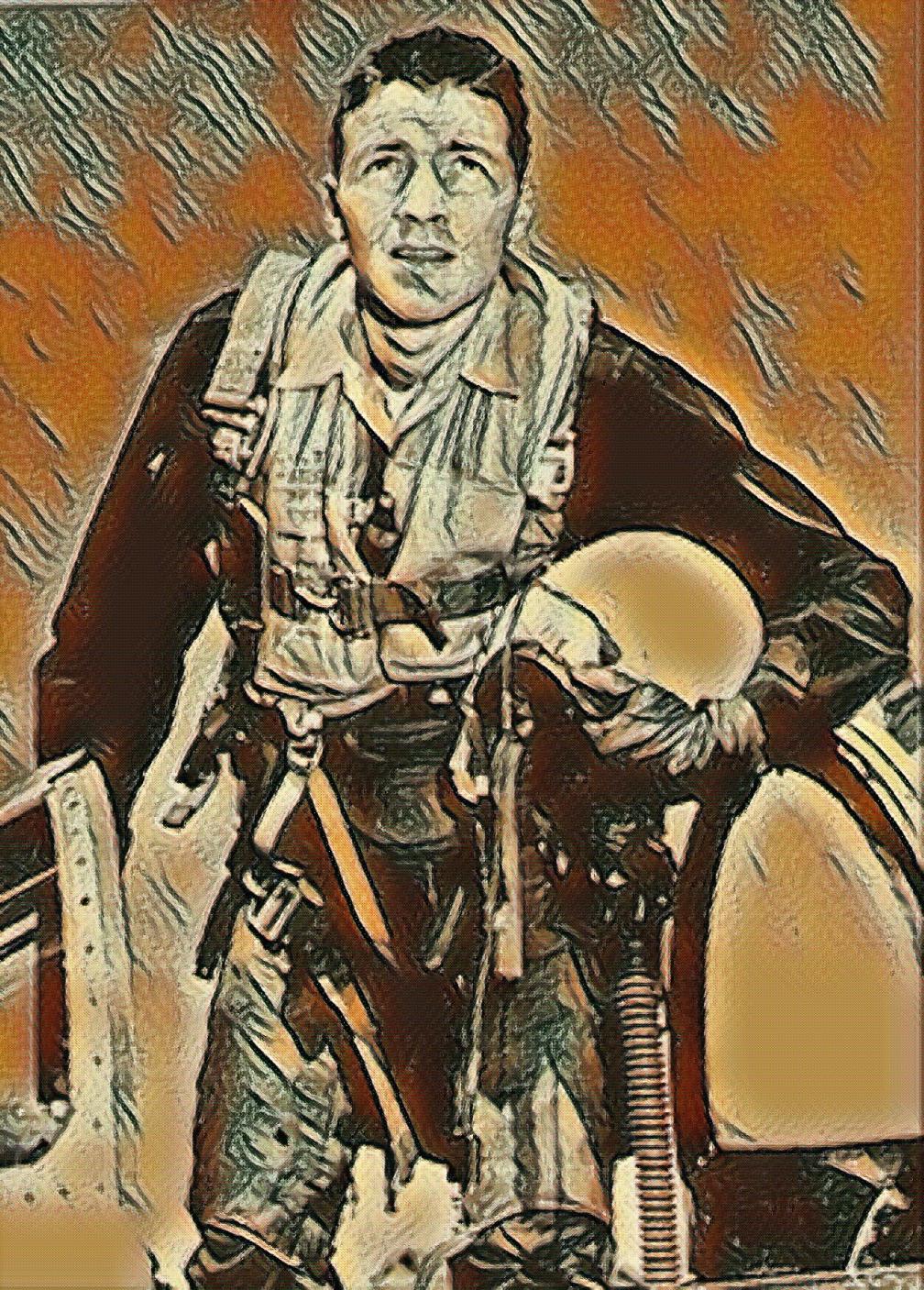
In today’s post, I am looking at OODA Loop, the brainchild of Col. John Boyd, a highly influential American military strategist. OODA is an acronym for Observe, Orient, Decide and Act. Boyd did not write any book detailing his ideas. However, he did write several papers and also gave lectures detailing his ideas. Boyd was a fighter pilot with the US Air Force. He was famously dubbed as the “40-second Boyd.” Legend goes that he could defeat any pilot who took him on in less than 40 seconds.

Francis Osinga, in his excellent book “Science, Strategy and War”, explained the OODA loop as:

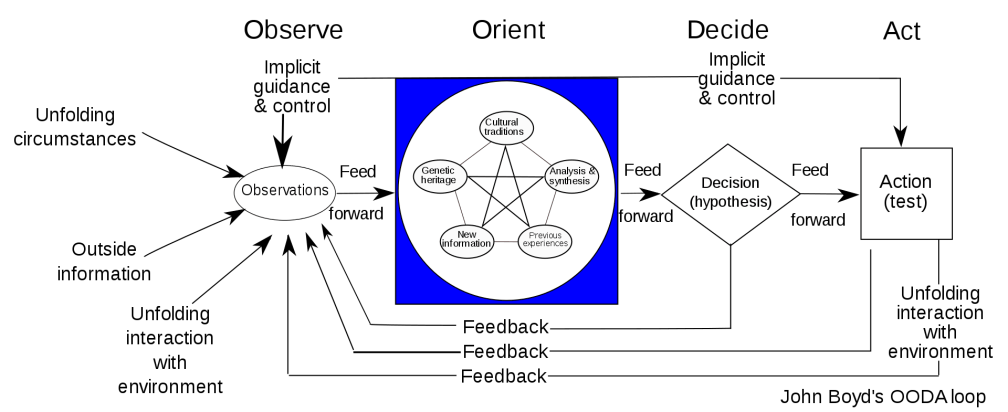
OODA stands for observation, orientation, decision, action. Explained in brief, observation is sensing yourself and the world around you. The second element, orientation, is the complex set of filters of genetic heritage, cultural predispositions, personal experience, and knowledge. The third is decision, a review of alternative courses of action and the selection of the preferred course as a hypothesis to be tested. The final element is action, the testing of the decision selected by implementation.  The notion of the loop, the constant repetition of the OODA cycle, is the essential connection that is repeated again and again.  Put simply, Boyd advances the idea that success in war, conflict, competition even survival hinges upon the quality and tempo of the cognitive processes of leaders and their organizations.

The OODA loop is generally shown as the schematic below:

Simple OODA

John Boyd’s final version of the OODA loop is given below:

1920px-OODA.Boyd.svg

From Osinga:

(Boyd) was the first to observe that the common underlying mechanism involved tactics that distort the enemy’s perception of time. He identified a general category of activities to achieve this distortion, the ability to change the situation faster than the opponent could comprehend, which he called “operating inside the Observation– Orientation–Decision–Action (OODA) loop.”

Boyd wonderfully explains the idea of getting inside the opponent’s OODA loop in his paper, “Destruction and Creation.”

Destruction and Creation:

Boyd starts with explaining that we have conceptual models of the external world, the reality. We interact with reality, and we update this model based on our continuous interaction. He stated:

To comprehend and cope with our environment we develop mental patterns or concepts of meaning. The purpose of this paper is to sketch out how we destroy and create these patterns to permit us to both shape and be shaped by a changing environment. In this sense, the discussion also literally shows why we cannot avoid this kind of activity if we intend to survive on our own terms. The activity is dialectic in nature generating both disorder and order that emerges as a changing and expanding universe of mental concepts matched to a changing and expanding universe of observed reality.

Boyd said that we are in a continuous struggle to remove or overcome physical and social environmental obstacles. This means that we have to take actions and decisions on an ongoing basis for our survival. We have to keep modifying our internal representation of reality based on new data. He called this destruction and creation, which he further detailed as analysis and synthesis. We have to use a reductive process of taking things apart, and assembling things together to gather meaning.

There are two ways in which we can develop and manipulate mental concepts to represent observed reality: We can start from a comprehensive whole and break it down to its particulars or we can start with the particulars and build towards a comprehensive whole.

Readers of this blog might see that the ideas of analysis and synthesis are very important in Systems Thinking. Boyd was an avid reader and he was able to see similar ideas in various fields and bring them all together. His sources of inspiration varied from Sun Tzu, Toyota to Kurt Godel.

Boyd continued that the acts of analysis and synthesis require verification to ensure that the newly created mental representation is appropriate.

Recalling that we use concepts or mental patterns to represent reality, it follows that the unstructuring and restructuring just shown reveals a way of changing our perception of reality. Naturally, such a notion implies that the emerging pattern of ideas and interactions must be internally consistent and match-up with reality… Over and over again this cycle of Destruction and Creation is repeated until we demonstrate internal consistency and match-up with reality.

Boyd brilliantly brings in the ideas of the great logician, mathematician, and analytic philosopher Kurt Godel. Godel in 1931 shook the world of mathematics and logic with his two phenomenal theorems – the Incompleteness Theorems. He proved that in any formal systems there will always be statements that cannot be proven within the logical structures of the system, and that any formal system cannot demonstrate its own consistency. Godel’s ideas were so powerful that the great polymath von Neumann is said to have remarked, “it’s all over!”

Boyd used ideas from Godel, Heisenberg’s uncertainty principle and entropy to further explain his OODA loop. Boyd explained Godel’s ideas as:

“You cannot use a system’s own workings to determine if a system is consistent or not…One cannot determine the character and nature of a system within itself. Moreover, attempts to do will lead to confusion and disorder.”

This was the great insight that Boyd had. One has to continuously stay in touch with his environment to have a consistent internal representation of reality. If the link to the environment is cut off, then the internal representation gets faulty, and the continuous destruction and creation of the internal representation is then based on faulty references.

“If I have an adversary out there, what I want to do is have the adversary fold back inside of himself where he cannot really consult the external environment he has to deal with, if I can do this then I can drive him to confusion and disorder, and bring him into paralysis.”

Boyd stated:

According to Gödel we cannot— in general—determine the consistency, hence the character or nature, of an abstract system within itself. According to Heisenberg and the Second Law of Thermodynamics any attempt to do so in the real world will expose uncertainty and generate disorder. Taken together, these three notions support the idea that any inward-oriented and continued effort to improve the match-up of concept with observed reality will only increase the degree of mismatch. Naturally, in this environment, uncertainty and disorder will increase as previously indicated by the Heisenberg Indeterminacy Principle and the Second Law of Thermodynamics, respectively. Put another way, we can expect unexplained and disturbing ambiguities, uncertainties, anomalies, or apparent inconsistencies to emerge more and more often. Furthermore, unless some kind of relief is available, we can expect confusion to increase until disorder approaches chaos— death.

Orient – the Most Important Step:

Orient

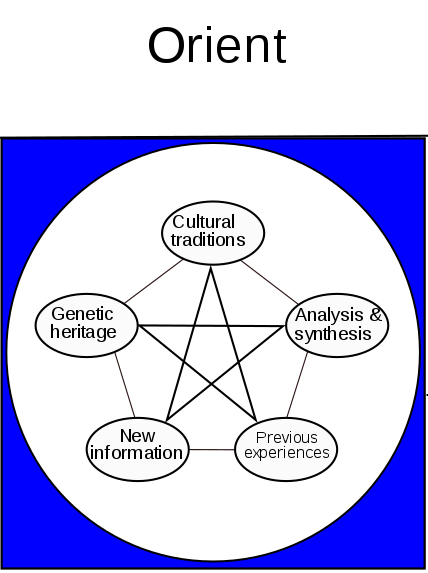
In the OODA loop, the most important step in OODA is the second O – Orient. This is the step about our mental models and internal representation of the external world. This is where all the schema reside.

Boyd wrote:

The second O, orientation—as the repository of our genetic heritage, cultural tradition, and previous experiences—is the most important part of the O-O-D-A loop since it shapes the way we observe, the way we decide, the way we act.

From Osinga:

Orientation is the schwerpunkt (center of gravity). It shapes the way we interact with the environment.

In this sense, Orientation shapes the character of present observations-orientation- decision-action loops – while these present loops shape the character of future orientation.

Chet Richards, friend of Boyd, writes about orientation:

Orientation, whether we want it to or not, exerts a strong control over what we observe. To a great extent, a person hears, as Paul Simon wrote in “The Boxer,” what he wants to hear and disregards the rest. This tendency to confirm what we already believe is not just sloppy thinking but is built into our brains (Molenberghs, Halász, Mattingley, Vanman. and Cunnington, 2012) … Strategists call the tendency to observe data that confirm our current orientations “incestuous amplification”.

Final Words:

OODA loop is a versatile framework to learn and understand. We already use the concept unconsciously. The knowledge about the OODA loop helps us prepare to face uncertainty in the everchanging environment. You can also see in today’s world that intentional misinformation can heavily disorient people and distort reality.

We should always stay close to the source, the gemba, to gather our data. We should keep updating our mental models, and not rely on old mental models. We should not try to find only data that corroborates our hypotheses. We should continuously update/improve our orientation. We should start learning from varying fields.

We should allow local autonomy in our organization. This allows for better adaptation since they are close to the source. The idea of not being able to adapt with a fast changing environment can also be explained by Murray Gell-Mann’s maladaptive schemata. From Osinga:

One of the most common reasons for the existence of maladaptive schemata is that they were once adaptive, but under conditions that no longer prevail. The environment has changed at a faster rate than the evolutionary process can accommodate.

In case you missed it, my last post was AQL/RQL/LTPD/OC Curve/Reliability and Confidence: