
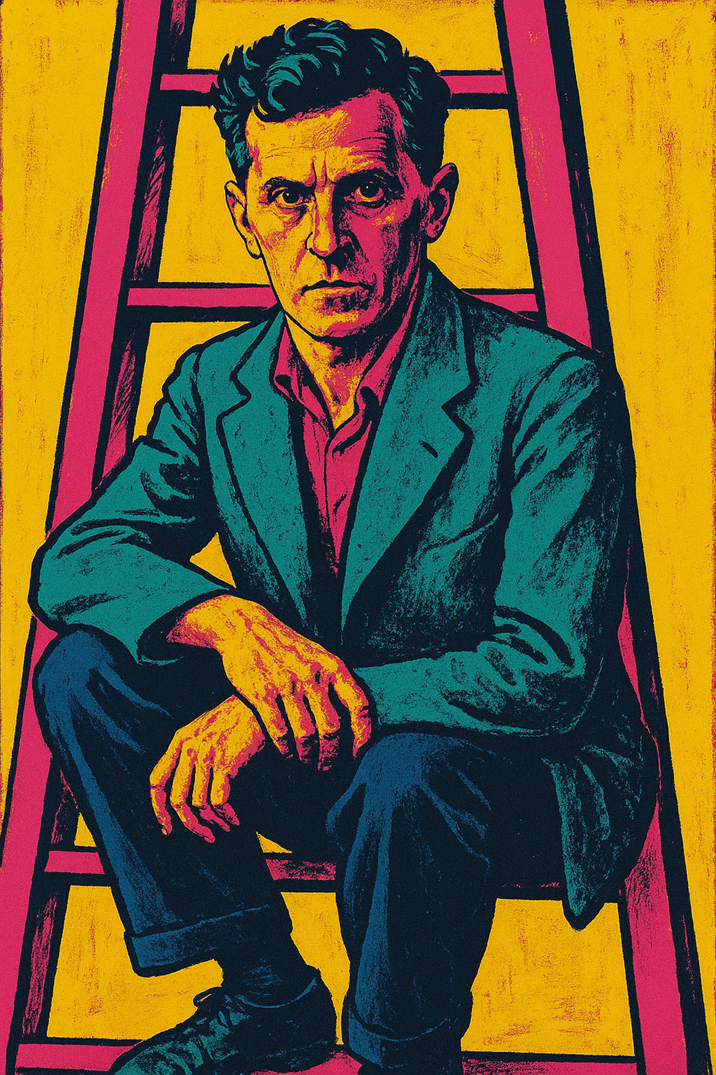
My propositions serve as elucidations in the following way: anyone who understands me eventually recognizes them as nonsensical, when he has used them as steps to climb beyond them. (He must, so to speak, throw away the ladder after he has climbed up it.) – Ludwig Wittgenstein, Tractus Logico-Philosophicus
In my recent post on the two dogmas of complexity science, I talked about ontological complexity realism and epistemological representationalism. These are the beliefs that complexity exists ‘out there’ to be measured and that our task is to create neutral representations of it. Today, I want to explore why these dogmas persist and why overcoming them requires something that seems paradoxical. We need conceptual tools that we must eventually abandon.
This is where Wittgenstein’s ladder becomes particularly relevant for complexity work. When reentry per Spencer-Brown’s Laws of Form is needed to achieve second-order understanding, the ladder offers a path through what might otherwise be an intractable problem.
The Reentry Problem in Complexity:
When talking about complexity, we often overlook the point that the observer cannot be separated from what they observe. Every attempt to map or measure complexity changes the observer-system relationship, which changes the ‘complexity’ itself. This creates what George Spencer-Brown called reentry: when a distinction folds back on itself.
Consider the Ashby Space framework I critiqued earlier. The moment we try to plot an organization on its coordinates, we encounter reentry. Who determines where the organization sits on the ‘variety of stimuli’ axis? The organization itself, through its own distinction-making processes. What counts as ‘variety of responses’? Again, this depends entirely on the distinctions the observer can make about meaningful action.
The framework cannot escape this recursion. It treats as measurable quantities what are actually dynamic processes of distinction-making between observer and observed. This recursion is not a bug to be fixed but a feature of complexity itself.
As I explored in my post on the form of decency, reentry reveals contradictions in systems that try to maintain rigid boundaries. When xenophobic ideologies apply their own criteria to themselves, when the form folds back, they collapse under their internal logic. The same dynamic occurs when complexity frameworks attempt to map the very processes of distinction-making that generate complexity.
Why Reentry Creates a Need for Ladders:
If our tools for understanding complexity are themselves subject to reentry effects, how do we develop more sophisticated ways of thinking about complex systems? We cannot simply abandon all conceptual tools, yet we cannot treat them as neutral representations either.
This is where we need to recognize a crucial distinction about when ladder consciousness becomes necessary. When we engage with situations in ways that generate significant recursive coupling between observer and observed (when our distinction-making substantially shapes what we are trying to understand, when our interventions change the system which changes us which changes our interventions), then treating our models as stable representations becomes counterproductive.
Consider the difference between using a roadmap to navigate familiar streets versus using a systems model to understand organizational dynamics. The roadmap engages with relatively stable relationships such as the streets that rarely change position because we are looking at the map. But organizational systems modeling involves high degrees of recursive coupling. The very process of creating models changes how participants see their organization, which changes how they behave, which changes the organizational dynamics, which requires updating the models.
When we are complexifying our relationship with a situation through high degrees of recursive engagement, our models must become ladders. They cannot remain permanent reference tools because both we and the situation are co-evolving through the modeling process itself.
This is where Wittgenstein’s ladder becomes relevant. The ladder offers a way to use conceptual tools while remaining aware of their provisional nature. We need frameworks to help us think about complexity, but we also need mechanisms for transcending the limitations of those same frameworks.
The ladder works through what might seem like a contradiction: we use conceptual distinctions to develop awareness of the limitations of conceptual distinctions. We employ frameworks like Ashby Space not because they represent reality accurately, but because they can help us recognize how our own distinction-making processes shape what appears as ‘complex’.
This creates what Heinz von Foerster called second-order cybernetics, observing observation. First-order thinking assumes we can step outside the system and create objective maps. Second-order thinking recognizes that we are always already participants in the systems we are trying to understand.
The Ladder in Practice: From Tools to Meta-Awareness:
Consider how this works in organizational consulting. When we facilitate a systems mapping exercise, we might begin by treating the resulting diagram as if it represents the ‘real’ organizational structure. This first-order approach focuses on improving the accuracy of the map.
But when we are engaged in recursive coupling with the organization (when the mapping process itself changes how participants understand and enact their organizational reality), ladder consciousness suggests a different approach. The map becomes valuable not when it accurately represents the organization, but when the mapping process helps participants recognize how their own distinction-making participates in creating organizational dynamics. We use the tool to develop meta-awareness of how we collectively complexify organizational life.
This shift points to the very needed meta-awareness. Instead of asking ‘Is our systems map accurate?’ we ask ‘How does the process of creating this map reveal and reshape our current ways of making distinctions about organizational life?’ The tool serves its purpose when it points beyond itself toward the processes that we participate in creating organizational reality, then becomes disposable once we have developed more direct awareness of our participation.
This principle applies across complexity frameworks. When we use any analytical tool, ladder consciousness means recognizing that we are not discovering objective properties but enacting particular ways of making sense that bring certain possibilities into view while obscuring others. The framework becomes useful when we can use it to examine our own sense-making, then let it go.
Beyond Tools: What Emerges After the Ladder:
This raises an important question. What happens after we kick away the ladder? What replaces our conceptual tools once we have transcended their limitations?
The answer is not the absence of structure but a different relationship to structure. After using and abandoning frameworks, what can emerge is what John Dewey called ‘inquiry’, a more fluid, responsive way of engaging with situations that draws on conceptual resources without being constrained by them.
Dewey’s conception of inquiry is particularly relevant here because it transcends the subject-object dualism that creates many of our analytical problems. Instead of treating thinking as something that happens inside our heads while we observe an external world, Dewey understood inquiry as a transactional process between organism and environment. The inquirer and the situation inquired into are parts of a single unfolding transaction.
This means inquiry is not about representing a pre-existing reality but about transforming problematic situations into more settled ones. When we encounter what we call a ‘complex situation’, inquiry suggests we are not discovering complexity ‘out there’ but participating in an ongoing transaction that we might call ‘complexifying’. The situation becomes complex through our engagement with it, just as we become complex through our engagement with the situation.
For Dewey, genuine inquiry involves what he called ‘learning by doing’ coupled with reflection on that doing. We act, observe the consequences, and adjust our future actions based on what we learn. This creates a recursive cycle where our understanding evolves through engagement rather than through detached observation. The goal is not to achieve final truth but to develop more intelligent ways of acting within ongoing situations.
This approach naturally incorporates ladder consciousness. We use conceptual tools as hypotheses for action rather than as final descriptions of reality. We test these tools against their consequences in lived experience, keeping those that prove helpful and abandoning those that constrain effective action. The tools serve inquiry rather than replacing it.
This post-ladder engagement is characterized by several qualities. This is not meant to be an exhaustive list by any means. Just like the ladder, this should serve as an intuition pump.
• Responsiveness over methodology: Instead of applying predetermined frameworks, we develop sensitivity to what each situation calls for. We maintain access to various conceptual tools while remaining free to abandon them when they no longer serve.
• Process awareness: We become more conscious of how our own sense-making participates in creating the realities we encounter. This is not relativism but what Donna Haraway called ‘situated knowledge’: knowledge that acknowledges its own positioning.
• Provisional commitment: We can act decisively based on our current understanding while remaining open to revision. This allows for second order approach to wisdom, intuitive knowledge of the limits of knowledge.
The Ethics of Temporary Tools:
There is an ethical dimension to ladder consciousness that connects to my earlier post on reentry and xenophobia. When we hold our conceptual tools too tightly, we risk treating our provisional distinctions as absolute truths, our temporary boundaries as permanent walls. This is one of the main reasons why we must discard the ladder rather than hold onto it.
The ladder teaches a different relationship to our beliefs and frameworks, firm enough to guide action, light enough to avoid becoming weapons. This balance is crucial and deserves deeper exploration.
What does it mean to hold beliefs firmly enough to guide action? It means we must be able to act decisively based on our current understanding, even while acknowledging that understanding is provisional. Without some degree of commitment to our frameworks, we become paralyzed by infinite doubt. We need enough conviction to move forward, to make choices, to take responsibility for our actions.
But what does it mean to hold these same beliefs lightly enough to avoid weaponizing them? It means maintaining what Keats called ‘negative capability’. This is the ability to remain in uncertainty and doubt without irritably reaching after fact and reason. It means recognizing that our strongest convictions might be wrong, our clearest insights might be partial, our most cherished frameworks might be limiting us in ways we cannot yet see.
This creates a paradoxical situation that the ladder helps us navigate. We must act as if our current understanding is enough to work with, while remaining open to its revision. We must commit without clinging. We must form strong opinions, but hold them lightly.
This becomes particularly crucial when working with others who hold different frameworks. Instead of engaging in battles over whose map is more accurate, ladder consciousness invites us to explore how different ways of making sense might serve different purposes. It asks us to treat our frameworks as offerings to collective inquiry rather than as territories to defend.
The ethical imperative here connects to von Foerster’s principle: ‘Act always so as to increase the number of choices’. When we hold our tools lightly, we create space for others to contribute their own sense-making resources. When we avoid weaponizing our frameworks, we keep possibilities open rather than shutting them down.
Our role becomes less about providing definitive maps and more about helping develop capacities for making better distinctions in the face of uncertainty. This suggests designing interventions that increase what von Foerster called ‘the number of choices’ rather than narrowing them down to predetermined solutions.
Climbing Toward Participatory Knowing:
This brings us back to my critique of complexity science’s foundational dogmas, but with an additional insight that shifts how we use language itself. We typically use complexity as a noun (‘this system has complexity’) or an adjective (‘this is a complex situation’). But it may be time to recognize complexity as a verb, something we do rather than something we encounter.
When we complexify a situation, we are not discovering pre-existing complexity but participating in an ongoing process of distinction-making and sense-making that brings complexity into being. The situation becomes complex through our engagement with it, just as we become complex through our engagement with the situation. Complexity emerges from what I have called epistemic coupling: the recursive interaction between knowing systems and their environments.
This verb-oriented understanding aligns with Dewey’s transactional thinking and Spencer-Brown’s emphasis on the observer’s role in creating distinctions. It suggests that when we say a situation is ‘complex’, we might more accurately say we are ‘complexifying’ our relationship with that situation through the particular ways we choose to engage with it.
This reframing has practical implications. Instead of asking ‘How can we manage this complex system?’ we might ask ‘How are we complexifying this situation, and how might we complexify it differently?’ Instead of treating complexity as a problem to be solved, we recognize complexifying as an ongoing process we participate in creating.
This perspective naturally leads to ladder consciousness. If complexity emerges from observer-system interactions, then studying complexity must include studying how we study. We cannot step outside the epistemic coupling that generates complexity in the first place.
The ladder provides a way to work with this recursion constructively. It allows us to use conceptual tools to bootstrap ourselves into meta-cognitive awareness, then abandon those tools once they have served their purpose of revealing our own participation in constructing what we take to be reality.
Final Words:
Wittgenstein’s ladder offers more than a philosophical metaphor for complexity work. It suggests a practical approach to navigating situations where traditional analytical tools reach their limits. In a world facing unprecedented challenges that resist conventional problem-solving approaches, we may need frameworks that can help us think more clearly while remaining open to possibilities we cannot yet imagine.
The ladder teaches us that sometimes the most sophisticated response to complexity is paradoxical, using our best analytical tools while remaining prepared to abandon them in favor of more direct engagement with emerging situations. Sometimes deeper understanding comes not from having better maps, but from developing better capacities for navigation in unmapped territory.
This suggests a form of wisdom that seems well-suited to our current historical moment: recursive and reflective, provisional and purposeful. Each of these qualities that represent a cybernetic Constructivist approach deserves elaboration.
Recursive wisdom acknowledges that we are always inside the systems we are trying to understand. It recognizes that our attempts to make sense of complexity are themselves part of the complexity we are trying to navigate. This leads to what we might call ‘meta-learning’: learning about how we learn, thinking about how we think. Recursive wisdom asks us to include ourselves in our analyses, to observe our own observing.
Reflective wisdom suggests that effective action in complex situations requires ongoing consideration of our own assumptions, biases, and blind spots. But this is not the paralysis of infinite self-doubt. Rather, it is the cultivation of the ability to think about what we are doing while we are doing it, to adjust our approach based on emerging feedback from the situation itself.
Provisional wisdom means holding our current understanding as our best guess given available information, while remaining genuinely open to revision. It means acting with conviction while maintaining epistemic humility. This is what we can call as ‘fallibilism’, the recognition that any particular perspective, no matter how well-supported, might be incomplete or mistaken.
Purposeful wisdom suggests that this openness to revision is not aimless but directed toward some vision of beneficial outcomes. It means using our provisional understanding to work toward flourishing, justice, and expanded possibilities for all participants in the situation. Purposeful wisdom asks us to take responsibility for the worlds our actions help create.
Together, these aspects suggest an approach to complexity that is both humble and decisive, both open and committed. It invites us to use our best tools while holding them lightly, to think systematically while remaining open to surprise, to act decisively while staying curious about the consequences of our actions.
Perhaps most importantly, it reminds us that we are not outside observers of complex systems but participants within them. The ladder helps us climb to a perspective from which we can see this participation more clearly. And then, if we choose wisely, we can kick it away and engage more consciously with the complexity we help create.
Stay curious and Always keep on learning…
Discover more from Harish's Notebook - My notes... Lean, Cybernetics, Quality & Data Science.
Subscribe to get the latest posts sent to your email.
 Harish's Notebook - My notes... Lean, Cybernetics, Quality & Data Science.
“It’s complex, yet there’s structure in it”.
Here in The Netherlands, Wittgenstein has been translated by one of our greatest authors, Willem Hermans. He published his translation along side the German version, which is, in my view, more subtle. In German, it sounds more about overcoming the propositions, as tools, and reaching a meta-level.
Also the German “Unsinn” (Nederlands: “onzin”) has a more limited use than “nonsense” (nonsens). We have both. “Unsinn” is not logical, inconsistent with (used) logic, where “nonsense” is also inconsistent with reality, against your senses.
—
Inspired by Wittgenstein Hermans wrote a book entitled: “De God Denkbaar, Denkbaar de God”. Or: “The God Thinkable, Thinkable the God”. (For some obscure reason, all his books start with the letter d).
The book is an enigma. In 16 chapters he shows how thinking has no “ground”: he compares thinking with the flight of a bat, needing a branch of a tree to start from and, in the end, having to return to the tree.
In an analysis, somebody noticed that in chapter 4, the root of 16, there is, written on a strip of paper, an enigmatic sentence, the message: “Cross out what does not apply, the amount in figures.”
Crossing out is like throwing away the ladder. If you apply the injunction, you should cross out what doesn’t apply: ‘the amount in figures’. Then you’re left with “Cross out what does not apply”. So you cross out ‘what doesn’t apply'”, leaving “Cross out”. Which you can do .
—-
In https://en.wikipedia.org/wiki/Willem_Frederik_Hermans you can read:
“Literature and the arts can “show truths” by employing irrational devices. For the greatest part the world is unknowable, and even language is no reliable tool of communication. Hermans’s characters are personifications of this state of affairs, loners who continuously misinterpret the reality surrounding them, unable to do something meaningful with other interpretive views when confronted with them, victims to the mercy of chance, misunderstanding. They fail, going under to the discrepancy between the world and their representation of it.” and “Specific elements of this pessimistic worldview are kindred to Marquis de Sade, Heinrich von Kleist, Arthur Schopenhauer, Sigmund Freud, Louis-Ferdinand Céline and Ludwig Wittgenstein.”.
You can see, why I’m a big fan of his novels….
LikeLiked by 1 person
Strongly related to the Zen Buddhist saying “If you meet the Buddha on the road, kill him.”
– attributed to the 9th-century Chinese Ch’an (Zen) master Linji Yixuan (臨済義玄), the founder of the Rinzai school of Zen.
Meaning you must destroy your attachment to any external, conceptualized idea of “Buddha” or “enlightenment.” If you think you’ve found the answer in a teacher, a book, a statue, or even a holy vision, that “answer” is just another mental idol that now stands in your way.
Also related, it seems to me, to the exploratory nature of learning and adaption for any complex adaptive system within an inherently uncertain, complex environment of interaction. Significantly though, the ladder is not “thrown away” nor is the “Buddha killed”, but rather, the prior learnings, within their relevant contexts, provide modular, composable, bases for further ongoing exploration.
So perhaps better and wiser, in the bigger picture, not to “throw away” the ladder, but to let go of the current rung to build the next rungs.
LikeLiked by 1 person
Perhaps. In the Tractatus, Wittgenstein tried to delineate the boundaries of language with a logical theory, working with Russell and Frege. In my view, he is already wrestling with the the difference (distinction) between reality (“Wirklichkeit“) and truth (“Wahrheit“).
In language, to paraphrase Einstein, there’s no difference between truth and reality, in reality there is.
He tries to limit the meaning of language to truth sentences (he uses the word “Sätze“, which is nearer to proposition) about natural sciences and philiosophy is not a science. He is already wresting with translating thoughts into language. As in:
In his later work, he abandoned this idea and saw language as a multiform human use, without one essence, but supported by practices and context. He introduces “languages games”.
He later rejected his early philosophy, but still thought philosophy should make clear how language works, creates and (perhaps) solve misunderstandings.
LikeLike