
In today’s post, I am exploring complexity through the lens of George Spencer Brown’s “Laws of Form”. This philosophical and mathematical treatise explores the foundations of logic and mathematics via a unique symbolic system. Spencer Brown introduces a primary algebra based on a simple mark and the act of drawing a distinction. The mark itself is a fundamental concept that represents both the act of drawing a boundary and the boundary itself. I welcome the reader to explore the main concepts here and here.
Spencer Brown wrote the following in Laws of Form:
A universe comes into being when a space is severed or taken apart. The skin of a living organism cuts off an outside from an inside. So does the circumference of a circle in the plane. By tracing the way we represent such a severance, we can begin to reconstruct, with an accuracy and coverage that appear almost uncanny, the basic forms underlying linguistic, mathematical, physical, and biological science, and can begin to see how the familiar laws of our own experience follow inexorably from the original act of severance.
Imagine a blank sheet of paper, and now imagine drawing a line anywhere on it. Perhaps you drew a vertical line or a horizontal line. Perhaps you drew it near the left edge, or perhaps in the middle. No matter where the line was drawn, you have now created two sides that were not there before. Now select one side. The side you chose might be the left side, or perhaps the smallest of the two sides, or the largest. It could be on your dominant side or the one with a black speck on it. As you can see, there are numerous ways to define the distinction you just made. All this depends on the observer.
The form of the mark is shown below:
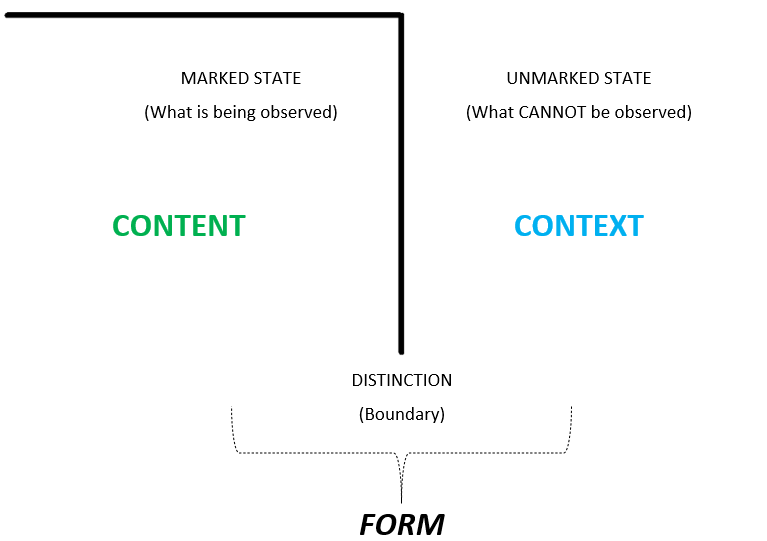
The side that you chose is the marked state, and the side that was not chosen is called the unmarked state. The line is called the distinction. The curious thing about the line is that it contains the marked state and yet is no part of the content itself. Consider the name of an object. The name is a word that refers to the object yet is not the object itself. Similar to a fence or a wall around a property, it marks the boundary while not being the property itself. The property is what is contained inside the boundary. It is neither part of the inside nor the outside. The boundary is what allows the observer to see the possibilities of the contained. The mark simultaneously separates and connects.
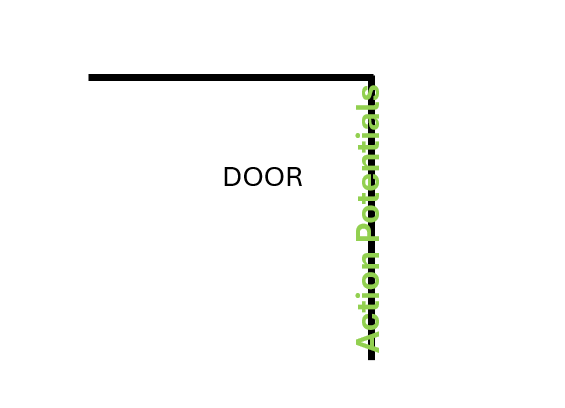
The reader might now be reminded of Gibson’s ‘affordances’. Affordances lie in the realm of the mark. They are not properties exclusive to the object or the subject. Affordances are action potentials identified by the subject or the person making the distinction. According to Gibson, affordances are opportunities for action that the environment offers to an organism, but these opportunities are defined in relation to the capabilities of the organism.
Let’s use the example of a door. The mark identifies action potentials such as the ability to provide an opening when the door handle is rotated, to hang a wreath on it, or to add a means to peek at the external world through the door. These action potentials are the various possibilities recognized by the observer. They are reliant on the observer’s previous interactions. This points to an important idea in Cybernetics called ‘variety’. Variety refers to the number of distinct states identified by an observer of a ‘system’ constructed by the observer. Variety is also used as a measure of complexity.
Spencer Brown said that the mark provides perfect continence. This means the mark perfectly contains what is inside without any leaks. It creates a boundary that separates the inside from the outside. From this perspective, what is inside the mark is internally coherent since it is perfectly contained by the mark. The observer can hold multiple distinctions within a mark. A door and a window are both framed openings for a building. The observer has distinguished between the two, yet they can be combined into a new grouping – framed openings for a building. A door is an internally coherent concept, as is a window. Both are internally coherent when taken as framed openings for a building. The concept of framed openings for a building is also an internally coherent concept.
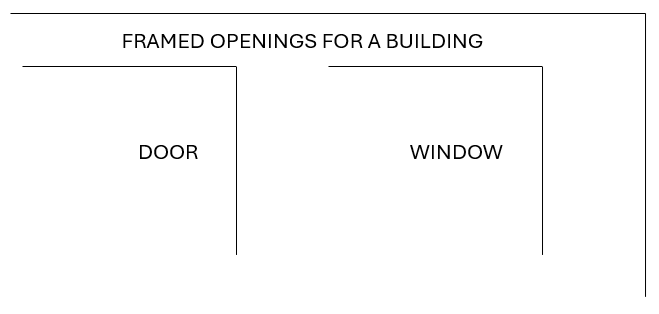
In the example above, the reader can see the ‘nestedness’ of various marks. This brings up the next important idea. The boundaries are recursive. What is contained inside the boundary or the mark is self-contained and can contain further marks or be positioned inside a larger mark. We have been discussing the notion of internal coherence. Another way to look at it is through the idea of viability. The various marks drawn that contain and are contained inside larger marks should be viable. When an observer is drawing a boundary around a whole, the whole should be a viable entity. This is also the basis for Stafford Beer’s Viable System Model. VSM offers a framework to diagnose the viability of a given ‘system’. I welcome the reader to explore this further here.
The last concept I want to introduce is the ‘Markovian’ nature of complexity. We have seen that complexity refers to the action possibilities of a situation reliant on the observer and the distinctions made that are internally coherent. The various distinctions go together, yielding new possibilities while maintaining the internal coherence of the larger whole. The action possibilities of a situation are entirely based on the current state – the different possibilities made available and identified by the observer at a given time. In other words, future possibilities are based on the current state only – where we are right now determines where we can go next. It does not depend on previous states. This can seem confusing since where we are right now depended on our past actions. But if you think about it, our next set of actions are made possible through our current states only.
Historical context and path dependency in many fields—from ecology to economics—seemingly suggest that past states fundamentally shape future potentials. While conventional wisdom argues that our trajectory is deeply rooted in historical conditions, this perspective oversimplifies the dynamic nature of complex ‘systems’. The current state is not merely a passive recipient of historical momentum, but an active generative point of emergence.
This means that every moment contains an infinite landscape of possibilities, yet these possibilities are simultaneously constrained and enabled by our present configuration. The past does not directly determine future states. Instead, it provides a contextual substrate from which current possibilities arise. Our current state is a complex compression of historical interactions, not a linear continuation of them.
In complex ‘systems’, the relationship between past and present is not deterministic but probabilistic. In this view, the current state acts as a filter, transforming historical conditions into immediate possibilities. These possibilities are not predetermined but emerge through the intricate interactions of the system’s current elements. The past provides context, but the present provides agency.
This understanding reveals a profound generative principle: potential is fundamentally a property of the present moment. While historical interactions create the conditions for current possibilities, these possibilities are activated and defined solely by the current state’s unique configuration. The past whispers, but the present speaks.
Moreover, this perspective invites a more dynamic understanding of complexity. Instead of viewing systems as predetermined trajectories, we can see them as constantly emerging landscapes of possibility, where each moment represents a unique point of potential transformation. The current state is not bound by historical determinism but is a creative threshold of becoming.
This approach does not negate the importance of historical context but reframes it. Historical interactions are not chains that bind future potential, but rather the rich, complex background from which new possibilities continuously emerge. The present moment is always more than the sum of its historical parts—it is a generative interface where past, present, and potential converge.
Final words:
This viewpoint invites us to see boundaries not as rigid divisions, but as dynamic interfaces of possibility. The concept of affordances and variety provides a rich framework for exploring how systems emerge, interact, and evolve. The true power of this perspective lies in its invitation to reimagine boundaries—not as limitations, but as generative spaces of potential. Whether in scientific inquiry, organizational design, or personal understanding, the act of drawing distinctions becomes a creative process of world-making.
I will finish with a wonderful quote from Spencer Brown:
Thus, we cannot escape the fact that the world we know is constructed in order to see itself. This is indeed amazing. Not so much in view of what it sees, although this may appear fantastic enough, but in respect of the fact that it can see at all. But in order to do so, evidently it must first cut itself up into at least one state which sees, and at least one other state which is seen.
Always keep learning.
Discover more from Harish's Notebook - My notes... Lean, Cybernetics, Quality & Data Science.
Subscribe to get the latest posts sent to your email.
 Harish's Notebook - My notes... Lean, Cybernetics, Quality & Data Science.
One thought on “The ‘Form’ of Complexity:”